Rights of IRS C&CE Officers in Annual General Transfer (AGT) 2026 – CBIC Rules

Rights of IRS C&CE Officers – Transfers are an important part of government service, especially in departments that require regular rotation of officers. However, transfers can also create stress and uncertainty if not handled fairly. For officers of the Indian Revenue Service (Customs & Central Excise), the Annual General Transfer (AGT) process plays a key role in shaping their careers. Therefore, understanding their rights under the Central Board of Indirect Taxes and Customs (CBIC) rules is essential.
At LawyerChennai.com – Best Lawyer Firm in Chennai India 24×7, we provide expert legal guidance to officers facing transfer-related issues and help them protect their rights effectively.
Rights of IRS C&CE Officers in Annual General Transfer (AGT) 2026 – CBIC Rules : LawyerChennai.com – Best Lawyer Firm in Chennai India 24×7
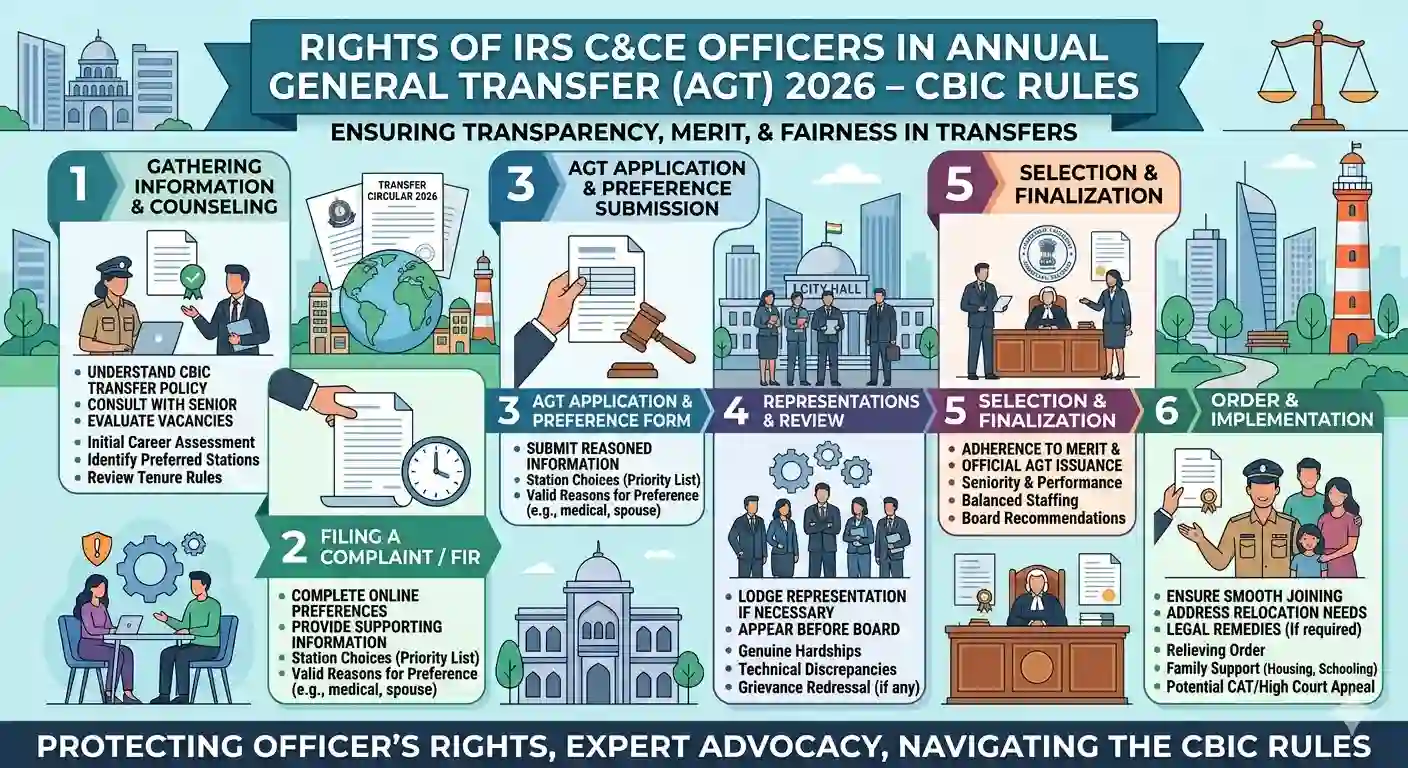
Understanding AGT in IRS (C&CE)
To begin with, the Annual General Transfer (AGT) is a structured process through which officers are transferred across different zones and postings. The main objective is to ensure transparency, efficiency, and proper distribution of manpower.
Moreover, AGT helps in preventing long-term postings in sensitive positions and promotes administrative fairness. However, while the system is designed to be systematic, it must also respect the rights and personal circumstances of officers.
Role of CBIC in Transfer Policies
The Central Board of Indirect Taxes and Customs (CBIC) is responsible for framing and implementing transfer guidelines for IRS (C&CE) officers. These guidelines define tenure limits, posting criteria, and transfer procedures.
Importantly, CBIC policies aim to strike a balance between administrative needs and individual rights. Therefore, officers are entitled to fair consideration during the transfer process. Any deviation from established norms can be challenged through proper legal channels.
Right to Fair and Transparent Transfer Process
One of the most important rights of IRS officers is the right to a fair and transparent transfer process. This means that transfers should be based on clear guidelines and not on arbitrary decisions.
For example, tenure policies must be followed, and officers should not be transferred before completing their minimum tenure unless there are valid reasons. Similarly, transfer orders should be issued in a consistent and non-discriminatory manner.
At LawyerChennai.com, we assist officers in reviewing transfer orders and identifying any irregularities or violations of CBIC rules.
Right to Representation and Grievance Redressal
Officers have the right to make representations against transfer orders. If an officer feels that the transfer is unfair or violates policy guidelines, they can submit a formal representation to the concerned authority.
Furthermore, CBIC provides grievance redressal mechanisms to address such concerns. Officers can present their case with supporting documents and request reconsideration.
Our legal team helps in drafting strong representations and ensures that all relevant facts are presented clearly and effectively.
Consideration of Personal and Medical Grounds
Another important right is the consideration of personal circumstances. CBIC guidelines often take into account factors such as medical conditions, family responsibilities, and spouse postings.
For instance, officers with serious health issues or those caring for dependent family members may request retention or transfer to a suitable location. Similarly, spouse posting policies aim to keep married officers in the same or nearby stations whenever possible.
Therefore, officers should not hesitate to highlight genuine hardships during the transfer process.
Tenure Protection and Stability
Tenure protection is a key feature of transfer policies. Officers are generally entitled to serve a minimum period at a posting before being transferred. This ensures stability and allows them to perform their duties effectively.
However, premature transfers can disrupt both professional and personal life. In such cases, officers have the right to question the validity of the transfer.
At LawyerChennai.com, we analyze whether tenure norms have been followed and provide legal remedies where necessary.
Protection Against Arbitrary Transfers
Arbitrary transfers are those made without proper justification or in violation of established rules. Such actions can be challenged legally.
Courts have repeatedly held that transfers should not be used as a tool for punishment or harassment. Therefore, any transfer lacking transparency or fairness can be contested.
Our firm provides legal support in filing petitions and seeking relief against unjust transfer orders.
Right to Equal Treatment
Equality is a fundamental principle in administrative decisions. All officers must be treated equally under the transfer policy.
This means that similarly placed officers should not be treated differently without valid reasons. Discrimination based on personal bias or external influence is not acceptable.
If an officer believes that they have been unfairly treated compared to others, they can seek legal remedy.
Legal Remedies Available to Officers
When internal mechanisms fail, officers can approach legal forums for relief. This may include filing applications before administrative tribunals or courts.
Legal remedies can result in the cancellation, modification, or stay of transfer orders. However, proper documentation and legal strategy are crucial for success.
At LawyerChennai.com, we guide officers through every step of the legal process and ensure that their rights are protected.
Importance of Proper Documentation
Documentation plays a vital role in transfer disputes. Officers must maintain records of transfer orders, representations, medical certificates, and other relevant documents.
These documents serve as evidence in both administrative and legal proceedings. Therefore, keeping accurate and complete records is essential.
Role of Legal Experts in Transfer Matters
Transfer-related disputes often involve complex rules and procedures. Therefore, seeking expert legal advice can make a significant difference.
Legal professionals help in interpreting CBIC guidelines, identifying violations, and preparing strong cases. They also represent officers before authorities and courts.
At LawyerChennai.com, our experienced team provides practical and result-oriented solutions tailored to each case.
Challenges Faced by Officers in AGT 2026
Despite clear guidelines, officers may face challenges such as sudden transfers, lack of transparency, or insufficient consideration of personal circumstances.
Additionally, changes in administrative priorities can sometimes lead to unexpected decisions. Therefore, staying informed and proactive is important.
Importance of Timely Action
Time is a critical factor in transfer matters. Delays in submitting representations or filing legal cases can weaken the officer’s position.
Therefore, it is advisable to act promptly upon receiving a transfer order. Early action allows for better preparation and increases the chances of a favorable outcome.
Ensuring a Balanced Approach
While protecting individual rights is important, administrative efficiency must also be maintained. Therefore, a balanced approach is necessary.
Officers should cooperate with authorities while also asserting their rights when needed. Similarly, authorities must ensure fairness and transparency in their decisions.
Frequently Asked Questions
The Annual General Transfer (AGT) is a structured system followed by the Central Board of Indirect Taxes and Customs to transfer IRS (Customs & Central Excise) officers across different postings. It ensures proper rotation, administrative efficiency, and transparency. Moreover, it helps prevent long-term postings in sensitive positions. However, the process must follow prescribed guidelines and respect officers’ rights.
Yes, an officer can challenge a transfer order if it violates CBIC guidelines or is arbitrary. For instance, premature transfers without valid reasons or ignoring personal grounds can be questioned. Officers can first submit a representation to the department. If unresolved, they may approach legal forums for relief.
Yes, CBIC rules provide for consideration of genuine personal circumstances. Officers can request relief based on medical conditions, dependent family members, or spouse postings. Supporting documents must be submitted. Therefore, proper representation increases the chances of a favorable decision.
Tenure protection ensures that officers serve a minimum period at a posting before transfer. This promotes stability and efficiency. If an officer is transferred before completing tenure without justification, it may be challenged as a violation of policy norms.
If internal remedies fail, officers can approach the Central Administrative Tribunal or courts. They may seek a stay, modification, or cancellation of the transfer order. Legal assistance helps in preparing strong cases and protecting officers’ rights effectively.
Conclusion
The Annual General Transfer (AGT) process is an essential part of the functioning of the IRS (C&CE). However, it must be carried out in a fair, transparent, and lawful manner. Officers have several rights under CBIC rules, including the right to representation, tenure protection, and protection against arbitrary transfers.
At LawyerChennai.com – Best Lawyer Firm in Chennai India 24×7, we are committed to helping officers navigate transfer-related challenges with confidence. Whether it is reviewing transfer orders, filing representations, or pursuing legal remedies, our team provides reliable and effective support.
Read More
- How to Challenge AGT 2026 Transfer Postings of CBIC Officers Before CAT
- CBIC AGT 2026 Due Lists & Transfer Orders: Legal Remedies & CAT Success Stories
- DPC Promotion Procedure IRS C&CE Officers 2026: Seniority Disputes & CAT Appeals
- Foreign Contribution Act FCRA: Registration, Compliance & Legal Guide Chennai
- APAR SPARROW CBIC 2025-26: Guidelines, Common Mistakes & Legal Remedies
- Transfer Petitions: Requesting transfer of cases to SC
- How to Challenge Adverse APAR Entries in SPARROW Module – CBIC Officers 2026
- AGT 2026 CBIC: Complete Legal Guide to Challenge Unfair Transfer Orders in CAT
- Rights of Father & Grandparents to See Newborn Child | Chennai Family Lawyer
- Ex Gratia: Comprehensive Legal Guide for Indian Citizens
- Central Board of Indirect Taxes and Customs (CBIC)