Government Employee Benefits vs Private Company Employee Benefits in India
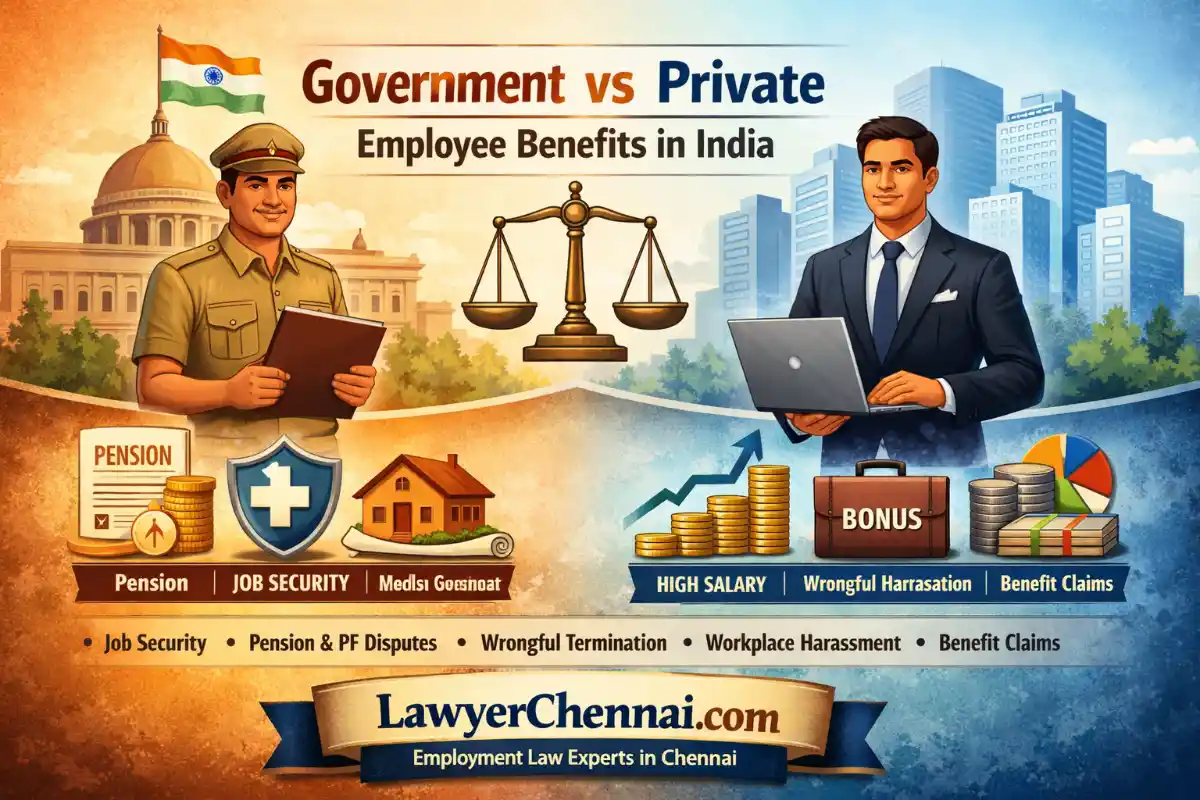
Government employee benefits and private company employee benefits differ significantly in salary structure, job security, retirement benefits, and legal protections. Government jobs in India offer strong job security, pension schemes, structured promotions, medical coverage, and long-term financial stability through service rules and administrative protections. In contrast, private sector employment often provides higher salary packages, performance incentives, stock options, corporate health insurance, and faster career growth opportunities. However, private employment may involve greater job uncertainty, contractual obligations, and performance-based evaluations.
Employees in both sectors may face legal issues involving wrongful termination, unpaid salary, provident fund disputes, promotion denial, workplace harassment, or pension calculation errors. Understanding employment laws such as the Industrial Disputes Act, Provident Fund Act, Payment of Gratuity Act, and service rules becomes essential for protecting employee rights. LawyerChennai.com provides legal guidance for employment disputes, labour law issues, service matters, and benefit recovery through experienced employment lawyers in Chennai.
Understanding Employment Benefits in India
Employment benefits shape financial stability and career security
Employment benefits influence financial security, retirement planning, healthcare protection, and family welfare. Government employment traditionally attracts candidates seeking stability, predictable salary growth, and pension benefits. Meanwhile, private sector employment attracts professionals seeking higher salary packages and faster career progression.
In India, employment benefits differ widely between government departments and private corporations. Government employment follows statutory rules under central and state service regulations. Private sector benefits depend largely on employment contracts, company policies, and labour law compliance.
However, labour legislation still protects both employment categories through statutory frameworks. Key legislation includes the Industrial Disputes Act, 1947, Payment of Gratuity Act, 1972, Employees’ Provident Fund Act, 1952, and Employees’ State Insurance Act, 1948.
Furthermore, courts regularly examine disputes relating to salary, pensions, termination, discrimination, and employee benefits. Consequently, employees increasingly seek legal advice from employment lawyers in Chennai to secure rightful benefits.
Key legal framework governing employee benefits
The legal structure governing employment benefits includes statutory entitlements and contractual rights. Several central laws protect employees regardless of government or private sector status.
Important laws include:
• Payment of Wages Act, 1936
• Employees’ Provident Fund and Miscellaneous Provisions Act, 1952
• Employees’ State Insurance Act, 1948
• Payment of Gratuity Act, 1972
• Industrial Employment Standing Orders Act, 1946
• Maternity Benefit Act, 1961
• Shops and Establishments Acts (State specific)
Government employees receive benefits through civil service rules and pension regulations. Meanwhile, private employees receive benefits through employment agreements and corporate HR policies.
Therefore, legal disputes may arise when employers deny statutory benefits or violate labour law provisions. Skilled labour law advocates in Chennai often handle such disputes before labour courts and tribunals.
Government Employee Benefits in India
Why government employment attracts long-term job seekers
Government employment offers stability, structured salary increments, and retirement security. Consequently, millions of candidates compete annually for public sector jobs.
Central government employees receive benefits through the Central Civil Services Rules and recommendations of the Pay Commission. State government employees follow state-specific service rules.
Government employment offers several significant advantages:
• Long-term job security
• Predictable salary increments
• Pension benefits
• Healthcare coverage
• Housing allowances
• Paid leave benefits
• Social status and job prestige
Moreover, termination of government employees requires strict disciplinary procedures. Authorities must follow principles of natural justice before imposing penalties.
Therefore, wrongful termination disputes frequently reach administrative tribunals and high courts.
Salary structure and allowances in government employment
Government employees receive salaries through structured pay matrices recommended by Pay Commissions. Currently, the 7th Pay Commission governs salary structures for central government employees.
Typical government salary components include:
• Basic pay
• Dearness allowance
• House rent allowance
• Transport allowance
• Medical allowance
• Special duty allowances
Additionally, government employees receive annual increments and periodic pay revisions. These increments ensure salary growth throughout service.
However, salary packages in government employment often remain lower than private sector executive compensation. Nevertheless, long-term benefits compensate for comparatively lower salary levels.
Therefore, many professionals still prefer public employment due to predictable financial security.
Pension and Retirement Benefits for Government Employees
Government pension schemes ensure post-retirement financial security
Government employees traditionally enjoyed defined pension benefits after retirement. Pension systems historically ensured lifelong monthly income for retired public servants.
However, pension structures changed significantly after the introduction of the National Pension System (NPS). Employees joining government service after January 2004 fall under this contributory pension scheme.
Key retirement benefits include:
• Monthly pension under old pension schemes
• National Pension System accumulation
• Gratuity payment
• Leave encashment
• Commutation of pension
• Family pension for dependents
Moreover, pension disputes sometimes arise due to incorrect service records or delayed pension approvals. In such cases, employees may approach administrative tribunals or high courts.
Experienced service law advocates in Chennai frequently represent retired government employees in pension disputes.
Legal remedies for pension disputes
Pension disputes arise when authorities delay payments, miscalculate benefits, or deny pension eligibility. Legal remedies exist for government employees facing such disputes.
Common legal remedies include:
- Filing representation before the department authority
- Approaching the Central Administrative Tribunal
- Filing writ petitions before High Courts
- Seeking judicial review for service rule violations
Courts consistently treat pension as a constitutional right under Article 21 principles of livelihood protection.
Therefore, government authorities cannot arbitrarily deny legitimate pension benefits.
Healthcare and Insurance Benefits for Government Employees
Comprehensive medical coverage for government employees
Government employees receive extensive healthcare benefits through government health schemes. These schemes protect employees and dependents from high medical expenses.
Major healthcare schemes include:
• Central Government Health Scheme (CGHS)
• State government health insurance schemes
• Medical reimbursement facilities
• Government hospital treatment
Additionally, retired employees also receive healthcare coverage under many government health schemes.
Medical reimbursement disputes occasionally arise due to claim rejections or delayed approvals. Employees may challenge such decisions through departmental appeals or legal proceedings.
Therefore, healthcare disputes sometimes reach administrative tribunals and constitutional courts.
Private Company Employee Benefits in India
Corporate employment offers higher salary potential and faster growth
Private sector employment attracts professionals seeking higher income and faster career progression. Companies compete aggressively for talent, particularly in technology, finance, consulting, and multinational corporations.
Private companies design employee benefits based on industry standards, corporate profitability, and HR policies. Therefore, benefits vary widely between startups, mid-size firms, and multinational organizations.
However, statutory labour laws still regulate minimum benefits and employee rights. Employers must comply with legislation such as the Employees Provident Fund Act, Payment of Gratuity Act, and Maternity Benefit Act.
Furthermore, employment contracts define most benefits offered by private companies. These agreements specify salary structures, incentives, bonuses, leave policies, and termination clauses.
Consequently, employment disputes often arise when employers violate contractual obligations or statutory benefits. Skilled employment lawyers in Chennai frequently assist professionals facing wrongful termination, unpaid salaries, or contract breaches.
Private sector employment therefore offers flexibility and financial opportunities, although job security often remains comparatively lower.
Salary structure and compensation packages in private companies
Private sector salary structures differ significantly from government pay matrices. Companies create customized compensation structures depending on role, experience, and industry competition.
Typical corporate salary structures include multiple components beyond basic pay.
Common components include:
• Basic salary
• House rent allowance
• Performance bonus
• Joining bonus
• Variable pay incentives
• Stock options or equity grants
• Retention bonuses
Additionally, multinational companies often offer international travel allowances, relocation benefits, and flexible compensation plans.
However, variable pay components may fluctuate depending on performance targets and company profitability. Consequently, employees may experience income variability compared with government salary stability.
Despite these fluctuations, corporate professionals often earn significantly higher annual packages than government employees.
Therefore, private employment attracts ambitious professionals seeking rapid financial growth and global career exposure.
Performance Incentives and Corporate Rewards
Incentive structures drive productivity in private companies
Corporate organizations heavily rely on performance incentives to motivate employees and increase productivity. Incentives encourage employees to achieve business targets and organizational goals.
Private companies therefore design sophisticated reward systems tied to individual performance metrics.
Typical corporate incentive structures include:
• Annual performance bonuses
• Quarterly performance incentives
• Sales commissions
• Employee stock ownership plans (ESOPs)
• Long-term retention bonuses
• Leadership incentive plans
Furthermore, technology companies frequently grant stock options to senior employees. These equity incentives may generate substantial financial wealth if company valuations rise.
However, incentive-based compensation may also create financial uncertainty during economic downturns. Companies may reduce bonuses or restructure compensation during financial challenges.
Nevertheless, professionals continue to prefer incentive-driven compensation because high performance directly increases earnings.
Therefore, private employment rewards talent, productivity, and innovation more aggressively than traditional government employment structures.
Legal issues relating to corporate bonuses and incentives
Bonus disputes frequently arise in corporate employment due to ambiguous compensation policies. Employees may challenge bonus denial when companies alter policies unfairly.
Common legal issues include:
• Non-payment of performance bonuses
• Withdrawal of promised stock options
• Discriminatory bonus allocation
• Breach of employment contracts
• Unfair revision of compensation policies
Employees facing such disputes may pursue legal remedies under employment contracts and labour laws.
Important remedies include:
- Negotiation with the HR department or management
- Filing a complaint before the Labour Commissioner
- Initiating proceedings under the Industrial Disputes Act
- Filing civil suits for breach of contract
Experienced labour law advocates in Chennai often represent employees in compensation disputes involving multinational corporations.
Retirement and Provident Fund Benefits in Private Employment
Provident fund and gratuity ensure retirement savings
Private sector employees rely primarily on statutory retirement savings schemes. These schemes provide financial support after retirement or resignation.
The Employees Provident Fund Organisation (EPFO) manages provident fund contributions for eligible employees. Both employer and employee contribute a fixed percentage of salary.
Major retirement benefits include:
• Employees Provident Fund (EPF)
• Employees Pension Scheme (EPS)
• Payment of gratuity after five years service
• Corporate retirement savings plans
• Superannuation schemes offered by companies
Additionally, employees may voluntarily contribute to provident funds through Voluntary Provident Fund (VPF) options.
Unlike government pension systems, private employees accumulate retirement savings through contributions and investment returns.
Therefore, retirement income depends heavily on salary levels and contribution duration.
However, disputes occasionally arise due to non-deposit of provident fund contributions by employers.
Legal remedies for provident fund and gratuity disputes
Employees possess strong legal protections regarding provident fund and gratuity payments. Employers must deposit provident fund contributions within prescribed deadlines.
Common legal disputes include:
• Non-deposit of PF contributions
• Incorrect PF account calculations
• Gratuity denial after resignation
• Delay in PF withdrawal processing
• Employer misappropriation of PF deductions
Employees may pursue several legal remedies when employers violate statutory obligations.
Important remedies include:
- Filing complaints before the EPFO authorities
- Initiating proceedings under the Payment of Gratuity Act
- Filing complaints before labour courts
- Seeking recovery proceedings against employers
Courts consistently treat provident fund contributions as employee property.
Consequently, employer misappropriation may attract civil liability and criminal prosecution.
Therefore, professionals frequently consult EPF dispute lawyers in Chennai for recovery of retirement benefits.
Health Insurance and Medical Benefits in Private Companies
Corporate health insurance protects employees and families
Private companies increasingly offer comprehensive health insurance policies for employees and dependents. Health insurance benefits form a crucial part of modern corporate compensation packages.
Many companies provide group medical insurance covering hospitalization, surgeries, and emergency medical expenses.
Typical corporate health benefits include:
• Group health insurance policies
• Cashless hospitalization facilities
• Coverage for dependent family members
• Annual health check-ups
• Mental health support programs
• Wellness and fitness reimbursements
Moreover, multinational corporations often offer international medical insurance for employees working abroad.
However, coverage limits may vary depending on company policies and employee designation.
Employees must carefully review policy terms, exclusions, and claim procedures before relying on corporate health insurance.
Legal disputes may arise when insurance companies reject legitimate medical claims.
Legal remedies for medical insurance disputes
Insurance claim disputes frequently occur in corporate health insurance policies. Claim rejections often arise due to policy exclusions or procedural deficiencies.
Common disputes include:
• Rejection of hospitalization claims
• Delay in reimbursement payments
• Denial of dependent coverage
• Incorrect policy interpretation by insurers
• Fraud allegations against policyholders
Employees may challenge unfair claim denials through multiple legal forums.
Available remedies include:
- Filing grievances before the insurance company grievance cell
- Approaching the Insurance Ombudsman
- Filing complaints before Consumer Disputes Redressal Commissions
- Initiating civil litigation for insurance claim recovery
Consumer courts frequently grant compensation when insurers wrongfully deny legitimate medical claims.
Therefore, consulting consumer protection lawyers in Chennai helps employees enforce medical insurance rights effectively.
Job Security: Government Employment vs Private Sector Employment
Government jobs provide unmatched employment stability
Job security remains the primary attraction of government employment in India. Public servants rarely face sudden termination when they perform duties responsibly.
Government service rules impose strict disciplinary procedures before termination or suspension. Authorities must conduct departmental enquiries and follow principles of natural justice.
Additionally, government employees receive protection under constitutional and administrative law principles. Courts consistently safeguard public servants against arbitrary disciplinary actions.
Government authorities must comply with service rules, conduct regulations, and disciplinary procedures before imposing penalties.
Important protections include:
• Departmental enquiry before dismissal
• Right to present defense evidence
• Opportunity to cross examine witnesses
• Written explanation before punishment
• Right to appeal disciplinary decisions
Furthermore, employees may challenge disciplinary actions before administrative tribunals and High Courts.
Therefore, government employment ensures long-term stability, which attracts candidates seeking predictable career paths and retirement security.
Legal remedies for wrongful disciplinary actions
Government employees occasionally face wrongful disciplinary proceedings due to administrative bias or procedural violations.
Common disciplinary disputes include:
• Illegal suspension orders
• Unfair departmental enquiries
• Disproportionate penalties
• Forced retirement decisions
• Service record manipulation
Employees possess several legal remedies to challenge such disciplinary actions.
Available remedies include:
- Departmental appeals before higher authorities
- Filing cases before the Central Administrative Tribunal
- Approaching State Administrative Tribunals
- Filing writ petitions before High Courts
Courts frequently intervene when authorities violate natural justice principles.
Therefore, experienced service law advocates in Chennai assist government employees in protecting employment rights and service benefits.
Job Stability Challenges in Private Company Employment
Corporate employment depends heavily on market conditions
Private sector employment offers flexibility and financial growth. However, job security often depends on business performance and market conditions.
Companies may restructure operations, reduce workforce, or terminate employees during financial downturns. Economic recessions and technological disruptions frequently trigger layoffs across industries.
Unlike government employment, corporate jobs rely heavily on employment contracts and company policies.
Typical employment risks include:
• Corporate restructuring layoffs
• Downsizing during economic recession
• Contractual termination clauses
• Project-based employment discontinuation
• Performance-based termination
Furthermore, startups and technology firms sometimes close operations due to financial challenges. Consequently, employees must evaluate job security risks before accepting corporate employment.
Nevertheless, skilled professionals continue to choose private sector jobs because higher salaries offset employment uncertainty.
Therefore, corporate employment demands adaptability, continuous learning, and strong professional networks.
Legal protections against wrongful termination
Private employees still enjoy several legal protections under labour and employment laws. Employers cannot terminate employees arbitrarily when statutory protections apply.
Important labour protections include:
• Protection against unfair labour practices
• Notice period requirements under employment contracts
• Compensation obligations during layoffs
• Protection against discrimination and harassment
• Statutory severance benefits in certain industries
Employees may challenge wrongful termination through legal proceedings when employers violate labour law provisions.
Available legal remedies include:
- Filing complaints before Labour Commissioners
- Initiating proceedings under the Industrial Disputes Act
- Approaching labour courts for reinstatement
- Filing civil suits for breach of employment contracts
Labour courts frequently examine termination cases involving unfair dismissal or unpaid severance benefits.
Therefore, employees facing corporate termination disputes often consult employment dispute lawyers in Chennai.
Leave Policies and Work-Life Balance
Government employees enjoy extensive leave benefits
Government employees receive generous leave entitlements under civil service rules. These benefits ensure proper work-life balance and family welfare.
Government service rules typically include multiple categories of leave benefits.
Common leave benefits include:
• Earned leave
• Casual leave
• Medical leave
• Maternity leave
• Child care leave
• Study leave
• Extraordinary leave
Additionally, government employees may accumulate earned leave for future use or encashment during retirement.
Leave encashment provides additional financial benefits at the end of service.
Moreover, government offices generally follow fixed working hours, which improves work-life balance.
Therefore, many professionals value government employment for its predictable schedules and family-friendly policies.
Legal disputes relating to leave benefits
Leave-related disputes occasionally arise when authorities deny legitimate leave requests or miscalculate leave balances.
Common disputes include:
• Denial of maternity leave benefits
• Incorrect leave encashment calculations
• Unlawful cancellation of sanctioned leave
• Rejection of medical leave claims
• Discrimination in granting study leave
Employees may challenge such decisions through administrative appeals or legal proceedings.
Available legal remedies include:
- Filing representation before departmental authorities
- Appealing before administrative tribunals
- Seeking judicial review before High Courts
Courts frequently interpret leave benefits liberally to protect employee welfare.
Therefore, legal intervention often resolves disputes relating to service rules and leave entitlements.
Work-Life Balance in Private Sector Employment
Corporate work culture varies significantly across industries
Private sector work culture varies widely depending on industry and company policies. Some companies promote flexible schedules and remote work environments.
However, many industries demand extended working hours and strict productivity targets.
Typical corporate work conditions include:
• Performance-driven deadlines
• Client-based working schedules
• Weekend project requirements
• Frequent travel obligations
• International time zone coordination
Technology and consulting sectors often require employees to work late hours or manage global clients.
Nevertheless, progressive companies increasingly promote flexible work environments.
Modern HR policies now include:
• Remote work options
• Flexible working hours
• Paid mental health leave
• Employee wellness programs
These policies improve employee satisfaction and productivity.
However, employees must carefully review employment contracts and HR policies before accepting job offers.
Legal remedies for workplace exploitation and harassment
Workplace disputes frequently arise due to excessive workloads, harassment, discrimination, or hostile work environments.
Important workplace legal issues include:
• Sexual harassment complaints
• Workplace bullying and intimidation
• Discriminatory employment practices
• Forced unpaid overtime
• Mental health harassment
Employees possess strong legal protections under workplace safety laws.
Key legal remedies include:
- Filing complaints under the Sexual Harassment Act
- Approaching Internal Complaints Committees
- Filing labour complaints for workplace exploitation
- Seeking compensation through civil litigation
Courts increasingly recognize workplace dignity as an essential employee right.
Therefore, professionals often seek assistance from workplace harassment lawyers in Chennai to protect employment rights.
Promotion Systems and Career Growth Opportunities
Government promotion structures follow seniority and service rules
Government promotion systems generally follow structured service rules and seniority principles. Employees progress through defined pay grades and promotional hierarchies.
Promotion eligibility usually depends on service duration, departmental examinations, and annual performance reports.
Government departments follow structured evaluation systems such as Annual Confidential Reports or performance appraisal systems.
Typical government promotion factors include:
• Length of service in a particular cadre
• Departmental promotion committee recommendations
• Seniority ranking within the department
• Performance reports and service records
• Departmental examinations for higher posts
However, promotions sometimes occur slowly because hierarchical structures remain rigid.
Consequently, younger professionals occasionally prefer private sector careers for faster advancement.
Nevertheless, government promotions offer long-term stability and predictable career progression.
Furthermore, employees may challenge unfair promotion decisions through administrative remedies.
Legal disputes relating to promotion and seniority
Promotion disputes frequently arise due to incorrect seniority lists or unfair evaluation procedures.
Common service law disputes include:
• Incorrect preparation of seniority lists
• Denial of promotion despite eligibility
• Favoritism during departmental promotions
• Manipulation of service records
• Reservation roster disputes
Employees may challenge such decisions through administrative tribunals and constitutional courts.
Available legal remedies include:
- Filing departmental representations against incorrect seniority lists
- Approaching the Central Administrative Tribunal for service disputes
- Filing writ petitions before High Courts for judicial review
- Seeking correction of promotion panels through court orders
Courts often examine whether authorities followed service rules and equality principles.
Therefore, service matter lawyers in Chennai frequently handle promotion disputes involving government departments.
Career Advancement in Private Companies
Corporate promotions depend on performance and leadership ability
Private companies follow performance-driven promotion systems rather than strict seniority structures.
Employees demonstrating leadership ability and business impact often receive faster promotions.
Corporate organizations therefore emphasize measurable performance indicators and managerial competencies.
Typical promotion criteria include:
• Achievement of business targets
• Leadership and management skills
• Innovation and strategic contributions
• Client relationship management
• Technical expertise and certifications
Additionally, multinational corporations often offer international assignments and leadership development programs.
Such opportunities significantly accelerate professional growth.
However, corporate promotion systems may sometimes appear subjective or politically influenced.
Consequently, employees must carefully document achievements and maintain professional networks.
Despite such challenges, private employment offers significantly faster career advancement opportunities compared with traditional government hierarchies.
Legal issues relating to workplace discrimination
Promotion disputes sometimes arise when employees face discrimination or unfair evaluation.
Common corporate legal disputes include:
• Gender discrimination in promotions
• Workplace discrimination based on religion or caste
• Retaliation after whistleblowing activities
• Bias in performance evaluations
• Harassment affecting career growth
Indian employment laws prohibit discriminatory employment practices.
Employees may pursue legal remedies when companies violate equality principles.
Available remedies include:
- Filing internal complaints through HR grievance mechanisms
- Approaching labour commissioners for workplace discrimination
- Filing civil suits for employment discrimination damages
- Initiating proceedings before labour courts
Courts increasingly recognize workplace equality as a fundamental employment right.
Therefore, many professionals seek assistance from employment discrimination lawyers in Chennai.
Employee Welfare Benefits Comparison
Government employment provides extensive welfare protections
Government employment offers several welfare benefits beyond salary and pension systems.
These welfare programs support employees and their families during illness, disability, or financial hardship.
Important welfare benefits include:
• Government housing schemes
• Education allowances for children
• Medical reimbursement programs
• Travel concessions for employees and families
• Leave travel concessions
• Family pension benefits
Additionally, government employees receive support through cooperative societies and welfare funds.
Such benefits improve financial stability and family welfare.
Government employment also provides security during medical emergencies and retirement.
Therefore, long-term welfare protections remain a major attraction of public sector employment.
Private companies offer flexible welfare programs
Private sector companies increasingly provide competitive welfare programs to attract skilled professionals.
Corporate HR policies now focus heavily on employee wellbeing and workplace satisfaction.
Common corporate welfare benefits include:
• Employee wellness programs
• Corporate gym memberships
• Flexible work arrangements
• Childcare assistance programs
• Skill development sponsorships
• Mental health counseling services
Moreover, multinational companies frequently provide international relocation benefits and global career mobility.
Such welfare programs enhance employee engagement and productivity.
However, these benefits depend heavily on company financial performance and HR policies.
Consequently, benefits may vary significantly between organizations.
Therefore, employees should evaluate welfare policies carefully before accepting employment offers.
Common Legal Disputes in Employment Benefits
Employee benefit disputes arise in both sectors
Employment disputes occur in both government and private sectors due to administrative errors or contractual disagreements.
Common employment disputes include multiple legal issues affecting salary, retirement benefits, and workplace rights.
Frequent legal disputes include:
• Salary arrears disputes
• Pension calculation disputes
• Provident fund misappropriation
• Wrongful termination claims
• Promotion and seniority disputes
• Workplace harassment complaints
These disputes often involve complex legal procedures and administrative regulations.
Employees must understand statutory rights before initiating legal action.
Professional legal advice significantly improves the chances of successful dispute resolution.
Therefore, consulting labour and service law advocates in Chennai often becomes necessary for employees facing benefit disputes.
Forums available for employment dispute resolution
Several legal forums exist for resolving employment benefit disputes in India.
Employees may approach different authorities depending on the nature of the dispute.
Important dispute resolution forums include:
- Labour Courts and Industrial Tribunals
- Central Administrative Tribunal
- State Administrative Tribunals
- Consumer Disputes Redressal Commissions
- High Courts through writ jurisdiction
These forums provide remedies including reinstatement, compensation, benefit recovery, and disciplinary review.
Courts frequently protect employees from unlawful employer actions.
Therefore, employees must choose the appropriate forum based on the nature of the dispute.
Legal strategy plays a crucial role in employment litigation success.
Comparative Overview of Government and Private Employee Benefits
Key differences between public sector and corporate employment
Government and private sector employment differ significantly in salary structures, job security, retirement benefits, and career growth opportunities. Job seekers often evaluate both sectors before choosing a long-term career path.
Government employment emphasizes stability, predictable income growth, and retirement security. Conversely, private sector employment emphasizes performance-driven compensation and faster career advancement.
The following comparison highlights major differences between the two sectors.
| Benefit Category | Government Employees | Private Company Employees |
|---|---|---|
| Job Security | Very high stability | Moderate stability |
| Salary Growth | Gradual increments | Rapid growth potential |
| Retirement Benefits | Pension or NPS | Provident fund and investments |
| Promotion System | Seniority based | Performance based |
| Work-Life Balance | Structured working hours | Depends on company culture |
| Healthcare Coverage | Government health schemes | Corporate insurance plans |
| Risk of Layoffs | Extremely low | Possible during downturns |
Therefore, professionals must carefully evaluate long-term priorities before selecting employment sectors.
Choosing the right employment sector
Career decisions depend on personal priorities such as income potential, lifestyle preferences, and long-term financial security.
Government employment suits individuals seeking predictable career stability and retirement security.
Private sector employment suits professionals seeking rapid income growth and dynamic career opportunities.
Several factors influence employment choices:
• Long-term financial planning goals
• Risk tolerance regarding job stability
• Family commitments and lifestyle priorities
• Career ambition and leadership aspirations
• Geographic mobility and relocation willingness
Consequently, professionals must evaluate employment opportunities strategically rather than emotionally.
Additionally, legal awareness remains essential regardless of employment sector.
Employees should understand statutory rights, contractual protections, and dispute resolution mechanisms before accepting job offers.
Legal Strategies to Protect Employee Rights
Importance of understanding employment rights
Employees frequently encounter disputes regarding salary, promotions, workplace harassment, or termination decisions. Legal awareness helps employees respond effectively to such situations.
Both government and private employees must understand the legal framework governing employment relationships.
Key employment laws include:
• Industrial Disputes Act, 1947
• Employees Provident Fund Act, 1952
• Payment of Gratuity Act, 1972
• Maternity Benefit Act, 1961
• Sexual Harassment of Women at Workplace Act, 2013
• Shops and Establishments Acts
Furthermore, government employees must understand civil service rules and departmental conduct regulations.
Legal awareness enables employees to protect rights and avoid exploitation.
Therefore, employment disputes often require professional legal advice and strategic litigation planning.
Practical steps employees should take during disputes
Employees facing employment disputes should follow structured legal steps to protect their rights.
Important steps include:
- Maintain detailed employment records and documents.
- Preserve salary slips, employment contracts, and performance records.
- Submit written representations before approaching legal forums.
- Seek professional legal consultation before initiating litigation.
- Choose appropriate legal forums based on dispute nature.
Proper documentation significantly strengthens employee claims during litigation.
Moreover, early legal consultation prevents procedural errors during dispute resolution.
Therefore, many professionals consult employment lawyers in Chennai for advice regarding service disputes and labour law issues.
Role of Employment Lawyers in Resolving Benefit Disputes
Legal professionals assist employees in enforcing rights
Employment disputes often involve complex legal provisions and procedural requirements. Skilled legal professionals provide strategic guidance and representation.
Employment lawyers assist employees in several ways:
• Legal consultation regarding employment rights
• Drafting legal notices to employers
• Representing employees before labour courts
• Filing writ petitions in High Courts
• Challenging wrongful termination or disciplinary action
• Recovering unpaid salary or benefits
Moreover, lawyers evaluate employment contracts and identify potential legal violations.
Strategic litigation frequently leads to reinstatement, compensation, or benefit recovery for employees.
Consequently, professional legal representation significantly improves the chances of successful dispute resolution.
Why legal consultation becomes essential in employment disputes
Employment disputes may escalate quickly when employers ignore employee grievances.
Legal consultation becomes essential in the following situations:
• Wrongful termination without proper notice
• Non-payment of salary or bonus
• Provident fund contribution disputes
• Workplace harassment or discrimination
• Pension or gratuity calculation errors
Lawyers analyze employment contracts, statutory provisions, and judicial precedents before advising clients.
Therefore, timely legal intervention prevents further violations of employee rights.
Experienced labour law advocates in Chennai regularly handle employment litigation involving government departments and private corporations.
Key Takeaways for Employees and Job Seekers
Important insights when comparing employment sectors
Choosing between government and private employment requires careful evaluation of long-term career goals.
Government employment offers exceptional job security and retirement protection. However, salary growth often progresses slowly compared with private sector opportunities.
Private sector employment offers higher salary potential and faster promotions. Nevertheless, job stability may fluctuate depending on economic conditions.
Key comparison insights include:
• Government jobs prioritize stability and pension benefits.
• Corporate jobs prioritize performance-based salary growth.
• Public sector promotions follow structured service rules.
• Private sector promotions depend on business performance.
• Government employees enjoy stronger disciplinary protection.
• Corporate employees experience greater professional mobility.
Therefore, professionals must align career choices with personal priorities and financial goals.
Strategic planning ensures long-term professional satisfaction and financial stability.
Frequently Asked Questions (FAQs)
Government employees receive pension benefits, job security, healthcare schemes, paid leave, housing allowances, and structured salary increments.
Private employees receive provident fund contributions, gratuity payments, and corporate retirement savings plans after completing required service.
Government jobs provide stronger job security because service rules restrict arbitrary termination.
Private employees may challenge wrongful termination through labour courts or civil courts depending on employment contract terms.
Employees may approach labour courts, labour commissioners, or civil courts to recover unpaid salary and compensation.
Many companies provide corporate health insurance voluntarily, although statutory schemes apply in certain employment sectors.
Government employees may challenge unfair promotion decisions before administrative tribunals or High Courts.
Companies employing eligible workers must deposit provident fund contributions under the Employees Provident Fund Act.
Labour courts, administrative tribunals, consumer forums, and High Courts resolve employment disputes depending on case type.
Employees should consult lawyers when employers deny salary, benefits, promotion rights, or terminate employment unfairly.
Read More