
AGT 2026 CBIC: Complete Legal Guide to Challenge Unfair Transfer Orders in CAT

AGT 2026 CBIC – Transfers are a normal part of government service. However, sometimes transfer orders feel unfair, arbitrary, or even punitive. In 2026, the Annual General Transfer (AGT) process under the Central Board of Indirect Taxes and Customs (CBIC) has raised several concerns among officers. Many employees believe that their transfers do not follow proper rules, guidelines, or principles of fairness.
If you are facing such a situation, you are not helpless. The law provides a clear remedy. You can challenge an unfair transfer order before the Central Administrative Tribunal (CAT). This article explains everything in simple words—your rights, legal grounds, procedure, and practical tips to help you take action confidently.
AGT 2026 CBIC: Complete Legal Guide to Challenge Unfair Transfer Orders in CAT – LawyerChennai.com – Best Lawyer Firm in Chennai India 24×7
Understanding AGT 2026 in CBIC
The Annual General Transfer (AGT) is a routine exercise conducted by CBIC to rotate officers across locations. The main aim is to ensure transparency, prevent corruption, and improve administrative efficiency.
However, problems arise when:
- Transfers ignore tenure rules
- Personal hardships are overlooked
- Officers are shifted frequently without justification
- Transfers appear to be punitive in nature
- Guidelines are not properly followed
In such cases, the transfer order can be challenged legally.
When is a Transfer Considered Unfair?
Not every inconvenient transfer is illegal. Courts and tribunals generally do not interfere with administrative decisions unless there is clear injustice. However, a transfer becomes unfair when it violates basic legal principles.
Common signs of unfair transfer:
- Violation of CBIC transfer policy
- Frequent transfers without minimum tenure completion
- Ignoring medical or family hardship grounds
- Transfer based on complaints without inquiry
- Bias, mala fide intention, or personal vendetta
- Lack of transparency in decision-making
Therefore, if your case falls into any of these categories, you may have valid grounds to challenge the order.
Legal Rights of Government Employees
Even though transfer is considered a condition of service, it must follow fairness and legality.
Key legal principles:
- Transfer must follow policy guidelines
- Administrative discretion cannot be arbitrary
- Natural justice must be respected
- No hidden punishment through transfer
- Equality under law must be maintained
In other words, authorities cannot misuse their power. If they do, the law allows you to seek relief.
Role of Central Administrative Tribunal (CAT)
The Central Administrative Tribunal (CAT) is a special forum that handles disputes related to government employees.
Why approach CAT?
- It provides faster relief than regular courts
- It specializes in service matters
- It has the power to stay transfer orders
- It can quash illegal orders
Therefore, CAT is the primary forum to challenge CBIC transfer orders.
Grounds to Challenge Transfer Orders in CAT
To succeed in CAT, you must show strong legal grounds. Let us look at the most important ones.
1. Violation of Transfer Policy
Every year, CBIC issues guidelines for AGT. If your transfer does not follow these rules, it can be challenged.
For example:
- Minimum tenure not completed
- Preference options ignored
- Posting outside zone without justification
2. Mala Fide Intent (Bad Faith)
If the transfer is done to punish or harass you, it becomes illegal.
Examples include:
- Transfer after filing complaints
- Targeting a specific officer
- Personal bias of senior officers
3. Arbitrary and Unreasonable Decision
If there is no proper reason behind your transfer, it can be termed arbitrary.
4. Hardship Grounds Ignored
Authorities must consider genuine hardships such as:
- Serious medical conditions
- Children’s education
- Spouse employment
Ignoring these factors without reason makes the order challengeable.
5. Transfer as a Punishment
Transfer should not be used as a punishment without following disciplinary procedures.
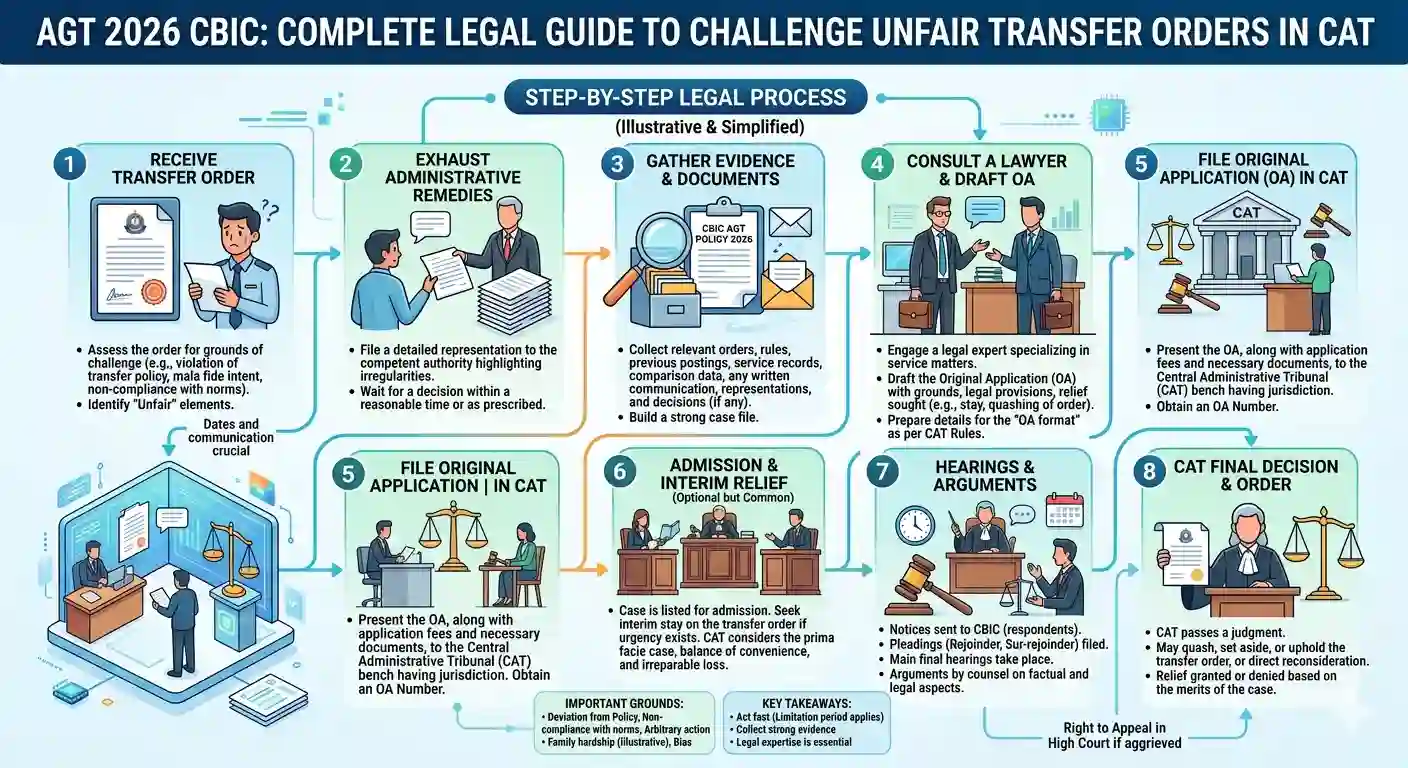
Step-by-Step Process to Challenge Transfer in CAT
Now, let us understand the practical steps you need to take.
Step 1: Analyze the Transfer Order
First, carefully read your transfer order. Check:
- Whether it follows policy guidelines
- Whether reasons are mentioned
- Whether your tenure is complete
Step 2: File a Representation
Before approaching CAT, you should submit a representation to the department.
Include:
- Your objections
- Supporting documents
- Hardship details
This step is important because CAT expects you to try internal remedies first.
Step 3: Wait for Response
Usually, departments take some time to respond. However, if:
- No reply is given, or
- Your request is rejected
Then you can proceed legally.
Step 4: Prepare Original Application (OA)
To approach CAT, you must file an Original Application (OA).
Your OA should include:
- Details of transfer order
- Grounds for challenge
- Supporting documents
- Relief sought (stay or cancellation)
Step 5: Seek Interim Stay
Along with OA, you can request an interim stay.
If granted:
- You don’t have to join the new posting immediately
- Status quo is maintained
This is a crucial step in urgent cases.
Step 6: Attend Hearings
After filing, CAT will:
- Issue notice to the department
- Hear both sides
- Examine records
Finally, it will pass an order.
Important Documents Required
To strengthen your case, you must attach proper documents.
Key documents include:
- Transfer order copy
- CBIC transfer policy guidelines
- Previous posting details
- Medical certificates (if applicable)
- School records of children
- Representation copy and reply
Strong documentation increases your chances of success.
Practical Tips for Success
While the law supports you, your approach also matters. Therefore, follow these practical tips:
1. Act Quickly
Do not delay filing your case. Late action weakens your position.
2. Stay Professional
Avoid emotional or aggressive language in your representation.
3. Focus on Rules
Base your arguments on policy violations, not personal inconvenience.
4. Maintain Evidence
Keep all records and communications safely.
5. Take Legal Assistance
An experienced lawyer can draft strong arguments and improve your chances.
Common Mistakes to Avoid
Many employees lose their cases due to simple mistakes. Therefore, avoid the following:
- Ignoring representation stage
- Filing incomplete documents
- Relying only on emotional arguments
- Missing deadlines
- Not seeking interim relief
By avoiding these errors, you can present a strong case.
Possible Outcomes in CAT
After hearing your case, CAT may pass different types of orders.
1. Stay Order
Temporary relief stopping the transfer.
2. Quashing the Transfer
Complete cancellation of the order.
3. Direction for Reconsideration
Authority must review your case again.
4. Dismissal
If no strong grounds are found.
Therefore, the outcome depends on the strength of your case.
Can You Appeal Further?
Yes, if you are not satisfied with CAT’s decision, you can approach the High Court under writ jurisdiction.
However, courts generally interfere only in serious legal issues. Hence, it is important to present your best case at the CAT level itself.
Why Legal Support Matters
Challenging a transfer order is not just about filing papers. It requires:
- Understanding service law
- Interpreting CBIC policies
- Drafting strong legal arguments
- Presenting evidence effectively
Therefore, professional legal assistance can make a big difference.
At LawyerChennai.com – Best Lawyer Firm in Chennai India 24×7, we provide dedicated support for government employees facing unfair transfers. Our team ensures that your case is handled with precision, speed, and care.
Frequently Asked Questions
No, you cannot challenge every transfer. Courts and the Central Administrative Tribunal (CAT) generally do not interfere in routine administrative transfers. However, you can challenge a transfer if it is arbitrary, violates CBIC guidelines, ignores tenure rules, or is issued with mala fide intent. Therefore, you must show clear legal grounds rather than personal inconvenience.
Yes, in most cases, filing a representation is important. You should first raise your concerns with the department by explaining policy violations or personal hardships. If the authority rejects your request or fails to respond, then you can approach CAT. This step strengthens your case and shows that you acted in good faith.
Yes, you can request an interim stay while filing your Original Application (OA). If CAT finds that your case has merit, it may grant temporary relief and stop the transfer order until the matter is decided. However, stay is not automatic and depends on the strength of your arguments.
You should provide key documents such as the transfer order, CBIC transfer policy, proof of tenure, representation copy, and any hardship evidence like medical records or children’s education details. Proper documentation plays a crucial role in proving that the transfer is unfair or illegal.
If CAT dismisses your application, you still have the option to approach the High Court under writ jurisdiction. However, higher courts interfere only in limited situations. Therefore, it is important to present a strong and well-prepared case before CAT itself for better chances of success.
Conclusion
In conclusion, while transfer is a normal part of service, it must be fair, transparent, and lawful. If your AGT 2026 CBIC transfer feels unjust, you have the full right to challenge it. By understanding your rights, identifying valid legal grounds, and following the correct procedure, you can seek justice through the Central Administrative Tribunal.
Read More
- Rights of Father & Grandparents to See Newborn Child | Chennai Family Lawyer
- Ex Gratia: Comprehensive Legal Guide for Indian Citizens
- Land Use and Zoning Appeals: Handling land use disputes in SC
- Judicial Review of Tribunals: Reviewing tribunal decisions
- Human Rights Appeals: Addressing human rights violations in SC
- Central Administrative Tribunal (CAT)