
How to Challenge AGT 2026 Transfer Postings of CBIC Officers Before CAT

Challenge AGT 2026 Transfer Postings – Transfers are a routine part of government service. However, sometimes transfer orders can create serious personal and professional difficulties for officers. In particular, during the Annual General Transfer (AGT) 2026 cycle of the Central Board of Indirect Taxes and Customs (CBIC), many officers may feel that their postings are unfair, arbitrary, or not in line with policy guidelines.
Therefore, it becomes important to understand that such transfer orders can be legally challenged. More importantly, the Central Administrative Tribunal (CAT) provides an effective forum for government officers to seek relief. At LawyerChennai.com – Best Lawyer Firm in Chennai India 24×7, we assist CBIC officers in navigating these legal challenges with clarity and confidence.
How to Challenge AGT 2026 Transfer Postings of CBIC Officers Before CAT – LawyerChennai.com – Best Lawyer Firm in Chennai India 24×7
Understanding AGT 2026 Transfer Postings
To begin with, AGT (Annual General Transfer) is a structured process followed by CBIC to transfer officers across locations. The objective is to ensure administrative efficiency, prevent stagnation, and maintain transparency.
However, despite clear policies, issues may arise due to:
- Non-compliance with transfer guidelines
- Ignoring tenure rules
- Lack of consideration for medical or family grounds
- Arbitrary or discriminatory decisions
As a result, affected officers may face hardship, which justifies legal intervention.
When Can a Transfer Order Be Challenged?
Although courts generally do not interfere in transfer matters, there are specific situations where a challenge is valid. Therefore, understanding these grounds is crucial.
Violation of Transfer Policy
If the transfer order clearly violates CBIC’s own guidelines, it can be challenged.
Mala Fide Intent
If the transfer is made with bad intention, such as personal bias or retaliation, it is legally questionable.
Lack of Administrative Reason
Transfers must serve a legitimate administrative purpose. If not, they can be contested.
Medical or Compassionate Grounds Ignored
If serious medical conditions or family issues are overlooked, the order may be unfair.
Discrimination or Unequal Treatment
If similarly placed officers are treated differently without justification, it raises legal concerns.
Thus, while transfers are administrative decisions, they must still follow fairness and legality.
Role of the Central Administrative Tribunal (CAT)
The Central Administrative Tribunal (CAT) is a specialized judicial body that handles service-related disputes of government employees. It provides a faster and more focused mechanism compared to regular courts.
Importantly, CAT has the authority to:
- Examine the legality of transfer orders
- Stay or suspend transfer orders
- Provide interim relief
- Set aside unfair or illegal transfers
Therefore, it becomes the primary forum for CBIC officers seeking justice.
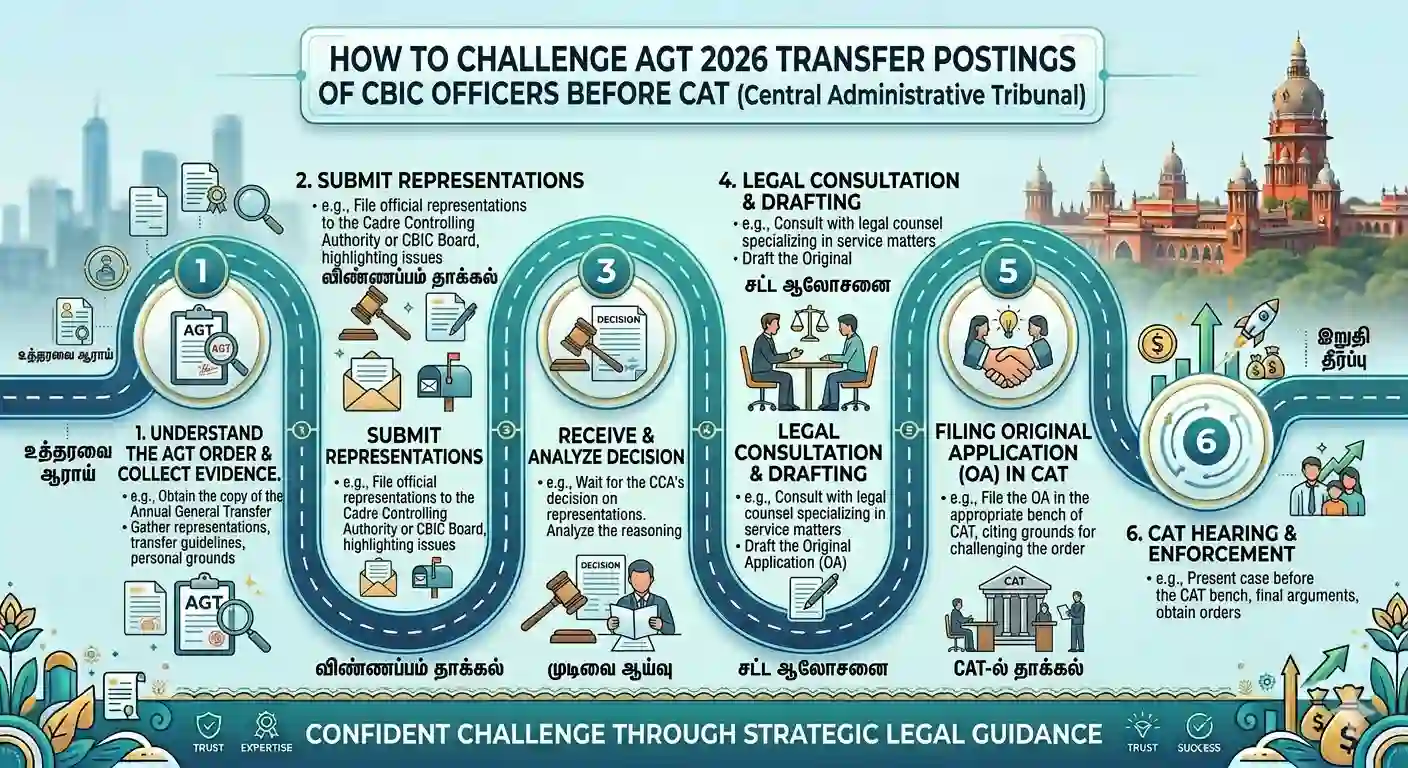
Step-by-Step Process to Challenge Transfer Before CAT
Challenging a transfer order requires careful planning and proper legal procedure. The following steps outline the process:
Step 1: Review the Transfer Order
Firstly, carefully examine the transfer order and compare it with CBIC transfer guidelines. Identify any violations or irregularities.
Step 2: Gather Supporting Documents
Collect all relevant documents, including:
- Transfer order copy
- Service records
- Medical certificates (if applicable)
- Previous postings and tenure details
Proper documentation strengthens your case.
Step 3: Submit Representation to Department
Before approaching CAT, it is advisable to submit a formal representation to the department. This shows that you have attempted internal resolution.
Step 4: Consult a Service Law Expert
At this stage, consulting an experienced lawyer is crucial. Legal experts can assess your case and guide you on the best course of action.
Step 5: File an Original Application (OA)
If the issue remains unresolved, you can file an Original Application before CAT. This document outlines your grievances and legal grounds.
Step 6: Seek Interim Relief
In urgent cases, you can request a stay on the transfer order. This prevents immediate relocation until the case is decided.
Step 7: Attend Hearings
Participate in hearings and present your case effectively through legal representation.
Step 8: Await Final Order
CAT will examine the facts and pass a judgment, which may uphold, modify, or cancel the transfer order.
Importance of Interim Relief
One of the most critical aspects of challenging a transfer is obtaining interim relief. Without it, the officer may be forced to join the new posting before the case is decided.
Therefore, lawyers often focus on securing a stay order at the initial stage. This ensures that the officer is not subjected to immediate hardship.
Common Mistakes to Avoid
While challenging a transfer, certain mistakes can weaken your case. Hence, it is important to avoid them.
- Delaying the filing of the application
- Submitting incomplete or incorrect documents
- Ignoring departmental remedies
- Filing without proper legal advice
By avoiding these errors, you improve your chances of success.
How LawyerChennai.com Can Help
At LawyerChennai.com – Best Lawyer Firm in Chennai India 24×7, we provide comprehensive legal support to CBIC officers facing transfer issues.
Case Evaluation
We analyze your transfer order and identify strong legal grounds.
Drafting and Filing
Our team prepares well-structured applications and representations.
Interim Relief Strategy
We focus on securing immediate relief to protect your interests.
Representation Before CAT
We provide professional and effective representation during hearings.
Personalized Legal Solutions
Every case is unique, and we tailor our approach accordingly.
As a result, our clients receive reliable and result-oriented legal support.
Legal Principles Applied by CAT
CAT follows certain principles while deciding transfer cases. Understanding these can help in building a strong case.
Administrative Discretion with Limits
While the government has the power to transfer employees, this power must not be arbitrary.
Fairness and Reasonableness
Decisions must be fair, reasonable, and based on valid grounds.
Policy Compliance
Authorities must follow their own transfer policies.
Protection of Fundamental Rights
If a transfer violates basic rights, CAT may intervene.
Therefore, a well-prepared case aligned with these principles has a higher chance of success.
Practical Tips for CBIC Officers
To handle transfer challenges effectively, consider the following tips:
- Keep records of all communications and postings
- Act quickly after receiving the transfer order
- Maintain professionalism in all representations
- Seek legal advice at an early stage
- Be prepared for both legal and administrative outcomes
These steps can make the process smoother and more effective.
Frequently Asked Questions
Yes, CBIC officers can legally challenge AGT 2026 transfer postings before the Central Administrative Tribunal (CAT) if the order is arbitrary, violates transfer guidelines, or causes undue hardship. Although transfer is an administrative decision, it must follow fairness and policy rules. Therefore, if any irregularity exists, officers have the right to seek judicial review and relief through CAT.
A transfer order can be challenged on several grounds. These include violation of CBIC transfer policy, mala fide intention, discrimination, ignoring medical or compassionate grounds, and lack of administrative justification. In addition, if tenure rules are not followed or similarly placed officers are treated differently, it strengthens the case. Hence, identifying proper legal grounds is essential.
Yes, it is advisable to first submit a representation to the concerned department. This shows that the officer has attempted internal resolution before approaching CAT. Moreover, in some cases, the department may reconsider the order. However, if no action is taken, filing an Original Application before CAT becomes necessary.
Yes, CAT has the power to grant interim relief, including a stay on the transfer order. This is especially important when the transfer causes immediate hardship. Therefore, seeking interim relief at the time of filing the case is crucial to prevent forced relocation until the matter is decided.
A lawyer plays a key role in building a strong case. They analyze the transfer order, identify legal issues, and prepare proper documentation. Furthermore, they draft the application, argue for interim relief, and represent the officer before CAT. As a result, professional legal support significantly improves the chances of success.
Conclusion
In conclusion, while transfer is a normal part of government service, it must be fair, transparent, and in accordance with established policies. If a transfer order under AGT 2026 appears unjust or arbitrary, CBIC officers have the legal right to challenge it before the Central Administrative Tribunal.
However, success in such cases depends on timely action, proper documentation, and strong legal representation. At LawyerChennai.com – Best Lawyer Firm in Chennai India 24×7, we are committed to helping officers protect their rights and navigate legal challenges with confidence.
Read More
- Foreign Contribution Act FCRA: Registration, Compliance & Legal Guide Chennai
- CBIC AGT 2026 Due Lists & Transfer Orders: Legal Remedies & CAT Success Stories
- AGT 2026 CBIC: Complete Legal Guide to Challenge Unfair Transfer Orders in CAT
- CENTRAL ADMINISTRATIVE TRIBUNAL: How to find the Best Senior Lawyers?
- Interim Orders and Stay Applications: Requesting interim relief from SC
- Rights of IRS C&CE Officers in Annual General Transfer (AGT) 2026 – CBIC Rules
- Transfer Petitions: Requesting transfer of cases to SC
- Rights of Father & Grandparents to See Newborn Child | Chennai Family Lawyer
- Ex Gratia: Comprehensive Legal Guide for Indian Citizens
- Land Use and Zoning Appeals: Handling land use disputes in SC
- Central Administrative Tribunal (CAT) – Official Website