
Social media managers at LawyerChennai.com handle a unique blend of digital communication and professional responsibility. They work within strict Bar Council of India norms while creating meaningful online engagement for clients. Although digital visibility matters, legal ethics guide every step they take. Their work strengthens public understanding of law, improves client communication, and builds trust. Moreover, they ensure that every online message remains informative without sounding promotional. Consequently, the firm’s online presence stays credible and authoritative across Chennai and Delhi.
Social media managers create structured content that explains legal issues, legal remedies, and client rights. They simplify complex disputes like property conflicts, civil suits, criminal complaints, corporate disagreements, and family law matters. Additionally, they ensure that each post empowers users with legal awareness. Their goal is simple: make law understandable without violating professional boundaries.
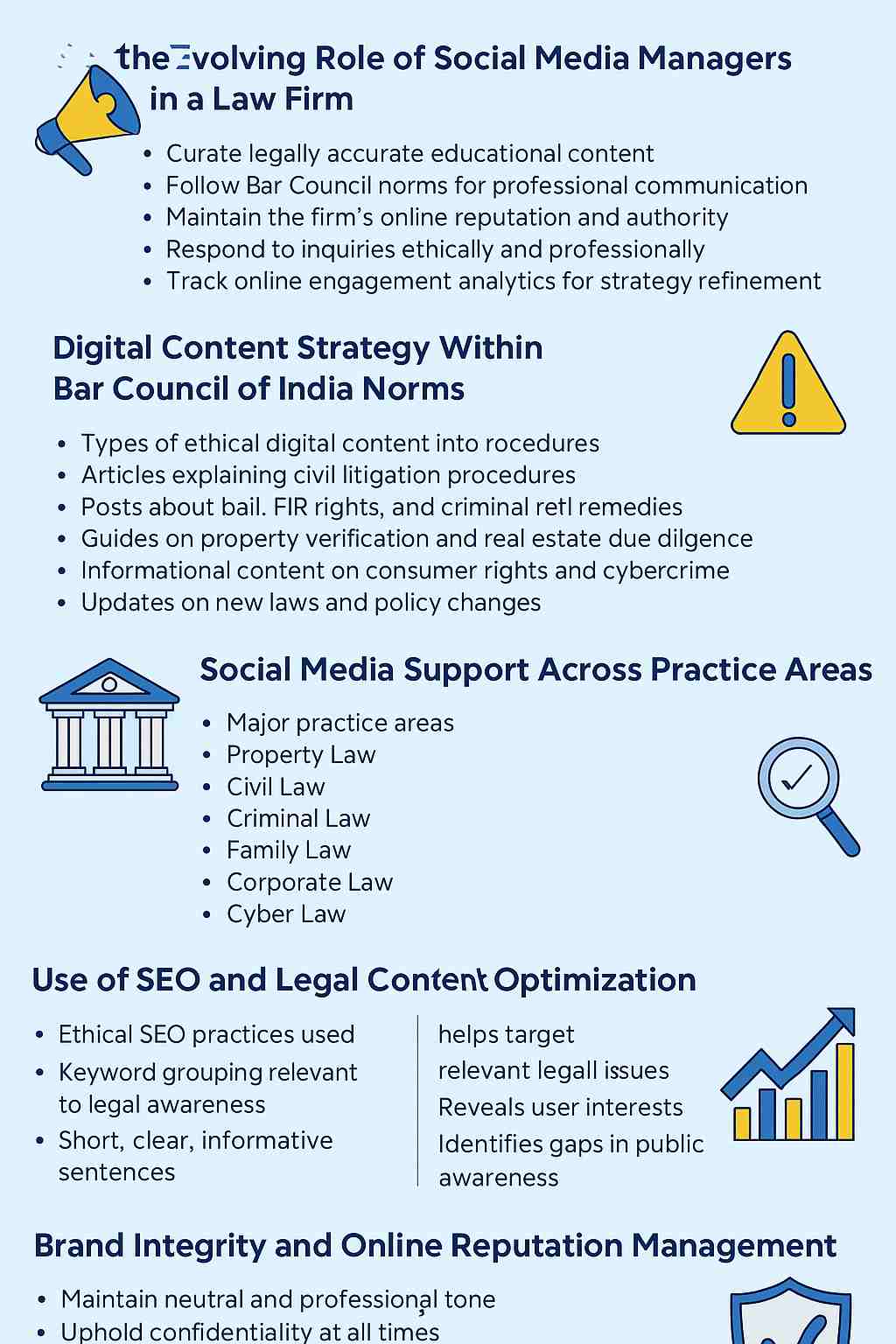
The Evolving Role of Social Media Managers in a Law Firm
Social media managers handle communication across multiple online platforms. Their job goes far beyond posting content. They also analyze engagement, understand client behavior, manage communication tone, and align posts with Bar Council restrictions. They ensure that the firm never advertises but only educates. Therefore, their role becomes both creative and responsible.
They highlight major practice areas like civil remedies, criminal procedures, corporate compliance, family disputes, cybercrime, consumer issues, property verification, and High Court litigation. Furthermore, they use a clear and structured communication method that respects client confidentiality.
Key Duties of Social Media Managers
- Curate legally accurate educational content.
- Follow Bar Council norms for professional communication.
- Maintain the firm’s online reputation and authority.
- Respond to inquiries ethically and professionally.
- Track online engagement analytics for strategy refinement.
Why Their Role Matters
- They support client awareness about legal rights.
- They help build trust without direct solicitation.
- They maintain consistent information flow across digital channels.
Thus, they bridge legal knowledge and public expectations with balanced professionalism.
Digital Content Strategy Within Bar Council of India Norms
A law firm must respect strict content rules. The Bar Council prohibits solicitation, direct advertising, or promotional messaging. Therefore, social media managers create purely informational posts. Firstly, They highlight legal procedures, case types, statutory rights, and remedies without offering guarantees or claims.
They never use client names or case details. Moreover, They also avoid language that suggests superiority. Instead, they highlight general legal awareness topics. This approach protects the firm while helping users understand available legal frameworks.
Types of Ethical Digital Content
- Articles explaining civil litigation procedures.
- Posts about bail, FIR rights, and criminal remedies.
- Guides on property verification and real estate due diligence.
- Informational content on consumer rights and cybercrime.
- Updates on new laws and policy changes.
SEO Keywords Used Ethically
- Civil law remedies
- Criminal defense rights
- Property dispute solutions
- Corporate compliance procedures
- Family law legal options
- Cybercrime complaints and remedies
Hence, every content piece educates without crossing ethical lines.
Supporting Legal Teams With Research-Based Online Communication
Social media managers work alongside associates, paralegals, and partners. They convert complex legal points into accessible content. Although they are not legal advisors, they reinforce the firm’s informational role. They coordinate with internal teams to ensure factual accuracy. Consequently, online trust increases among readers.
They also help clients understand where remedies exist. For instance, users may learn about injunctions, quash petitions, arbitration, maintenance claims, patta corrections, or fraud remedies. Furthermore, they ensure that the firm’s messaging remains neutral and informative.
Core Internal Coordination Tasks
- Verify facts with legal teams before posting.
- Avoid sensitive or confidential information.
- Maintain updated knowledge of legal changes.
- Share analytics to improve communication strategies.
Benefits of Internal Collaboration
- Ensures accuracy in all legal explanations.
- Aligns public messages with firm capacity.
- Prevents unnecessary confusion or miscommunication.
Thus, social media managers strengthen alignment between digital communication and legal professionalism.
Client Engagement and Ethical Interaction
Client interaction online must remain measured and respectful. Social media managers respond to general queries without offering specific legal advice. They encourage users to book appointments for detailed discussions. This approach protects against unauthorized practice concerns.
Moreover, they maintain polite communication even during high-traffic periods. They guide users toward correct legal categories and clarify basic procedural terms. Consequently, the firm maintains both accessibility and professionalism.
Ethical Engagement Guidelines
- Provide only general information.
- Avoid case-specific advice.
- Suggest consultation for detailed guidance.
- Maintain respectful, neutral communication.
How Social Media Managers Build Trust
- They maintain consistent response timing.
- They share help-oriented posts regularly.
- They use simple language to improve clarity.
Therefore, they serve as the first level of public interaction while staying within legal norms.
Social Media Support Across Practice Areas
LawyerChennai.com handles a wide range of disputes. Social media managers prepare awareness content for each practice area. They explain remedies clients can pursue legally. This educates the public and builds informed expectations.
Major Practice Areas Covered
- Property Law – Patta correction, encroachment suits, title issues, fraudulent registration remedies.
- Civil Law – Injunctions, recovery suits, partition cases, declaration suits.
- Criminal Law – Bail, anticipatory bail, FIR rights, quash petitions.
- Family Law – Divorce, maintenance, guardianship, domestic violence remedies.
- Corporate Law – Arbitration, partnership disputes, compliance filings.
- Consumer Law – Defective goods, service deficiency complaints.
- Cyber Law – Online fraud, harassment, data theft remedies.
Types of Legal Remedies Highlighted
- Injunction and stay applications
- Bail processes and criminal defense
- Property verification and title clarification
- Arbitration and mediation options
- DV Act remedies and maintenance claims
- Consumer forum litigation options
- Cybercrime complaint filing
Hence, users gain clarity about available legal paths even before consulting.
Use of SEO and Legal Content Optimization
Search engine optimization helps informational content reach users effectively. Social media managers use SEO within legal limits. They optimize keywords, structure posts clearly, and ensure strong readability.
They also build authority through consistent posting. However, they avoid advertising terms. Their focus stays on legal literacy and public education.
Ethical SEO Practices Used
- Keyword grouping relevant to legal awareness.
- Short, clear, informative sentences.
- Structured posts with headers and bullets.
- Metadata that informs without promoting.
Examples of SEO-Safe Keyphrases
- “legal remedies for property disputes”
- “civil court procedures in India”
- “criminal law rights and processes”
- “corporate compliance basics”
- “family law procedures explained”
Therefore, SEO boosts visibility while keeping full compliance.
Technology, Analytics, and Continuous Improvement
Modern legal communication depends on data analysis. Social media managers study audience behavior, track engagement, and refine strategies. They monitor which posts gain traction. Additionally, they focus on topics that benefit the public. Consequently, content becomes stronger over time.
They also manage digital tools like scheduling software, analytics platforms, and content management systems. This efficiency helps maintain a reliable publishing routine.
Digital Tools Used By the Team
- Analytics dashboards
- Social media scheduling platforms
- Legal content checklists
- Keyword research tools
- Secure communication platforms
Why Analytics Matter
- Helps target relevant legal issues.
- Reveals user interests.
- Identifies gaps in public awareness.
- Improves future content accuracy.
Thus, digital insights support growth and consistent quality.
Brand Integrity and Online Reputation Management
A law firm’s online reputation must remain clear and trustworthy. Social media managers monitor comments, feedback, and public impressions. They remove inappropriate content politely. They also ensure the firm’s brand tone matches its values: dignity, accuracy, and professionalism. In fact, They highlight achievements ethically, such as educational seminars, legal awareness programs, or policy discussions. However, they avoid posting personal victories or case outcomes.
Brand Integrity Practices
- Maintain neutral and professional tone.
- Uphold confidentiality at all times.
- Correct misinformation quickly.
- Align every post with firm values.
Reputation Management Goals
- Prevent confusion
- Build awareness
- Reinforce trust
- Maintain professionalism
Therefore, brand integrity remains a major priority in all communications.
FAQs on Social Media Managers at LawyerChennai.com
They manage educational legal content, engage ethically, and ensure Bar-Council-approved communication across platforms.
No, they only share general information and always direct users to formal consultations.
They simplify complex statutes into easy content and coordinate for accuracy before posting.
They explain civil, criminal, corporate, property, cyber, and family law procedures ethically.
They avoid advertising, respect confidentiality, and focus only on legal awareness and education.
Read More
- Ultimate Guide to Dunning Letters: Reclaim Your Finances and Take Control
- Conquer the best Chennai’s Law Labyrinth: Your Legal FAQ Guide
- Best Legal Services: Civil, Criminal, Corporate, Family, and More – Expert Attorneys
- Comprehensive Guide to Trademarks in Franchising: Protect and Grow Your Brand
- Public Interest Litigation (PIL): Addressing public issues in SC