DPC Promotion Procedure IRS C&CE Officers 2026: Seniority Disputes & CAT Appeals

DPC Promotion Procedure – Promotions in government service are not just about career growth; they directly affect seniority, pay, responsibilities, and long-term benefits. For officers of the Indian Revenue Service (Customs & Central Excise), commonly known as IRS C&CE, the Departmental Promotion Committee (DPC) process plays a crucial role in shaping their professional journey.
However, promotions are not always smooth. Seniority disputes, eligibility issues, and procedural delays often lead to dissatisfaction among officers. As a result, many officers seek legal remedies, especially through the Central Administrative Tribunal (CAT).
In this article, we explain the DPC promotion procedure for IRS C&CE officers in 2026, the common causes of seniority disputes, and how CAT appeals work. We also highlight how legal assistance can help officers protect their rights effectively.
DPC Promotion Procedure IRS C&CE Officers 2026: Seniority Disputes & CAT Appeals – LawyerChennai.com – Best Lawyer Firm in Chennai India 24×7
Understanding the DPC Promotion Process
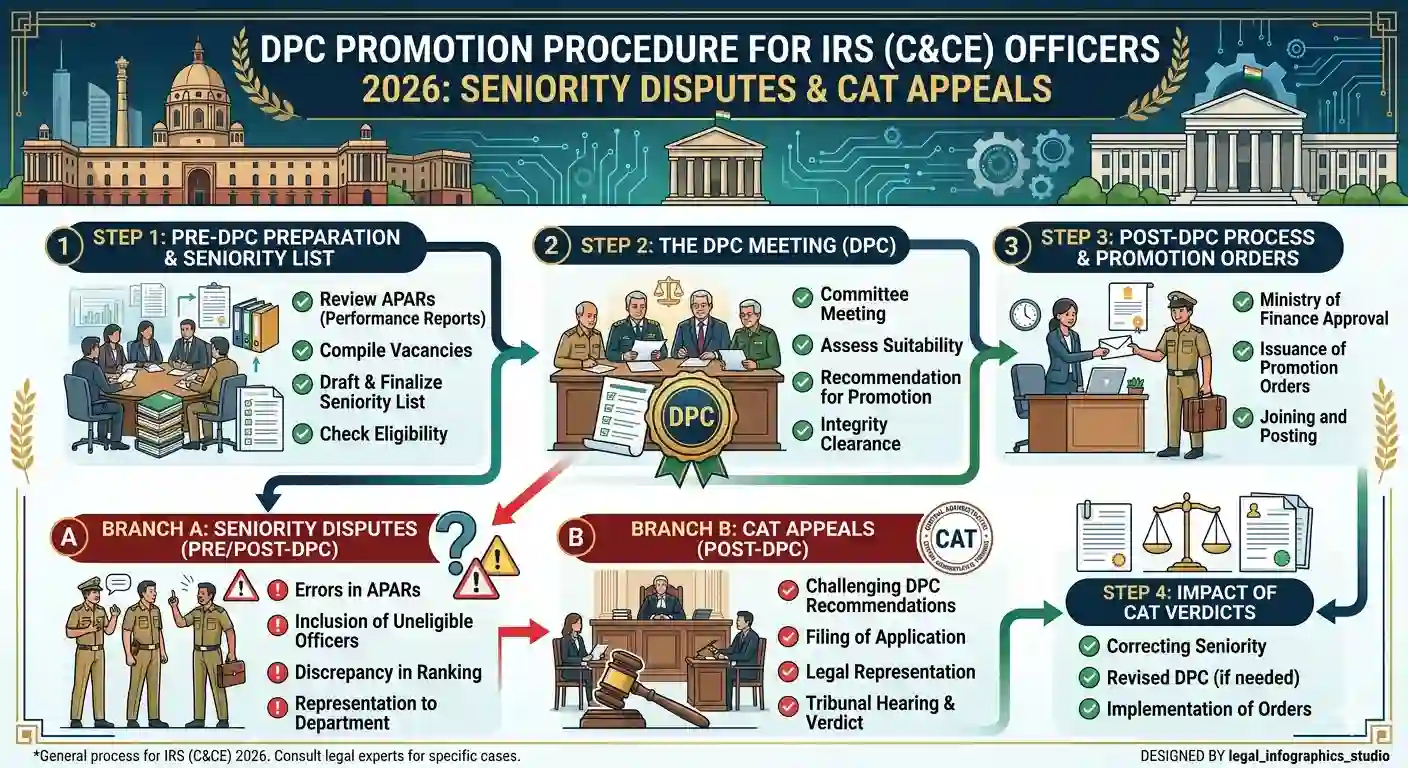
The Departmental Promotion Committee (DPC) is responsible for evaluating eligible officers and recommending them for promotion. The process is guided by service rules, government instructions, and seniority lists.
First, the department identifies vacancies based on sanctioned strength and available posts. Next, it prepares a list of eligible officers based on seniority, qualifications, and years of service.
Then, the DPC reviews the Annual Confidential Reports (ACRs), vigilance clearance, and overall performance of each officer. Based on this assessment, it prepares a panel of officers recommended for promotion.
Finally, the competent authority approves the recommendations, and promotion orders are issued.
Thus, the DPC process must be fair, transparent, and in line with established rules.
Eligibility Criteria for Promotion
Eligibility for promotion depends on several factors. These include length of service, performance record, and integrity status.
For example, an officer must complete the required number of years in a particular grade before becoming eligible. Additionally, their service record must be satisfactory, with no major disciplinary issues.
Moreover, vigilance clearance is essential. If an officer is under investigation or facing disciplinary proceedings, their promotion may be delayed or kept in a sealed cover.
Therefore, meeting all eligibility conditions is critical for a successful promotion.
Importance of Seniority in Promotions
Seniority plays a key role in determining promotion order. In most cases, promotions follow a seniority-cum-fitness or merit-cum-seniority principle.
However, disputes often arise regarding seniority lists. These disputes may relate to date of joining, inter-se ranking, or changes due to court orders.
Furthermore, errors in seniority lists can affect multiple officers. Even a small mistake can lead to serious consequences, including wrongful promotions or denial of rightful advancement.
Hence, maintaining accurate seniority records is essential.
Common Causes of Seniority Disputes
Seniority disputes among IRS C&CE officers can arise due to various reasons. Firstly, differences in recruitment batches may create confusion in ranking.
Secondly, promotions from different streams or quotas may lead to conflicts. For instance, direct recruits and promotees may have different seniority positions.
Thirdly, delays in conducting DPC meetings can disturb the promotion timeline. As a result, officers may lose their rightful place in the seniority list.
Additionally, implementation of court judgments or policy changes can alter seniority positions.
Therefore, such disputes require careful legal examination and timely resolution.
Sealed Cover Procedure and Its Impact
The sealed cover procedure is applied when an officer is under investigation or facing disciplinary action. In such cases, the DPC assesses the officer but keeps the result in a sealed cover.
If the officer is later cleared of charges, the sealed cover is opened, and promotion may be granted with retrospective effect.
However, this process often leads to complications. Delays in investigations can affect career progression and create uncertainty.
Thus, understanding the sealed cover procedure is important for affected officers.
Role of Vigilance Clearance
Vigilance clearance is a mandatory requirement for promotion. It confirms that the officer has no pending disciplinary or criminal cases.
Without this clearance, the DPC may defer or withhold promotion. Therefore, maintaining a clean service record is essential.
At the same time, officers have the right to challenge unjust denial of vigilance clearance through legal means.
Legal Framework Governing DPC Promotions
The DPC process is governed by service rules, government guidelines, and judicial decisions. Instructions issued by the Department of Personnel and Training (DoPT) provide detailed procedures for conducting DPCs.
Moreover, court judgments have clarified several aspects of promotions, seniority, and sealed cover procedures. These decisions ensure fairness and consistency in administrative actions.
Therefore, legal awareness is crucial for officers navigating the promotion process.
When Disputes Arise: Need for Legal Intervention
Despite clear rules, disputes may still arise. In such situations, officers must act promptly to protect their rights.
First, they can submit representations to the department. If the issue is not resolved, they may approach legal forums.
Timely action is important because delays can weaken the case. Therefore, seeking legal advice at an early stage is highly recommended.
Central Administrative Tribunal (CAT): An Overview
The Central Administrative Tribunal (CAT) is a specialized body that handles service matters of government employees. It provides a faster and more efficient alternative to regular courts.
Officers can approach CAT for issues related to promotions, seniority, transfers, and disciplinary actions.
CAT has the power to examine records, hear arguments, and pass binding orders. Thus, it plays a key role in resolving service disputes.
Filing a CAT Appeal
Filing an appeal before CAT involves several steps. First, the officer must prepare an application outlining the facts, legal grounds, and relief sought.
Next, supporting documents such as seniority lists, promotion orders, and representations must be attached.
Then, the application is filed within the prescribed limitation period, usually one year from the cause of action.
After filing, the tribunal issues notices, hears both parties, and delivers a judgment.
Therefore, proper preparation and documentation are essential for a successful appeal.
Reliefs Granted by CAT
CAT can grant various types of relief depending on the case. These include:
- Correction of seniority lists
- Direction to conduct fresh DPC
- Grant of promotion with retrospective effect
- Payment of arrears and benefits
- Quashing of незаконные orders
Such remedies help restore fairness and protect the rights of officers.
Importance of Legal Representation
Service law matters are often complex and technical. Therefore, professional legal assistance can make a significant difference.
Experienced lawyers understand the rules, precedents, and procedural requirements. They can present strong arguments and ensure proper documentation.
At LawyerChennai.com – Best Lawyer Firm in Chennai India 24×7, we specialize in handling service matters, including DPC disputes and CAT appeals. We guide officers through every stage, from representation to final resolution.
Practical Tips for IRS C&CE Officers
To avoid disputes, officers should take proactive steps. First, regularly check seniority lists and service records.
Second, maintain copies of ACRs, promotion orders, and official communications.
Third, respond promptly to any discrepancies or issues.
Finally, seek legal advice whenever necessary.
By staying informed and proactive, officers can protect their career progression effectively.
Challenges in the Promotion Process
Although the system aims to be fair, challenges still exist. Administrative delays, lack of transparency, and complex rules can create confusion.
Moreover, litigation can take time and effort. However, with proper guidance, these challenges can be managed effectively.
Thus, awareness and legal support are key to overcoming obstacles.
Frequently Asked Questions
Conclusion
The DPC promotion process for IRS C&CE officers in 2026 is a critical aspect of their career. While the system is designed to ensure fairness, seniority disputes and procedural issues can arise.
Understanding the rules, staying vigilant, and taking timely action are essential. When disputes occur, the Central Administrative Tribunal provides an effective platform for redressal.
At LawyerChennai.com – Best Lawyer Firm in Chennai India 24×7, we are committed to helping officers navigate these challenges. With the right legal support, officers can safeguard their rights and achieve rightful career growth.
Read More
- SPARROW CBIC Module: Missing APAR / IPR Issues & Legal Solutions for Promotion
- Criminal Law: Code of Criminal Procedure – Expert Attorneys
- How to File Cyber Crime Complaint in Chennai: Step-by-Step Guide 2024
- How to Challenge Adverse APAR Entries in SPARROW Module – CBIC Officers 2026
- Property Title Verification Process in Chennai | Legal Due Diligence Lawyers
- Public Interest Litigation (PIL) & Social Justice Matters in India – Complete Legal Guide for High Court Remedies
- CENTRAL ADMINISTRATIVE TRIBUNAL: How to find the Best Senior Lawyers?
- Police harassment in Chennai: Expert Criminal Lawyers Help
- Procedure to File Divorce Cases in Chennai
- CBI arrested Chennai income Tax Officer, CA in Bribery Matter
- Appeals in Public Administrative Law: Handling public admin disputes in Supreme court
- Department of Personnel and Training (DoPT)