Foreign Contribution Act FCRA: Registration, Compliance & Legal Guide Chennai

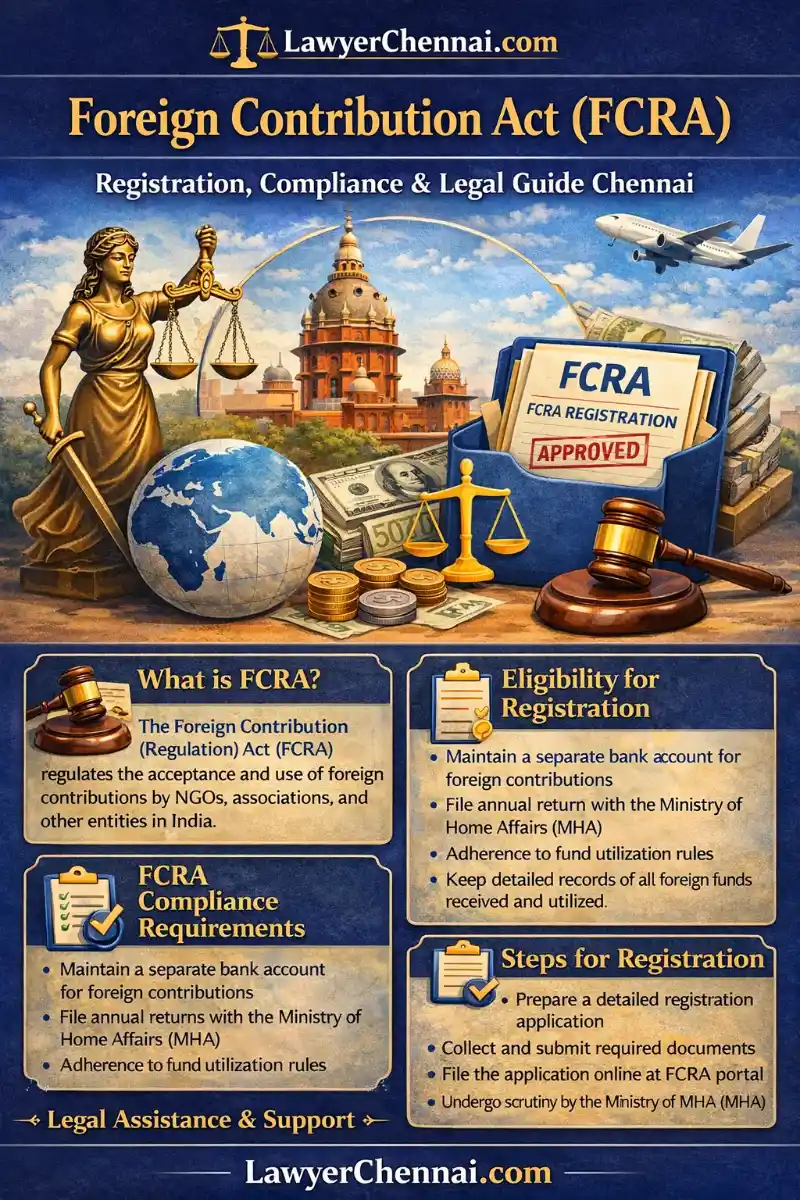
The Foreign Contribution (Regulation) Act (FCRA) stands as a critical legislative framework governing foreign donations in India. Enacted in 2010, this statute replaced the earlier 1976 legislation with enhanced provisions. Consequently, organizations receiving foreign funds must comply with stringent regulatory requirements. The Ministry of Home Affairs (MHA) administers this Act through dedicated enforcement mechanisms. Furthermore, recent amendments in 2020 have significantly tightened compliance obligations for registered entities. Legal practitioners at LawyerChennai.com provide comprehensive guidance on FCRA matters across Chennai and beyond. Moreover, understanding these regulations becomes essential for NGOs, charitable trusts, and various organizations.
The Act ensures transparency while preventing misuse of foreign contributions for detrimental activities. Additionally, violations attract severe penalties including imprisonment and monetary fines. Therefore, organizations must navigate these complex provisions with expert legal assistance. Our firm specializes in registration applications, compliance audits, and renewal procedures under FCRA. Subsequently, proper legal advice prevents inadvertent violations and ensures smooth operations.
Understanding Foreign Contribution (Regulation) Act (FCRA): Complete Legal Framework
Legislative Framework and Historical Evolution of FCRA
The original Foreign Contribution Regulation Act emerged in 1976 during the Emergency period in India. Parliament subsequently repealed this outdated legislation and enacted the comprehensive FCRA 2010. This modern statute addresses contemporary challenges related to foreign funding transparency and accountability. Meanwhile, the 2020 amendments introduced transformative changes affecting thousands of registered organizations nationwide. Key modifications included mandatory Aadhaar linking for office bearers and restricted administrative expense utilization. Furthermore, the banking provisions now mandate single designated accounts in specified State Bank branches.
The legislative intent focuses on preventing money laundering and ensuring legitimate utilization of funds. Additionally, Parliament designed these provisions to safeguard national interest and sovereignty from external influences. Organizations operating in sectors like education, healthcare, rural development, and social welfare particularly require registration. Consequently, legal compliance becomes paramount for continued operations and funding receipt. Expert legal consultation helps organizations understand applicability, exemptions, and procedural requirements comprehensively.
- Original FCRA enacted in 1976 during Emergency period
- Comprehensive replacement legislation passed in 2010
- Significant amendments introduced in September 2020
- Ministry of Home Affairs serves as nodal agency
- Enhanced transparency and accountability provisions incorporated
Objectives and Purpose of Foreign Contribution Regulation
The primary objective involves regulating acceptance and utilization of foreign contributions by Indian entities. National security considerations remain paramount throughout the legislative framework and enforcement mechanisms. Moreover, preventing foreign interference in domestic political, religious, and social affairs constitutes a fundamental goal. The Act ensures foreign funds serve genuine developmental and charitable purposes without ulterior motives. Additionally, maintaining detailed records and transparent reporting mechanisms helps achieve these objectives effectively. Organizations must demonstrate legitimate activities aligned with their stated objectives and registered purposes. Furthermore, the government monitors compliance through regular audits, inspections, and scrutiny of annual returns. Unauthorized receipt or misutilization attracts stringent legal consequences including registration cancellation and criminal prosecution. Therefore, organizations must establish robust internal controls and compliance systems from the outset. Professional legal guidance ensures alignment between organizational activities and regulatory expectations under FCRA provisions.
Registration Requirements and Application Procedures Under FCRA
Organizations seeking foreign contributions must obtain prior registration from the Ministry of Home Affairs. The application process requires comprehensive documentation including registration certificates, financial statements, and activity reports. Subsequently, applicants must demonstrate three years of consistent operations in their chosen field. The registration remains valid for five years from the date of issue. Renewal applications must be submitted six months before expiry to ensure continuity. Moreover, organizations must maintain a designated FCRA account in the New Delhi main branch of State Bank of India exclusively for foreign funds. This centralized banking requirement enables better monitoring and transparency. Furthermore, the application portal facilitates online submission with digital signatures and document uploads. Processing typically takes six to nine months depending on scrutiny and verification requirements. Meanwhile, organizations cannot accept foreign contributions without valid registration except under specific exemptions. Therefore, timely application submission with complete documentation becomes crucial for uninterrupted operations and funding.
| Registration Type | Validity Period | Application Timeline | Key Requirements |
|---|---|---|---|
| Fresh Registration | 5 Years | 6-9 Months | 3 Years Activity Proof |
| Renewal Registration | 5 Years | 6 Months Before Expiry | Compliance Certificate Required |
| Prior Permission | Specific Purpose | 45-60 Days | Project-Based Approval |
Eligibility Criteria for FCRA Registration Applications
Applicant organizations must be registered as societies, trusts, or companies under respective Indian laws. Political parties, government officials, and judges remain prohibited from receiving foreign contributions under any circumstances. Moreover, organizations involved in active politics or religious conversions face automatic disqualification from registration. The entity must demonstrate definite cultural, economic, educational, religious, or social programs for community benefit. Financial stability indicators including consistent income sources and proper accounting systems require thorough documentation. Additionally, office bearers must provide Aadhaar details, PAN cards, and declarations regarding criminal antecedents. Organizations cannot have adverse findings in previous compliance reports or pending investigations under FCRA. Furthermore, the physical infrastructure including registered office and operational facilities undergoes verification through field visits. Therefore, maintaining transparent operations and proper documentation from inception facilitates smooth registration approval. Legal experts assist in preparing comprehensive applications addressing all statutory requirements and potential concerns.
Documentation Requirements for Registration Process
The registration application demands extensive documentation proving organizational legitimacy and operational capacity. Registration certificate under Societies Registration Act, Indian Trusts Act, or Companies Act forms the foundation. Audited financial statements for the preceding three years demonstrate financial discipline and accountability. Activity reports detailing projects, beneficiaries, and outcomes showcase organizational impact and credibility. Memorandum of Association and Rules/Bye-laws outline objectives, governance structure, and operational framework. Bank statements reflecting transactions and fund utilization patterns undergo careful scrutiny. Additionally, Income Tax registration certificates, PAN cards, and tax returns establish fiscal compliance. Details of key functionaries including names, addresses, Aadhaar, and backgrounds require submission. Furthermore, asset ownership documents and office lease agreements prove infrastructure availability. Therefore, meticulous preparation of these documents with legal verification prevents application rejections. Professional assistance ensures completeness, accuracy, and alignment with regulatory expectations throughout the process.
- Society/Trust/Company registration certificate with current status
- Audited accounts for three consecutive financial years
- Detailed activity reports demonstrating consistent operations
- Memorandum, Articles, or Trust Deed copies
- Income Tax registration and PAN details
- Aadhaar and identity proofs of all office bearers
- Bank account statements and financial records
- Office address proof and infrastructure details
Online Application Portal and Submission Process
The Ministry of Home Affairs operates a dedicated online portal for all FCRA-related applications and submissions. Organizations must register on the portal using valid email addresses and contact information. Digital signatures of authorized signatories enable secure document uploads and form submissions. The portal facilitates tracking of application status, deficiency communications, and approval notifications in real-time. Subsequently, applicants receive queries and clarifications through the portal requiring prompt responses. Payment of application fees occurs online through integrated payment gateways with transaction receipts. Moreover, the system maintains complete audit trails of all submissions and communications for transparency. Technical support and user manuals assist applicants in navigating the portal effectively. However, organizations often face challenges with document formats, size limitations, and technical glitches. Therefore, expert assistance in portal navigation and application preparation ensures smooth submission. Legal professionals familiar with the system help avoid common mistakes and expedite processing.
Compliance Obligations and Reporting Requirements
Registered organizations bear continuous compliance obligations throughout their registration validity period. Annual submission of Form FC-4 detailing receipts, utilization, and activities remains mandatory before December 31st. The form requires comprehensive disclosure of all foreign contributions received during the financial year. Moreover, organizations must report sources, amounts, purposes, and utilization patterns with supporting documentation. Quarterly submissions of Form FC-3 within fifteen days of quarter-end report foreign hospitality details. The Chartered Accountant certificate accompanies Form FC-4 certifying accounts and compliance with FCRA provisions. Additionally, any changes in office bearers, address, or objectives require intimation within fifteen days. Organizations must maintain separate books of accounts specifically for foreign contribution transactions. Furthermore, banking operations must exclusively occur through the designated FCRA account in State Bank of India. Therefore, robust compliance systems and timely reporting prevent penalties and registration cancellations. Professional accounting and legal support ensures accurate reporting and regulatory adherence consistently.
Annual Return Filing and Certificate Requirements
Form FC-4 constitutes the primary annual return requiring detailed financial and operational disclosures. Organizations must report opening balances, receipts, utilization, and closing balances with complete breakups. The utilization section demands classification into administrative expenses, project expenses, and other categories. Administrative expenses cannot exceed twenty percent of total foreign contribution received during the year. Moreover, the Chartered Accountant certificate must confirm compliance with this expenditure limitation. The certificate also verifies maintenance of separate accounts, proper banking procedures, and statutory compliance. Additionally, organizations must upload digitally signed financial statements and audit reports. Details of foreign contributors including names, addresses, and amounts require accurate disclosure. Furthermore, project-wise utilization with beneficiary details and outcomes needs comprehensive documentation. Late filing attracts penalties and may lead to registration suspension or cancellation. Therefore, organizations must establish internal systems ensuring timely and accurate annual return preparation and submission.
- Prepare comprehensive annual accounts by August 31st
- Engage Chartered Accountant for audit and certification
- Complete Form FC-4 with all mandatory details and annexures
- Upload digitally signed documents on FCRA portal
- Submit before December 31st deadline without fail
- Maintain copies and acknowledgments for records
- Address deficiencies or queries promptly if raised
Banking Compliance and Account Management
The 2020 amendments mandate all foreign contributions flow through a designated account in State Bank of India main branch in New Delhi exclusively. Organizations must open this FCRA account before receiving any foreign funds post-registration approval. Subsequently, received foreign contributions must be transferred to other bank accounts for utilization purposes. The designated account serves as a receipt and monitoring point for all foreign contributions. Moreover, organizations cannot receive foreign funds in any other bank account under any circumstances. Violations of banking provisions attract severe penalties including registration cancellation and criminal prosecution. Additionally, organizations must maintain proper vouchers, receipts, and documentation for all transactions.
The bank statements undergo scrutiny during inspections and investigations by enforcement authorities. Furthermore, suspicious transactions or non-compliance trigger alerts and investigation proceedings. Therefore, strict adherence to banking procedures and maintaining transparent financial records becomes absolutely essential. Expert financial management and legal oversight prevent inadvertent violations and ensure smooth operations.
Restrictions on Administrative Expenses and Fund Utilization
Organizations cannot utilize more than twenty percent of annual foreign contribution for administrative expenses. Administrative expenses include salaries, rent, utilities, travel, communication, stationery, and similar operational costs. This restriction ensures maximum fund utilization for charitable activities and beneficiary welfare. Moreover, organizations must maintain detailed expense records with proper categorization and supporting vouchers. The Chartered Accountant certification verifies compliance with this twenty percent ceiling during annual audits. Excess administrative expenditure constitutes a serious violation attracting penalties and registration cancellation. Additionally, organizations must demonstrate reasonable expense patterns aligned with their scale and activities. Inflated salaries, excessive travel, or luxurious expenditure invite scrutiny and adverse findings. Furthermore, enforcement authorities conduct inspections and investigations to verify proper fund utilization. Therefore, organizations must establish prudent financial management systems with internal controls and approval mechanisms. Professional accounting guidance helps maintain compliance while ensuring operational efficiency and effectiveness.
Prohibited Activities and Restrictions Under FCRA
The Act explicitly prohibits certain persons and organizations from receiving foreign contributions under any circumstances. Political parties and their office bearers cannot accept foreign funding to preserve democratic processes. Government servants, judges, and public officials face absolute prohibition to prevent conflicts of interest. Moreover, organizations with adverse findings in previous inspections or pending criminal cases remain disqualified. Entities engaged in religious conversion activities cannot receive foreign contributions irrespective of other charitable works. Organizations involved in active politics or communally divisive activities face automatic prohibition. Additionally, the government maintains a list of organizations prohibited from receiving foreign contributions.
Transfer or sub-granting of foreign contributions to other organizations requires prior permission from authorities. Furthermore, foreign contributions cannot be used for personal benefits of trustees, directors, or office bearers. Therefore, organizations must carefully assess applicability and restrictions before accepting any foreign funding. Legal due diligence prevents inadvertent violations and potential criminal liability for individuals and organizations.
Political and Religious Activity Restrictions
Organizations receiving foreign contributions cannot participate in active politics or election-related activities whatsoever. Support to political parties, candidates, or election campaigns through foreign funds constitutes serious violation. Moreover, religious conversion activities using foreign contributions attract strict prohibition and severe penalties. The law distinguishes between genuine religious, cultural, or educational activities and conversion-focused programs. Organizations must demonstrate clear separation between charitable activities and any political or conversion agendas. Additionally, enforcement authorities monitor organizational activities through inspections, surveillance, and intelligence gathering. Adverse media reports, complaints, or intelligence inputs trigger investigations and scrutiny of operations. Furthermore, violations lead to immediate registration cancellation, fund seizure, and criminal prosecution. Office bearers face imprisonment up to five years and substantial fines for knowingly violating provisions. Therefore, organizations must maintain strict boundaries and transparent operations to avoid complications. Professional legal guidance helps navigate these sensitive areas and ensure continued compliance.
Transfer and Sub-Granting of Foreign Contributions
Organizations cannot transfer or sub-grant foreign contributions to other entities without prior government permission. This restriction prevents misuse through circulation of foreign funds among multiple organizations. Moreover, the recipient organization must possess valid FCRA registration for any permissible transfer. The transfer application requires justification, beneficiary details, and project information for approval. Additionally, organizations must maintain complete records of transferred amounts with proper documentation. Unauthorized transfers constitute serious violations attracting penalties, registration cancellation, and criminal prosecution. Furthermore, both transferor and transferee organizations face scrutiny and potential action for non-compliance. The government examines the necessity, genuineness, and legitimacy of transfer requests before granting permission. Therefore, organizations must obtain approvals before any fund transfers and maintain meticulous records. Legal consultation helps assess permissibility, prepare applications, and ensure regulatory compliance throughout the process.
Investment and Asset Creation Provisions
Foreign contributions cannot be invested except in government securities, fixed deposits, or specified instruments. Organizations must ensure liquidity and safety while generating reasonable returns on unutilized funds. Moreover, speculative investments, stock markets, or high-risk ventures remain strictly prohibited for foreign contributions. Asset creation using foreign funds requires alignment with organizational objectives and regulatory compliance. Buildings, equipment, and infrastructure acquired through foreign contributions must serve charitable purposes exclusively. Additionally, organizations must maintain asset registers with complete details including acquisition cost, utilization, and maintenance. Sale or disposal of assets purchased through foreign contributions requires prior intimation to authorities. Furthermore, proceeds from asset sales must be utilized for similar charitable purposes only. Therefore, prudent financial management and proper asset documentation prevent compliance issues and violations. Professional financial and legal guidance ensures appropriate investment decisions and regulatory adherence consistently.
Enforcement Mechanisms and Penalties for Violations
The Ministry of Home Affairs exercises extensive enforcement powers to ensure FCRA compliance nationwide. Inspections and investigations occur regularly to verify organizational activities, fund utilization, and compliance status. Moreover, authorities can suspend registrations pending inquiry into alleged violations or suspicious activities. Registration cancellation follows serious violations, repeated non-compliance, or engagement in prohibited activities. Organizations face fund seizure, asset attachment, and criminal prosecution for substantial violations. Additionally, office bearers and individuals involved in violations face imprisonment up to five years. Monetary penalties can reach five times the value of foreign contribution involved in violations. Furthermore, prosecutions occur in designated courts with specialized knowledge of FCRA provisions. The Bharatiya Nagarik Suraksha Sanhita (BNSS) governs procedural aspects replacing the Criminal Procedure Code. Therefore, organizations must maintain strict compliance to avoid these severe consequences and legal complications. Immediate legal assistance upon notice or investigation helps minimize adverse outcomes.
Investigation Procedures and Rights of Organizations
Enforcement authorities possess powers to conduct inspections, seize documents, and record statements during investigations. Organizations receive notices requiring information, documents, or explanations regarding alleged non-compliance or suspicious activities. Moreover, officers can enter premises, examine records, and interview staff during investigation proceedings. Organizations must cooperate with investigations while exercising rights to legal representation and fair procedures. The investigation reports form the basis for suspension, cancellation, or prosecution decisions. Additionally, organizations receive opportunities to respond to allegations and present their defense before final orders. Show cause notices precede adverse actions providing reasonable opportunity for explanation and clarification. Furthermore, organizations can challenge investigation findings, orders, and actions through appropriate legal remedies. Therefore, immediate engagement of legal counsel upon investigation commencement protects organizational interests effectively. Professional representation ensures procedural compliance, rights protection, and favorable outcomes during enforcement proceedings.
Criminal Prosecution and Penal Provisions
Violations attract criminal prosecution under the Bharatiya Nyaya Sanhita (BNS) replacing the Indian Penal Code. Unauthorized receipt of foreign contribution constitutes an offense punishable with imprisonment and fines. Moreover, false statements, document fabrication, or compliance report manipulation attract additional criminal liability. Office bearers found guilty of violations face imprisonment extending to five years. The organization faces monetary penalties calculated as five times the involved foreign contribution amount. Additionally, the Bharatiya Sakshya Adhiniyam (BSA) governs evidence and proof requirements replacing the Indian Evidence Act. Courts designated by the Central Government possess jurisdiction over FCRA violation prosecutions. Furthermore, convicted individuals and organizations face registration cancellation and future disqualification from FCRA benefits. Therefore, strict compliance and transparent operations prevent criminal liability and devastating consequences. Immediate legal intervention upon allegations helps avoid prosecution or secure favorable outcomes.
Administrative Actions: Suspension and Cancellation
The Ministry can suspend registrations for 180 days pending inquiry into alleged violations. Suspension immediately prohibits receipt of foreign contributions during the inquiry period. Moreover, organizations must continue compliance reporting and maintain existing accounts during suspension. Extensions beyond 180 days require specific justification and notification to the organization. Registration cancellation follows confirmed violations, non-compliance, or engagement in prohibited activities. Additionally, cancellation orders specify reasons, violations, and evidence forming the basis for action. Organizations can challenge suspension and cancellation through statutory appeals and judicial review. Furthermore, cancelled organizations face fund return obligations to contributors or government deposit requirements. Therefore, responding promptly to show cause notices and investigation queries helps prevent adverse actions. Professional legal representation during inquiry and appeal stages maximizes chances of favorable outcomes.
Appeals and Judicial Remedies Against Orders
Organizations can file appeals against rejection, suspension, or cancellation orders within specified timelines. The appellate authority examines case records, representations, and evidence before deciding appeals. Moreover, judicial review remains available through writ petitions in High Courts challenging arbitrary orders. Organizations must demonstrate procedural irregularities, factual errors, or legal misinterpretation in challenged orders. Additionally, stay orders can be sought preventing implementation of adverse orders during appeal pendency. The Civil Procedure Code (CPC) governs procedural aspects of civil proceedings related to FCRA matters. Furthermore, legal remedies include representations to the Ministry, approaching ombudsman mechanisms, and parliamentary interventions. Therefore, timely filing of appeals with comprehensive grounds and supporting evidence becomes crucial. Experienced legal counsel familiar with FCRA litigation ensures effective representation and favorable outcomes consistently.
Recent Amendments and Their Impact on Organizations
The FCRA Amendment Act 2020 introduced transformative changes significantly affecting registered organizations nationwide. Aadhaar linking for all office bearers became mandatory creating identification and verification requirements. Moreover, the administrative expense ceiling reduced from fifty percent to twenty percent impacting operational budgets. The designated bank account requirement shifted all receipts to single State Bank of India branch. Public servants face absolute prohibition on foreign contribution receipt eliminating previous discretion. Additionally, the definition of “political party” expanded covering broader range of entities and activities. Transfer and sub-granting restrictions tightened requiring prior permission for all fund transfers. Furthermore, the amendment enhanced penalties and enforcement powers for better compliance monitoring. Thousands of organizations faced registration cancellations during post-amendment compliance verification exercises. Therefore, organizations must urgently review operations, update compliance systems, and seek legal guidance. Professional assistance helps navigate these changes and ensure continued registration validity and operational continuity.
| Amendment Provision | Previous Position | Current Position | Impact |
|---|---|---|---|
| Administrative Expenses | 50% Maximum | 20% Maximum | Operational Budget Constraints |
| Bank Account | Any Scheduled Bank | SBI New Delhi Only | Centralized Monitoring |
| Aadhaar Requirement | Not Mandatory | Mandatory for All | Enhanced Verification |
| Public Servant Receipt | With Permission | Absolute Prohibition | Complete Bar |
Aadhaar Linking and Identity Verification Requirements
All office bearers must provide Aadhaar numbers for verification and linking with FCRA registrations. The requirement applies to trustees, directors, managing committee members, and key functionaries. Moreover, organizations must update Aadhaar details within prescribed timelines to maintain registration validity. Foreign nationals serving as office bearers must provide passport details and other identification documents. Additionally, changes in office bearers require immediate updating with Aadhaar or passport information. The verification process helps establish identity, prevent impersonation, and enhance accountability measures. Furthermore, authorities cross-verify Aadhaar details with UIDAI databases ensuring authenticity and accuracy. Non-compliance with Aadhaar linking requirements leads to registration suspension or cancellation. Therefore, organizations must prioritize Aadhaar collection and updating to avoid compliance issues. Legal guidance helps navigate privacy concerns, exemptions, and procedural requirements during implementation.
Transition Provisions and Compliance Deadlines
The government provided transition periods for organizations to comply with new amendment requirements. Existing registrations required renewal applications with updated compliance to continue post-amendment operations. Moreover, organizations had specific deadlines for opening designated SBI accounts and transferring operations. Aadhaar linking requirements came with extended timelines considering practical challenges and verification processes. Additionally, the Ministry issued circulars clarifying applicability, procedures, and transition mechanisms for smooth implementation. Many organizations faced difficulties meeting deadlines due to documentation challenges and procedural complexities. Furthermore, the government conducted compliance verification exercises resulting in thousands of registration cancellations. Therefore, organizations must remain vigilant regarding deadlines, requirements, and compliance obligations under amendments. Proactive legal consultation helps ensure timely compliance and prevents registration lapses or cancellations.
Legal Support and Professional Assistance for FCRA Matters
LawyerChennai.com provides comprehensive legal services for all FCRA-related matters across Chennai and India. Our experienced legal team assists with registration applications, renewals, compliance audits, and investigation defense. Moreover, we offer strategic guidance on organizational structuring, fund management, and regulatory adherence. Fresh registration applications require meticulous preparation with documentation, compliance demonstration, and application drafting. Renewal applications demand updated compliance certificates, audits, and rectification of previous deficiencies. Additionally, we represent organizations during investigations, appeals, and litigation before authorities and courts. Our services include annual compliance planning, internal audits, and remedial measures for violations. Furthermore, we assist with banking setups, Aadhaar linking, and amendment compliance requirements. Organizations benefit from preventive legal advice reducing violation risks and ensuring smooth operations. Therefore, engaging experienced FCRA legal counsel prevents costly mistakes and protects organizational interests effectively.
Registration and Renewal Application Services
Our firm provides end-to-end assistance for FCRA registration applications from documentation to approval. We assess organizational eligibility, identify potential issues, and develop compliance strategies before application submission. Moreover, our team prepares comprehensive applications with all required documents, declarations, and supporting evidence. We liaise with Ministry officials, respond to queries, and expedite processing through professional engagement. Renewal applications require careful compliance review, rectification of deficiencies, and updated documentation. Additionally, we assist with prior permission applications for specific projects when full registration seems unsuitable. Our services include portal registration, digital signature arrangements, and online submission support. Furthermore, we monitor application status, follow up regularly, and keep clients informed throughout the process. Therefore, professional legal assistance significantly improves approval chances and reduces processing times. Organizations benefit from our experience with hundreds of successful FCRA applications and renewals.
Compliance Audits and Annual Return Preparation
Regular compliance audits help organizations identify gaps, rectify issues, and maintain regulatory adherence consistently. Our team conducts comprehensive reviews of banking, accounting, reporting, and operational compliance. Moreover, we assess administrative expense patterns, fund utilization, and alignment with registered objectives. Audit reports highlight deficiencies with practical recommendations for immediate rectification and future prevention. Annual return preparation requires accurate financial compilation, project documentation, and Chartered Accountant coordination. Additionally, we ensure timely submission with complete disclosures, supporting documents, and proper certifications. Our services include resolving deficiency communications, providing clarifications, and addressing authority queries. Furthermore, we maintain compliance calendars with deadline reminders and proactive preparation schedules. Therefore, regular legal and financial audits prevent violations and ensure smooth regulatory interactions. Organizations achieve peace of mind with professional oversight and systematic compliance management.
Investigation Defense and Litigation Support
Immediate legal representation during investigations protects organizational rights and minimizes adverse outcomes effectively. Our lawyers accompany clients during inspection visits, statement recordings, and document production requirements. Moreover, we analyze investigation allegations, prepare detailed responses, and present compelling defenses. Show cause notice responses require careful drafting with legal arguments, factual clarifications, and supporting evidence. Additionally, we represent organizations during personal hearings providing oral submissions and legal advocacy. Our litigation services include appeals against adverse orders, writ petitions in High Courts, and Supreme Court matters. Furthermore, we coordinate with Chartered Accountants, forensic experts, and technical specialists for comprehensive defense. Criminal prosecution defense requires specialized expertise in FCRA provisions, BNSS procedures, and evidence laws. Therefore, experienced litigation counsel becomes essential when facing enforcement actions or prosecution. Our firm’s proven track record includes numerous successful defenses and favorable outcomes for clients.
Remedial Measures and Voluntary Compliance Programs
Organizations discovering violations should immediately engage legal counsel for remedial action and compliance restoration. Voluntary disclosure of irregularities with corrective measures often results in reduced penalties and favorable treatment. Moreover, we help organizations develop corrective action plans addressing identified violations and preventing recurrence. Remedial measures include fund returns, amended reporting, system improvements, and governance reforms. Additionally, we prepare voluntary compliance applications with explanations, rectifications, and commitment assurances. Our guidance helps organizations navigate the delicate balance between disclosure and self-incrimination. Furthermore, we negotiate with authorities for lenient treatment considering voluntary cooperation and corrective actions. Therefore, proactive legal intervention after discovering violations prevents escalation and minimizes consequences. Organizations benefit from professional guidance transforming potential crises into resolved compliance matters.
Jurisdictional Forums and Authorities for FCRA Matters
Multiple government departments, courts, and tribunals exercise jurisdiction over different aspects of FCRA matters. The Ministry of Home Affairs (FCRA Division) serves as the primary regulatory authority nationwide. Moreover, the Enforcement Directorate investigates money laundering aspects under Prevention of Money Laundering Act. The Income Tax Department examines tax implications, exemptions, and compliance under Income Tax Act provisions. Additionally, State Police including Chennai Central Police Station, Egmore Police Station, and specialized Economic Offenses Wing investigate criminal violations. The designated Special Courts hear FCRA prosecution cases with exclusive jurisdiction under the Act. Furthermore, High Courts exercise writ jurisdiction over administrative actions, orders, and governmental decisions. The Supreme Court serves as the final appellate authority for constitutional and legal questions. Therefore, understanding appropriate forums and jurisdictional aspects becomes crucial for effective legal strategy. Professional legal counsel navigates these multiple authorities ensuring coordinated and effective representation.
Ministry of Home Affairs and Administrative Authorities
The FCRA Division within the Ministry of Home Affairs administers all aspects of the Act. Registration applications, renewals, prior permissions, and compliance monitoring occur through this division. Moreover, the Under Secretary (FCRA) serves as the designated authority for processing applications and orders. Investigation and enforcement actions originate from the Ministry based on intelligence, complaints, or audit findings. Additionally, the appellate authority within the Ministry hears appeals against rejection and cancellation orders. Organizations communicate with the Ministry through online portal, physical correspondence, and personal hearings. Furthermore, the Ministry issues circulars, notifications, and guidelines clarifying provisions and procedures. Therefore, maintaining professional and compliant relationships with Ministry officials facilitates smooth operations. Legal representation ensures appropriate communication, timely responses, and favorable consideration of applications and representations.
Law Enforcement Agencies and Investigation Authorities
State Police forces investigate FCRA violations occurring within their territorial jurisdiction under BNSS provisions. Economic Offenses Wing handles complex financial frauds and money laundering aspects of FCRA violations. Moreover, the Central Bureau of Investigation (CBI) investigates cases involving substantial amounts or interstate ramifications. The Enforcement Directorate examines money laundering angles under Prevention of Money Laundering Act simultaneously. Additionally, Intelligence Bureau and Research and Analysis Wing provide intelligence inputs regarding foreign funding patterns. Organizations must cooperate with investigations while protecting legal rights and avoiding self-incrimination. Furthermore, legal representation during investigation stages prevents procedural irregularities and protects constitutional rights. Therefore, immediate engagement of criminal defense counsel becomes essential upon investigation commencement. Our firm coordinates defense strategies across multiple investigating agencies ensuring consistent and effective representation.
- Ministry of Home Affairs – FCRA Division (Primary Regulatory Authority)
- Enforcement Directorate (Money Laundering Investigations)
- Income Tax Department (Tax Compliance and Exemptions)
- State Police – Economic Offenses Wing (Criminal Investigations)
- Central Bureau of Investigation (Serious Financial Crimes)
- Intelligence Bureau (Foreign Funding Intelligence)
Judicial Forums and Appellate Authorities
Designated Special Courts established under FCRA exercise exclusive jurisdiction over prosecution cases nationwide. The Madras High Court entertains writ petitions challenging administrative actions affecting organizations in Tamil Nadu. Moreover, the Principal Bench and Madurai Bench provide geographically accessible forums for Chennai-based organizations. Constitutional challenges, policy questions, and jurisdictional issues require High Court intervention through writ proceedings. Additionally, appeals from Special Court convictions lie to respective High Courts under BNSS provisions. The Supreme Court hears appeals from High Court decisions and special leave petitions in significant matters. Furthermore, tribunals like Income Tax Appellate Tribunal address tax-related aspects of foreign contributions. Therefore, selecting appropriate forums and following correct procedures becomes critical for successful litigation. Experienced litigation counsel ensures proper forum selection, procedural compliance, and effective advocacy throughout judicial proceedings.
Alternative Dispute Resolution and Settlement Mechanisms
While formal alternative dispute resolution mechanisms don’t exist for FCRA matters, settlement opportunities emerge occasionally. Organizations can negotiate with authorities regarding penalties, compliance timelines, and corrective measures. Moreover, voluntary compliance and cooperation often result in reduced penalties and favorable treatment. Representations to higher authorities including Ministers and Secretaries help resolve disputed matters amicably. Additionally, parliamentary interventions through MPs and committees sometimes facilitate administrative reconsiderations. Organizations should explore settlement possibilities before expensive and prolonged litigation whenever feasible. Furthermore, professional mediation during investigation stages prevents escalation and achieves mutually acceptable outcomes. Therefore, experienced legal counsel explores all resolution avenues before committing to adversarial litigation. Our firm’s established relationships and negotiation expertise help achieve favorable settlements protecting client interests.
Practical Guidance for Organizations Receiving Foreign Contributions
Organizations must establish robust compliance systems from inception ensuring regulatory adherence throughout operations. Comprehensive internal policies covering fund receipt, utilization, accounting, and reporting form the foundation. Moreover, designated compliance officers should monitor adherence, conduct internal audits, and maintain documentation systematically. Training programs for staff, trustees, and volunteers ensure awareness of FCRA provisions and organizational policies. Additionally, segregation of duties in financial management prevents errors and establishes checks and balances. Technology solutions including accounting software, document management systems, and compliance calendars enhance efficiency. Furthermore, regular legal and financial audits identify gaps enabling timely rectification before violations occur. Organizations should maintain open communication with regulators, respond promptly to queries, and seek clarifications proactively. Therefore, proactive compliance management prevents violations, investigations, and adverse consequences effectively. Professional legal and accounting support ensures systems remain current with evolving regulations and best practices.
Internal Controls and Governance Frameworks
Strong governance structures with independent trustees, transparent decision-making, and accountability mechanisms prevent compliance failures. Board committees focused on audit, compliance, and risk management provide specialized oversight and guidance. Moreover, conflict of interest policies prevent personal benefits and ensure fund utilization for charitable purposes. Delegation of authority frameworks specify approval requirements for different transaction types and amounts. Additionally, whistleblower policies enable staff to report violations without fear of retaliation or adverse consequences. Document retention policies ensure availability of records during audits, investigations, and legal proceedings. Furthermore, succession planning for key personnel prevents operational disruptions and knowledge loss. Therefore, investing in governance infrastructure pays dividends through reduced violation risks and enhanced credibility. Organizations should periodically review and update governance frameworks aligned with regulatory expectations and best practices.
Record Keeping and Documentation Best Practices
Comprehensive documentation of all foreign contribution transactions, decisions, and activities protects organizations during scrutiny. Receipt vouchers, bank statements, foreign inward remittance certificates, and contributor correspondence require systematic maintenance. Moreover, project files containing proposals, approvals, implementation reports, and beneficiary details establish proper utilization. Board minutes documenting decisions regarding fund acceptance, utilization, and policy matters provide governance evidence. Additionally, correspondence with authorities including applications, returns, queries, and responses needs organized archiving. Accounting records with vouchers, invoices, expense reports, and reconciliations must support financial statements. Furthermore, digital backups and physical storage in secure locations prevent document loss or damage. Therefore, disciplined record-keeping practices enable smooth compliance reporting and effective investigation defense. Professional guidance helps establish record management systems aligned with regulatory requirements and organizational needs.
Due Diligence on Foreign Contributors and Projects
Organizations must conduct thorough due diligence on foreign contributors before accepting funds. Verification of contributor legitimacy, source of funds, and absence of questionable connections becomes essential. Moreover, organizations should assess alignment between contributor interests and organizational objectives preventing conflicts. Researching contributor backgrounds using internet searches, database checks, and reference verification helps identify concerns. Additionally, organizations must ensure contributors don’t appear on United Nations sanctions lists or government watch lists. Project proposals should undergo scrutiny for feasibility, alignment with objectives, and compliance with FCRA restrictions. Furthermore, organizations should document due diligence processes, findings, and acceptance decisions comprehensively. Therefore, robust due diligence prevents association with problematic contributors and projects protecting organizational reputation. Professional guidance helps establish due diligence protocols balancing thoroughness with operational efficiency.
Crisis Management and Violation Response Protocols
Organizations should develop crisis management plans addressing potential violations, investigations, and adverse publicity scenarios. Immediate legal consultation upon discovering irregularities or receiving investigation notices prevents situation escalation. Moreover, internal investigation committees should assess violation severity, causes, and necessary corrective actions. Communication strategies balancing transparency with legal caution help manage stakeholder concerns and media inquiries. Additionally, organizations should preserve all relevant documents and instruct staff regarding investigation cooperation. Crisis teams including legal counsel, public relations experts, and senior management should coordinate response strategies. Furthermore, learning from violations through system improvements and policy reforms prevents recurrence. Therefore, prepared organizations navigate crises more effectively minimizing damage and facilitating recovery. Professional crisis management support helps organizations respond appropriately protecting reputation and operational continuity.
Contact LawyerChennai.com for Expert FCRA Legal Assistance
LawyerChennai.com stands as Chennai’s premier legal firm specializing in Foreign Contribution Regulation Act matters. Senior Advocate Saravvanan R leads our experienced team with deep expertise in FCRA compliance, litigation, and advisory services. Moreover, our firm serves clients across Chennai, Tamil Nadu, and throughout India with comprehensive legal solutions. We assist NGOs, trusts, societies, educational institutions, healthcare organizations, and various charitable entities. Additionally, our services span registration applications, compliance audits, investigation defense, appeals, and strategic advisory. Organizations benefit from our proven track record of successful registrations, favorable investigation outcomes, and litigation victories. Furthermore, we maintain strong relationships with regulatory authorities facilitating effective advocacy and representation. Our Chennai offices in West Mogappair and George Town provide convenient access for consultations and meetings. Therefore, organizations facing FCRA challenges should immediately contact our firm for professional legal assistance. Schedule your consultation today to discuss registration, compliance, investigations, or any FCRA-related concerns comprehensively.
Read More
- Appeals in Civil Rights Cases: Appealing civil rights violations cases
- Bail Applications in SC: Seeking bail in criminal matters
- Interim Orders and Stay Applications: Requesting interim relief from SC
- Environmental Crimes & Remedies: Expert Lawyers Protecting Our Planet
- BUDS Act: Safeguarding Your Investments – Understanding Its Impact on Unregulated Deposits
- Cross-Border & International Law
Frequently Asked Questions About FCRA
Disclaimer: This article provides general information about FCRA for educational purposes only. It does not constitute legal advice for specific situations. Organizations should consult qualified legal professionals for advice on their particular circumstances and compliance requirements.