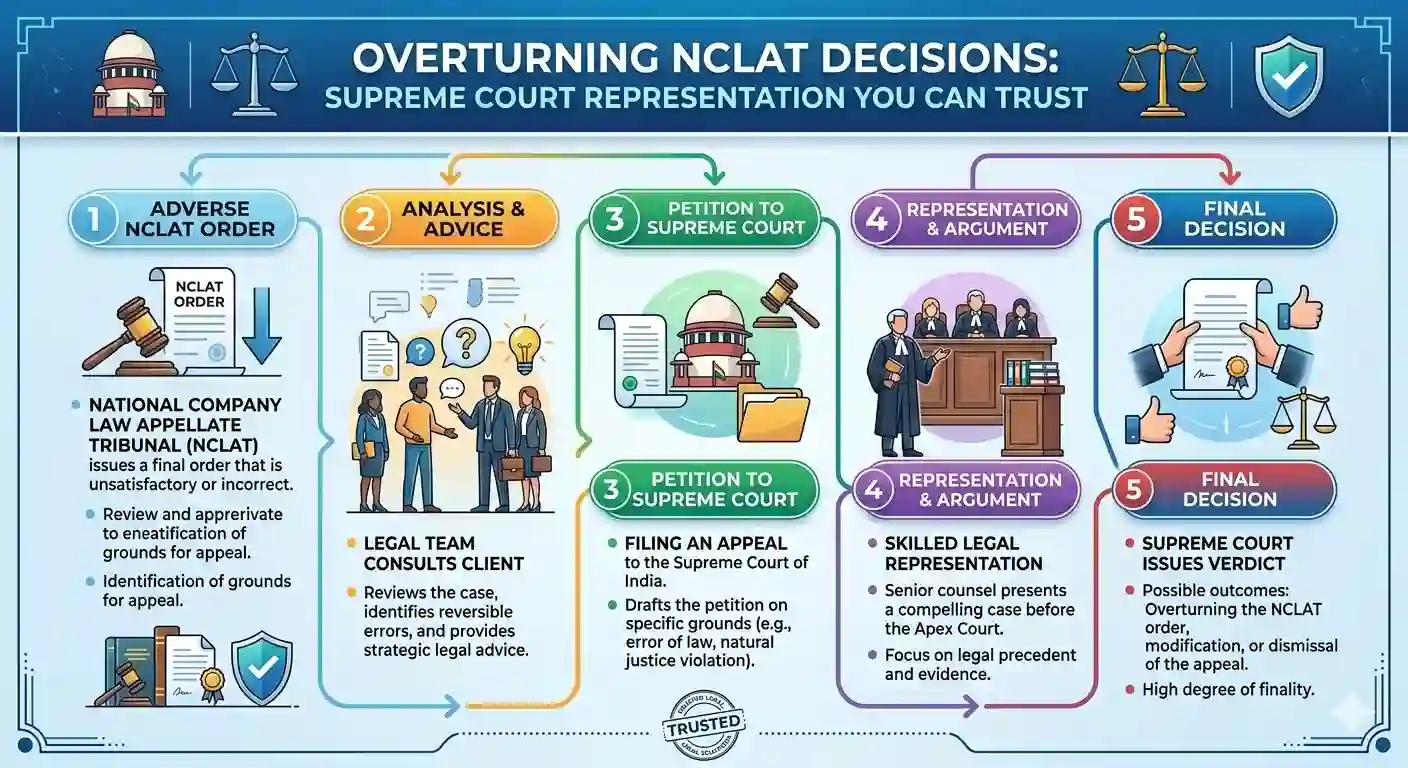
Overturning NCLAT Decisions: Supreme Court Representation You Can Trust

Overturning NCLAT Decisions – In the modern corporate and financial landscape, disputes between companies, creditors, shareholders, and stakeholders have become increasingly common. To handle such matters efficiently, India has established specialized tribunals that deal with corporate and insolvency issues. One of the most important among them is the National Company Law Appellate Tribunal (NCLAT).
The NCLAT hears appeals against decisions made by the National Company Law Tribunal (NCLT). However, even decisions of the NCLAT are not always final. In certain situations, parties may approach the Supreme Court of India to challenge or overturn these decisions.
Appealing to the Supreme Court is a complex legal process that requires deep legal knowledge, strategic preparation, and strong advocacy skills. Therefore, experienced legal representation becomes extremely important.
At LawyerChennai.com – Best Lawyer Firm in Chennai India 24×7, our experienced legal professionals provide trusted representation for clients seeking to challenge or overturn NCLAT decisions before the Supreme Court. Through careful legal strategy and dedicated advocacy, we help protect the rights and interests of our clients.
Overturning NCLAT Decisions: Supreme Court Representation You Can Trust – LawyerChennai.com – Best Lawyer Firm in Chennai India 24×7
Understanding the Role of NCLT and NCLAT
Before discussing Supreme Court appeals, it is important to understand how the corporate tribunal system works in India.
National Company Law Tribunal (NCLT)
The National Company Law Tribunal is the primary forum that deals with corporate disputes and insolvency matters. It handles cases related to:
- Corporate insolvency and bankruptcy
- Company law disputes
- Oppression and mismanagement claims
- Mergers and acquisitions
- Liquidation proceedings
The NCLT operates across several benches in India and serves as the first level of decision-making for many corporate matters.
National Company Law Appellate Tribunal (NCLAT)
If a party is dissatisfied with an NCLT order, they may file an appeal before the NCLAT. The NCLAT reviews the case and determines whether the NCLT decision was legally correct.
The tribunal may confirm, modify, or set aside the NCLT decision based on the evidence and legal arguments presented.
However, even after the NCLAT issues its decision, the matter may not necessarily end there.
When Can an NCLAT Decision Be Challenged?
Although NCLAT decisions carry significant authority, they can still be challenged before the Supreme Court under certain circumstances.
Typically, an appeal to the Supreme Court is allowed when there is a question of law involved. This means that the appellant must demonstrate that the NCLAT decision contains a legal error or misinterpretation of law.
Common reasons for challenging NCLAT decisions include:
- Incorrect interpretation of insolvency laws
- Procedural irregularities during hearings
- Violation of principles of natural justice
- Misapplication of legal provisions
- Errors in evaluating evidence
When such issues arise, the affected party may approach the Supreme Court for relief.
Importance of the Supreme Court in Corporate Appeals
The Supreme Court of India is the highest judicial authority in the country. Its decisions are final and binding on all lower courts and tribunals.
Therefore, when parties challenge NCLAT decisions before the Supreme Court, they are seeking the final resolution of the dispute.
The Supreme Court has the power to:
- Set aside NCLAT judgments
- Modify tribunal orders
- Clarify legal principles
- Provide directions for further proceedings
Because of the importance of these proceedings, careful legal preparation becomes essential.
Legal Procedure for Appealing Against NCLAT Decisions
The process of challenging an NCLAT decision in the Supreme Court involves several steps.
Filing a Civil Appeal
The first step is filing a civil appeal before the Supreme Court. The appellant must clearly explain the legal grounds for challenging the NCLAT order.
This appeal must be filed within the time period prescribed by law.
Preparing Legal Documents
The appeal must include relevant legal documents such as:
- Certified copies of the NCLT and NCLAT orders
- Case records and evidence
- Legal arguments explaining the grounds of appeal
These documents help the Supreme Court understand the background of the dispute.
Supreme Court Hearings
Once the appeal is admitted, the Supreme Court schedules hearings where lawyers from both sides present their arguments.
The court carefully examines the legal issues before issuing its final judgment.
Challenges in Supreme Court Appeals
Appealing against an NCLAT decision is not an easy task. The process involves several challenges.
Complex Legal Issues
Corporate and insolvency matters often involve complex legal frameworks. Understanding these laws requires specialized legal expertise.
Strict Procedural Requirements
The Supreme Court follows strict procedural rules. Missing deadlines or filing incomplete documents can weaken a case.
High-Level Legal Arguments
Since the Supreme Court focuses on legal questions rather than factual disputes, lawyers must present strong legal arguments supported by precedents and statutory provisions.
For these reasons, professional legal representation is essential.
Importance of Experienced Legal Representation
Experienced lawyers play a crucial role in Supreme Court appeals. Their expertise can significantly influence the outcome of the case.
At LawyerChennai.com – Best Lawyer Firm in Chennai India 24×7, our legal team provides strategic representation for clients challenging NCLAT decisions.
Our approach includes:
- Detailed legal analysis of tribunal orders
- Identification of strong legal grounds for appeal
- Preparation of comprehensive case documentation
- Strategic presentation of legal arguments
Through careful preparation, we help clients pursue justice at the highest level.
Common Types of Cases Appealed to the Supreme Court
Several types of corporate disputes may reach the Supreme Court after NCLAT decisions.
Insolvency and Bankruptcy Matters
Many appeals involve disputes under the Insolvency and Bankruptcy Code (IBC). These cases may concern creditor claims, resolution plans, or liquidation processes.
Corporate Governance Disputes
Disputes involving shareholder rights, oppression, and mismanagement may also be appealed.
Mergers and Corporate Restructuring
Cases involving corporate restructuring or merger approvals sometimes reach the Supreme Court if parties challenge tribunal decisions.
Regulatory Compliance Issues
Companies may challenge regulatory interpretations or compliance obligations decided by the tribunals.
Strategic Approach to Overturning NCLAT Decisions
Successfully overturning an NCLAT decision requires a carefully planned legal strategy.
Identifying Legal Errors
Lawyers carefully examine tribunal judgments to identify legal errors or inconsistencies.
Studying Legal Precedents
Supreme Court decisions often rely on earlier judgments. Legal professionals analyze relevant precedents to strengthen their arguments.
Building Strong Legal Arguments
A well-structured legal argument clearly explains how the NCLAT decision conflicts with legal principles or statutory provisions.
Presenting Effective Advocacy
Persuasive advocacy during hearings is essential for convincing the court to reconsider the tribunal’s decision.
Why Businesses Need Reliable Legal Support
Corporate disputes often involve significant financial and reputational stakes. An unfavorable tribunal decision can affect business operations, investor confidence, and long-term growth.
Therefore, businesses must seek reliable legal support when challenging such decisions.
Professional legal representation ensures that the appeal is presented effectively and that the company’s interests are protected.
Role of LawyerChennai.com in Supreme Court Appeals
At LawyerChennai.com – Best Lawyer Firm in Chennai India 24×7, we understand the complexities involved in corporate litigation and appellate proceedings.
Our legal team provides comprehensive services including:
- Legal consultation on NCLT and NCLAT matters
- Preparation of Supreme Court appeals
- Representation in complex corporate disputes
- Strategic legal advice for companies and investors
We focus on delivering professional, reliable, and result-oriented legal services.
Building Confidence in the Legal Process
Facing a tribunal decision that negatively affects a business can be discouraging. However, the legal system provides opportunities to challenge such decisions through appellate mechanisms.
With proper legal guidance, clients can approach the Supreme Court with confidence and pursue justice through lawful means.
A well-prepared appeal not only challenges the decision but also helps clarify important legal principles that shape corporate law in India.
Frequently Asked Questions
Yes, an order passed by the National Company Law Appellate Tribunal (NCLAT) can be challenged before the Supreme Court of India. However, such appeals are generally allowed only on questions of law. This means the appellant must show that the tribunal made a legal error, misinterpreted a statutory provision, or violated principles of natural justice.
Under the Insolvency and Bankruptcy Code, 2016, an appeal against an NCLAT order must typically be filed within 45 days from the date of the judgment. However, the Supreme Court of India may allow an additional limited extension if the appellant shows valid reasons for the delay. Filing within the prescribed time is very important because missing the deadline can weaken the case or lead to dismissal of the appeal.
Many appeals arise from disputes handled by the National Company Law Appellate Tribunal involving corporate and insolvency matters. Common examples include insolvency resolution disputes, creditor claims, approval or rejection of resolution plans, liquidation proceedings, and corporate governance conflicts.
To challenge an NCLAT decision before the Supreme Court of India, several important documents must be prepared and filed. These usually include certified copies of the orders issued by the National Company Law Tribunal and the National Company Law Appellate Tribunal, the memorandum of appeal explaining legal grounds, supporting evidence, case records, and relevant legal precedents.
Appeals before the Supreme Court of India involve complex legal questions and strict procedural requirements. Lawyers must carefully analyze the judgment of the National Company Law Appellate Tribunal, identify legal errors, and present well-structured arguments supported by statutory provisions and judicial precedents.
Conclusion
The National Company Law Appellate Tribunal plays a critical role in resolving corporate and insolvency disputes in India. However, when parties believe that an NCLAT decision contains legal errors, they have the right to challenge it before the Supreme Court.
Appealing to the Supreme Court requires careful legal preparation, strong arguments, and experienced representation. Without proper guidance, navigating this process can be extremely challenging.
At LawyerChennai.com – Best Lawyer Firm in Chennai India 24×7, we provide trusted legal representation for clients seeking to overturn NCLAT decisions. Our dedicated legal team works diligently to analyze cases, build effective strategies, and advocate for our clients at the highest level of the judicial system.
Read More
- How to Remove a Cell Phone Tower from a Damaged Building: 9 Legal Remedies in Chennai
- Draft Sale Deed: What Is the Fee for Drafting and Registering It in the Sub-Registrar Office?
- Gift Deed in India: Legal Process, Registration, Remedies, and Property Transfer Laws
- Supreme Court Appeals for NCLAT Judgments: Effective Legal Solutions
- Applying for SC Certificate for the New 1st Generation Certificate in India
- National Company Law Appellate Tribunal (NCLAT) – Official Portal