Company Refusing to Return Security Deposit? Legal Remedies, Civil Suit Process & Lawyer Help in Chennai

Many tenants, vendors, and service providers deposit security amounts with private limited companies during contracts. Problems begin when the company delays refund after termination or completion. Many companies rely on silence, procedural delays, or financial excuses to retain deposits. However, Indian law gives strong remedies for recovery of security deposits from companies. Affected individuals can initiate legal action through civil courts, tribunals, or statutory forums. The recovery process depends on contract terms, jurisdiction, and documentary evidence. Proper legal strategy improves chances of fast recovery and compensation. Lawyers usually evaluate agreements, invoices, and communication records before suggesting remedies. Courts in Chennai frequently handle disputes involving unpaid deposits by companies.
Legal assistance helps identify the correct forum and legal provisions. Furthermore, strategic notice drafting often resolves disputes without litigation. If companies still refuse payment, litigation under the Civil Procedure Code becomes necessary. Therefore, understanding legal remedies protects financial interests and discourages unfair corporate conduct. Business relationships remain protected when parties enforce legal rights confidently.
Need Legal Help for Recovery of Security Deposit from a Private Limited Company in India
Common Situations Where Companies Withhold Security Deposits
Security deposits arise in commercial leasing, vendor contracts, equipment supply agreements, and service engagements. Many companies promise refund after contract completion or property handover. Disputes arise when companies refuse payment citing vague damages or internal policy issues. Some companies attempt unilateral deductions without proper documentation or justification. In other cases, companies delay payment hoping the claimant abandons recovery efforts. Legal disputes frequently occur in commercial premises leases involving refundable deposits. Contract termination disputes also cause deposit recovery conflicts. Sometimes companies misuse arbitration clauses to delay refund obligations. Consequently, claimants must act promptly to protect their legal rights. Legal consultation helps identify the most effective remedy under Indian law. Lawyers also examine whether criminal breach of trust or cheating occurred. Early legal intervention usually increases settlement chances. Courts often favor claimants when contracts clearly require refund of deposits. Strong documentary evidence plays a decisive role during legal proceedings.
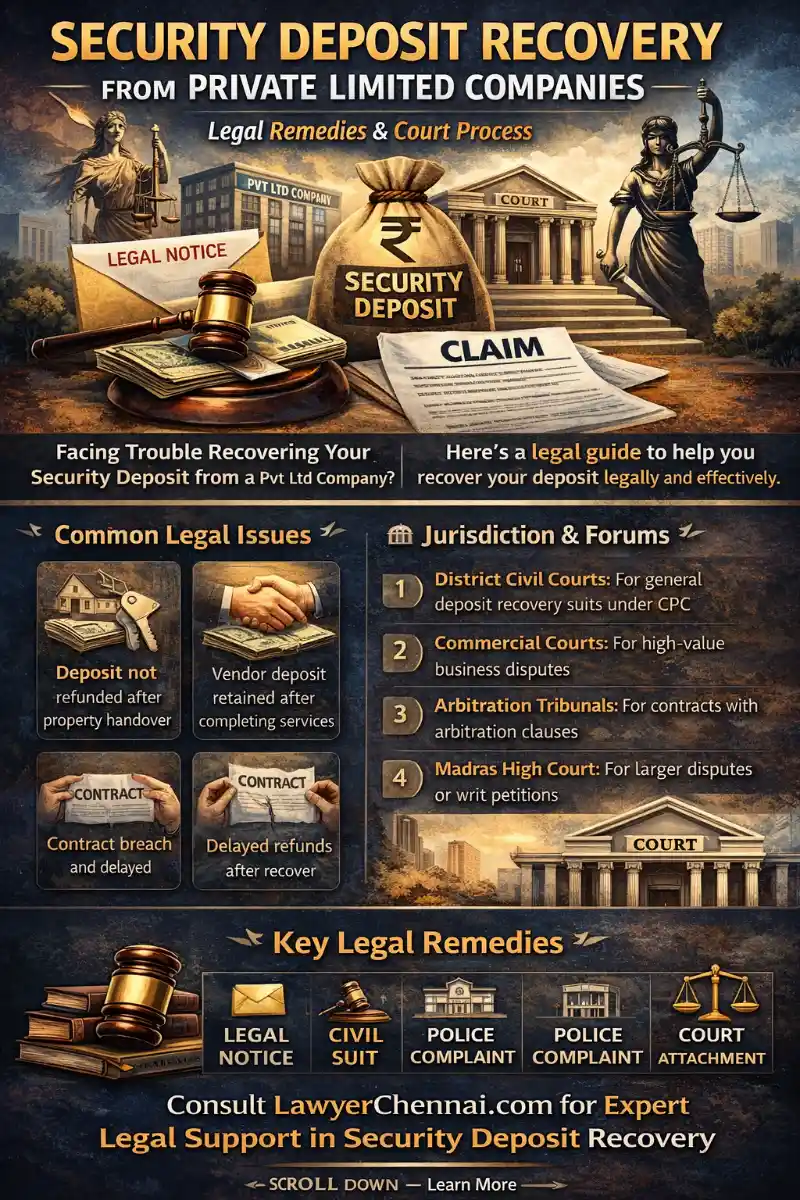
Typical Legal Issues in Security Deposit Recovery
Security deposit disputes often involve breach of contract and unjust enrichment by companies. Companies sometimes misinterpret contract clauses to justify deposit retention. Disagreements also arise regarding property damage, maintenance costs, or outstanding dues. Many disputes emerge from commercial lease agreements involving large refundable deposits. Contract termination disagreements frequently escalate deposit recovery conflicts. Businesses sometimes argue adjustment against alleged losses or penalties. However, such deductions require proof and contractual authority. Courts carefully examine contractual clauses and evidence before approving deductions. Furthermore, delay without valid reason may attract compensation or interest. Claimants may also allege criminal breach of trust when deposits remain intentionally withheld. Legal professionals analyze facts to determine whether civil or criminal remedies apply. Strategic case preparation improves recovery chances significantly. Proper jurisdiction selection also influences litigation speed. Consequently, claimants should document every communication and transaction carefully.
Examples of Legal Issues Frequently Reported
- Commercial lease security deposit not refunded after premises handover
- Vendor agreement deposit retained despite contract completion
- Service contract deposit withheld citing unverifiable damages
- Corporate maintenance deposit not returned after termination
- Equipment supply deposit withheld after project completion
- Employment related deposit withheld by corporate employers
Jurisdiction and Courts for Deposit Recovery Cases
Jurisdiction determines where claimants must file legal proceedings against the company. Generally, jurisdiction depends on contract location, company office, or cause of action. In Chennai, commercial disputes often reach the Madras High Court Commercial Division. Smaller monetary disputes usually proceed before District Civil Courts. Commercial Courts Act also governs high value business disputes. Furthermore, arbitration clauses may require proceedings before arbitral tribunals. Claimants should carefully review contract dispute resolution clauses before initiating litigation. Lawyers often determine jurisdiction based on registered office of the company. Courts consider location of contract execution and payment obligations. Choosing the correct forum prevents procedural delays and objections. Strategic forum selection also strengthens the claimant’s legal position. Therefore, experienced legal counsel becomes crucial in complex commercial disputes. Proper filing ensures efficient case progress and faster recovery.
Important Forums for Security Deposit Recovery
| Forum | Applicable Situation | Relevant Law |
|---|---|---|
| Civil Court | General recovery suits and contract disputes | Civil Procedure Code |
| Commercial Court | High value commercial contract disputes | Commercial Courts Act |
| Arbitration Tribunal | Contracts containing arbitration clauses | Arbitration and Conciliation Act |
| High Court | Large commercial disputes or writ remedies | Constitution of India |
Legal Remedies Available for Recovery of Security Deposits
Indian law offers several remedies when companies fail to refund security deposits. Civil recovery suits remain the most common legal approach. Claimants may seek refund, interest, and litigation costs through civil courts. Legal notice often becomes the first step before filing a lawsuit. Many companies settle disputes after receiving a strong legal notice. However, litigation becomes necessary when companies refuse compliance. Courts rely on written contracts, payment records, and communication evidence. Plaintiffs must clearly establish contractual obligation to refund deposits. Furthermore, claimants may also pursue criminal remedies if fraudulent intention exists. Police complaints sometimes apply when companies intentionally misappropriate deposits. However, courts usually treat deposit disputes as civil matters. Legal experts evaluate facts before choosing the appropriate strategy. Proper legal documentation significantly improves case outcomes.
Civil Recovery Suit under the Civil Procedure Code
A civil recovery suit represents the most structured legal remedy for deposit recovery. Plaintiffs file a suit seeking refund of security deposit with interest and costs. The Civil Procedure Code governs procedure for filing and trial. Plaintiffs must submit documentary proof including agreements, invoices, and payment receipts. Courts examine whether the company breached contractual refund obligations. Additionally, courts evaluate any deductions claimed by the company. If the court finds unjustified retention, it orders refund with interest. Interim applications may seek attachment of company assets during litigation. Such measures protect claimants against asset diversion. Civil suits also allow claimants to claim damages for wrongful retention. Strategic pleadings strengthen the plaintiff’s legal position significantly. Experienced legal drafting increases the chances of faster decree. Consequently, proper legal representation becomes essential.
Steps for Filing a Recovery Suit
- Review contract and identify refund clause
- Collect documentary evidence of deposit payment
- Issue legal notice demanding refund
- Prepare plaint under Civil Procedure Code
- File suit before competent jurisdiction court
- Present evidence and witness testimony
- Seek decree for refund with interest
Criminal Remedies under BNS and BNSS
In certain situations, criminal remedies may apply alongside civil proceedings. If companies intentionally misappropriate deposits, criminal offences may arise. The Bharatiya Nyaya Sanhita addresses offences such as cheating and criminal breach of trust. Victims may file complaints before jurisdictional police stations. Investigation procedures follow the Bharatiya Nagarik Suraksha Sanhita framework. Police may examine financial records and contractual documents during investigation. Courts evaluate whether dishonest intention existed during the transaction. Criminal proceedings sometimes pressure companies to settle disputes quickly. However, courts discourage misuse of criminal law for purely civil disputes. Legal counsel usually assesses evidence before recommending criminal complaints. Balanced legal strategy protects claimants from unnecessary litigation risks. Furthermore, civil recovery suits generally remain the primary remedy.
Nearby Authorities and Enforcement Agencies in Chennai
- Local jurisdictional Police Station for criminal complaints
- Economic Offences Wing for serious financial fraud cases
- District Civil Court for recovery suits
- Commercial Court for large business disputes
- Madras High Court for writ remedies
Role of Legal Notices in Deposit Recovery
Legal notices often resolve deposit disputes without lengthy litigation. A well drafted notice clearly demands refund within a specified period. Lawyers usually include contractual clauses and legal consequences within the notice. Companies often respond seriously when advocates issue formal notices. Moreover, notices establish documentary proof of demand before litigation. Courts frequently consider notice history during case evaluation. Early notice sometimes triggers negotiation or mediation discussions. Strategic wording improves chances of voluntary settlement. Legal notices also warn companies about possible civil and criminal action. Professional drafting ensures compliance with legal requirements. Consequently, many disputes resolve at the notice stage itself. This approach saves time, cost, and procedural complexity.
Key Elements of an Effective Legal Notice
- Clear description of deposit amount and contract terms
- Reference to breach of refund obligation
- Demand for refund within specific timeframe
- Warning of civil and criminal legal action
- Advocate signature and legal authority
Strategic Legal Support from Property and Commercial Lawyers
Experienced commercial lawyers play a crucial role in deposit recovery disputes. Lawyers analyze contracts and identify enforceable refund clauses. They also evaluate evidence including payment receipts and communications. Strategic legal advice helps choose the correct forum and remedy. Lawyers often attempt negotiation before initiating litigation. Many companies prefer settlement to avoid legal exposure. However, strong litigation strategy becomes essential when settlement fails. Lawyers draft plaints, petitions, and interim applications during litigation. They also represent clients before civil courts and commercial tribunals. Proper legal representation improves recovery prospects significantly. Moreover, legal professionals help claim interest and damages for wrongful retention. Professional guidance reduces procedural mistakes and delays. Consequently, engaging experienced advocates strengthens the claimant’s legal position.
Documents Required for Security Deposit Recovery Cases
Documentary evidence forms the backbone of deposit recovery litigation. Courts rely heavily on written agreements and financial records. Claimants must maintain detailed documentation during commercial transactions. Proper documentation reduces dispute complexity during litigation. Lawyers usually review documents before drafting legal notices or suits. Contracts often contain refund timelines and dispute resolution clauses. Payment receipts and bank statements confirm deposit transactions. Communication records also establish repeated refund requests. Furthermore, property handover documents may prove completion of contractual obligations. Organized documentation strengthens arguments before courts and tribunals. Claimants should preserve all digital and physical evidence carefully. Strong documentation improves chances of quick recovery and favorable judgment.
Important Documents for Legal Proceedings
- Lease or commercial agreement
- Security deposit payment receipts
- Bank transaction statements
- Email communication with the company
- Property handover or completion documents
- Legal notice copy and acknowledgment
Read More
- BUDS Act: Safeguarding Your Investments – Understanding Its Impact on Unregulated Deposits
- Consumer Court Lawyers in Chennai
- advocates For Company Law
- Unlocking Social Security Benefits: Trusted Lawyers in Chennai
- Recovery of Money Suit: How to find the Step-by-Step Legal Process?
Conclusion: Protecting Financial Rights against Corporate Deposit Disputes
Security deposit disputes with private limited companies frequently occur in commercial transactions. However, Indian law offers strong remedies to protect deposit payers. Civil suits under the Civil Procedure Code remain the primary recovery mechanism. Criminal provisions under the Bharatiya Nyaya Sanhita may apply in fraudulent cases. Strategic legal notices often resolve disputes without litigation. Courts evaluate contractual obligations and documentary evidence carefully. Therefore, proper documentation significantly strengthens recovery claims. Choosing the correct forum improves litigation efficiency and enforceability. Legal assistance ensures compliance with procedural and jurisdictional requirements. Experienced advocates also pursue compensation and interest for delayed refunds. Businesses and individuals must assert legal rights confidently when companies refuse refunds. Early legal intervention prevents financial loss and procedural complications. Ultimately, strong legal strategy ensures accountability and promotes fair commercial practices.
Frequently Asked Questions
Yes. You may file a civil recovery suit or issue a legal notice demanding refund with interest.
Civil courts, commercial courts, or arbitration tribunals may handle such disputes depending on contract terms.
Legal notice is not mandatory but strongly recommended. It often encourages settlement.
Yes. Criminal complaints may apply if cheating or breach of trust appears.
Timeline varies. However, commercial courts often resolve cases faster than ordinary civil courts.
Yes. Courts may award contractual or reasonable interest for delayed payment.
Written agreements, bank proof, communication records, and legal notices strengthen claims.
Yes. If the agreement contains an arbitration clause, arbitration becomes mandatory.
Yes. Courts may order attachment before judgment to secure recovery.
Lawyers determine the best legal strategy, jurisdiction, and evidence for effective recovery.