
Applying for SC Certificate for the New 1st Generation Certificate in India

Applying for a Scheduled Caste certificate as a first-generation applicant often creates confusion for many families. However, the process remains straightforward when the correct legal steps are followed. A first-generation SC certificate means no ancestor previously obtained a caste certificate. Therefore, verification must rely on genealogy, historical records, and community confirmation. Government authorities verify these claims through the Revenue Department and district administration. The Tahsildar office usually acts as the primary authority for issuing such certificates. Applicants must establish genuine caste identity under the Scheduled Castes list notified by the Government of India. Proper documentation significantly reduces delays and objections during verification. Additionally, digital portals have simplified submission procedures across several states including Tamil Nadu. The certificate helps applicants access constitutional safeguards, education reservations, and employment benefits. Consequently, families without historical certificates must carefully compile ancestral records before applying. Professional legal guidance often ensures proper documentation and prevents rejection of the application.
Understanding the Concept of a First Generation Scheduled Caste Certificate
A first-generation Scheduled Caste certificate is issued when no direct ancestor previously obtained caste certification. Such situations frequently occur in rural families where documentation never existed historically. Government authorities therefore rely on community verification and supporting evidence. The certificate confirms inclusion under the Constitution (Scheduled Castes) Order. Additionally, the caste must match the list applicable to the concerned state jurisdiction. Local administrative officers investigate the applicant’s lineage, residence, and community background. School records, land documents, and birth registers often support the claim. Furthermore, affidavits from community elders sometimes assist the verification process. The Revenue Department conducts field inspections through Village Administrative Officers. After verification, the Tahsildar forwards approval through the district administration system. Consequently, the applicant receives an official caste certificate recognized nationwide. This certificate enables access to reservation policies under Articles 15 and 16 of the Constitution. Therefore, understanding the legal foundation helps applicants prepare reliable documentation.
Legal Framework Governing SC Certificate Issuance in India
Several constitutional provisions govern the recognition of Scheduled Caste communities in India. Article 341 empowers the President to specify Scheduled Castes for each state. Parliament also holds authority to modify the notified list through legislation. Therefore, caste recognition depends strictly on statutory notification. State governments administer the certification process through the Revenue Department. The procedure is implemented under various state rules and executive instructions. Additionally, verification guidelines prevent misuse of reservation benefits. District Collectors supervise issuance through subordinate revenue officers. Scrutiny committees also examine disputed cases involving suspected false caste claims. Courts have repeatedly emphasized strict verification standards in caste certificate matters. The Supreme Court established guidelines in several landmark judgments addressing caste verification procedures. Consequently, applicants must ensure complete accuracy while submitting records. False claims may attract criminal prosecution and certificate cancellation. Hence, the legal framework strongly protects genuine beneficiaries while preventing fraudulent claims.
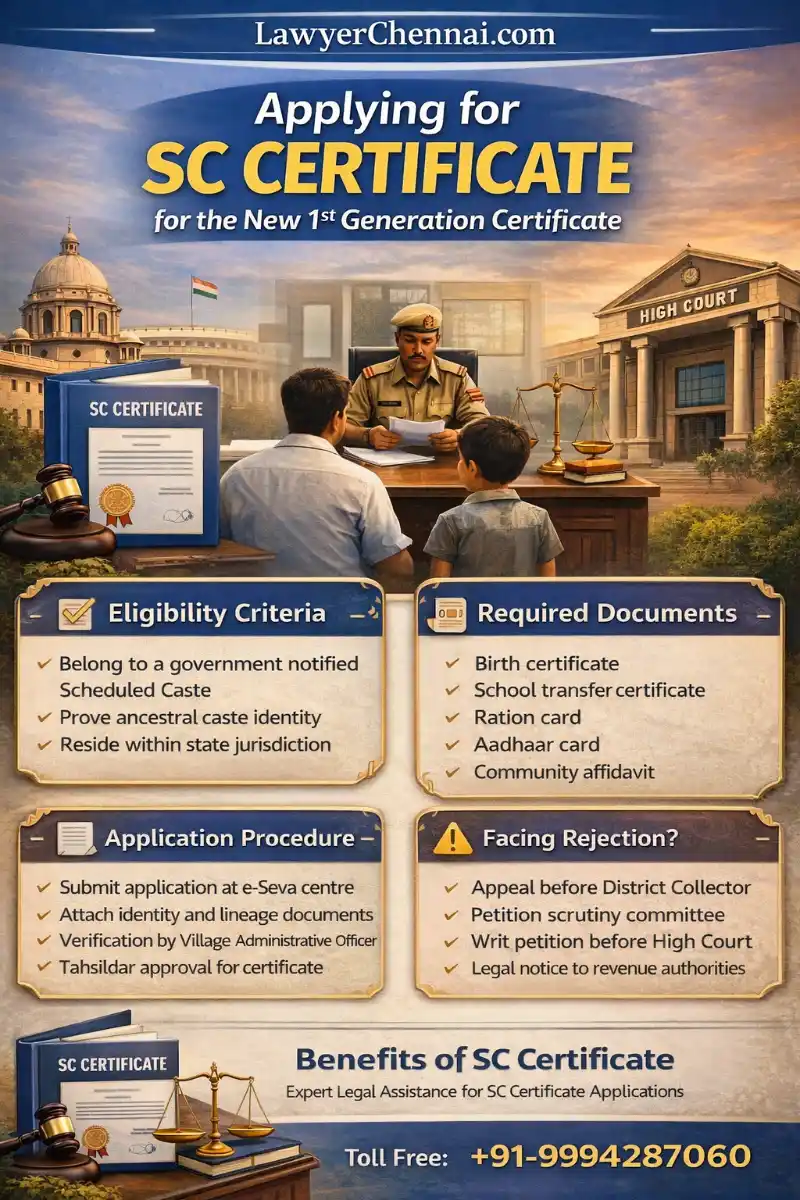
Authorities Responsible for Issuing the First Generation SC Certificate
Multiple government authorities participate in the caste certificate verification process. However, the Tahsildar office remains the primary authority responsible for issuing SC certificates. Applications are usually submitted through e-Seva centres or state government portals. Village Administrative Officers assist in verifying the applicant’s residence and community details. Revenue Inspectors may also conduct field inquiries when additional confirmation becomes necessary. District Collectors supervise the entire process through district revenue administration. Moreover, scrutiny committees evaluate complicated or disputed caste claims. These committees examine genealogical evidence and historical records thoroughly. If objections arise, applicants may present supporting documents before the committee. Additionally, legal appeals may be filed before the District Collector or competent appellate authority. Courts may intervene when administrative remedies fail. Consequently, applicants must understand which authority controls each stage of verification. This awareness helps applicants respond effectively during inspections and document verification procedures.
Eligibility Criteria for Applying First Generation SC Certificate
Applicants must satisfy several eligibility requirements before applying for a first-generation Scheduled Caste certificate. Firstly, the applicant must belong to a caste notified under the Scheduled Castes list. Secondly, the caste must correspond with the state where the certificate is requested. Additionally, the applicant must prove ancestral community identity through historical evidence. Local residence within the jurisdiction of the issuing authority must also be established. School records often provide early proof of caste identity. Family genealogy frequently supports the claim during administrative inquiry. Furthermore, statements from village elders may confirm the applicant’s caste background. Government authorities carefully evaluate these records before granting approval. Inconsistent information may trigger additional field verification. Consequently, applicants must prepare documents with complete accuracy and clarity. Legal consultation often becomes beneficial when records remain incomplete. Proper preparation significantly improves approval chances and reduces administrative delays.
Documents Required for Applying First Generation SC Certificate
Documentary evidence forms the most critical component of the first-generation caste certificate application process. Applicants must submit multiple documents establishing caste identity and lineage. Government authorities review these documents carefully during verification. Therefore, incomplete records frequently cause application rejection or prolonged delays. Essential documents usually include identity proof, residence proof, and ancestral records. School certificates often indicate caste identity recorded during admission. Birth certificates may also support genealogical verification. Land documents sometimes reveal community status recorded historically. Additionally, sworn affidavits may supplement missing documentary evidence. However, affidavits alone rarely satisfy the verification authority. Authorities generally prefer documentary proof originating from government records. Consequently, applicants must collect authentic records before submitting the application. Proper document organization also helps administrative officers complete verification efficiently. Therefore, preparing a structured document file significantly strengthens the application.
| Document | Purpose | Issuing Authority |
|---|---|---|
| Birth Certificate | Establish lineage | Municipality / Panchayat |
| School Transfer Certificate | Caste entry verification | School Authority |
| Ration Card | Family identity confirmation | Civil Supplies Department |
| Aadhaar Card | Identity verification | UIDAI |
| Community Affidavit | Supporting evidence | Notary / Magistrate |
Step by Step Procedure to Apply for First Generation SC Certificate
Applicants must follow a structured administrative procedure when applying for a first-generation Scheduled Caste certificate. Initially, the application form must be obtained through the state revenue portal or e-Seva centre. All required documents should be attached with the completed form. Authorities then register the application within the district revenue database. Subsequently, the Village Administrative Officer conducts a field verification. The officer confirms the applicant’s residence and community background. Revenue Inspectors may also participate during complex verification cases. The verification report is then forwarded to the Tahsildar for final approval. Additionally, digital systems track the application progress through online status updates. If discrepancies appear, clarification notices may be issued to the applicant. Consequently, timely responses help prevent application rejection. After successful verification, the Tahsildar issues the Scheduled Caste certificate digitally and physically. Therefore, applicants must maintain communication with revenue authorities throughout the verification process.
- Submit application through government portal or e-Seva centre
- Attach identity and ancestral documents
- Field verification by Village Administrative Officer
- Revenue Inspector verification if required
- Tahsildar approval and certificate issuance
Common Legal Issues Faced During First Generation SC Certificate Applications
Applicants frequently encounter several legal challenges during the first-generation caste certificate process. Documentary gaps often create the most significant obstacles. Many families lack historical records due to earlier administrative practices. Consequently, authorities may demand additional evidence verifying caste identity. Disputes sometimes arise when neighboring communities challenge the claim. Administrative officers may also request genealogical verification spanning several generations. Additionally, conflicting school records occasionally create verification difficulties. Authorities may suspend applications until inconsistencies are clarified. Moreover, fraudulent caste claims in earlier cases have increased verification scrutiny. Therefore, officials conduct more detailed inquiries before issuing certificates. Applicants may also experience delays caused by workload within revenue offices. In certain cases, rejection orders may be issued due to insufficient evidence. However, legal remedies remain available through administrative appeals and judicial review. Proper legal guidance helps applicants respond effectively to these procedural challenges.
Legal Remedies if SC Certificate Application is Rejected
Rejection of a caste certificate application does not end the applicant’s legal rights. Several remedies remain available within the administrative and judicial system. Initially, the applicant may file an appeal before the District Collector. The appeal must explain why the rejection decision was incorrect. Supporting documents should accompany the appeal petition. Additionally, applicants may request reconsideration based on newly discovered evidence. Scrutiny committees may review the case during appellate proceedings. If administrative remedies fail, judicial review may be sought before the High Court. Courts frequently examine whether the rejection violated principles of natural justice. Moreover, courts may order reconsideration when authorities ignore relevant evidence. Legal representation often strengthens such petitions. Consequently, applicants must act promptly after receiving rejection orders. Delay may weaken the legal challenge. Therefore, understanding available remedies ensures protection of genuine community rights.
- Appeal before District Collector
- Petition before State Level Scrutiny Committee
- Representation before Revenue Department
- Writ Petition before High Court
Role of Legal Professionals in First Generation Caste Certificate Cases
Legal professionals frequently assist applicants facing difficulties during caste certificate verification. Lawyers analyze documentary evidence supporting the applicant’s caste identity. They also identify missing documents and recommend appropriate alternatives. Additionally, advocates prepare affidavits and legal representations before revenue authorities. In complex disputes, lawyers may argue the case before scrutiny committees. Legal professionals also assist during appeals before District Collectors. Furthermore, constitutional remedies may be pursued through writ petitions before High Courts. Courts examine administrative decisions carefully in such matters. Legal arguments often emphasize constitutional rights and statutory provisions. Consequently, professional legal assistance strengthens the applicant’s position during disputes. Law firms experienced in revenue law and constitutional remedies offer strategic guidance. This support ensures procedural compliance throughout the verification process. Therefore, legal expertise often plays a decisive role in obtaining first-generation caste certificates successfully.
Importance of SC Certificate for Education, Employment and Welfare Benefits
Scheduled Caste certificates provide access to several constitutional benefits and welfare schemes. Educational institutions reserve seats for SC students under reservation policies. Government employment also includes reserved positions for eligible candidates. Additionally, scholarships support higher education opportunities for SC communities. Welfare programs often prioritize families belonging to Scheduled Castes. These programs include housing assistance, financial subsidies, and social welfare benefits. Moreover, SC certificates help protect individuals against discrimination. The Constitution guarantees equal opportunities for historically disadvantaged communities. Consequently, obtaining a valid caste certificate becomes essential for accessing these safeguards. Families without prior documentation must secure first-generation certificates to claim benefits. Therefore, proper legal awareness remains critical for marginalized communities. Administrative authorities play a significant role in ensuring fair access to these benefits. Consequently, efficient certification procedures strengthen social justice objectives under the Constitution.
Government Departments Involved in SC Certificate Issuance
| Department | Role | Jurisdiction |
|---|---|---|
| Revenue Department | Primary verification | District Administration |
| Tahsildar Office | Certificate issuance | Taluk Level |
| Village Administrative Office | Field verification | Village Jurisdiction |
| District Collector Office | Appellate authority | District Level |
| State Scrutiny Committee | Disputed caste verification | State Jurisdiction |
Conclusion
Obtaining a first-generation Scheduled Caste certificate requires careful preparation and accurate documentation. Applicants must understand the administrative verification process before submitting applications. Government authorities evaluate each claim through field inspections and documentary evidence. Consequently, incomplete records frequently delay the approval process. Legal guidance often helps applicants organize documents properly. Moreover, professional advice prevents avoidable procedural mistakes. Administrative remedies remain available when applications face rejection. Courts also protect genuine claimants through constitutional remedies. Therefore, applicants must remain proactive during verification and appeal stages. Access to caste certificates plays a crucial role in securing constitutional benefits. Education, employment, and welfare schemes depend heavily on proper certification. Consequently, the certification system supports social justice objectives across India. Families seeking first-generation certificates should approach the process with diligence and legal awareness. Accurate documentation and proper legal strategy significantly improve approval success.
Read more
- Real Estate & Property Law
- Police records for each offender cannot be translated: HC
- Passports (Amendment) Rules, 2025: Everything You Need to Know
- Appeals in Public Administrative Law: Handling public admin disputes in Supreme court
- How to Get Patta When There Is Objection in Tamil Nadu
Frequently Asked Questions
It is a caste certificate issued when no ancestor previously obtained a Scheduled Caste certificate.
The Tahsildar or competent revenue authority usually issues the Scheduled Caste certificate.
School records, birth certificates, genealogy documents, and community affidavits commonly support caste verification.
Yes. Most states provide online portals through e-Seva centres or revenue department websites.
Processing generally takes two to six weeks depending on verification complexity.
Applicants may file an appeal before the District Collector or approach the High Court.
Yes. Revenue officials normally conduct field verification before issuing caste certificates.
Affidavits support claims but rarely replace official documentary evidence completely.
Yes. However, caste recognition depends on the state-specific Scheduled Caste list.
Legal professionals ensure proper documentation and assist in appeals or court proceedings.