
Inheritance Dispute Appeals: Appealing inheritance-related matters

Inheritance Dispute Appeals: Appealing Inheritance-Related Matters – LawyerChennai.com
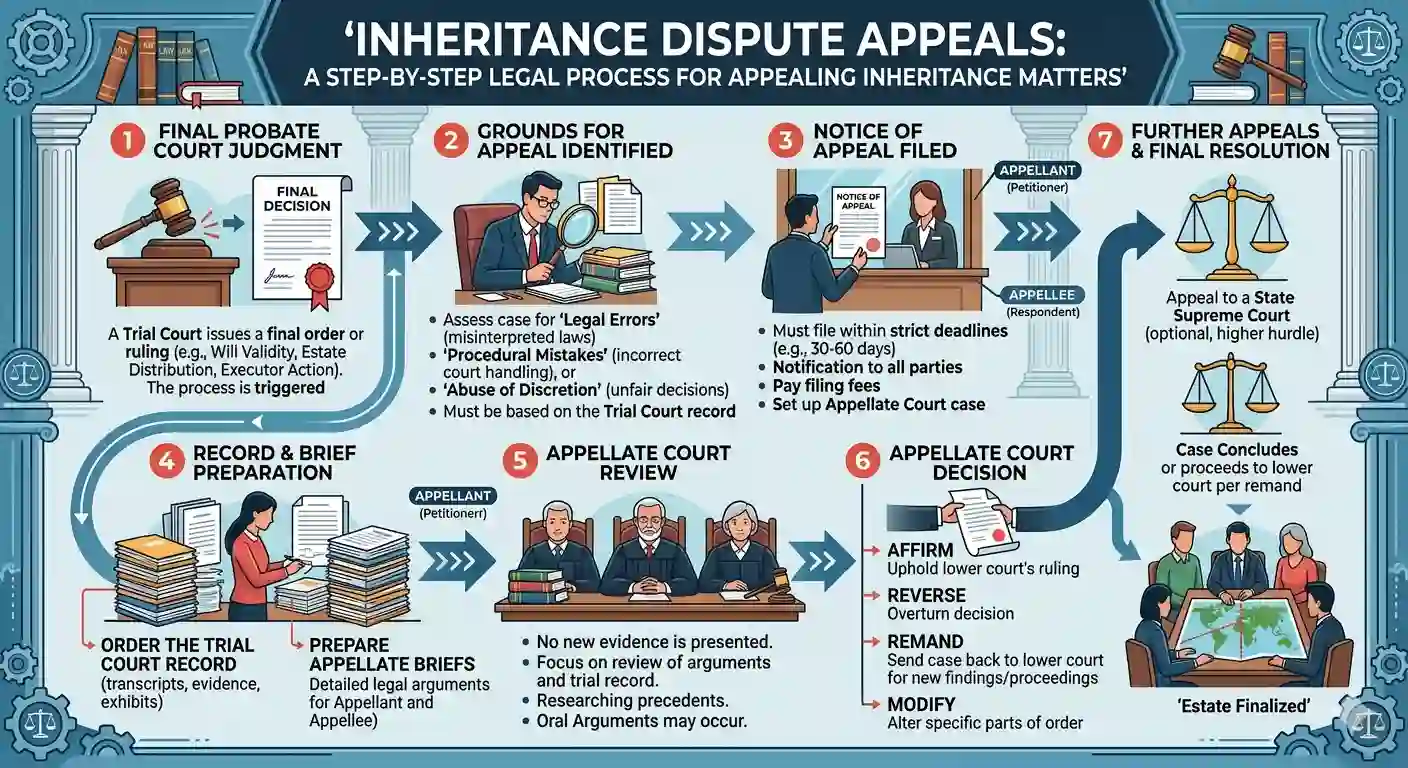
Important legal forums include:
- Civil Courts.
- Probate Courts.
- Revenue Divisional Offices.
- High Courts.
- Supreme Court of India.
| Applicable Law | Legal Purpose |
|---|---|
| CPC | Civil appeal procedures |
| BNSS | Criminal procedural safeguards |
| BSA | Evidence admissibility |
| Hindu Succession Act | Property succession |
| Indian Succession Act | Probate matters |
Consequently, skilled appellate advocacy significantly impacts inheritance dispute outcomes across India.
Common Causes Behind Inheritance Appeal Litigation
Inheritance appeals usually arise after dissatisfied parties challenge trial court judgments involving succession disputes. Consequently, appellate courts review procedural errors, evidentiary mistakes, and misinterpretation of succession laws. Family disputes frequently concern self-acquired property, joint family assets, and testamentary succession rights. Furthermore, NRIs commonly challenge illegal property occupation and fraudulent registrations affecting inherited assets. Courts regularly examine:
- Forged testamentary documents.
- Coercive will execution claims.
- Unregistered partition disputes.
- Benami transaction allegations.
- Illegal mutation entries.
Nearby authorities relevant during inheritance disputes include:
- Sub-Registrar Offices.
- Tahsildar Offices.
- Corporation Revenue Departments.
- Local Police Stations.
- District Legal Services Authorities.
Moreover, litigants increasingly rely upon digital evidence and forensic examination during inheritance appeal proceedings.
Importance Of Appellate Remedies In Succession Matters
Appellate remedies protect parties against erroneous judgments affecting valuable inheritance and succession rights. Therefore, appellate courts reassess evidence, legal interpretation, and procedural compliance carefully. High Courts possess extensive jurisdiction under CPC provisions governing first and second appeals. Furthermore, constitutional remedies remain available against arbitrary judicial or administrative actions. Inheritance disputes often involve emotional family conflicts and substantial financial consequences. Important appellate remedies include:
- First appeals.
- Second appeals.
- Civil revision petitions.
- Review petitions.
- Special Leave Petitions.
| Appellate Forum | Common Jurisdiction |
|---|---|
| District Court | First appeal |
| High Court | Second appeal |
| Supreme Court | Constitutional appeals |
| Revenue Tribunal | Mutation appeals |
Consequently, timely appeals help preserve ownership rights and prevent irreversible property alienation.
Role Of CPC, BNSS, And BSA In Appeal Proceedings
The Civil Procedure Code governs inheritance appeal procedures before civil appellate courts throughout India. Simultaneously, BNSS regulates criminal proceedings involving forgery, cheating, and criminal breach allegations. Bharatiya Sakshya Adhiniyam now governs evidentiary admissibility during inheritance litigation. Consequently, appellate courts increasingly analyze electronic records and forensic reports. Important evidence categories include:
- Registered wills.
- Audio recordings.
- Medical certificates.
- Bank transactions.
- Property tax records.
| Evidence Type | Legal Relevance |
|---|---|
| Medical records | Testamentary capacity |
| Video recordings | Execution authenticity |
| Revenue documents | Possession proof |
| Emails | Family communication |
Therefore, effective inheritance appeals require careful procedural strategy and comprehensive evidentiary preparation.
Appellate Courts And Legal Remedies In Inheritance Disputes
First Appeals Against Inheritance Judgments
First appeals allow litigants to challenge factual and legal findings issued by trial courts. Therefore, appellate courts reassess oral evidence, documentary records, and witness credibility comprehensively. Courts also evaluate procedural irregularities affecting inheritance dispute outcomes. Furthermore, appellate judges may reverse findings involving forged wills and unlawful property transfers. Common inheritance litigation grounds include:
- Incorrect evidence appreciation.
- Misinterpretation of succession laws.
- Ignoring material documents.
- Procedural irregularities.
- Fraudulent suppression allegations.
| Appeal Ground | Possible Relief |
|---|---|
| Forged will findings | Judgment reversal |
| Property exclusion | Partition relief |
| Fraud allegations | Fresh adjudication |
| Revenue mutation errors | Correction orders |
Additionally, appellate courts may grant interim injunctions protecting disputed inheritance properties during ongoing proceedings.
High Court Jurisdiction In Inheritance Appeals
High Courts exercise extensive jurisdiction over inheritance disputes through second appeals and constitutional remedies. Consequently, litigants challenge substantial legal errors affecting succession rights and probate findings. Courts examine whether lower courts properly interpreted inheritance statutes and evidentiary principles. Moreover, judges intervene where findings appear perverse or legally unsustainable. Important High Court remedies include:
- Stay orders.
- Property injunctions.
- Judgment modification.
- Remand directions.
- Record preservation orders.
Nearby legal institutions handling inheritance appeals include:
- Madras High Court.
- City Civil Courts Chennai.
- Family Courts Chennai.
- District Registrar Offices.
- Police Commissioner Offices.
Therefore, strategic appellate drafting substantially improves inheritance appeal success probabilities.
Probate Appeals And Testamentary Litigation
Probate disputes commonly arise after contested wills and suspicious testamentary document execution circumstances. Therefore, appellate courts carefully assess testamentary capacity and execution formalities. Courts also analyze attesting witness credibility and medical evidence relating to mental fitness. Furthermore, inheritance disputes frequently involve allegations of undue influence and coercion. Important probate dispute issues include:
- Suspicious signature variations.
- Medical incapacity claims.
- Exclusion of legal heirs.
- Unnatural property distribution.
- Forged witness attestations.
| Probate Issue | Judicial Examination |
|---|---|
| Mental capacity | Medical evidence |
| Signature dispute | Handwriting analysis |
| Witness contradictions | Credibility review |
| Delay in probate | Conduct analysis |
Consequently, probate appeals require detailed documentary scrutiny and persuasive legal submissions.
Criminal Complaints In Inheritance Fraud Matters
Inheritance disputes sometimes involve criminal allegations involving forgery, trespass, cheating, and document fabrication. Consequently, aggrieved heirs approach nearby police stations and criminal courts for legal protection. BNS provisions criminalize fraudulent property transactions and forged testamentary documentation. Furthermore, BNSS safeguards procedural fairness during inheritance-related criminal investigations. Common criminal allegations include:
- Forged settlement deeds.
- Illegal land grabbing.
- Fake power of attorney use.
- Threat and intimidation complaints.
- Criminal breach of trust.
Important enforcement authorities include:
- Economic Offences Wings.
- Cyber Crime Cells.
- Local Police Stations.
- District Crime Branches.
- Registration Departments.
Courts frequently coordinate civil and criminal proceedings involving inheritance property disputes.
Revenue Appeals And Mutation Disputes
Revenue authorities significantly influence inheritance disputes involving patta transfers and mutation entries. Therefore, appellate remedies exist against unlawful revenue decisions affecting inherited property rights. Litigants often challenge fraudulent mutation proceedings before Tahsildars and Revenue Divisional Officers. Moreover, appellate authorities examine title documents and succession certificates carefully. Important revenue appeal issues include:
- Illegal patta transfer.
- Joint ownership disputes.
- Encroachment allegations.
- Survey boundary conflicts.
- Tax assessment errors.
| Revenue Authority | Jurisdiction |
|---|---|
| Tahsildar | Mutation proceedings |
| RDO | Revenue appeals |
| District Collector | Revision authority |
| Survey Department | Boundary disputes |
Consequently, parallel civil litigation frequently accompanies inheritance-related revenue appeals throughout Tamil Nadu.
Interim Relief During Inheritance Appeal Proceedings
Interim relief remains crucial during inheritance appeals involving valuable immovable and ancestral properties. Consequently, litigants seek injunctions preventing alienation, demolition, or unlawful occupation during pending appeals. Courts balance competing ownership claims while preserving disputed assets. Furthermore, judges frequently appoint commissioners for property inspection and valuation purposes. Important interim remedies include:
- Temporary injunctions.
- Status quo orders.
- Receiver appointments.
- Police protection directions.
- Document preservation orders.
Nearby authorities assisting enforcement include:
- Jurisdictional Police Stations.
- Revenue Inspectors.
- Sub-Registrar Offices.
- Taluk Offices.
- Municipal Authorities.
Therefore, timely interim applications often prevent irreversible financial and legal consequences during inheritance litigation.
NRI Inheritance Appeals And Overseas Property Rights
NRIs frequently face inheritance fraud, illegal occupation, and forged transfer disputes involving Indian ancestral properties. Therefore, appellate courts increasingly address cross-border succession conflicts and overseas heir claims. Courts also examine power of attorney misuse and unauthorized property sales. Furthermore, digital hearings now assist NRIs participating from foreign jurisdictions. Important NRI inheritance issues include:
- Fraudulent sale deeds.
- Illegal tenancy claims.
- Forged signatures.
- Encroachment disputes.
- Probate objections.
| NRI Legal Issue | Available Remedy |
|---|---|
| Illegal occupation | Eviction proceedings |
| Forged transfer | Cancellation suit |
| Revenue mutation fraud | Appeal petition |
| Property threats | Police protection |
Consequently, specialized legal representation becomes essential for protecting overseas inheritance interests effectively.
Electronic Evidence In Inheritance Appeal Litigation
Electronic evidence increasingly determines inheritance appeal outcomes before Indian appellate courts. Therefore, Bharatiya Sakshya Adhiniyam provisions now play significant roles during appellate adjudication. Courts examine digital signatures, electronic communications, and online banking records carefully. Moreover, forensic examination frequently resolves authenticity disputes involving testamentary documents. Important electronic evidence includes:
- WhatsApp communications.
- CCTV recordings.
- Online banking statements.
- Email correspondence.
- Cloud-stored documents.
| Digital Record | Litigation Importance |
|---|---|
| Emails | Intent evidence |
| Bank records | Financial transactions |
| CCTV footage | Property possession |
| Audio files | Threat allegations |
Consequently, litigants should preserve electronic evidence immediately after inheritance disputes emerge.
Mediation And Settlement During Inheritance Appeals
Indian courts strongly encourage mediation during inheritance appeals involving prolonged family disputes. Consequently, many appellate courts refer parties toward mediation centers and Lok Adalats. Mediation reduces litigation expenses and preserves valuable family relationships. Furthermore, negotiated settlements often prevent future inheritance litigation among siblings and legal heirs. Important settlement terms commonly include:
- Property division arrangements.
- Monetary compensation.
- Joint ownership recognition.
- Possession schedules.
- Withdrawal of criminal complaints.
| Mediation Benefit | Practical Impact |
|---|---|
| Faster settlement | Reduced litigation |
| Confidential negotiations | Family privacy |
| Flexible solutions | Customized division |
| Reduced hostility | Relationship preservation |
Therefore, mediation frequently offers practical and financially beneficial inheritance dispute resolution opportunities.
Supreme Court Remedies Inheritance Appeal Matters
The Supreme Court remains the final appellate authority for substantial inheritance and succession disputes. Therefore, litigants file Special Leave Petitions challenging significant legal errors and constitutional violations. Courts examine broader legal principles affecting succession jurisprudence and property rights. Moreover, Supreme Court precedents guide inheritance adjudication across subordinate Indian courts. Important Supreme Court considerations include:
- Constitutional property protections.
- Interpretation of succession statutes.
- Probate jurisdiction disputes.
- Gender equality inheritance rights.
- Fraudulent transfer consequences.
Relevant institutions supporting litigants include:
- Supreme Court Legal Services Committee.
- National Legal Services Authority.
- State Bar Councils.
- Registration Departments.
- Revenue Administration Offices.
Consequently, strong appellate strategy and documentation significantly influence Supreme Court inheritance appeal outcomes.
Legal Strategy For Successful Inheritance Appeals
Successful inheritance appeals require disciplined legal strategy, documentary preparation, and timely procedural compliance. Consequently, litigants should preserve title documents, tax receipts, and communication records immediately. Lawyers also recommend early forensic analysis where forgery allegations exist. Furthermore, strategic appellate drafting helps identify substantial legal and factual errors persuasively. Important litigation practices include:
- Timely appeal filing.
- Evidence preservation.
- Witness preparation.
- Digital record authentication.
- Revenue document verification.
| Strategic Action | Legal Advantage |
|---|---|
| Early injunction filing | Property protection |
| Forensic examination | Fraud detection |
| Mediation participation | Settlement opportunities |
| Proper drafting | Strong appellate presentation |
Therefore, professional appellate representation substantially improves inheritance dispute resolution and property protection outcomes.
FAQs
Can inheritance judgments be appealed before High Courts?
Yes. Aggrieved parties may file first appeals, second appeals, or constitutional petitions before competent appellate courts.
What evidence helps inheritance appeal cases?
Registered wills, revenue records, medical documents, digital communications, and witness testimony strongly support inheritance appeals.
Can NRIs challenge fraudulent property transfers in India?
Yes. NRIs may challenge illegal transfers, forged documents, and unlawful occupation before Indian civil and criminal courts.
Which laws govern inheritance disputes in India?
Inheritance disputes involve CPC, BNS, BNSS, BSA, Hindu Succession Act, and Indian Succession Act provisions.
Can courts stop property sales during inheritance appeals?
Yes. Courts frequently grant injunctions and status quo orders preventing illegal sale or transfer during pending appeals.
Are criminal complaints possible during inheritance disputes?
Yes. Parties may file criminal complaints involving forgery, cheating, trespass, intimidation, and fabricated property documents.
Read More
- High Court Review Petitions: Seeking review of HC judgments
- Regulatory Authority Appeals: Appealing decisions by regulators
- Consumer Warranty Disputes: Handling disputes over warranties
- Public Law Challenges: Appealing public law decisions
- RTI & Grievance Redressal for CBIC Employees: DGHRD CBIC Service Law Guide 2026
- Department of Justice – Government of India