
RTI & Grievance Redressal for CBIC Employees: DGHRD CBIC Service Law Guide 2026
Government service comes with responsibility, discipline, and structure. At the same time, it also gives employees certain legal rights. However, many employees are not fully aware of how to use these rights effectively. As a result, issues related to service conditions, transfers, promotions, or disciplinary actions often remain unresolved. For employees of the Central Board of Indirect Taxes and Customs (CBIC), understanding Right to Information RTI & grievance redressal mechanisms is extremely important. These tools help ensure transparency, fairness, and accountability within the system.
At LawyerChennai.com – Best Lawyer Firm in Chennai India 24×7, we assist CBIC employees in navigating service law matters with clarity and confidence. In this guide, we explain how RTI and grievance redressal systems work and how you can use them effectively in 2026.
RTI & Grievance Redressal for CBIC Employees: DGHRD CBIC Service Law Guide 2026 – LawyerChennai.com
Understanding CBIC and DGHRD
The Central Board of Indirect Taxes and Customs (CBIC) is responsible for administering indirect taxes such as GST and customs duties. It functions under the Ministry of Finance.
Within CBIC, the Directorate General of Human Resource Development (DGHRD) plays a key role. It handles matters related to:
- Recruitment and training
- Transfers and postings
- Promotions and performance management
- Service records and employee welfare
Therefore, if you are a CBIC employee, many of your service-related concerns are connected to DGHRD processes.
What is RTI and Why It Matters
The Right to Information (RTI) Act allows citizens to seek information from public authorities. This includes government departments like CBIC.
For employees, RTI becomes a powerful tool. It helps you:
- Access service records
- Understand decisions affecting your career
- Verify rules and policies
- Ensure transparency in administrative actions
Instead of relying on assumptions, you can obtain official information directly.
When Should CBIC Employees Use RTI?
RTI is useful in several situations. For example:
- When promotion lists are unclear
- When transfer policies are not properly followed
- When disciplinary actions lack transparency
- When service records contain discrepancies
However, RTI should be used carefully. It is meant for seeking information, not for raising complaints.
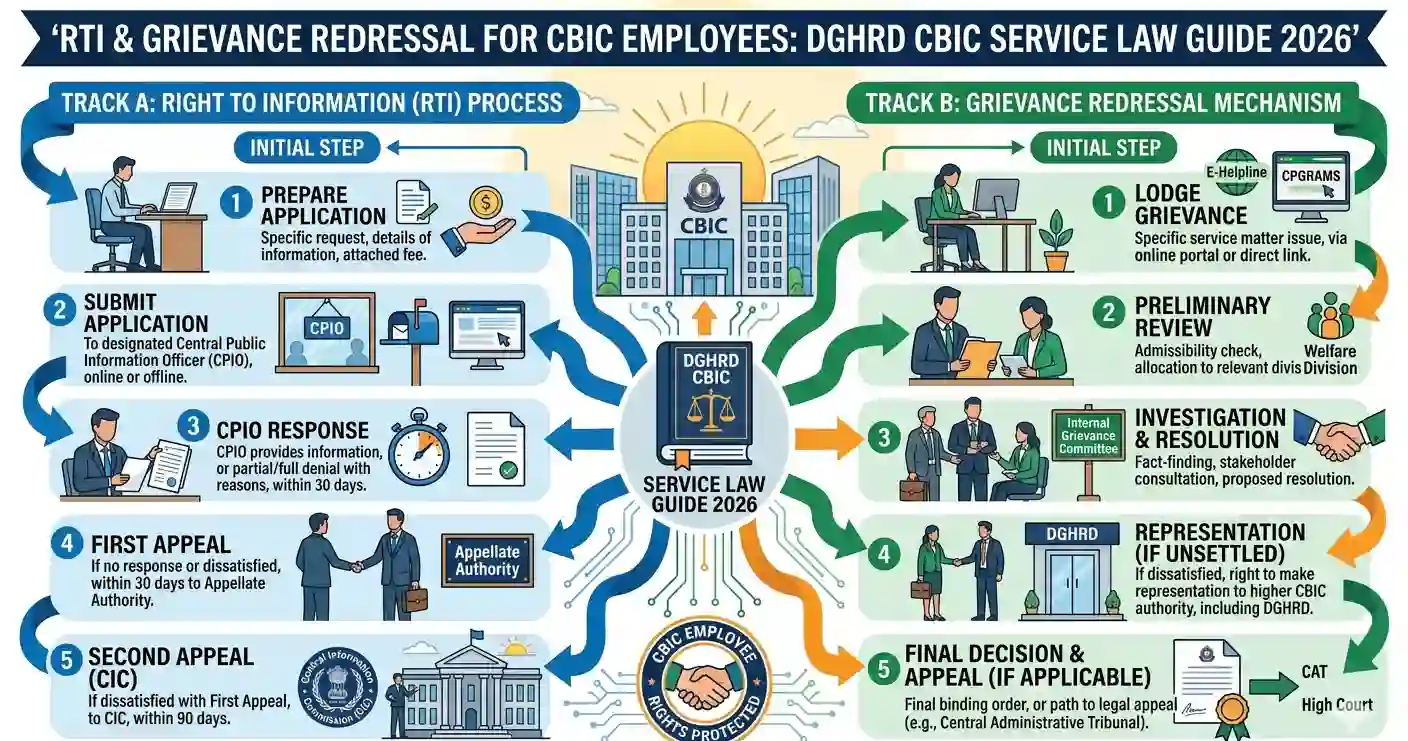
How to File an RTI Application
Filing an RTI application is a simple process. Still, it requires clarity and precision.
Step 1: Identify the Public Authority
First, determine the correct department within CBIC or DGHRD.
Step 2: Draft the Application
Write a clear and specific request. Avoid vague or lengthy questions.
Step 3: Pay the Prescribed Fee
Submit the required application fee as per rules.
Step 4: Submit the Application
You can file RTI online or offline.
Step 5: Wait for Response
The authority must respond within the prescribed time, usually 30 days.
Common Mistakes in RTI Applications
Many employees make avoidable mistakes while filing RTI.
- Asking questions instead of seeking information
- Submitting unclear or broad requests
- Filing repeated or unnecessary applications
Therefore, proper drafting is essential for effective results.
Grievance Redressal Mechanism in CBIC
While RTI provides information, grievance redressal systems address complaints.
CBIC employees can raise grievances related to:
- Transfers and postings
- Promotions and seniority
- Salary and service benefits
- Workplace issues
These grievances are handled through structured mechanisms within the department.
Role of CPGRAMS in Grievance Redressal
The Centralized Public Grievance Redress and Monitoring System (CPGRAMS) is an online platform for filing complaints.
Through this system, employees can:
- Submit grievances
- Track complaint status
- Receive responses from authorities
It ensures accountability and timely resolution.
Internal Departmental Remedies
Before approaching external forums, employees should use internal remedies.
These include:
- Representations to senior officers
- Departmental appeals
- Review petitions
Using internal channels first often leads to faster resolution.
When to Approach Legal Forums
If grievances remain unresolved, legal action may be necessary.
Employees can approach:
- Central Administrative Tribunal (CAT)
- High Courts
However, legal proceedings require proper documentation and strategy. Therefore, professional legal assistance becomes essential.
Importance of Documentation
Strong documentation is the foundation of any service law case.
Keep records such as:
- Appointment letters
- Promotion orders
- Transfer orders
- Salary slips
- Official communications
These documents support your claims and strengthen your case.
Balancing RTI and Grievance Mechanisms
RTI and grievance redressal serve different purposes. However, they complement each other.
For example:
- Use RTI to gather information
- Use grievance systems to seek remedies
By combining both, you can build a strong and effective approach.
Challenges Faced by CBIC Employees
Despite available systems, employees often face challenges.
Lack of Awareness
Many employees are not aware of their rights and procedures.
Delays in Response
Sometimes, responses from authorities are delayed or incomplete.
Complex Procedures
Legal and administrative processes can be complicated.
Fear of Retaliation
Some employees hesitate to raise issues due to fear of consequences.
How Legal Assistance Helps
Professional legal support can make a significant difference.
Proper Guidance
Lawyers explain procedures clearly and help you choose the right approach.
Drafting Effective Applications
Well-drafted RTI applications and grievances improve chances of success.
Representation in Legal Forums
If needed, lawyers represent you before tribunals and courts.
Strategic Planning
Legal experts help you plan your case step by step.
How LawyerChennai.com Can Support You
At LawyerChennai.com – Best Lawyer Firm in Chennai India 24×7, we specialize in service law matters.
We assist CBIC employees with:
- RTI drafting and filing
- Grievance submission and follow-up
- Service law advisory
- CAT and court representation
- Documentation and case preparation
We focus on practical solutions. Our goal is to resolve issues efficiently while protecting your rights.
Tips for CBIC Employees
To handle service law issues effectively, follow these tips:
- Stay informed about rules and policies
- Keep records of all official communications
- Act promptly when issues arise
- Use RTI wisely and responsibly
- Seek legal advice when needed
These steps can help you avoid complications and protect your career.
Why Timely Action Matters
Delays can weaken your case. For example, late appeals may be rejected.
On the other hand, timely action ensures:
- Strong legal position
- Better chances of resolution
- Reduced stress and uncertainty
Therefore, do not wait until the problem becomes serious.
Frequently Asked Questions
RTI allows CBIC employees to access official information related to service matters such as promotions, transfers, seniority lists, and disciplinary actions. It promotes transparency and helps employees verify whether rules and procedures are properly followed. Therefore, RTI is a powerful tool for ensuring fairness within the department.
A CBIC employee can file a grievance through internal departmental channels or online platforms like CPGRAMS. First, the employee should submit a written representation to the concerned authority. If the issue is not resolved, it can be escalated through proper channels. Clear documentation and timely action improve the chances of resolution.
RTI is used to obtain information from public authorities, while grievance redressal is used to seek solutions for complaints. In simple terms, RTI helps you understand the issue, and grievance mechanisms help you resolve it. Both tools work together for effective service law remedies.
If internal remedies and grievance mechanisms fail to resolve the issue, the employee can approach legal forums such as the Central Administrative Tribunal. However, this step should be taken after proper preparation and legal consultation to ensure a strong case.
Legal experts help in drafting RTI applications, filing grievances, and representing employees before tribunals or courts. They also provide strategic advice and ensure compliance with legal procedures. As a result, professional support increases the chances of successful and timely resolution.
Conclusion
RTI and grievance redressal mechanisms are powerful tools for CBIC employees. They promote transparency, accountability, and fairness in service matters.
However, using these tools effectively requires knowledge, planning, and proper guidance. By understanding the system and taking timely action, you can protect your rights and resolve issues efficiently.
At LawyerChennai.com – Best Lawyer Firm in Chennai India 24×7, we are committed to supporting you at every step. Whether you need help with RTI, grievance redressal, or legal proceedings, our team is here to assist you.
Do not let service-related issues affect your career. Take control, seek guidance, and move forward with confidence.
Read More
- CBIC Civil List & Seniority Disputes 2026: Legal Remedies for IRS Officers
- Legal Support for Compassionate Job | Expert Guidance for Dependent Employment Rights
- 7th CPC Recruitment Rules Amendments CBIC 2026: Complete Legal Overview
- Pending CBIC Cadre Review 2026: How It Affects IRS Officers & Group B Posts
- Real Estate Lawyers in Chennai: Expert Property Legal Services
- Central RTI Online Portal (Government of India)