Partition suit Advocates: How to find the Best Property Lawyers?

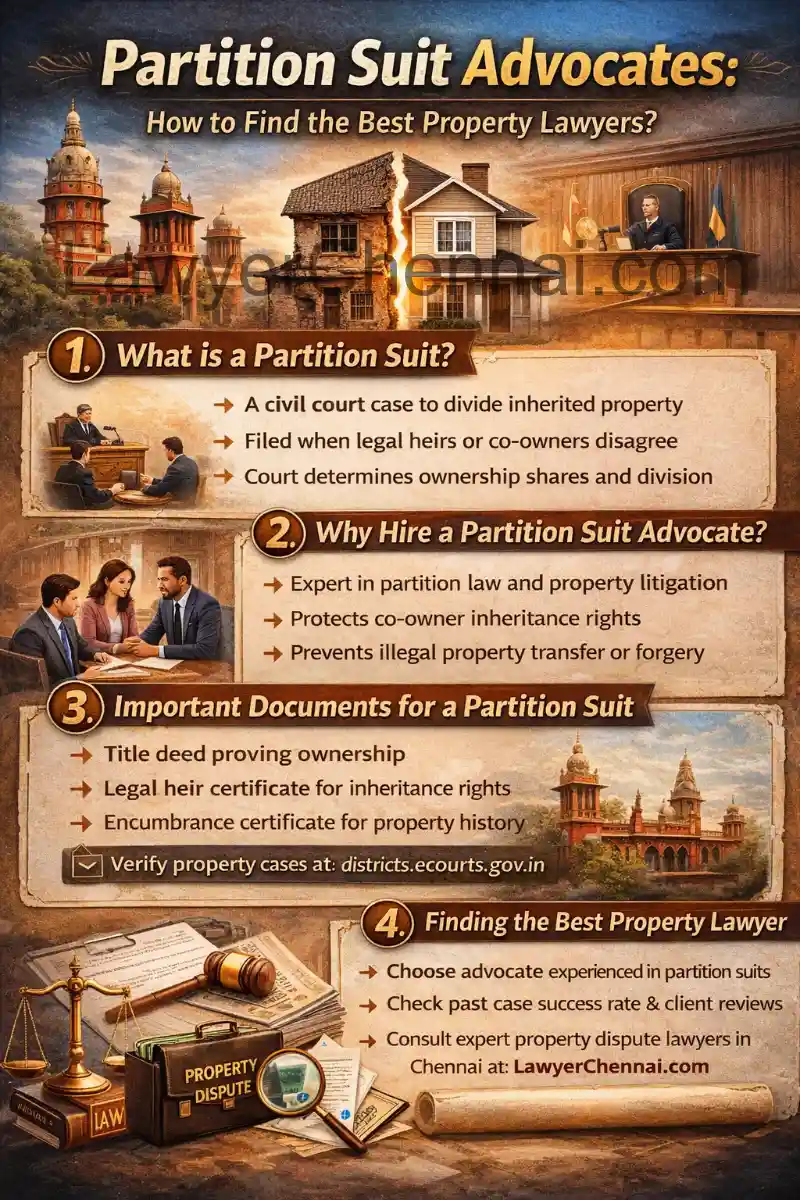
What is a property partition? Where do you need partition suit advocates? When there is a dispute between legal heirs or joint owners, property must be divided legally. Property disputes frequently arise within families that share inherited land or buildings. Therefore, courts provide structured remedies through a partition suit under civil law. Partition suit advocates guide families through legal procedures and property documentation. Moreover, experienced property dispute lawyers protect ownership rights during litigation. In Chennai, property litigation often involves ancestral property, joint ownership conflicts, and inheritance disputes. Consequently, individuals seek the best property lawyer in Chennai for guidance. Reliable advocates help file cases in civil courts and higher forums. Furthermore, strong legal strategy prevents fraudulent sale or illegal mutation of shared assets.
- Partition disputes between siblings
- Joint ownership land conflicts
- Ancestral property inheritance disputes
- Encroachment by co-owners
- Identify ownership shares
- Attempt family settlement
- Prepare partition deed
- File partition suit in civil court
Partition Suit Advocates and Property Lawyers in Chennai

Partition suits play a major role in resolving property inheritance disputes across India. Families often disagree about property shares after the death of parents. Consequently, unresolved conflicts escalate into civil litigation. Experienced partition suit advocates help determine legal rights and property shares. Furthermore, property litigation Chennai frequently involves ancestral property, joint family property, and inherited buildings. Lawyers prepare pleadings according to the Civil Procedure Code. They also analyze title documents, revenue records, and registration deeds. Therefore, selecting the best property lawyer Chennai becomes essential for success. Courts examine ownership evidence, property possession, and historical title records.
- Title deed verification
- Encumbrance certificate analysis
- Revenue record verification
- Property tax records review
| Legal Issue | Legal Remedy |
| Inheritance dispute | Partition suit |
| Illegal sale | Cancellation of deed |
| Encroachment | Injunction |
Property Partition and Family Disputes

Family property disputes usually arise when legal heirs disagree about property ownership shares. Therefore, the law provides structured solutions through partition litigation. Partition Act 1893 governs division of jointly owned properties in India. Moreover, civil courts supervise the division when parties cannot reach settlement. Property dispute lawyers examine inheritance documents and property records carefully. Additionally, advocates review wills, gift deeds, and settlement deeds. Chennai courts handle thousands of property disputes every year. Consequently, property litigation Chennai requires experienced advocates who understand procedural law. Lawyers must follow Civil Procedure Code provisions while drafting plaints.
- Partition between brothers
- Dispute among legal heirs
- Property ownership conflict
- Joint family property division
- Consult property lawyer
- Verify property documents
- Issue legal notice
- File partition suit
Understanding Partition Deeds and Property Division
A partition deed legally records the division of jointly owned property. Therefore, each co-owner receives a defined share after registration. Families often create a registered partition deed to avoid litigation. However, disputes still arise when parties disagree about shares. Consequently, courts intervene to determine ownership rights. Partition deed lawyer Chennai services help draft legally valid documents. Lawyers also ensure proper registration at the Sub-Registrar Office. Additionally, the document must comply with registration laws and stamp duty rules. Therefore, property owners must follow formal legal procedures carefully.
- Registered partition deed
- Family settlement deed
- Release deed
- Settlement agreement
| Document | Purpose |
| Partition Deed | Divide property legally |
| Release Deed | Relinquish share |
| Settlement Deed | Transfer property rights |
Land or Building Partition Litigation

Land or building partition disputes commonly reach civil courts across India. Therefore, litigants must follow procedural law carefully. Partition litigation often involves ancestral land, residential buildings, or commercial properties. Moreover, courts analyze revenue records, title deeds, and historical ownership documents. Property dispute lawyers present documentary evidence during hearings. Consequently, judges determine ownership shares based on evidence and inheritance law. Courts may appoint a commissioner to divide property physically. Furthermore, legal disputes sometimes include fraudulent sale or illegal transfer. In such situations, advocates seek cancellation of fraudulent documents.
- Ancestral land disputes
- Joint family property conflicts
- Illegal property sale
- Encroachment by relatives
- Draft partition plaint
- File suit before civil court
- Serve summons to defendants
- Proceed with trial
Partition Act 1893 and Civil Procedure Code
The Partition Act 1893 regulates division of jointly owned property through court intervention. Therefore, courts apply statutory principles while deciding partition disputes. Additionally, the Civil Procedure Code governs procedural aspects of civil litigation. Lawyers rely on these provisions while filing partition suits. Moreover, courts examine documentary evidence under Bharatiya Sakshya Adhiniyam. Criminal intimidation or property fraud may trigger provisions under Bharatiya Nyaya Sanhita. Consequently, police complaints may accompany civil litigation in serious disputes. Legal strategy must integrate both civil and criminal remedies.
- Partition Act 1893 provisions
- Civil Procedure Code rules
- Bharatiya Nyaya Sanhita provisions
- Bharatiya Sakshya Adhiniyam evidence rules
| Law | Purpose |
| Partition Act | Property division |
| CPC | Civil procedure |
| BSA | Evidence rules |
Property Dispute Legal Framework in India
Property disputes require a structured legal framework to protect ownership rights. Therefore, Indian law regulates partition suits through several statutes and procedural rules. The Civil Procedure Code governs filing procedures, pleadings, and trial stages in civil courts. Moreover, the Partition Act 1893 allows courts to divide jointly owned properties among co-owners. Courts examine ownership evidence according to Bharatiya Sakshya Adhiniyam. Consequently, documentary proof plays a major role in property litigation Chennai. Revenue records, sale deeds, and settlement deeds establish ownership history. Additionally, criminal provisions under Bharatiya Nyaya Sanhita may apply when fraud or intimidation occurs. Legal professionals therefore combine civil and criminal remedies strategically. Proper legal representation improves the chances of obtaining a fair partition decree.
- Civil Procedure Code governs suit filing
- Partition Act regulates division of property
- Bharatiya Sakshya Adhiniyam governs evidence
- Bharatiya Nyaya Sanhita addresses fraud or threats
| Legal Authority | Function |
| Civil Courts | Partition litigation |
| Sub-Registrar Office | Property registration |
| Revenue Authorities | Land records verification |
Common Legal Issues in Partition Suits
Partition litigation usually arises when family members disagree about property ownership shares. Therefore, property dispute lawyers often handle complex inheritance conflicts and title disputes. Joint ownership frequently creates uncertainty about property possession rights. Moreover, ancestral property disputes involve multiple legal heirs across generations. Consequently, courts must determine lawful shares before dividing assets. Lawyers review documents such as wills, settlement deeds, and previous registrations. However, some cases involve forged documents or fraudulent transfers. Property litigation Chennai therefore requires experienced advocates with investigative skills. Courts may also appoint a commissioner to measure property and determine division feasibility. Additionally, litigants often request injunction orders to prevent illegal sale of disputed property.
- Ancestral property disputes among siblings
- Joint ownership disagreements
- Illegal mutation of land records
- Encroachment by co-owners
- Forgery of property documents
- Identify co-owners and heirs
- Verify title documents
- Send legal notice to parties
- Initiate civil litigation
Fraudulent Transfer of Joint Property
Fraudulent transfer of joint property often triggers serious litigation in civil courts. Therefore, co-owners must monitor property transactions carefully. Sometimes one heir sells joint property without consent from other legal heirs. Consequently, such transfers become legally challengeable in partition suits. Property dispute lawyers file cancellation suits against fraudulent sale deeds. Moreover, courts examine registration records and witness testimony during trial. Legal experts also review encumbrance certificates obtained from the Sub-Registrar portal. Additionally, police complaints may arise under Bharatiya Nyaya Sanhita provisions when fraud occurs. Civil courts simultaneously consider ownership rights and fraudulent transactions. Therefore, victims must approach experienced property lawyers immediately.
- Unauthorized sale of joint property
- Forgery of signatures on sale deeds
- Illegal registration of disputed property
- Misrepresentation of ownership rights
| Fraud Type | Legal Remedy |
| Forged sale deed | Cancellation suit |
| Illegal registration | Injunction order |
| Fraudulent mutation | Revenue appeal |
Inheritance Conflicts and Legal Heir Rights
Inheritance conflicts often trigger family litigation regarding ancestral property. Therefore, determining legal heir rights becomes essential in partition suits. Hindu Succession law governs inheritance rights among family members. Moreover, daughters and sons possess equal rights in ancestral property. Consequently, property litigation Chennai frequently involves disputes among siblings and extended relatives. Courts examine succession certificates, legal heir certificates, and family records. Additionally, lawyers verify revenue documents issued by Tahsildar offices. Proper documentation strengthens claims during trial proceedings. However, disputes intensify when heirs live in different locations. Courts may therefore encourage mediation before conducting a full trial.
- Disputes between siblings
- Claims by distant relatives
- Multiple marriages creating heirs
- Unregistered wills causing confusion
- Obtain legal heir certificate
- Verify ancestral ownership records
- Consult property dispute lawyer
- File partition claim in civil court
Document Verification in Property Litigation
Document verification forms the foundation of every successful partition suit. Therefore, property lawyers conduct detailed due diligence before filing cases. Title deeds establish ownership history across generations. Moreover, encumbrance certificates reveal mortgages or prior transactions on property. Lawyers also inspect patta records and land survey documents. Consequently, accurate verification prevents fraudulent claims during litigation. Courts rely heavily on documentary evidence under Bharatiya Sakshya Adhiniyam rules. Advocates often collect records from the Sub-Registrar Office and revenue departments. Furthermore, digital court databases help lawyers track ongoing litigation related to disputed properties. Parties may verify case details through e-Courts services.
- Title deed verification
- Encumbrance certificate review
- Patta and revenue records
- Property tax receipts
| Document | Authority |
| Sale Deed | Sub-Registrar Office |
| Patta | Tahsildar Office |
| Encumbrance Certificate | Registration Department |
Civil Courts and Jurisdiction in Partition Suits
Civil courts handle most partition litigation involving family property disputes. Therefore, jurisdiction depends on the location of the disputed property. Property dispute lawyers normally file the suit before the appropriate district civil court. Moreover, the Civil Procedure Code determines territorial and pecuniary jurisdiction for such cases. Courts examine ownership documents before admitting the suit. Consequently, litigants must present title deeds and revenue records carefully. Property litigation Chennai usually begins before district civil courts. However, appeals may later reach the Madras High Court. Judges evaluate documentary evidence, witness testimony, and legal submissions. Courts may also issue interim orders to protect disputed property during trial. Consequently, legal representation becomes essential for effective litigation strategy.
- District civil courts hear partition suits
- Jurisdiction depends on property location
- Appeals reach higher courts
- Civil Procedure Code governs proceedings
| Court Level | Role in Partition Suit |
| District Civil Court | Trial stage |
| High Court | Appeals and revisions |
| Supreme Court | Final appeal |
Madras High Court Property Litigation
The Madras High Court plays an important role in property litigation Chennai. Therefore, appeals from civil courts frequently reach this constitutional court. Senior advocates argue complex property disputes before High Court benches. Moreover, the court reviews procedural errors and legal interpretations made by lower courts. Consequently, High Court judgments shape property law across Tamil Nadu. Lawyers often rely on precedents while presenting arguments. Additionally, the High Court supervises subordinate courts through revision jurisdiction. Property dispute lawyers therefore prepare detailed case records before filing appeals. Litigants may verify case status through the official portal of the Indian judiciary system. Effective advocacy at the High Court stage can significantly influence the outcome of property disputes.
- High Court hears civil appeals
- Judges interpret property laws
- Precedents guide lower courts
- Revisions correct procedural errors
- File appeal against civil court decree
- Submit certified judgment copies
- Present legal arguments
- Await High Court decision
Revenue Departments and Land Records
Revenue departments maintain official land ownership records in India. Therefore, courts often rely on revenue documents during partition litigation. The Tahsildar office maintains patta records and land survey information. Moreover, revenue authorities record property mutations after inheritance or transfer. Consequently, lawyers must verify these records before filing partition suits. Property dispute lawyers frequently obtain certified copies of revenue documents. Additionally, digital records are accessible through government portals. Lawyers cross-check these documents with registered sale deeds. Revenue records help establish possession and historical ownership. However, these records alone do not establish title conclusively. Courts therefore examine both registration records and revenue entries.
- Patta records confirm land ownership entries
- Mutation records track property transfer
- Survey records identify property boundaries
- Revenue receipts prove possession
| Record Type | Maintained By |
| Patta | Tahsildar Office |
| Survey Records | Land Survey Department |
| Encumbrance Certificate | Sub-Registrar Office |
Police Complaints in Property Disputes
Property disputes occasionally involve criminal conduct requiring police intervention. Therefore, victims may file complaints at local police stations. Criminal intimidation, document forgery, or property fraud attracts provisions under Bharatiya Nyaya Sanhita. Moreover, illegal trespass or property damage may trigger criminal investigation. Consequently, property dispute lawyers sometimes pursue parallel civil and criminal proceedings. Police investigations collect evidence such as forged documents or witness statements. Meanwhile, civil courts determine ownership rights separately. Lawyers therefore coordinate both proceedings carefully. Criminal complaints also discourage fraudulent property transactions. Police records may later support civil litigation claims.
- Forgery of property documents
- Criminal intimidation between heirs
- Illegal trespass into property
- Fraudulent sale of joint property
- File complaint at local police station
- Provide supporting property documents
- Request investigation under BNS provisions
- Use police report during civil litigation
Legal Remedies in Partition Litigation
Courts provide several legal remedies during partition litigation. Therefore, property dispute lawyers often request interim relief to protect disputed property. Temporary injunctions prevent illegal sale or construction during trial. Moreover, courts may grant permanent injunctions after final judgment. Judges frequently appoint commissioners to divide property physically. Consequently, surveyors inspect land boundaries and prepare division reports. Lawyers may also claim mesne profits for wrongful possession. Declaration suits determine ownership rights before partition. Courts can cancel fraudulent sale deeds affecting joint property. Effective legal strategy therefore combines several remedies during litigation.
- Temporary injunction to prevent sale
- Permanent injunction against interference
- Court commissioner for property division
- Mesne profits for wrongful possession
| Legal Remedy | Purpose |
| Partition Suit | Divide joint property |
| Injunction | Prevent illegal actions |
| Declaration | Confirm ownership rights |
| Mesne Profits | Compensation for possession |
How to Find the Best Partition Suit Advocates
Choosing the right partition suit advocates significantly influences the success of property litigation. Therefore, families must evaluate legal expertise carefully before appointing a lawyer. Experienced property dispute lawyers understand civil procedure and inheritance law deeply. Moreover, they analyze complex ownership records and revenue documents. Clients should prefer advocates who regularly handle property litigation Chennai cases. Consequently, such lawyers possess practical courtroom experience and negotiation skills. Reliable lawyers also explain legal options clearly during consultation. Furthermore, strong advocates prepare strategic pleadings and evidence before filing suits. Legal expertise also includes handling appeals before the Madras High Court.
- Experience in partition suits and civil litigation
- Knowledge of property registration and revenue records
- Ability to represent clients before High Courts
- Strong negotiation and mediation skills
- Verify lawyer experience
- Discuss legal strategy
- Evaluate previous case success
- Confirm consultation availability
Checklist for Selecting Property Lawyers
Selecting property dispute lawyers requires careful evaluation of legal competence and reputation. Therefore, clients should review professional credentials and case history. Lawyers must understand property law, civil procedure, and registration regulations. Moreover, experienced advocates regularly appear before civil courts and appellate forums. Consequently, clients benefit from strategic legal advice and effective representation. Transparent communication also builds trust between lawyer and client. Additionally, property lawyers must review documents carefully before advising litigation. Clients should therefore prepare complete property records during consultation.
- Experience in property litigation
- Knowledge of inheritance and succession law
- Ability to draft strong legal pleadings
- Familiarity with revenue and registration authorities
| Evaluation Factor | Importance |
| Experience | Understanding of court procedures |
| Reputation | Client confidence |
| Strategy | Improves litigation success |
Effective Legal Consultation Strategy
A structured legal consultation helps clients understand their property rights clearly. Therefore, individuals should prepare relevant documents before meeting property lawyers. Advocates examine title deeds, encumbrance certificates, and revenue records carefully. Moreover, they identify legal heirs and ownership shares during consultation. Consequently, lawyers provide practical advice about settlement or litigation options. Clients may also explore mediation to avoid lengthy court battles. However, some disputes require immediate legal action to prevent property transfer. Lawyers therefore recommend filing injunction applications when necessary. Proper consultation helps clients evaluate risks and potential outcomes.
- Carry property title documents
- Bring legal heir certificates
- Prepare previous property agreements
- Explain family ownership history
- Document verification
- Legal rights assessment
- Strategy planning
- Decision on litigation
Partition Litigation Timeline and Case Stages
Partition litigation normally progresses through several procedural stages in civil courts. Therefore, understanding the timeline helps clients prepare for legal proceedings. Initially, lawyers draft the plaint describing property ownership and disputes. Courts then issue summons to defendants involved in the dispute. Consequently, parties file written statements explaining their claims. Evidence stages follow where lawyers present documents and witness testimony. Courts may appoint commissioners to inspect property boundaries. Final arguments occur after evidence examination. Judges then pronounce judgment determining ownership shares and partition orders. Appeals may later reach the High Court.
- Plaint drafting and filing
- Summons to defendants
- Written statements submission
- Evidence and witness examination
- Final judgment
| Stage | Description |
| Plaint | Suit filing |
| Evidence | Document submission |
| Judgment | Final decision |
Cost Planning for Property Litigation
Property litigation involves several financial considerations including court fees and legal expenses. Therefore, clients should plan litigation costs carefully before filing suits. Court fees depend on property value and jurisdiction rules. Moreover, legal consultation and drafting charges may vary between advocates. Litigation expenses also include document certification and commissioner inspection fees. Consequently, clients must budget for prolonged litigation when disputes become complex. Lawyers often provide tentative fee structures during consultation. Transparent cost planning reduces financial uncertainty during legal proceedings. Clients should therefore discuss payment arrangements before initiating litigation.
- Court filing fees
- Advocate professional charges
- Document certification expenses
- Court commissioner fees
- Evaluate property value
- Calculate court fees
- Estimate advocate charges
- Plan litigation budget
Internal Legal Resources and Guides
Comprehensive legal guidance improves awareness about property rights and litigation procedures. Therefore, individuals should explore authoritative legal resources online. LawyerChennai.com provides detailed guides on property disputes and asset protection strategies. Moreover, these resources explain civil litigation procedures and legal remedies clearly. Readers seeking professional legal help may consult property dispute experts through the website. Additional information about property protection strategies appears at Asset Protection Legal Services. Clients facing property conflicts may also review guidance on Property Dispute Lawyers in Chennai. These resources help clients understand legal rights before consultation. Therefore, internal legal knowledge supports informed decision making.
- Property litigation legal guides
- Asset protection strategies
- Family property dispute solutions
- Professional legal consultation services
| Resource | Purpose |
| Property dispute guide | Understand litigation |
| Asset protection | Prevent property loss |
| Legal consultation | Professional advice |
Frequently Asked Questions About Partition Suit Advocates
Property disputes often create confusion about legal rights and procedures. Therefore, many individuals search online for quick answers regarding partition suits. The following frequently asked questions explain key legal concepts briefly. These answers follow featured snippet style explanations used in search engines. Consequently, readers gain immediate understanding of property litigation procedures. Moreover, these answers support answer engine optimization and AI search summaries. Property dispute lawyers often address these issues during legal consultations. Therefore, reviewing these questions helps clients prepare for discussions with advocates.
What is a partition suit in property law?
A partition suit is a civil case filed to divide jointly owned property. Courts determine ownership shares and order physical division or sale of property among legal heirs.
Who can file a partition suit in India?
Any co-owner or legal heir of jointly owned property can file a partition suit. The claimant must prove ownership rights through title deeds, inheritance documents, or revenue records.
Which court handles partition suits in Chennai?
Partition suits normally begin in district civil courts where the property exists. Appeals from these courts may later reach the Madras High Court depending on legal issues.
How long does a partition case usually take?
Partition cases may take several years depending on complexity. Court workload, evidence examination, and appeals influence the overall timeline of property litigation.
Can a co-owner sell property without consent?
A co-owner generally cannot sell the entire joint property without consent. Such unauthorized transactions may be challenged in court and cancelled through civil litigation.
What documents are required for a partition suit?
Important documents include sale deeds, patta records, encumbrance certificates, legal heir certificates, and property tax receipts proving ownership and possession.
What is a partition deed?
A partition deed is a legal document dividing jointly owned property among co-owners. Once registered, each party receives a defined share of the property.
Can courts appoint a commissioner in partition suits?
Courts may appoint a commissioner to inspect the property and prepare a division report. This process helps judges divide land or buildings fairly.
Can property disputes involve criminal cases?
Yes. Fraudulent sale, document forgery, or criminal intimidation may lead to police complaints under Bharatiya Nyaya Sanhita while civil litigation continues.
How do I find the best property lawyer in Chennai?
Choose experienced advocates specializing in property litigation. Evaluate their knowledge of civil procedure, inheritance law, and courtroom experience before hiring.
Legal Support from Senior Property Lawyers in Chennai
Property disputes require careful legal strategy and professional guidance. Therefore, individuals facing inheritance or joint property conflicts should consult experienced advocates. LawyerChennai.com provides professional legal services for partition suits and property litigation. Moreover, senior property lawyers assist clients in drafting suits, collecting evidence, and presenting arguments before courts. Legal consultation helps clients understand ownership rights and litigation options. Consequently, timely legal advice prevents further property disputes.
Senior Property Lawyers – LawyerChennai.com
Expert legal assistance for property partition suits, inheritance disputes, and civil litigation.
Call or WhatsApp: +91-9994287060
Consult experienced property dispute advocates in Chennai for legal guidance.
Individuals facing family property disputes should seek legal guidance immediately. Early legal intervention prevents fraudulent transactions and protects ownership rights. LawyerChennai.com offers professional legal consultation for partition suits across Chennai and Tamil Nadu.