7th CPC Recruitment Rules Amendments CBIC 2026: Complete Legal Overview

7th CPC Recruitment Rules Amendments – The amendment of Recruitment Rules (RRs) under the 7th Central Pay Commission (7th CPC) continues to shape the structure of government employment in India. In 2026, developments within the Central Board of Indirect Taxes and Customs (CBIC) have once again brought attention to how pay structures, eligibility conditions, and service rules evolve in response to administrative and legal needs.
In this article, we explain the legal framework, recent amendments, and their impact in simple words. We also highlight how these changes affect employees, aspirants, and government departments.
7th CPC Recruitment Rules Amendments CBIC 2026: Complete Legal Overview – LawyerChennai.com
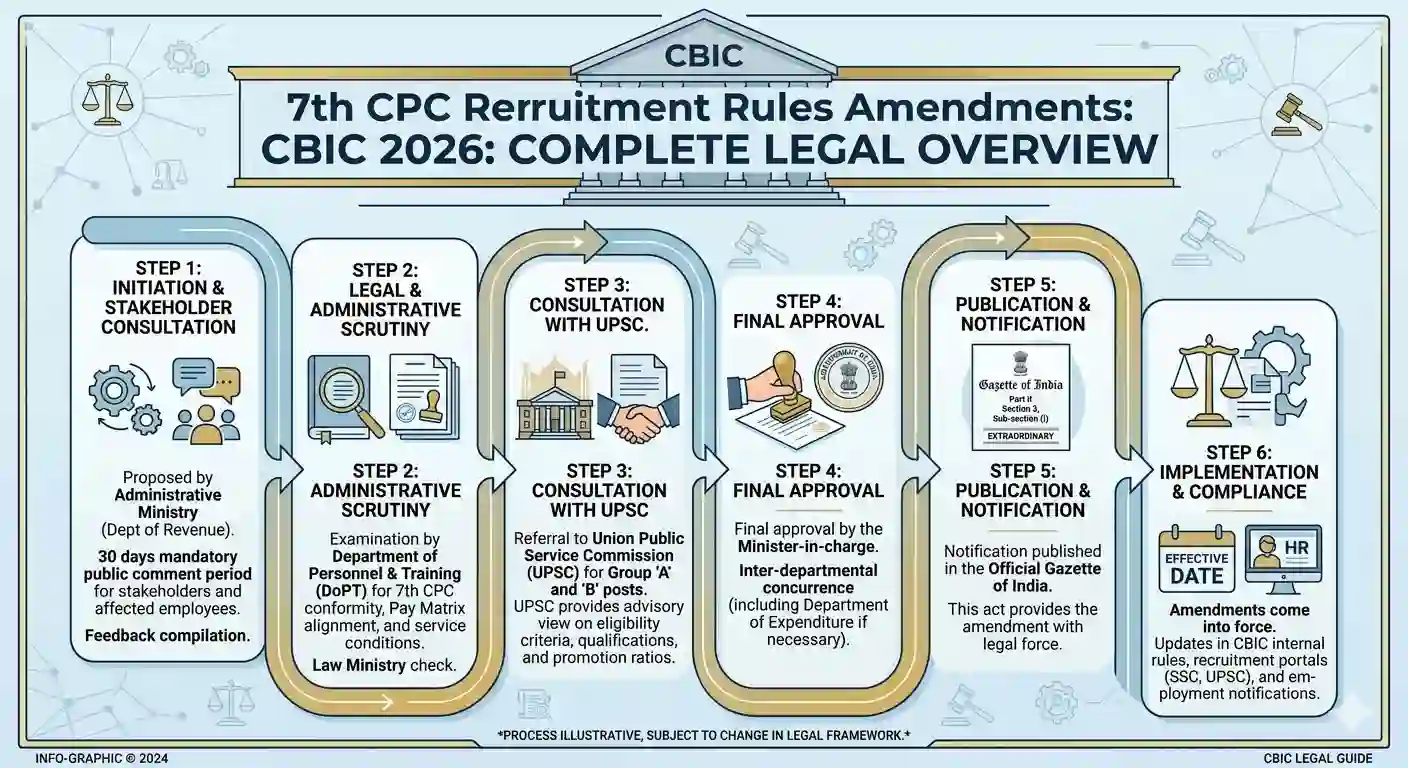
Understanding the 7th CPC Framework
The 7th CPC introduced a major shift in how salaries and service structures are defined. Instead of the earlier system of Pay Band and Grade Pay, the government introduced a Pay Matrix system.
Importantly, the Department of Personnel and Training (DoPT) directed all ministries and departments to amend their recruitment rules accordingly. These amendments required replacing old pay structures with the “Level in Pay Matrix” across all service rules.
Therefore, recruitment rules are not static—they must align with pay commission recommendations.
What Are Recruitment Rules (RRs)?
Recruitment Rules are the legal backbone of government employment. They define:
- Eligibility criteria
- Educational qualifications
- Age limits
- Promotion channels
- Pay levels
- Method of recruitment (direct, promotion, deputation)
In CBIC, these rules govern posts such as Inspectors, Superintendents, and other customs and GST officials.
Why Amendments Became Necessary
After the 7th CPC recommendations were implemented, the government mandated that all departments must update their recruitment rules to reflect the new pay structure.
This requirement was not optional. Ministries had to:
- Replace Pay Band/Grade Pay with Pay Matrix Levels
- Update promotion criteria
- Align service conditions with revised pay scales
The government clearly instructed departments to carry out these amendments immediately without waiting for further approvals.
Thus, amendments became a legal necessity rather than an administrative choice.
CBIC Recruitment Rules Amendments – 2026 Context
In 2026, CBIC-related notifications and administrative updates indicate continued refinement of recruitment rules and service structures. These include:
- Changes in eligibility conditions
- Updates in recruitment criteria for certain posts
- Alignment with evolving administrative needs
Recent documents also reflect ongoing amendments and updates in CBIC rules and notifications, showing that the regulatory framework is continuously evolving.
Therefore, 2026 is not about a single amendment but a continuing process of modernization.
Key Legal Changes Under 7th CPC Amendments
1. Introduction of Pay Matrix System
The most important change is the replacement of Grade Pay with Pay Levels. This ensures transparency and uniformity in salary progression.
2. Revision of Promotion Criteria
Departments now link promotions to specific pay levels rather than vague pay bands.
3. Standardization Across Departments
All ministries, including CBIC, must follow a uniform structure. This reduces discrepancies between departments.
4. Simplification of Recruitment Rules
The government introduced model recruitment rules to ensure faster amendments and implementation.
Legal Authority Behind the Amendments
The amendments derive their authority from:
- Central Civil Services (Revised Pay) Rules, 2016
- Office Memorandums issued by DoPT
- Notifications issued by respective departments
For example, the CCS (Revised Pay) Rules override earlier inconsistent rules wherever applicable.
Thus, the legal framework ensures that new pay structures take precedence.
Impact on CBIC Employees
The amendments have a direct impact on employees working in CBIC:
Positive Impacts
- Clear salary progression through Pay Matrix
- Improved transparency in promotions
- Standardized service conditions
Challenges
- Adjustment to new eligibility criteria
- Reinterpretation of promotion rules
- Transitional disputes regarding pay fixation
In some cases, courts have also examined pay anomalies and service-related disputes, highlighting the importance of proper implementation.
Impact on Job Aspirants
For individuals preparing for CBIC or similar government jobs, these amendments are highly relevant.
Key Effects
- Updated eligibility conditions
- Revised age and qualification criteria
- Changes in recruitment process
Therefore, aspirants must always refer to the latest recruitment rules before applying.
Legal Issues and Litigation Trends
Amendments in recruitment rules often lead to legal disputes. Common issues include:
- Disputes over promotion eligibility
- Pay fixation conflicts
- Interpretation of amended rules
- Retrospective application of amendments
Courts generally examine whether amendments:
- Follow due process
- Maintain fairness
- Do not violate fundamental rights
Thus, judicial scrutiny plays a key role in ensuring legality.
Role of High Courts and Tribunals
High Courts and service tribunals actively handle disputes arising from recruitment rules.
They examine:
- Validity of amendments
- Compliance with constitutional principles
- Fairness in implementation
For instance, courts have clarified how pay and service rules operate under the 7th CPC framework in various cases.
Compliance Requirements for Departments
Government departments, including CBIC, must ensure:
- Timely amendment of recruitment rules
- Consistency with 7th CPC structure
- Proper notification and publication
- Legal vetting before implementation
Failure to comply can lead to litigation and administrative complications.
Practical Challenges in Implementation
Despite clear guidelines, implementation often faces hurdles:
- Delay in updating rules
- Lack of clarity in interpretation
- Coordination issues between departments
- Resistance to change
However, continuous updates and clarifications help resolve these challenges over time.
Future Outlook: What to Expect
Looking ahead, recruitment rules will continue to evolve. Possible developments include:
- Further digitization of recruitment processes
- Integration with performance-based systems
- Simplification of service rules
- Greater transparency and accountability
Thus, amendments are not one-time events but part of an ongoing reform process.
How LawyerChennai.com Can Help
At LawyerChennai.com – Best Lawyer Firm in Chennai India 24×7, we provide expert legal assistance in:
- Service law disputes
- Recruitment rule challenges
- Pay fixation issues
- Promotion and seniority matters
We actively assist clients in navigating complex government service regulations and litigation.
Frequently Asked Questions
The 7th CPC Recruitment Rules amendments refer to updates made by the Central Board of Indirect Taxes and Customs to align service rules with the 7th Pay Commission structure. These changes mainly replace the old pay band and grade pay system with the Pay Matrix levels. In 2026, CBIC continues refining eligibility criteria, promotion norms, and pay structures to ensure uniformity and administrative efficiency across departments.
These amendments were necessary to bring consistency in pay structures and recruitment processes across all central government departments. After the implementation of the 7th CPC, the government mandated that all recruitment rules must reflect the new pay matrix system. Without such amendments, there would be confusion, inconsistency, and possible legal disputes regarding salary, promotions, and service conditions.
The amendments directly affect salary structure, promotion eligibility, and career progression. Employees benefit from a more transparent pay system and clearly defined promotion levels. However, some employees may face challenges such as reclassification of posts, changes in eligibility criteria, or disputes related to pay fixation and seniority.
Common legal issues include disputes over promotion eligibility, incorrect pay fixation, retrospective application of rules, and lack of clarity in implementation. Employees often approach tribunals or High Courts when they believe amendments are unfair or improperly applied. Courts generally examine whether the rules are reasonable, lawful, and properly notified.
Affected individuals can file representations before their department, approach the Central Administrative Tribunal, or file writ petitions before the High Court. Legal assistance is crucial to understand rights, interpret rules correctly, and challenge any unfair decisions effectively.
Conclusion
The 7th CPC Recruitment Rules Amendments in CBIC (2026) represent an important step in modernizing India’s government employment system. While these changes bring clarity and uniformity, they also create legal and administrative challenges.
Therefore, both employees and aspirants must stay informed and proactive. At the same time, departments must ensure strict compliance with legal requirements. Ultimately, the success of these amendments depends on proper implementation, transparency, and adherence to the rule of law.
Read More
- Pending CBIC Cadre Review 2026: How It Affects IRS Officers & Group B Posts
- Real Estate Lawyers in Chennai: Expert Property Legal Services
- CBIC Cadre Restructuring 2026 Latest Updates: Impact on Promotions & Legal Rights
- CBIC DPC 2026: Zone of Consideration, Seniority List & Legal Challenges Explained
- DPC Promotion Procedure IRS C&CE Officers 2026: Seniority Disputes & CAT Appeals
- Central Board of Indirect Taxes and Customs (CBIC Official Website)