
Can High Court Reappreciate Evidence in Divorce Appeals?
Divorce cases are often emotionally intense and legally complex. When a Family Court passes a judgment, one party may feel that the decision is unfair or based on incorrect findings. Therefore, they approach the High Court in appeal. At this stage, a common question arises: Can High Court reappreciate evidence in divorce appeals?
At LawyerChennai.com, we regularly handle matrimonial appeals before High Courts. Therefore, we understand how appellate courts examine evidence and when they interfere with Family Court findings. In this article, we explain the legal position in simple words.
Can High Court Reappreciate Evidence in Divorce Appeals? – LawyerChennai.com
Understanding Divorce Appeals
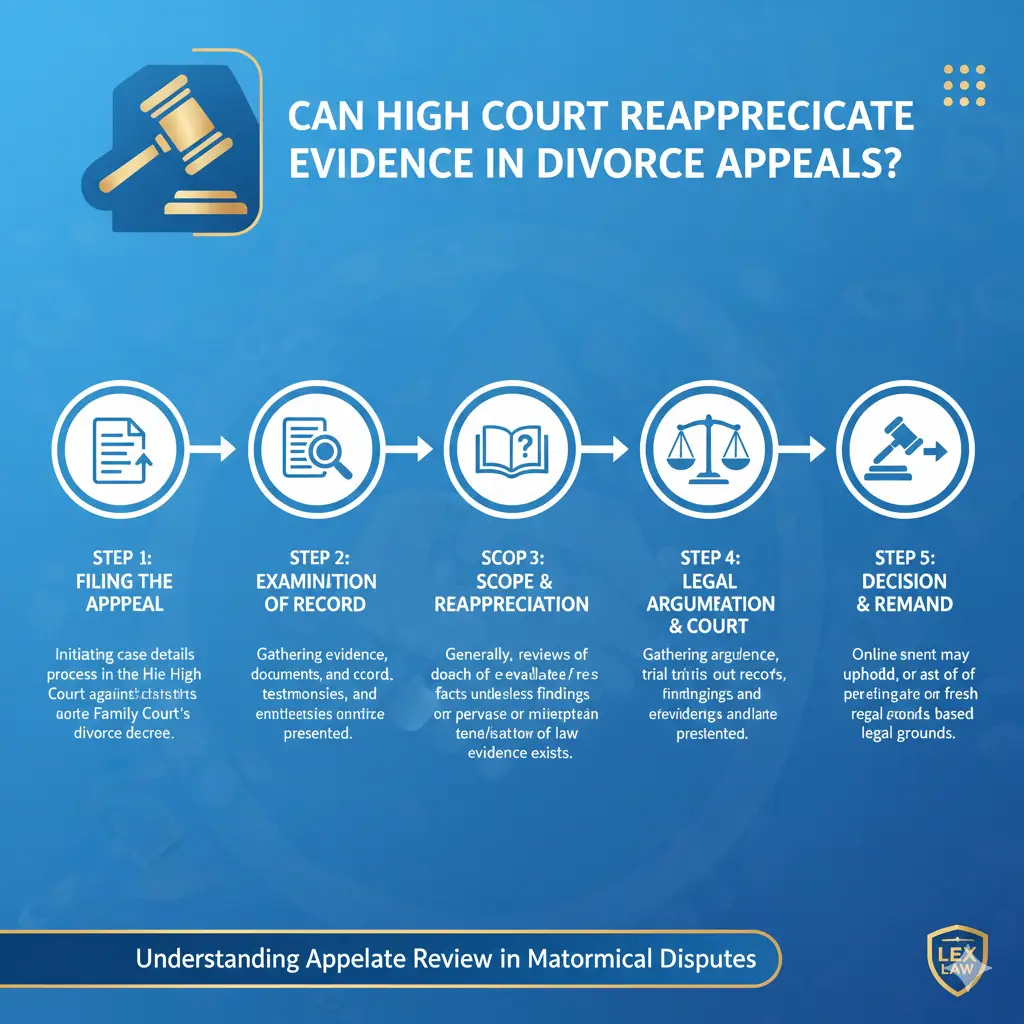
A divorce appeal is filed when a party challenges the judgment of a Family Court. Generally, appeals are filed under Section 19 of the Family Courts Act, 1984, or under relevant personal laws.
However, an appeal is not a fresh trial. The High Court does not automatically conduct the entire case again. Instead, it examines whether the Family Court:
- Applied the correct law
- Appreciated the evidence properly
- Followed proper procedure
- Gave a reasoned judgment
Therefore, the scope of appeal becomes crucial.
What Does “Reappreciation of Evidence” Mean?
Reappreciation of evidence means that the appellate court re-examines the evidence already recorded by the trial court. This includes:
- Oral testimony of witnesses
- Cross-examination
- Documentary evidence
- Medical reports
- Electronic records
In simple terms, the High Court reassesses whether the trial court correctly understood and evaluated the evidence.
General Rule: Appellate Courts Can Reappreciate Evidence
In matrimonial appeals, the High Court has the power to reappreciate evidence. This is because divorce proceedings are civil in nature, and appeals in civil cases allow reconsideration of facts as well as law.
Therefore, if the Family Court misreads evidence, ignores important documents, or draws incorrect conclusions, the High Court can intervene.
However, this power is exercised carefully.
When Will the High Court Reappreciate Evidence?
Although the High Court has the authority, it does not interfere in every case. It generally reappreciates evidence in the following situations:
1. Perverse Findings
If the Family Court gives a finding that is clearly unreasonable or unsupported by evidence, the High Court may reassess the record.
2. Ignoring Material Evidence
If important documents or testimonies were ignored, the appellate court may examine them afresh.
3. Misinterpretation of Evidence
Sometimes, the trial court misunderstands witness statements or medical records. In such cases, the High Court may correct the error.
4. Procedural Irregularities
If evidence was improperly admitted or wrongly rejected, the appellate court can reconsider its impact.
Therefore, while the High Court respects the trial court’s role, it ensures justice through careful scrutiny.
Situations Where High Court May Not Interfere
On the other hand, the High Court usually avoids interference when:
- The findings are based on proper appreciation of evidence
- The trial court observed witness demeanor directly
- The conclusions are reasonable and supported by records
Since the Family Court directly hears witnesses, it has the advantage of observing their behavior and credibility. Therefore, appellate courts give weight to such findings.
Divorce Grounds and Evidence Review
Different divorce grounds require careful evaluation of facts. For example:
Cruelty
In cruelty cases, courts examine behavior patterns, mental harassment, and supporting evidence. If the Family Court wrongly assesses such conduct, the High Court may reassess the entire record.
Desertion
Desertion involves intention and continuous separation. Therefore, documentary proof and witness testimony become important. Incorrect findings may justify reappreciation.
Adultery
Although difficult to prove directly, circumstantial evidence plays a key role. If the trial court misinterprets such evidence, the High Court can intervene.
Thus, the nature of the allegation influences the extent of evidence review.
Power Under Civil Procedure Code
Appeals in matrimonial matters follow principles under the Code of Civil Procedure (CPC). Under these principles, appellate courts can:
- Review evidence
- Frame additional issues
- Call for additional evidence in rare cases
- Reverse or modify judgments
Therefore, legally speaking, the High Court has wide powers. However, it exercises them with judicial restraint.
Can New Evidence Be Introduced?
Generally, appeals are decided based on existing records. However, in exceptional circumstances, the High Court may permit additional evidence if:
- The evidence was unavailable earlier despite due diligence
- It is necessary for justice
- The trial court wrongly refused to admit it
Nevertheless, courts discourage parties from withholding evidence during trial and introducing it later.
Importance of Strong Appellate Strategy
Since High Courts carefully analyze trial records, a well-prepared appeal becomes essential. Therefore, appellate advocacy requires:
- Clear identification of legal errors
- Demonstration of factual misinterpretation
- Structured legal arguments
- Reference to precedents
At LawyerChennai.com, we prepare appeals strategically. We thoroughly study depositions, documents, and findings before drafting grounds of appeal.
Role of Precedents
High Courts rely heavily on Supreme Court and earlier High Court judgments. These precedents guide how evidence should be evaluated in divorce cases.
For example, courts have repeatedly held that appellate courts can reassess evidence in first appeals. However, they should not interfere merely because another view is possible.
Therefore, legal expertise plays a crucial role in persuading the court.
Modification of Divorce Decrees
In some cases, the High Court may not fully reverse the judgment. Instead, it may:
- Modify findings
- Alter maintenance amounts
- Adjust custody arrangements
- Change reasoning while maintaining the outcome
Thus, appellate intervention can vary depending on the circumstances.
Maintenance and Custody Findings
In matters of maintenance and child custody, the High Court closely reviews evidence because these issues directly affect livelihood and welfare.
For example, incorrect assessment of income or financial documents may justify reappreciation. Similarly, in custody cases, the welfare of the child remains paramount. Therefore, the High Court carefully reassesses relevant evidence when necessary.
Practical Example
Suppose a Family Court dismisses a cruelty petition stating insufficient proof. However, medical records and messages clearly indicate harassment. In such a case, the High Court may re-examine those records and conclude that the trial court overlooked crucial material.
On the other hand, if both parties present conflicting testimonies and the Family Court chooses one version after observing witnesses, the High Court may hesitate to interfere unless the conclusion appears unreasonable.
Why Professional Representation Matters
Appeals require technical knowledge and precise drafting. Unlike trial courts, appellate courts focus on legal reasoning and documented evidence. Therefore, even a strong case can fail if grounds of appeal are weak.
At LawyerChennai.com, we:
- Analyze complete trial records
- Identify substantial legal errors
- Draft persuasive appeal memorandums
- Present structured oral arguments
Our experience ensures that genuine grievances receive proper judicial attention.
Frequently Asked Questions
Yes. In a first appeal against a Family Court judgment, the High Court has the power to reappreciate both facts and law. This means it can re-examine oral testimony, documents, and findings recorded by the trial court. However, the High Court exercises this power carefully. It generally interferes only when the findings are perverse, unsupported by evidence, or based on misinterpretation of material on record.
No. An appeal is not a complete retrial. The High Court mainly reviews the existing record from the Family Court. It studies pleadings, depositions, exhibits, and the reasoning in the judgment. Only in rare and exceptional circumstances will it allow additional evidence. Therefore, the focus remains on whether the trial court correctly appreciated the evidence already presented.
The High Court may interfere if the Family Court ignored crucial documents, misunderstood witness statements, applied incorrect legal principles, or delivered unreasonable conclusions. If the findings are based on proper appreciation of evidence and are reasonably possible, the appellate court usually avoids interference, even if another view is possible.
Yes. The High Court can reassess evidence related to income, financial capacity, and child welfare. Since maintenance and custody directly affect rights and welfare, appellate courts closely scrutinize such findings where errors appear.
Appeals require precise drafting and strong legal reasoning. Skilled lawyers identify substantial errors, frame clear grounds, and present structured arguments, thereby improving the chances of success in High Court.
Conclusion
So, can the High Court reappreciate evidence in divorce appeals? The answer is yes. The High Court has the authority to reassess evidence in matrimonial appeals. However, it exercises this power cautiously and with respect for the trial court’s findings.
If the Family Court commits legal errors, ignores crucial evidence, or delivers perverse findings, the High Court can interfere. At the same time, it avoids substituting its view merely because another interpretation is possible. Therefore, if you believe that a divorce judgment suffers from serious factual or legal errors, timely legal advice becomes essential. At LawyerChennai.com, we provide strategic appellate representation and guide clients confidently through High Court proceedings.
Read More
- Divorce Appeal vs Revision Petition: Correct Legal Remedy Explained
- Anton Piller Orders in India | Search & Seizure Remedies in IP Litigation
- John Doe Suit and Orders in India | Quia Timet & Dynamic Injunctions Explained
- Errors by Family Courts That Justify Appellate Interference in Divorce Cases
- Ex Parte Divorce Decree: Remedy Before High Court and Supreme Court
- Department of Justice – Family Court Overview