
Regulatory Authority Appeals: Appealing decisions by regulators
Regulatory Authority Appeals – In today’s business and professional world, regulatory authorities play an important role in maintaining fairness, safety, compliance, and ethical standards. These authorities supervise industries, issue licenses, conduct inspections, and enforce rules. However, there are times when individuals, companies, institutions, or organizations may feel that a regulator’s decision is unfair, incorrect, or legally improper. In such situations, regulatory authority appeals become extremely important.
At LawyerChennai.com – Best Lawyer Firm in Chennai India 24×7, we regularly assist clients in challenging and appealing decisions made by regulatory bodies across different sectors. Whether the matter relates to education, finance, taxation, environment, labor, real estate, healthcare, corporate governance, or professional licensing, a proper appeal process can protect legal rights and business interests.
Regulatory Authority Appeals: Appealing Decisions by Regulators – LawyerChennai.com
Understanding Regulatory Authorities
Regulatory authorities are government agencies or statutory bodies that monitor and regulate specific industries or activities. Their main purpose is to ensure that laws, rules, and standards are properly followed. These authorities also investigate violations and impose penalties when required.
For example, in India, several important regulators operate in different sectors. These include the Securities and Exchange Board of India (SEBI), Reserve Bank of India (RBI), Competition Commission of India (CCI), National Medical Commission (NMC), Bar Council authorities, GST authorities, labor departments, pollution control boards, and educational regulators.
Although regulators have significant powers, their decisions are not always final. The law usually provides a mechanism for appeal, review, or judicial challenge. Therefore, affected parties can seek legal remedies through appellate authorities, tribunals, or courts.
What Is a Regulatory Authority Appeal?
A regulatory authority appeal is a legal process through which a person or organization challenges a decision made by a regulator. The appeal requests a higher authority, tribunal, or court to review the original decision and determine whether it was lawful, fair, and reasonable.
An appeal may arise in many situations. For instance, a business may challenge the cancellation of its license. Similarly, a professional may appeal against disciplinary action. A company may also contest heavy penalties imposed by a regulatory body.
The appeal process gives affected parties an opportunity to present evidence, legal arguments, and supporting documents before an independent authority. As a result, this process strengthens accountability and protects against misuse of power.
Common Reasons for Filing Appeals
There are many reasons why people or organizations decide to appeal regulatory decisions. Some of the most common reasons include:
Violation of Natural Justice
Sometimes regulators issue decisions without giving proper notice or an adequate hearing opportunity. In such cases, the affected party may argue that the principles of natural justice were violated.
Incorrect Interpretation of Law
A regulatory authority may misunderstand or wrongly apply legal provisions. Consequently, the decision may become legally unsustainable.
Lack of Evidence
Certain orders are passed without sufficient evidence or factual support. Therefore, the affected party can challenge the findings.
Excessive Penalties
At times, regulators impose penalties that are too harsh or disproportionate to the alleged violation. Appeals help in reducing or removing such penalties.
Procedural Irregularities
If the authority failed to follow the prescribed procedure, the decision can be challenged on procedural grounds.
Bias or Unfair Treatment
In some cases, the affected party may believe that the decision was biased or discriminatory. An appeal helps ensure an impartial review.
Types of Regulatory Decisions That Can Be Appealed
Regulatory appeals can arise from many kinds of decisions. These may include:
- Cancellation or suspension of licenses
- Imposition of financial penalties
- Denylisting of contractors or businesses
- Rejection of approvals or permits
- Professional misconduct findings
- Compliance notices and enforcement orders
- Environmental clearance disputes
- Tax assessments and recovery actions
- Educational institution recognition issues
- Corporate governance violations
- Consumer protection orders
Each sector has its own appeal structure and timelines. Therefore, professional legal guidance becomes very important.
The Importance of Acting Quickly
One of the most critical aspects of a regulatory appeal is timing. Most laws prescribe strict deadlines for filing appeals. Missing the limitation period may result in dismissal of the appeal.
For example, some appellate authorities allow only 30 days for filing an appeal, while others may permit 60 or 90 days. Therefore, affected parties should immediately seek legal advice after receiving an adverse order.
Quick action also helps preserve evidence, prepare documents properly, and develop a stronger legal strategy.
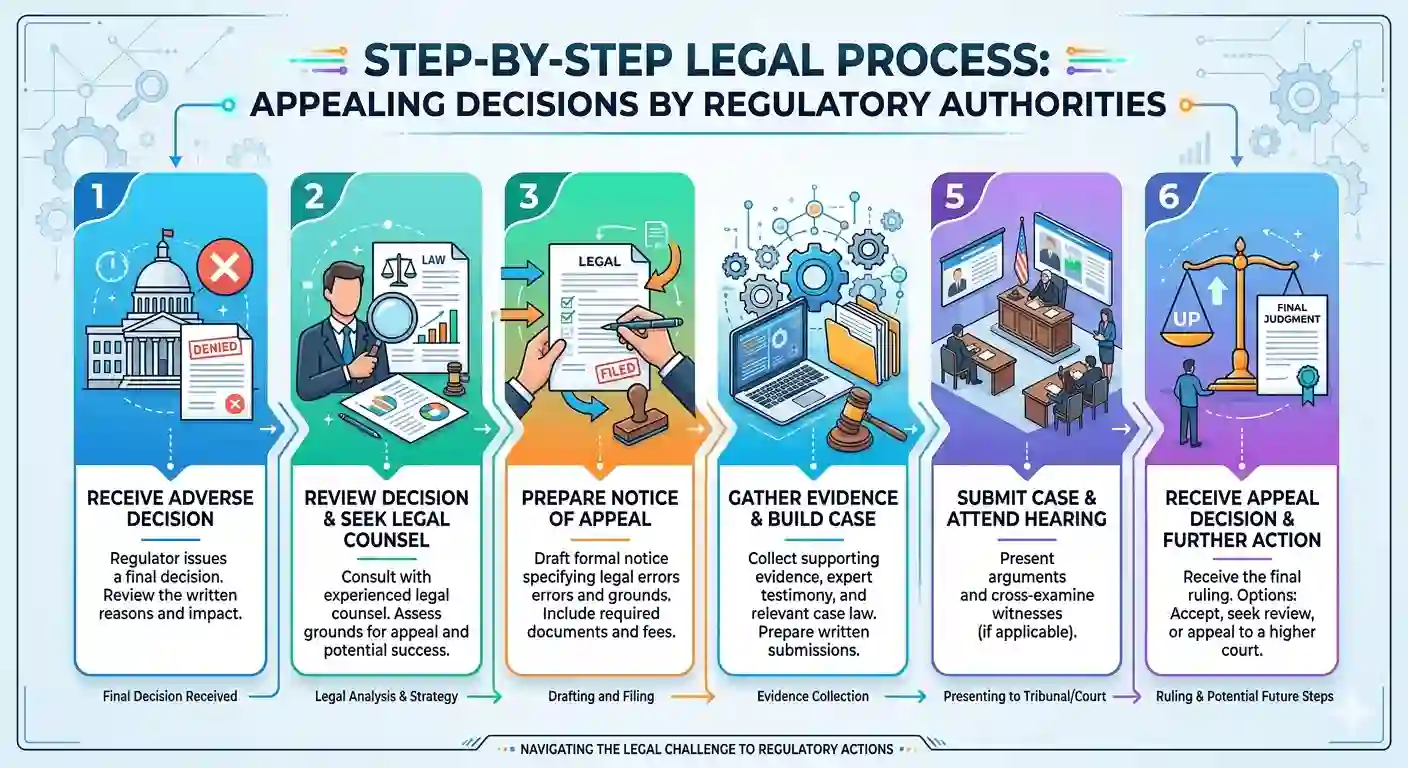
Steps Involved in Regulatory Authority Appeals
Although procedures vary between sectors, the general appeal process usually follows certain common steps.
Reviewing the Original Order
The first step involves carefully examining the regulatory authority’s order. Lawyers study the findings, legal reasoning, procedural compliance, and supporting evidence.
This stage helps identify weaknesses, legal errors, and possible grounds for challenge.
Collecting Documents and Evidence
The next step involves gathering all relevant records. These may include notices, correspondence, inspection reports, licenses, financial records, agreements, and previous submissions.
Strong documentary evidence often plays a major role in successful appeals.
Identifying Legal Grounds
An appeal cannot succeed merely because the party disagrees with the regulator. Instead, proper legal grounds must be established.
For example, lawyers may argue that:
- the authority exceeded its powers,
- the order violated constitutional rights,
- mandatory procedures were ignored,
- evidence was insufficient, or
- penalties were unreasonable.
Drafting the Appeal Petition
The appeal petition is a highly important legal document. It must clearly explain:
- facts of the case,
- procedural history,
- legal issues,
- grounds for challenge,
- supporting evidence, and
- relief sought.
Well-drafted appeals significantly improve the chances of success.
Filing Before the Appropriate Forum
The appeal must be filed before the correct appellate authority, tribunal, or court. Different regulators have different appellate forums.
For example:
- SEBI matters may go before the Securities Appellate Tribunal,
- tax disputes may go before tax appellate tribunals,
- consumer matters may proceed before consumer commissions,
- labor disputes may go before labor courts or industrial tribunals.
Filing in the wrong forum can delay or weaken the case.
Hearings and Arguments
After filing, hearings are conducted where both sides present arguments. Lawyers explain why the original decision should be modified or cancelled.
The appellate authority may:
- uphold the original order,
- modify the penalty,
- remand the matter for reconsideration, or
- completely set aside the order.
Judicial Review and Writ Petitions
In certain situations, appellate remedies may not be available or may not provide effective relief. In such cases, parties may approach High Courts under writ jurisdiction.
Courts can intervene when:
- fundamental rights are violated,
- authorities act beyond jurisdiction,
- procedures are unfair,
- decisions are arbitrary, or
- principles of natural justice are ignored.
Judicial review acts as an important safeguard against abuse of regulatory powers.
Challenges Faced During Regulatory Appeals
Regulatory appeals can become highly complex. Many parties struggle due to technical legal procedures and strict compliance requirements.
Complex Regulations
Modern industries operate under detailed laws and technical guidelines. Therefore, understanding regulatory frameworks requires legal expertise.
Heavy Documentation
Appeals often involve extensive records, compliance reports, and technical evidence. Organizing these documents properly is essential.
Financial Risks
Regulatory penalties can severely impact businesses, professionals, and institutions. Therefore, the stakes are often very high.
Reputation Concerns
Adverse regulatory findings may damage reputation and public trust. Consequently, handling the matter professionally becomes extremely important.
Multiple Proceedings
Sometimes regulatory actions lead to parallel civil, criminal, or administrative proceedings. Managing all these matters together requires careful coordination.
Importance of Professional Legal Representation
Appealing against regulators without proper legal support can be risky. Experienced lawyers understand procedural rules, statutory requirements, and appellate strategies.
At LawyerChennai.com – Best Lawyer Firm in Chennai India 24×7, our legal team helps clients:
- analyze regulatory orders,
- identify strong grounds for appeal,
- prepare legal documentation,
- represent clients before tribunals and courts,
- negotiate settlements where possible, and
- protect long-term business interests.
Professional representation also improves communication with authorities and reduces procedural mistakes.
Regulatory Appeals in the Education Sector
Educational institutions frequently face regulatory disputes involving approvals, affiliations, inspections, faculty requirements, fee regulations, and accreditation matters.
Fashion institutes, colleges, training centers, and universities may encounter actions from educational regulators or local authorities. In such cases, appeals become necessary to protect institutional operations and student interests.
Legal support helps institutions respond effectively while maintaining compliance standards.
Preventive Compliance Measures
While appeals are important, prevention is always better than litigation. Organizations should adopt strong compliance systems to reduce regulatory risks.
Some useful preventive measures include:
- regular legal audits,
- employee training,
- maintaining accurate records,
- timely filing of returns,
- internal compliance monitoring,
- transparent communication with regulators, and
- quick response to notices.
Proactive compliance reduces the likelihood of penalties and enforcement actions.
Alternative Dispute Resolution in Regulatory Matters
In some cases, disputes can be resolved through negotiation, mediation, or settlement mechanisms. Regulatory authorities sometimes allow compounding, settlement applications, or consent arrangements.
Alternative dispute resolution may help parties:
- save time,
- reduce costs,
- avoid lengthy litigation, and
- protect commercial relationships.
However, each case requires careful legal evaluation before choosing this approach.
The Role of Courts in Protecting Rights
Indian courts have repeatedly emphasized that regulators must act fairly, reasonably, and within the limits of law. Courts also ensure that administrative powers are exercised responsibly.
Judicial oversight helps maintain balance between regulatory enforcement and individual rights. Therefore, appellate and judicial remedies form a crucial part of the legal system.
Frequently Asked Questions
A regulatory authority appeal is a legal process used to challenge a decision made by a government regulator or statutory authority. Individuals, companies, NGOs, and institutions can file appeals when they believe a regulator acted unfairly, exceeded its powers, ignored procedures, or imposed unreasonable penalties. Appeals are usually filed before appellate tribunals, higher authorities, or courts depending on the governing law. This process helps protect legal rights and ensures accountability in administrative decisions across sectors such as taxation, education, finance, healthcare, labor, environmental regulation, and corporate governance matters.
A person or business can file an appeal after receiving an adverse order such as license cancellation, penalties, suspension, rejection of approvals, compliance notices, or disciplinary action. Appeals are commonly filed when there is lack of evidence, procedural unfairness, legal errors, or violation of natural justice principles. However, every law specifies a limitation period for filing appeals. Therefore, affected parties should act quickly and seek legal guidance immediately after receiving the regulator’s order to avoid dismissal due to delay or procedural defects.
Different sectors have different appellate bodies. Tax disputes may go before tax tribunals, SEBI matters before the Securities Appellate Tribunal, labor disputes before labor courts, and consumer disputes before consumer commissions. High Courts may also review decisions through writ petitions in exceptional circumstances involving jurisdictional errors or constitutional violations.
Important documents include the original order, notices, correspondence, licenses, agreements, evidence, financial records, and supporting legal submissions relevant to the dispute.
Experienced lawyers help prepare strong arguments, follow procedures correctly, protect rights, and improve the chances of obtaining favorable outcomes before appellate authorities or courts.
Conclusion
Regulatory authorities play a vital role in maintaining discipline and compliance across industries. However, regulators are not beyond legal scrutiny. When decisions are unfair, excessive, or legally incorrect, affected parties have the right to challenge them through appeals and judicial remedies.
Regulatory authority appeals help ensure accountability, fairness, and protection of legal rights. Whether the issue involves licensing, penalties, compliance actions, professional discipline, or institutional approvals, timely legal action can make a significant difference.
At LawyerChennai.com – Best Lawyer Firm in Chennai India 24×7, we are committed to helping clients navigate complex regulatory disputes with confidence and clarity. Our experienced legal team provides strategic advice, strong representation, and practical solutions for individuals, companies, educational institutions, NGOs, and NRIs facing regulatory challenges.
Read More
- Consumer Warranty Disputes: Handling disputes over warranties
- Public Law Challenges: Appealing public law decisions
- RTI & Grievance Redressal for CBIC Employees: DGHRD CBIC Service Law Guide 2026
- CBIC Civil List & Seniority Disputes 2026: Legal Remedies for IRS Officers
- Legal Support for Compassionate Job | Expert Guidance for Dependent Employment Rights
- Grievance Appellate Committee (GAC) – Government of India