Government Contract Disputes: Handling disputes over government contracts
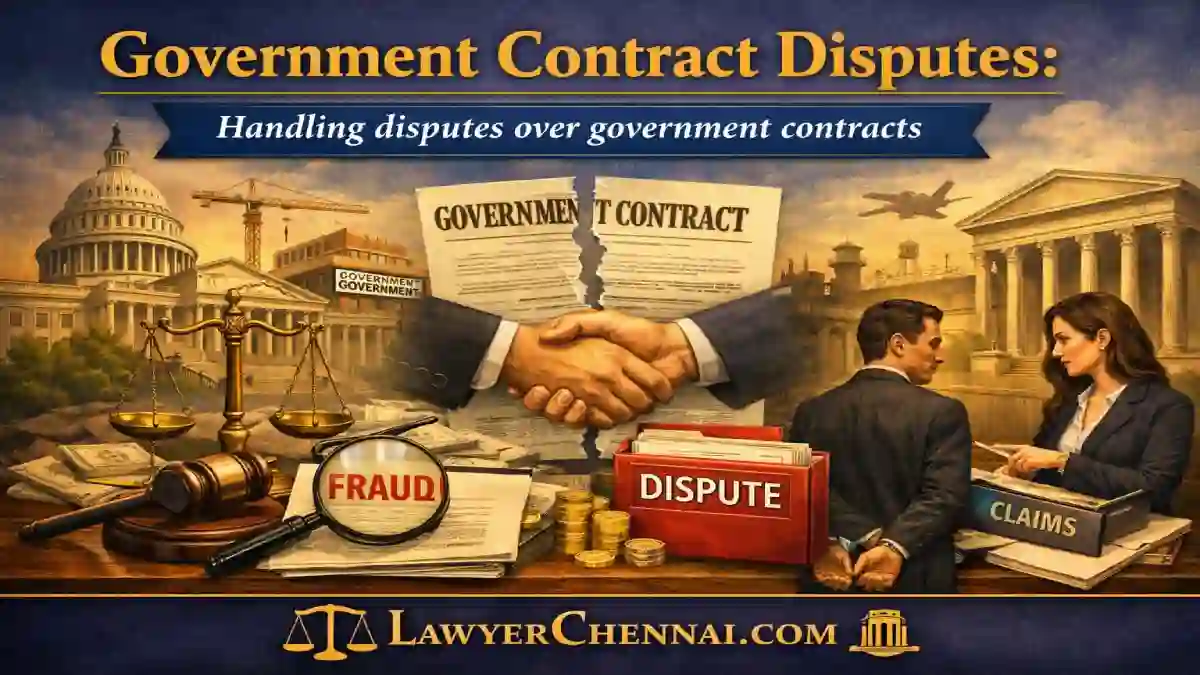
Government contract disputes arise when parties disagree regarding tender conditions, payments, performance obligations, or contract termination. LawyerChennai.com – Best Lawyer Firm in Chennai India 24×7 assists contractors, suppliers, consultants, NGOs, companies, and NRIs facing such disputes. Government contracts involve ministries, public sector undertakings, municipalities, state departments, and central agencies. Therefore, contractual compliance remains essential throughout project execution. Disputes frequently involve delayed payments, deny listing, wrongful termination, bid rejection, and breach of contractual obligations. Furthermore, public procurement rules require transparency and accountability. Government authorities often enforce strict contractual conditions and compliance standards.
Government Contract Disputes: Handling Disputes Over Government Contracts – LawyerChennai.com
Common legal issues include:
- Tender disputes
- Payment delays
- Contract termination
- Black listing orders
- Performance guarantee disputes
Affected parties should seek prompt legal advice. Consequently, early intervention often prevents escalation and protects commercial interests. Effective representation improves prospects for negotiation, arbitration, and judicial remedies.
Common Causes of Government Contract Disputes
Government projects frequently involve complex contractual arrangements and compliance requirements. Disputes may arise during bidding, execution, payment processing, or project completion. Therefore, contractors must understand contractual rights and obligations thoroughly. Careful documentation reduces future legal complications.
| Dispute Type | Common Issue |
|---|---|
| Tender Dispute | Bid rejection |
| Payment Dispute | Delayed invoices |
| Performance Dispute | Contract breach |
| Black listing | Procurement restrictions |
| Termination | Contract cancellation |
Frequent causes include:
- Scope variations
- Delayed approvals
- Payment withholding
- Defective performance claims
- Compliance disputes
Moreover, government departments often issue notices requiring immediate responses. Proper legal analysis helps determine available remedies and procedural options. Strategic dispute management protects contractual rights and business continuity.
Government Departments and Regulatory Authorities
Numerous government bodies participate in public procurement and contract administration. LawyerChennai.com represents clients before these departments and authorities. Furthermore, disputes may involve several agencies simultaneously.
Important authorities include:
- Central Government Departments
- State Government Departments
- Public Sector Undertakings
- Municipal Corporations
- Government Procurement Agencies
Contractors often interact with:
- GeM authorities
- Tender committees
- Finance departments
- Engineering departments
- Audit authorities
Consequently, understanding departmental procedures remains critical. Legal professionals prepare representations, objections, and appeals before competent authorities. Effective communication often facilitates early dispute resolution. Timely responses strengthen contractual claims and reduce litigation risks.
Legal Remedies and Forums for Government Contract Disputes
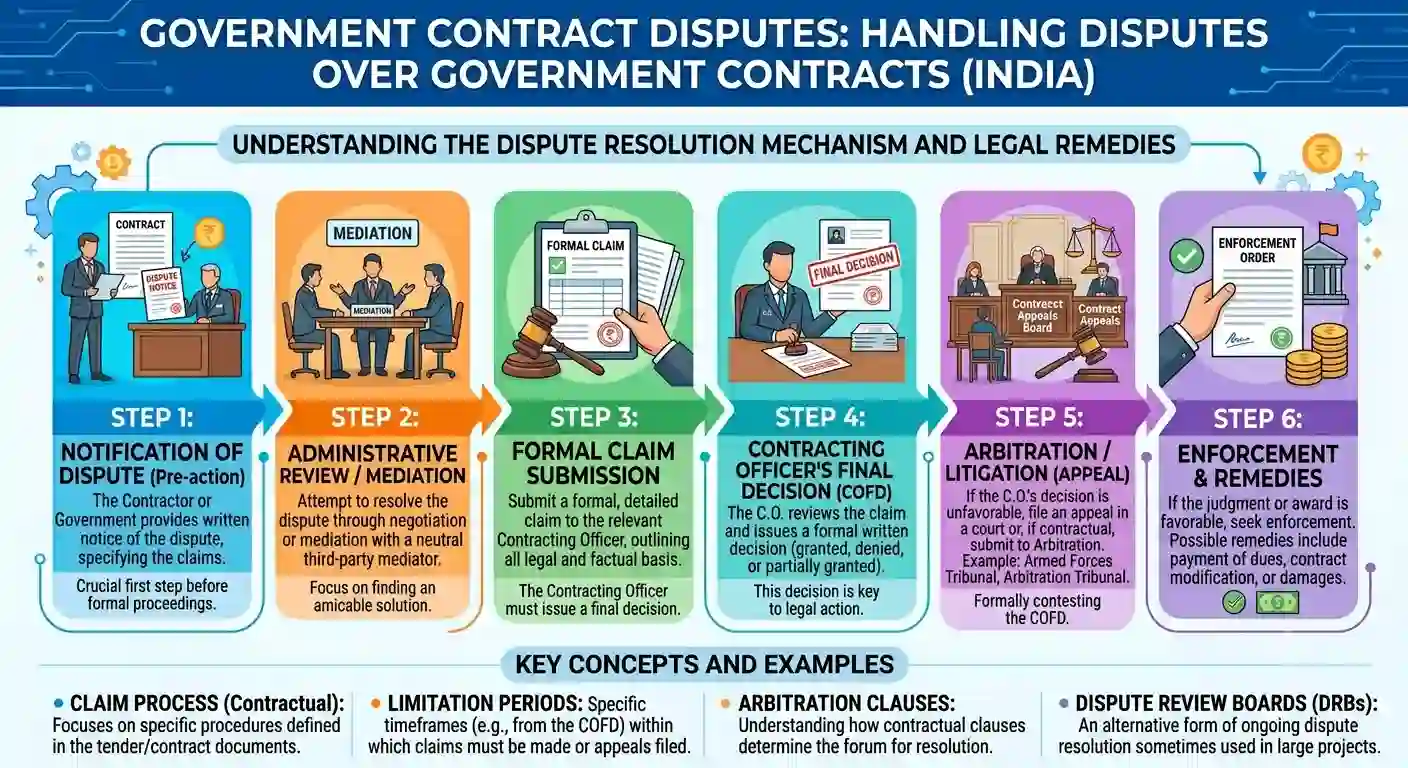
Government contract disputes require careful assessment of contractual terms and applicable laws. LawyerChennai.com provides legal support from negotiations through final adjudication. Therefore, parties should evaluate all remedies before commencing litigation. Appropriate forum selection significantly impacts outcomes.
Contract Enforcement and Civil Remedies
Contractors may pursue several remedies when authorities breach contractual obligations. Courts and arbitral tribunals frequently adjudicate such disputes. Consequently, documentation remains the foundation of successful claims.
Available remedies include:
- Specific performance
- Damages claims
- Recovery suits
- Injunctions
- Arbitration proceedings
| Remedy | Objective |
|---|---|
| Damages | Compensation |
| Injunction | Prevent adverse action |
| Recovery Suit | Payment recovery |
| Arbitration | Private adjudication |
The Code of Civil Procedure, 1908 governs many civil proceedings. Furthermore, contractual clauses often determine dispute resolution mechanisms. Legal review helps identify enforceable rights and strategic options. Early claim preparation strengthens negotiation leverage and litigation prospects.
Tender Rejection and Black listing Challenges
Tender rejection and black listing significantly affect commercial opportunities. Government agencies must follow principles of fairness and natural justice. Therefore, affected parties may challenge arbitrary decisions before appropriate forums. Courts scrutinize procedural irregularities carefully.
Common grounds include:
- Lack of hearing
- Arbitrary action
- Procedural violations
- Discriminatory treatment
- Excessive penalties
High Courts frequently exercise writ jurisdiction in suitable cases. Moreover, judicial review protects constitutional and contractual rights. Legal professionals assess records and prepare detailed challenges. Timely action often prevents irreversible commercial losses and reputational harm.
Arbitration in Government Contract Matters
Many government contracts contain arbitration clauses for dispute resolution. Arbitration offers a specialized mechanism for resolving commercial disagreements. Consequently, parties often prefer arbitration over lengthy litigation.
Key arbitration benefits include:
- Confidential proceedings
- Expert adjudicators
- Faster resolution
- Flexible procedures
- Enforceable awards
The Arbitration and Conciliation Act governs arbitral proceedings. Furthermore, courts may assist with interim measures and award enforcement. Proper case preparation remains crucial during arbitration. Experienced lawyers protect contractual interests throughout proceedings. Strategic advocacy often improves outcomes and settlement opportunities.
Criminal Issues Arising from Contract Disputes
Certain disputes involve allegations of fraud, forgery, corruption, or misappropriation. Such allegations may trigger criminal investigations alongside civil proceedings. Therefore, parties require coordinated legal strategies.
Relevant laws include:
- Bharatiya Nyaya Sanhita, 2023
- Bharatiya Nagarik Suraksha Sanhita, 2023
- Bharatiya Sakshya Adhiniyam, 2023
Authorities may include:
- Local Police Stations
- Economic Offences Wings
- Anti-Corruption Agencies
Furthermore, criminal proceedings may affect contractual rights and reputations. Legal representation during investigations protects procedural safeguards. Early defense preparation reduces unnecessary risks and complications.
Jurisdiction of Courts and Legal Forums
Government contract disputes may proceed before several forums depending on contractual terms. Therefore, jurisdiction analysis forms an essential part of legal strategy. Incorrect forum selection often causes delays and additional costs.
| Forum | Jurisdiction |
|---|---|
| Civil Courts | Contract disputes |
| Commercial Courts | Commercial claims |
| Arbitral Tribunals | Contractual arbitration |
| High Courts | Writ petitions |
| Supreme Court | Appeals |
Commercial Courts handle substantial business disputes efficiently. Moreover, writ remedies may address arbitrary governmental actions. Legal professionals evaluate contractual clauses before initiating proceedings. Proper forum selection enhances efficiency and enforceability.
Evidence and Documentation Requirements
Strong documentary evidence strengthens contractual claims and defenses. Government contract disputes often depend upon written records and correspondence. Consequently, parties should preserve documents carefully.
Important evidence includes:
- Tender documents
- Work orders
- Invoices
- Correspondence
- Performance records
The Bharatiya Sakshya Adhiniyam, 2023 governs evidentiary standards. Furthermore, electronic communications frequently support contractual claims. Legal teams organize evidence systematically before hearings or negotiations. Proper documentation improves credibility and litigation outcomes significantly.
Why Choose LawyerChennai.com – Best Lawyer Firm in Chennai India 24×7
LawyerChennai.com provides comprehensive legal services for government contract disputes across India. Our lawyers assist contractors, vendors, suppliers, consultants, NGOs, and corporate entities. Furthermore, we offer practical solutions tailored to commercial objectives.
Our services include:
- Contract review
- Arbitration representation
- Writ petitions
- Recovery proceedings
- Dispute management
We represent clients before courts, tribunals, arbitral forums, and government authorities. Additionally, our team handles tender disputes, black listing challenges, and payment recovery claims. Timely legal advice reduces financial exposure and procedural risks. LawyerChennai.com remains committed to protecting contractual rights through strategic, result-oriented legal representation.
FAQs
Q1. What causes government contract disputes?
Payment delays, contract breaches, tender rejections, black listing orders, scope changes, and performance disagreements commonly cause disputes.
Q2. Can contractors challenge black listing orders?
Yes. Contractors may challenge arbitrary black listing through representations, arbitration, writ petitions, or other legal remedies.
Q3. Which court handles government contract disputes?
Civil Courts, Commercial Courts, High Courts, and arbitral tribunals may hear disputes depending on facts and contract terms.
Q4. Is arbitration available in government contracts?
Many government contracts contain arbitration clauses allowing parties to resolve disputes through arbitral proceedings.
Q5. Can criminal proceedings arise from contract disputes?
Yes. Fraud, forgery, corruption, or misappropriation allegations may trigger investigations under applicable criminal laws.
Q6. How can LawyerChennai.com assist contractors?
The firm provides contract review, arbitration support, litigation, recovery actions, writ remedies, and dispute resolution services.
Read More
- Appeals in Employment Termination: Challenging wrongful terminations
- Charity Dispute Appeals: Appealing charity-related disputes
- Regulatory Fines Appeals: Challenging fines imposed by regulators
- Tax Evasion Appeals: Handling appeals in tax evasion cases
- International Trade Disputes: Appealing trade-related disputes
- Central Public Procurement Portal (CPPP)