Supreme Court Appeals for NCLAT Judgments: Effective Legal Solutions

Supreme Court Appeals for NCLAT Judgments – Corporate disputes and insolvency matters have become increasingly complex in today’s business environment. Companies, creditors, and investors often rely on specialized legal forums to resolve such disputes efficiently. In India, many corporate insolvency and company law disputes are first handled by the National Company Law Tribunal and then appealed before the National Company Law Appellate Tribunal.
However, in certain cases, parties may still feel dissatisfied with the decision of the appellate tribunal. When this happens, the law provides an important legal remedy — filing an appeal before the Supreme Court of India.
Appealing to the Supreme Court is a serious legal step. It requires strong legal arguments, careful documentation, and deep knowledge of corporate and insolvency laws. Therefore, individuals and businesses must seek professional legal assistance when approaching the highest court in the country.
At LawyerChennai.com – Best Lawyer Firm in Chennai India 24×7, we provide strategic legal guidance for clients seeking effective solutions in Supreme Court appeals related to corporate and insolvency matters.
Supreme Court Appeals for NCLAT Judgments: Effective Legal Solutions – LawyerChennai.com – Best Lawyer Firm in Chennai India 24×7
Understanding the Corporate Dispute Resolution Framework
India has developed a structured legal framework for resolving company disputes and insolvency issues.
The process typically begins before the National Company Law Tribunal. This tribunal handles cases involving insolvency, company mismanagement, mergers, and other corporate disputes.
If a party disagrees with the tribunal’s decision, they may appeal before the National Company Law Appellate Tribunal. The appellate tribunal reviews the case and may confirm, modify, or overturn the earlier decision.
However, if the dispute still remains unresolved, the law allows a further appeal before the Supreme Court of India on specific legal grounds.
Thus, the Supreme Court acts as the final authority in such matters.
What Is an NCLAT Judgment?
An NCLAT judgment is the decision issued by the appellate tribunal after reviewing an order passed by the tribunal.
The appellate tribunal carefully examines the legal arguments, documents, and evidence presented by both parties. Based on this review, it delivers a reasoned judgment.
These judgments may involve several important corporate matters, including:
- Insolvency resolution proceedings
- Corporate restructuring disputes
- Liquidation orders
- Mismanagement or oppression cases
- Disputes between creditors and companies
Although the appellate tribunal plays a critical role in resolving corporate disputes, parties still have the right to approach the Supreme Court if legal issues remain unresolved.
Legal Basis for Supreme Court Appeals
Appeals against NCLAT judgments are permitted under the Insolvency and Bankruptcy Code, 2016.
However, the appeal can only be filed on questions of law, not merely on factual disagreements.
This means that the appellant must demonstrate that the appellate tribunal made a legal error while interpreting or applying the law.
Therefore, preparing a strong legal argument becomes extremely important when filing an appeal before the Supreme Court.
When Can an Appeal Be Filed Before the Supreme Court?
Not every NCLAT decision automatically qualifies for an appeal before the Supreme Court. Instead, the appeal must satisfy certain legal conditions.
An appeal may be filed when:
- There is a significant question of law involved
- The tribunal has misinterpreted legal provisions
- The judgment conflicts with existing Supreme Court precedents
- There has been a serious procedural error
- The decision affects public interest or corporate governance principles
When these conditions are present, the Supreme Court may agree to hear the appeal.
Time Limit for Filing the Appeal
Time plays a crucial role in Supreme Court appeals.
Under the Insolvency and Bankruptcy Code, 2016, an appeal must generally be filed within 45 days from the date of the NCLAT judgment.
However, the Supreme Court may allow a limited extension if the appellant shows sufficient reason for the delay.
Therefore, parties must act quickly and seek legal assistance immediately after receiving the appellate tribunal’s judgment.
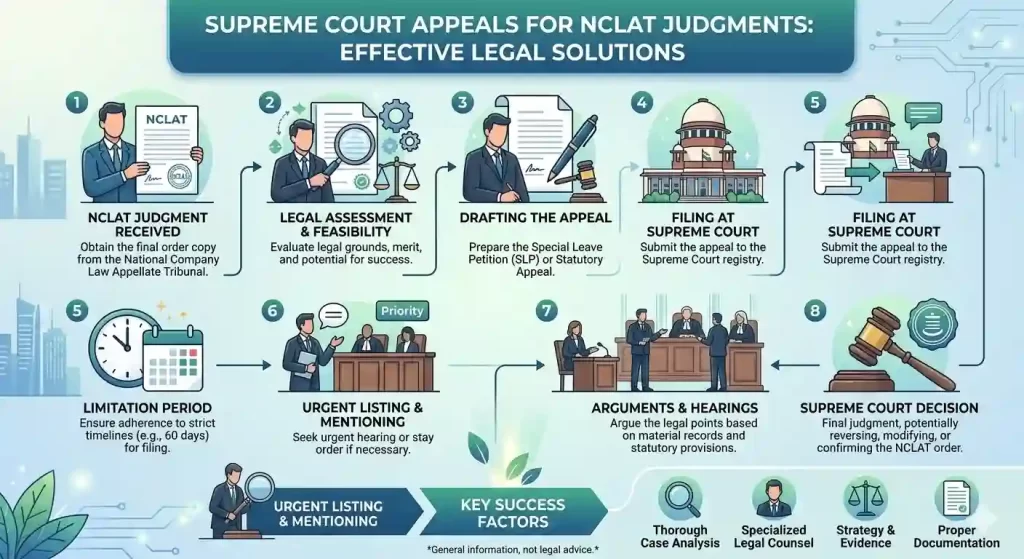
Steps Involved in Filing a Supreme Court Appeal
Filing an appeal before the Supreme Court involves several legal and procedural steps.
1. Reviewing the NCLAT Judgment
First, the legal team carefully studies the appellate tribunal’s order. This helps identify possible legal errors and grounds for appeal.
2. Identifying Questions of Law
Next, lawyers determine the key legal questions that justify the Supreme Court’s intervention.
3. Preparing the Appeal Petition
The legal team drafts a detailed appeal petition explaining the legal issues, facts of the case, and reasons why the judgment should be reconsidered.
4. Filing the Petition
The appeal is then formally filed before the Supreme Court of India along with supporting documents.
5. Supreme Court Hearing
Finally, the Supreme Court may hear arguments from both parties and issue its final decision.
Each of these steps requires precision, legal expertise, and thorough preparation.
Challenges in Supreme Court Appeals
Appealing before the Supreme Court is not a simple process. Several challenges may arise during the proceedings.
First, the court carefully filters cases and only accepts appeals involving significant legal questions.
Second, the legal arguments must be strong and well-supported by statutory provisions and precedents.
Third, the documentation must be complete and properly presented.
Finally, the opposing party may present counterarguments that require careful legal strategy.
Because of these challenges, professional legal representation becomes extremely important.
Importance of Experienced Legal Representation
Handling Supreme Court appeals requires deep knowledge of corporate law, insolvency law, and appellate procedures.
Experienced lawyers provide valuable assistance in several ways.
They analyze complex judgments and identify legal flaws. They also draft strong appeal petitions and present persuasive arguments before the court.
Moreover, experienced advocates understand the procedural rules of the Supreme Court, which helps avoid unnecessary delays or technical errors.
Therefore, choosing the right legal team significantly improves the chances of success.
Impact of Supreme Court Decisions
The Supreme Court plays a vital role in shaping corporate and insolvency law in India.
When the court delivers a judgment in such appeals, the decision often creates legal precedents that influence future cases.
These rulings may clarify legal provisions, interpret complex regulations, or establish new principles for corporate governance.
As a result, Supreme Court judgments have a lasting impact on businesses, investors, and financial institutions across the country.
Preventing Corporate Disputes
Although appeals provide an important legal remedy, businesses should also focus on preventing disputes whenever possible.
Companies can reduce legal risks by:
- Maintaining transparent corporate governance
- Keeping proper financial records
- Following regulatory compliance requirements
- Conducting regular legal audits
- Seeking legal advice during major corporate decisions
By adopting these practices, businesses can avoid many disputes that may otherwise escalate into lengthy litigation.
How LawyerChennai.com Assists Clients
At LawyerChennai.com – Best Lawyer Firm in Chennai India 24×7, we provide comprehensive legal support for corporate disputes and appellate litigation.
Our services include:
- Reviewing NCLAT judgments
- Identifying legal grounds for appeal
- Preparing Supreme Court appeal petitions
- Representing clients during hearings
- Advising on corporate dispute resolution strategies
We focus on delivering practical and effective legal solutions tailored to the needs of our clients.
Because corporate disputes often involve significant financial stakes, we approach every case with careful analysis and strategic planning.
Why Timely Legal Action Matters
In appellate litigation, timing is extremely important.
Delays in filing appeals may result in the loss of legal remedies. Moreover, delayed action can weaken a party’s legal position.
Therefore, businesses and individuals should consult legal experts immediately after receiving an unfavorable appellate tribunal judgment.
Early legal intervention allows lawyers to evaluate the case, prepare strong arguments, and meet all procedural deadlines.
Frequently Asked Questions
The National Company Law Appellate Tribunal (NCLAT) functions as the appellate authority for decisions issued by the National Company Law Tribunal. It reviews orders related to corporate insolvency, company law disputes, liquidation matters, and cases involving creditors and companies. If a party is dissatisfied with an order issued by the tribunal, they can file an appeal before NCLAT. The appellate tribunal examines the legal arguments, evidence, and records before issuing its judgment. However, if a party believes the judgment contains a legal error, they may approach the Supreme Court of India for further relief.
Yes, an NCLAT judgment can be challenged before the Supreme Court of India. However, such appeals are usually allowed only on questions of law rather than simple disagreements about facts. The legal basis for such appeals is provided under the Insolvency and Bankruptcy Code, 2016. The appellant must clearly demonstrate that the tribunal misinterpreted the law or applied the legal provisions incorrectly.
Under the Insolvency and Bankruptcy Code, 2016, an appeal against an NCLAT judgment must generally be filed within 45 days from the date of the order. In certain situations, the Supreme Court of India may allow a short extension if sufficient reasons for the delay are provided. Therefore, parties should seek legal advice quickly after receiving the judgment.
Important documents include the certified copy of the NCLAT judgment, copies of pleadings filed before lower tribunals, relevant contracts or financial records, and the detailed appeal petition. Proper documentation helps the court understand the legal issues clearly.
Supreme Court appeals involve complex legal procedures and strict documentation requirements. Experienced lawyers analyze the tribunal’s judgment, identify legal errors, and prepare strong arguments. Professional representation improves the chances of a favorable outcome and ensures compliance with court procedures.
Conclusion
Corporate disputes and insolvency matters require a structured legal approach. While the National Company Law Appellate Tribunal plays an important role in resolving such disputes, the law also provides a final remedy through appeals before the Supreme Court of India.
However, filing a Supreme Court appeal is a complex legal process that demands careful preparation, strong legal arguments, and professional expertise. Therefore, individuals, companies, and financial institutions must seek experienced legal guidance when considering such appeals.
At LawyerChennai.com – Best Lawyer Firm in Chennai India 24×7, we remain committed to helping clients navigate complex corporate litigation and Supreme Court appeals with confidence and clarity.
Read More
- Applying for SC Certificate for the New 1st Generation Certificate in India
- Expert Arbitration Appeals Lawyers in the Supreme Court of India
- Safety of Grooms in Terms of Cheating from Bride Side After Marriage: Legal Rights and Remedies
- Pending Bill of Entries and Legal Queries: Resolving Unresolved Customs Matters in India
- Arbitration Dispute Resolution: Supreme Court Legal Strategies
- National Company Law Appellate Tribunal – Official Portal