
Pending Bill of Entries and Legal Queries: Resolving Unresolved Customs Matters in India
International trade compliance requires accurate documentation, especially the Bill of Entry under Indian customs law. Businesses frequently encounter unresolved matters relating to pending Bills of Entry. Consequently, importers face operational delays, financial penalties, and legal uncertainty. A Bill of Entry acts as a mandatory declaration filed with Customs authorities during goods importation. However, disputes or technical errors sometimes prevent timely clearance. Therefore, unresolved customs queries remain pending for extended periods. Importers often struggle with compliance issues, valuation disputes, and documentation discrepancies. Moreover, digital filing systems occasionally generate procedural complications. Legal guidance becomes essential when customs authorities issue queries or hold documentation. Businesses must respond strategically to avoid penalties or seizure actions. Import compliance professionals recommend proactive monitoring of customs documentation. Furthermore, customs litigation lawyers assist in resolving legal disputes efficiently. Importers should understand their statutory rights under customs regulations. An experienced customs lawyer can help navigate complex regulatory frameworks. Ultimately, resolving pending Bills of Entry protects business continuity and regulatory compliance.
Understanding the Concept of Bill of Entry in Indian Customs Law
A Bill of Entry serves as the primary customs declaration submitted by importers during goods clearance. Indian Customs authorities require this document under the Customs Act, 1962. Importers must disclose accurate details regarding goods, valuation, and applicable duties. Consequently, authorities assess duties and determine compliance with import regulations. Errors in documentation often trigger legal queries from customs officials. Therefore, pending Bills of Entry usually arise due to unresolved verification requirements. Businesses importing machinery, electronics, pharmaceuticals, and raw materials frequently face these challenges. Moreover, incomplete documentation delays customs assessment procedures. Importers must submit supporting documents such as invoices, packing lists, and certificates. Additionally, digital filing through ICEGATE requires strict procedural compliance. Customs officers scrutinize valuation, classification, and duty calculations carefully. Legal disputes sometimes arise regarding tariff classification or import restrictions. Furthermore, regulatory compliance extends to GST integration within customs processes. Proper legal advisory ensures faster resolution of customs queries. Therefore, businesses benefit significantly from specialized customs law expertise.
Common Reasons for Pending Bill of Entry Issues
Pending Bills of Entry usually arise due to documentation inconsistencies or unresolved customs queries. Many importers underestimate the importance of accurate tariff classification. Consequently, incorrect Harmonized System codes generate legal disputes with customs authorities. Valuation discrepancies also trigger detailed investigations by customs officers. Therefore, importers must justify declared values with authentic commercial documentation. In addition, licensing requirements sometimes remain unfulfilled during the import process. Certain goods require permits from specialized regulatory authorities. Delays in obtaining such approvals create unresolved customs matters. Furthermore, incomplete invoices or mismatched product descriptions cause procedural obstacles. Digital filing errors within ICEGATE systems also contribute to unresolved entries. Importers sometimes neglect responding promptly to customs notices. Such delays complicate the clearance process significantly. Moreover, compliance with Foreign Trade Policy regulations becomes necessary for certain imports. Customs lawyers regularly assist businesses facing such challenges. Strategic legal intervention accelerates the resolution of pending documentation disputes.
Major Legal Issues Arising from Unresolved Customs Queries
Unresolved customs queries frequently trigger complex legal consequences for importing businesses. Authorities may suspend goods clearance until satisfactory responses are submitted. Consequently, supply chain disruptions affect commercial operations significantly. Businesses often face demurrage charges due to delayed cargo release. Furthermore, customs officials may initiate adjudication proceedings under applicable laws. Importers must defend their declarations before customs adjudicating authorities. Valuation disputes represent a common category of customs litigation. Therefore, documentary evidence must support declared transaction values convincingly. Misclassification disputes also create legal complications during customs assessment. Importers sometimes challenge classification decisions through appellate mechanisms. Moreover, allegations of misdeclaration may attract penalty proceedings. Businesses should respond strategically to avoid severe financial consequences. Legal experts specializing in customs litigation provide critical advisory support. Experienced advocates analyze statutory provisions and judicial precedents carefully. Ultimately, early legal intervention helps resolve unresolved customs matters efficiently.
Types of Legal Disputes Related to Pending Bills of Entry
Several categories of legal disputes emerge from unresolved Bills of Entry. Each dispute type requires specialized legal analysis and strategic resolution. Import valuation disputes frequently arise during customs scrutiny procedures. Authorities may challenge declared values under customs valuation rules. Additionally, tariff classification disagreements often trigger prolonged litigation. Customs officers sometimes classify goods under higher duty categories. Importers usually contest such classifications through legal remedies. Licensing violations represent another frequent dispute category. Certain products require import authorization under the Foreign Trade Policy. Failure to obtain approvals generates unresolved customs queries. Moreover, anti-dumping duty investigations occasionally impact pending import entries. Regulatory compliance with BIS certification requirements may also create delays. Furthermore, import restrictions relating to environmental regulations can trigger legal complications. Businesses must consult customs law specialists during such disputes. Effective legal representation strengthens compliance and accelerates dispute resolution.
Key Compliance Requirements for Importers
Importers must comply with several statutory requirements to avoid unresolved Bills of Entry. Accurate product classification represents a fundamental compliance obligation. Therefore, businesses should carefully verify Harmonized System codes before filing documentation. Importers must maintain authentic commercial invoices and transaction records. Furthermore, customs authorities require transparent disclosure of freight and insurance values. Licensing requirements should also be verified before shipment dispatch. Certain goods require approval from regulatory agencies such as DGFT or BIS. Moreover, importers must comply with GST integration within customs procedures. Timely responses to customs queries help prevent prolonged documentation disputes. Businesses should regularly monitor ICEGATE portal updates for query notifications. Additionally, legal professionals can assist in drafting effective responses. Strategic compliance planning minimizes litigation risks significantly. Import compliance audits also help detect potential documentation errors. Consequently, businesses can resolve customs matters proactively.
Legal Remedies for Pending Bill of Entry and Unresolved Customs Queries
Businesses facing pending Bills of Entry often require immediate legal intervention. Delays in customs clearance affect commercial supply chains significantly. Therefore, importers should evaluate statutory remedies available under Indian customs law. Legal remedies help resolve valuation disputes, classification disagreements, and compliance queries. Customs authorities allow importers to respond through documented clarifications. Consequently, proper legal drafting improves the chances of quick resolution. Experienced customs lawyers analyze the legal position before submitting replies. Furthermore, legal professionals interpret provisions of the Customs Act carefully. Importers must submit documentary evidence supporting declared transaction values. Additionally, legal representation becomes necessary during adjudication proceedings. Many disputes can be resolved during preliminary customs verification stages. However, complex cases require formal litigation remedies. Importers must understand available administrative and appellate procedures clearly. Strategic legal advice protects business interests and reduces financial exposure. Ultimately, proper legal remedies ensure timely resolution of pending customs matters.
Administrative Remedies Before Customs Authorities
Administrative remedies offer the first opportunity to resolve pending Bills of Entry. Importers should respond quickly to customs queries through the ICEGATE portal. Prompt responses demonstrate compliance and cooperation with customs authorities. Consequently, officials often close minor documentation queries without litigation. Importers must submit accurate invoices, certificates, and technical specifications. Furthermore, clarifications regarding valuation or classification should include supporting documents. Businesses may request reassessment of customs declarations if errors appear. Customs officers also conduct personal hearings during dispute examination. Therefore, importers can present legal arguments during such proceedings. Legal representation strengthens submissions before customs adjudicating officers. Moreover, importers may request provisional assessment to release goods immediately. Such requests protect business operations from unnecessary delays. Customs authorities examine submissions before issuing final assessment orders. Strategic documentation management improves compliance outcomes significantly.
Role of Legal Notice and Representation in Customs Disputes
Legal notices sometimes become necessary during unresolved customs documentation disputes. Businesses may issue formal representations addressing procedural irregularities. Consequently, customs authorities often reconsider administrative decisions carefully. Legal notices help importers assert statutory rights effectively. Skilled customs lawyers draft comprehensive representations supported by legal provisions. Furthermore, judicial precedents strengthen arguments presented before authorities. Importers must highlight compliance with the Customs Act and Foreign Trade Policy. Legal representation also ensures that authorities follow procedural fairness principles. Additionally, advocates analyze the legality of customs demands or penalties. Strategic communication often resolves disputes before litigation becomes necessary. Importers should maintain detailed documentation supporting their submissions. Moreover, lawyers frequently negotiate resolutions during administrative hearings. Such proactive engagement prevents escalation into lengthy legal proceedings. Ultimately, professional representation strengthens compliance and dispute resolution.
Appellate Remedies Under Customs Law
Importers possess statutory rights to challenge adverse customs decisions. Appeals represent a powerful remedy against unjust adjudication orders. Therefore, businesses must understand appellate mechanisms within the customs legal framework. The first appellate authority usually examines disputes arising from adjudication orders. Importers must file appeals within prescribed limitation periods. Furthermore, legal documentation must clearly explain grounds of appeal. Appellate authorities analyze valuation disputes, classification issues, and penalty orders. Consequently, well-prepared appeals improve success probabilities significantly. Importers should include supporting documents and legal precedents carefully. Additionally, professional legal drafting strengthens appellate submissions. Complex customs litigation often involves interpretation of tariff schedules. Experienced advocates present arguments based on statutory provisions and case law. Businesses should avoid procedural errors during appeal filing. Therefore, legal consultation remains essential during appellate proceedings.
Practical Compliance Measures to Prevent Pending Bills of Entry
Preventive compliance strategies help businesses avoid unresolved customs queries. Importers should implement systematic documentation management processes. Accurate classification of imported goods remains extremely important. Therefore, businesses must verify Harmonized System codes before filing Bills of Entry. Importers should also maintain transparent commercial transaction records. Furthermore, regular internal audits help identify documentation inconsistencies. Businesses should train logistics teams regarding customs compliance procedures. Import compliance software also improves documentation accuracy significantly. Additionally, timely responses to customs queries prevent escalation of disputes. Importers should monitor ICEGATE notifications regularly. Legal advisors can review complex import transactions proactively. Strategic planning helps businesses comply with evolving customs regulations. Consequently, companies avoid unnecessary penalties and delays. Preventive compliance ultimately protects supply chain efficiency.
Common Legal Remedies Available for Importers
- Submission of clarification replies through ICEGATE portal.
- Request for reassessment of Bill of Entry.
- Application for provisional assessment of imported goods.
- Representation before customs adjudicating authorities.
- Filing appeal against adverse customs orders.
- Request for personal hearing before assessment authority.
- Submission of additional documentation supporting valuation.
- Legal challenge before appellate tribunal.
Strategic Steps to Address Pending Customs Documentation
- Review customs queries raised on the ICEGATE portal.
- Collect relevant commercial invoices and supporting records.
- Verify tariff classification under customs tariff schedules.
- Prepare a detailed legal explanation addressing each query.
- Submit clarifications within prescribed deadlines.
- Attend personal hearings before customs officers.
- Seek reassessment if valuation disputes arise.
- Consult customs lawyers for complex legal matters.
Step by Step Legal Process to Resolve Pending Bills of Entry in India
Importers must follow a structured legal process when a Bill of Entry remains pending. Delays usually occur due to unresolved customs queries. Therefore, businesses should immediately review notifications within the ICEGATE customs portal. Customs officers normally raise queries relating to classification, valuation, or regulatory compliance. Consequently, importers must prepare clear and documented responses. Professional customs legal advice improves the accuracy of submissions. Importers should gather invoices, contracts, freight documents, and product specifications. Furthermore, supporting evidence strengthens the importer’s position during assessment review. Legal professionals also analyze tariff classification disputes carefully. Businesses should avoid submitting incomplete explanations to customs authorities. Additionally, importers must respect timelines provided in customs communications. Delayed responses may trigger further scrutiny by officials. Strategic legal responses accelerate clearance procedures significantly. Import compliance specialists help businesses navigate technical documentation requirements. Ultimately, following the correct legal process reduces the risk of prolonged customs disputes.
Initial Assessment of Customs Queries
Customs authorities often issue queries after preliminary examination of the Bill of Entry. Importers must analyze those queries carefully before responding. Each query usually addresses specific compliance concerns or documentation inconsistencies. Therefore, businesses should review every observation mentioned by customs officials. Importers must verify tariff classification against the Customs Tariff Act schedules. Furthermore, declared transaction values should match commercial invoices and contracts. Authorities frequently investigate suspected undervaluation of imported goods. Consequently, businesses must present authentic documentation supporting declared values. Importers should also confirm compliance with licensing regulations. Certain goods require approvals from DGFT or specialized regulatory bodies. Additionally, technical product descriptions must match import documentation accurately. Legal advisors help interpret customs queries and statutory provisions. Strategic analysis ensures that responses address all concerns clearly. Early legal assessment significantly improves the chances of quick customs clearance.
Preparation of Legal Clarification and Supporting Documentation
Preparation of comprehensive clarification forms the foundation of successful dispute resolution. Importers must draft precise explanations addressing each customs query. Therefore, legal documentation should reference relevant statutory provisions. Customs officers examine explanations together with supporting documents. Businesses should attach invoices, purchase contracts, shipping documents, and insurance records. Furthermore, product specifications often clarify classification disputes effectively. Technical catalogs and manufacturer certificates strengthen legal submissions. Importers must also explain the basis of declared transaction values. Authorities frequently evaluate international pricing data during valuation verification. Consequently, market comparison data may support the importer’s position. Legal professionals usually draft detailed representations explaining compliance under customs law. Additionally, clear documentation prevents further procedural queries. Strategic legal drafting reduces misunderstandings between importers and customs authorities. Well-prepared submissions often resolve pending Bills of Entry efficiently.
Personal Hearing and Representation Before Customs Officers
Customs officers may schedule personal hearings when documentation disputes remain unresolved. Importers receive an opportunity to present explanations directly. Therefore, preparation for the hearing becomes extremely important. Legal representatives often attend hearings to present statutory arguments. Advocates explain compliance with customs valuation rules and tariff classification. Furthermore, lawyers highlight supporting evidence submitted during earlier responses. Personal hearings allow importers to clarify technical product details. Customs officers may also request additional documents during the hearing. Consequently, businesses should maintain organized documentation records. Professional representation ensures that legal rights remain protected. Lawyers frequently cite judicial precedents supporting the importer’s position. Additionally, strategic negotiation sometimes resolves disputes during hearings. Effective legal representation improves credibility before customs authorities. Properly conducted hearings often lead to favorable reassessment decisions.
Issuance of Assessment Order and Further Legal Options
After reviewing submissions, customs authorities issue a final assessment order. The order determines duty liability and compliance status. Importers must carefully review the assessment order issued by customs officials. If the decision appears reasonable, businesses can proceed with duty payment. Consequently, customs authorities release imported goods after completion of formalities. However, disputes may continue if importers disagree with the assessment. Businesses then possess the right to pursue appellate remedies. Legal professionals analyze the order before recommending further action. Appeals may challenge classification decisions, valuation determinations, or penalty orders. Furthermore, appellate authorities review legal and factual aspects of the dispute. Importers should file appeals within statutory limitation periods. Strategic legal action protects businesses from unjust customs demands. Ultimately, appellate remedies ensure fairness within the customs regulatory framework.
Important Documents Required to Resolve Pending Bills of Entry
- Commercial invoice issued by the foreign supplier.
- Packing list describing quantity and specifications of goods.
- Bill of lading or airway bill issued by the carrier.
- Import purchase agreement or contract.
- Insurance certificate relating to the shipment.
- Technical catalog or product specification documents.
- Import license or regulatory approval certificates.
- Customs valuation supporting documents.
Key Compliance Steps During the Customs Resolution Process
- Monitor ICEGATE portal notifications regularly.
- Review each customs query immediately after notification.
- Collect relevant commercial and technical documentation.
- Verify tariff classification under customs tariff schedules.
- Prepare a detailed written clarification for authorities.
- Submit responses through the customs electronic portal.
- Attend personal hearing when requested by customs officers.
- Review final assessment order carefully.
- Initiate appellate proceedings if disputes remain unresolved.
Customs Litigation and Tribunal Remedies for Pending Bills of Entry
Customs disputes sometimes escalate into formal litigation when administrative remedies fail. Importers must understand the available judicial forums. Therefore, businesses should evaluate appellate remedies provided under the Customs Act. Customs litigation generally arises from valuation disputes, classification disagreements, or penalty proceedings. Consequently, legal representation becomes essential during complex disputes. Importers often challenge adverse assessment orders through statutory appeals. Furthermore, experienced customs lawyers prepare detailed legal arguments supported by documentary evidence. Litigation may involve interpretation of tariff classification rules and valuation regulations. Courts and tribunals examine both legal principles and factual evidence carefully. Additionally, businesses must follow prescribed procedural timelines during appeals. Strategic litigation planning strengthens the importer’s legal position significantly. Professional representation also prevents procedural errors during filings. Importers benefit greatly from specialized customs litigation expertise. Ultimately, judicial remedies provide an effective pathway for resolving unresolved Bills of Entry disputes.
Appeal Before Commissioner of Customs (Appeals)
The first appellate forum usually involves the Commissioner of Customs (Appeals). Importers may challenge adjudication orders issued by customs authorities. Therefore, businesses must file appeals within the statutory limitation period. Legal submissions must clearly explain errors in the original assessment order. Importers should include detailed grounds of appeal supported by evidence. Furthermore, lawyers often analyze tariff classification and valuation provisions carefully. Appellate authorities examine both legal arguments and documentary records. Consequently, well-structured appeals increase the likelihood of favorable outcomes. Importers must also attach supporting documents such as invoices and technical specifications. Legal representatives frequently present oral submissions during appellate hearings. Additionally, judicial precedents often strengthen the importer’s legal arguments. Appellate authorities may modify, confirm, or cancel the disputed order. Strategic legal drafting improves the effectiveness of appellate filings. Businesses should approach appeals with strong legal preparation.
Appeal Before Customs, Excise and Service Tax Appellate Tribunal
Complex customs disputes frequently reach the Customs, Excise and Service Tax Appellate Tribunal. The tribunal acts as an independent judicial body reviewing customs decisions. Therefore, importers can challenge unfavorable appellate orders before this forum. Tribunal proceedings involve detailed examination of legal and factual issues. Lawyers usually prepare comprehensive written submissions before the hearing. Furthermore, tribunal members analyze statutory provisions and previous judicial decisions. Importers often challenge classification rulings or valuation determinations at this stage. Consequently, expert legal representation becomes extremely important. Businesses must present documentary evidence supporting their interpretation of customs regulations. Tribunal hearings often include technical discussions regarding product classification. Additionally, tribunal orders create precedents influencing future customs disputes. Strategic litigation before the tribunal protects importers against unjust duty demands. Effective advocacy significantly improves the chances of successful outcomes.
High Court Writ Jurisdiction in Customs Matters
High Courts possess constitutional powers to review illegal administrative actions. Importers may approach the High Court through writ petitions. Therefore, writ jurisdiction becomes relevant when authorities violate principles of natural justice. Courts also intervene when jurisdictional errors appear in customs proceedings. Businesses often file writ petitions challenging illegal detention of goods. Furthermore, procedural irregularities during adjudication may justify judicial review. High Courts analyze whether authorities acted within statutory powers. Consequently, courts may quash arbitrary customs orders. Lawyers must present strong constitutional and statutory arguments before the court. Judicial review does not normally replace appellate remedies. However, courts intervene when serious legal violations occur. Additionally, urgent relief may be granted through interim orders. High Court intervention often accelerates resolution of unresolved customs matters. Strategic litigation ensures protection of importer rights.
Supreme Court Appeals in Customs Litigation
The Supreme Court represents the highest judicial authority in customs disputes. Appeals may arise from tribunal or High Court decisions. Therefore, only significant legal questions usually reach this forum. Importers must demonstrate substantial questions of law during such appeals. Lawyers prepare extensive legal briefs addressing statutory interpretation issues. Furthermore, the Supreme Court examines complex legal principles affecting customs administration. Landmark judgments often influence national customs jurisprudence. Consequently, Supreme Court decisions guide future administrative practices. Businesses rarely approach the court without strong legal grounds. Legal strategy must consider litigation costs and potential outcomes. Additionally, precedent value makes Supreme Court judgments extremely important. Successful appeals can overturn significant customs demands. Strategic advocacy before the court requires exceptional legal expertise. Importers should pursue this remedy only after careful legal evaluation.
Common Penalties Arising From Unresolved Customs Queries
- Penalty for misdeclaration of imported goods.
- Additional duty demand due to incorrect classification.
- Penalty for undervaluation of imported products.
- Seizure or confiscation of imported goods.
- Demurrage charges for delayed cargo clearance.
- Interest liability on unpaid customs duties.
- Regulatory penalties under Foreign Trade Policy.
- Compliance penalties relating to restricted imports.
Key Litigation Strategies for Importers Facing Customs Disputes
- Conduct a detailed legal review of the customs assessment order.
- Collect documentary evidence supporting valuation declarations.
- Verify tariff classification through customs tariff schedules.
- Prepare strong legal grounds before filing appeals.
- Consult customs litigation lawyers for procedural guidance.
- Monitor statutory timelines for appeal filings.
- Present technical product evidence during tribunal hearings.
- Consider writ jurisdiction when procedural violations occur.
- Evaluate cost and benefit before pursuing Supreme Court appeals.
Compliance Checklist for Resolving Pending Bills of Entry Efficiently
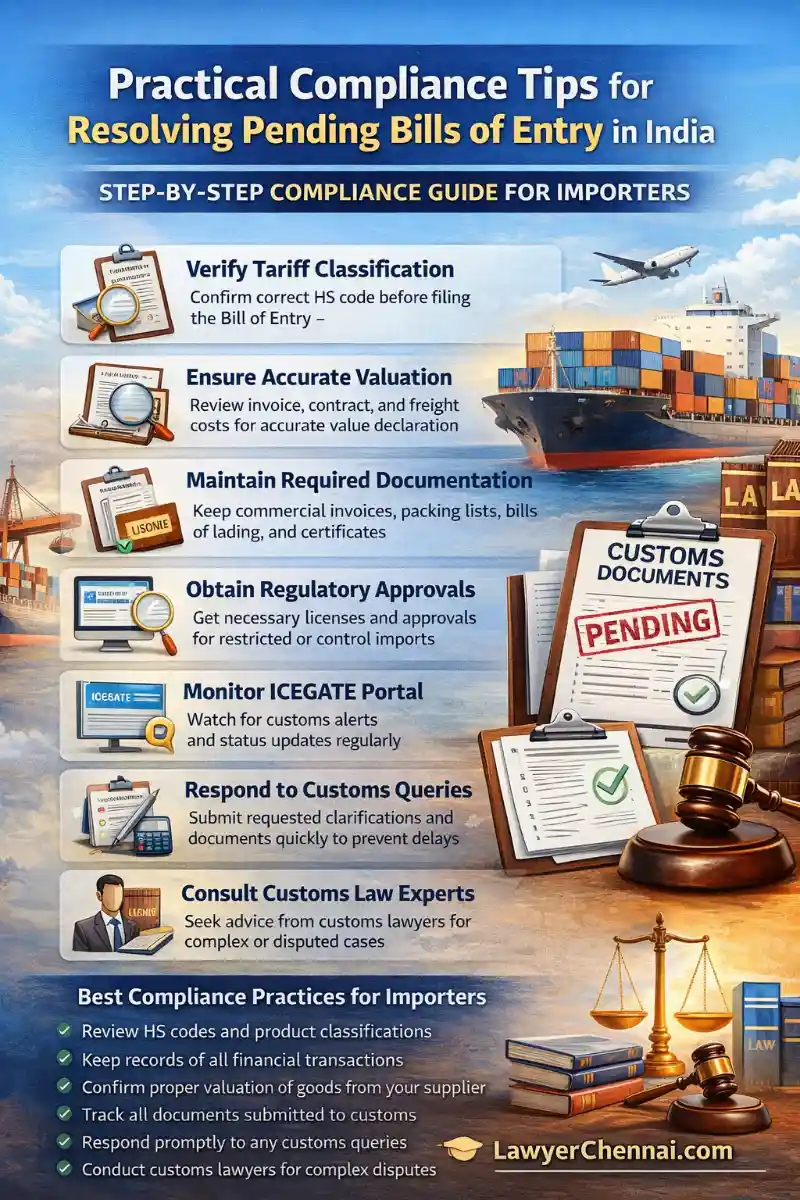
Importers should adopt structured compliance strategies to prevent unresolved customs documentation issues. Businesses involved in international trade must prioritize accurate customs declarations. Therefore, proper verification of documentation remains essential before filing the Bill of Entry. Importers should confirm tariff classification using updated customs tariff schedules. Furthermore, transaction values must match commercial invoices and contractual agreements. Accurate declarations reduce the risk of customs scrutiny. Companies should also verify regulatory approvals for restricted or regulated imports. Additionally, product descriptions must align with technical documentation and manufacturer certificates. Businesses should maintain organized records for each import transaction. Consequently, authorities can verify compliance quickly during customs examination. Import compliance teams should monitor the ICEGATE portal regularly. Legal advisors can review complex import documentation proactively. Strategic documentation management improves transparency with customs authorities. Preventive compliance measures ultimately reduce the likelihood of customs disputes.
Risk Management Strategies for Importers
Risk management plays a critical role in customs compliance. Importers should implement internal compliance policies for international trade operations. Therefore, companies must regularly audit import documentation and customs declarations. Import compliance audits identify errors before authorities initiate queries. Furthermore, training programs help logistics teams understand customs regulations. Businesses should maintain communication with customs brokers and legal advisors. Additionally, real-time monitoring of shipment documentation prevents discrepancies. Importers should review supplier invoices carefully before customs filing. Consequently, valuation disputes can be minimized significantly. Regulatory changes in customs law should also be monitored continuously. Legal professionals provide guidance regarding new compliance requirements. Businesses may adopt digital compliance systems for document management. Structured compliance programs strengthen the importer’s credibility before customs authorities. Effective risk management strategies protect businesses from penalties and litigation.
Legal Advisory Role in Customs Documentation Matters
Legal advisory services help businesses navigate complex customs regulatory frameworks. Experienced customs lawyers evaluate import documentation for compliance risks. Therefore, legal advisors often assist during Bill of Entry preparation. Importers benefit from professional analysis of tariff classification rules. Furthermore, legal experts interpret valuation provisions under customs regulations. Businesses frequently consult lawyers when customs queries arise. Legal advisors draft detailed responses addressing regulatory concerns. Additionally, professional representation improves communication with customs authorities. Lawyers also assist during personal hearings and adjudication proceedings. Consequently, importers receive strategic guidance during dispute resolution. Legal professionals examine judicial precedents affecting customs litigation. Their expertise strengthens the importer’s legal position significantly. Businesses should involve legal advisors during complex import transactions. Early legal consultation reduces compliance errors and prevents prolonged disputes.
Benefits of Professional Legal Assistance in Customs Matters
Professional legal assistance provides valuable protection during customs disputes. Importers often encounter complicated regulatory requirements during international trade operations. Therefore, legal expertise becomes essential for compliance management. Customs lawyers understand procedural requirements within customs assessment processes. Furthermore, advocates analyze legal provisions affecting tariff classification and valuation. Businesses benefit from structured legal strategies during dispute resolution. Legal professionals draft strong representations addressing customs queries effectively. Additionally, advocates represent importers during hearings and appellate proceedings. Strategic legal intervention often reduces litigation risks. Lawyers also monitor regulatory changes affecting import compliance. Consequently, businesses stay updated regarding evolving customs laws. Professional legal advice strengthens documentation accuracy and compliance confidence. Importers can resolve pending Bills of Entry more efficiently with legal support.
Conclusion: Resolving Pending Bills of Entry Through Strategic Legal Action
Pending Bills of Entry represent a serious operational challenge for importers. Delays in customs clearance disrupt supply chains and increase financial costs. Therefore, businesses must respond promptly to customs queries. Accurate documentation remains the most effective preventive strategy. Furthermore, importers should adopt systematic compliance procedures for every shipment. Strategic legal advice strengthens responses to customs authorities. Businesses may also pursue appellate remedies when disputes remain unresolved. Additionally, litigation before tribunals or courts may become necessary. Importers should carefully evaluate legal options before pursuing litigation. Professional legal guidance improves the chances of successful dispute resolution. Companies engaged in global trade must prioritize customs compliance. Effective documentation management prevents unnecessary legal complications. Ultimately, timely legal action ensures smooth customs clearance and regulatory compliance.
Practical Compliance Checklist for Importers
- Verify tariff classification before filing the Bill of Entry.
- Confirm transaction value with supporting commercial invoices.
- Maintain shipment documents including bill of lading and packing list.
- Obtain regulatory approvals for restricted or regulated goods.
- Monitor ICEGATE portal notifications regularly.
- Respond promptly to customs queries and documentation requests.
- Consult customs lawyers during complex import transactions.
- Maintain digital records for audit and compliance purposes.
Step by Step Compliance Process to Avoid Customs Disputes
- Review import contract and commercial invoice details.
- Confirm product classification using customs tariff schedules.
- Verify regulatory approvals required for specific goods.
- Prepare accurate Bill of Entry documentation.
- Upload documents through the ICEGATE customs portal.
- Respond quickly to customs verification queries.
- Attend hearings or meetings with customs authorities if required.
- Maintain documentation for audit and appellate purposes.
Frequently Asked Questions on Pending Bills of Entry
A Bill of Entry is a customs declaration filed by importers for clearance of goods and duty assessment.
A Bill of Entry remains pending due to valuation disputes, classification errors, documentation gaps, or regulatory compliance queries.
Importers should submit clarifications through ICEGATE with supporting documents such as invoices and product specifications.
Importers may seek reassessment, file appeals, request hearings, or approach tribunals and courts for dispute resolution.
The Commissioner of Customs (Appeals) usually hears the first statutory appeal against adjudication orders.
Yes, disputes may reach the Customs, Excise and Service Tax Appellate Tribunal when appellate orders remain contested.
High Courts may intervene through writ petitions when authorities violate procedural fairness or statutory provisions.
Penalties may include additional duty demand, confiscation of goods, interest liability, or regulatory fines.
Accurate documentation, tariff verification, regulatory approvals, and timely responses reduce the risk of pending entries.
Customs lawyers provide legal guidance, represent importers before authorities, and resolve disputes efficiently.
Read More


![Enforcement Directorate [ED] Summons Issued](https://www.lawyerchennai.com/wp-content/uploads/2024/01/Enforcement-Directorate-ED-Summons-768x432.jpg)