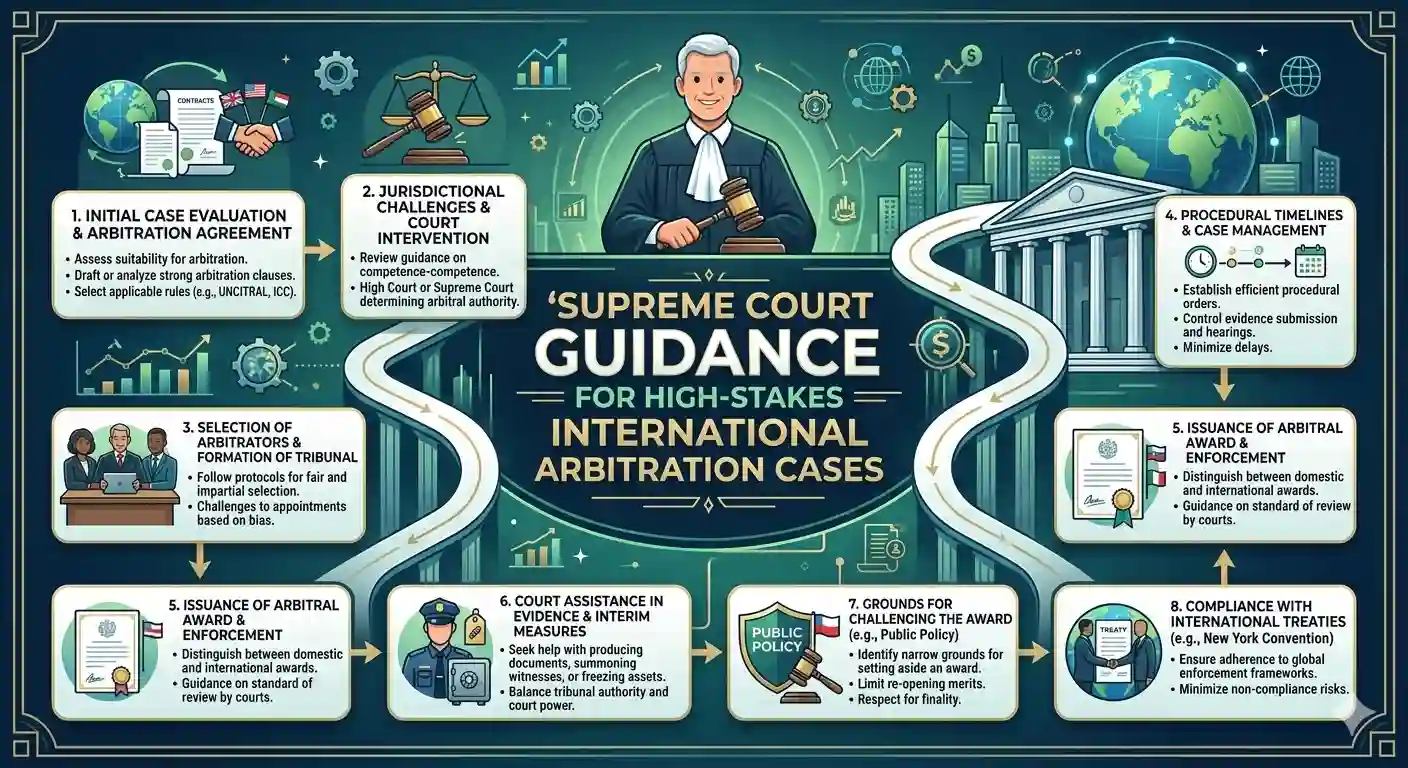
Supreme Court Guidance for High-Stakes International Arbitration Cases

In today’s global economy, businesses frequently enter into cross-border contracts. Naturally, when disputes arise, parties often choose arbitration instead of court litigation. International arbitration offers flexibility, confidentiality, and enforceability across countries. However, high-stakes arbitration cases involve large financial claims, complex legal issues, and strategic risks. Therefore, the guidance provided by the Supreme Court of India plays a critical role in shaping how international arbitration functions in India. Over the years, the Supreme Court has clarified important principles relating to jurisdiction, enforcement, interim relief, public policy, and judicial interference.
At LawyerChennai.com – Best Lawyer Firm in Chennai India 24×7, we closely follow these judicial developments. In this article, we explain, in simple words, how Supreme Court guidance impacts high-value international arbitration cases and why it matters for businesses.
Supreme Court Guidance for High-Stakes International Arbitration Cases – LawyerChennai.com – Best Lawyer Firm in Chennai India 24×7
The Legal Framework Governing International Arbitration in India
International arbitration in India is governed by the Arbitration and Conciliation Act, 1996. This law is based on the UNCITRAL Model Law and aims to promote minimal court interference.
The Act distinguishes between:
- Domestic arbitration
- International commercial arbitration seated in India
- Foreign-seated arbitration
- Enforcement of foreign awards
Over time, the Supreme Court has interpreted this Act to strengthen India’s position as an arbitration-friendly jurisdiction. Consequently, businesses now view India as more supportive of international dispute resolution.
Minimizing Judicial Interference
One of the most important principles laid down by the Supreme Court is minimal judicial interference. Arbitration is meant to be an alternative to lengthy court proceedings. Therefore, courts must not interfere unnecessarily.
The Supreme Court has repeatedly emphasized that courts should:
- Respect party autonomy
- Avoid re-examining merits of arbitral awards
- Intervene only in limited circumstances
This approach builds confidence among international investors and multinational corporations.
Determining Jurisdiction and Seat of Arbitration
In international arbitration, the “seat” of arbitration determines which country’s courts have supervisory jurisdiction. Naturally, disputes often arise regarding seat versus venue.
The Supreme Court has clarified that:
- The seat determines legal control.
- Venue alone does not decide jurisdiction.
- Clear contractual drafting is essential.
Therefore, businesses must draft arbitration clauses carefully. At LawyerChennai.com, we ensure that arbitration clauses clearly specify seat, governing law, and procedural rules to avoid future confusion.
Enforcement of Foreign Arbitral Awards
High-stakes disputes often result in foreign arbitral awards. However, enforcement becomes critical. Without enforceability, even a favorable award has no value.
Under Part II of the Arbitration and Conciliation Act, 1996, India recognizes and enforces foreign awards under the New York Convention.
The Supreme Court has consistently adopted a pro-enforcement approach. It has narrowed the scope of refusing enforcement only to specific grounds such as:
- Violation of public policy
- Lack of proper notice
- Invalid arbitration agreement
Importantly, the Court has clarified that “public policy” must be interpreted narrowly. This prevents misuse of objections to delay enforcement.
Public Policy – A Narrow Interpretation
Earlier, parties often challenged awards by broadly arguing that they violated public policy. However, the Supreme Court restricted this interpretation.
The Court has clarified that public policy grounds apply only when:
- The award violates fundamental policy of Indian law.
- The award is contrary to basic morality or justice.
- There is patent illegality (in domestic awards).
This clarification protects the finality of arbitration awards. Therefore, high-value international awards now face fewer challenges in Indian courts.
Interim Relief in International Arbitration
In urgent commercial disputes, parties may need immediate protection. For example:
- Freezing assets
- Securing disputed amounts
- Protecting intellectual property
- Preventing disposal of goods
The Supreme Court has clarified that Indian courts can grant interim relief even in foreign-seated arbitration in certain circumstances.
This ensures that Indian parties are not left without remedy during ongoing arbitration proceedings abroad.
Kompetenz-Kompetenz Principle
The principle of Kompetenz-Kompetenz allows arbitral tribunals to decide their own jurisdiction. The Supreme Court has supported this principle.
Therefore, courts should not prematurely decide jurisdictional objections unless absolutely necessary. Instead, tribunals should first examine:
- Validity of arbitration agreement
- Scope of arbitration clause
- Arbitrability of disputes
This approach strengthens arbitration autonomy and reduces early-stage litigation.
Arbitrability of Disputes
Not all disputes are arbitrable. The Supreme Court has clarified categories of non-arbitrable disputes such as:
- Criminal offences
- Matrimonial disputes
- Testamentary matters
- Certain insolvency matters
However, commercial disputes, shareholder disputes, and contractual claims are generally arbitrable.
Therefore, understanding arbitrability is crucial before invoking arbitration in high-value matters.
Time-Bound Resolution and Efficiency
High-stakes arbitration cases often involve complex documentation and expert evidence. However, delay defeats commercial purpose.
The Supreme Court has encouraged time-bound arbitration and strict compliance with statutory timelines. Amendments to the Act further emphasize speedy resolution.
As a result, India’s arbitration environment is becoming more efficient and business-friendly.
Limited Scope of Appeal
The Supreme Court has clarified that courts cannot act as appellate authorities over arbitral awards. Under Section 34, courts can set aside awards only on limited grounds.
They cannot:
- Reassess evidence
- Recalculate damages
- Substitute their interpretation
This principle protects finality and certainty in arbitration.
High-Stakes Arbitration and Corporate Strategy
In international arbitration involving large financial exposure, strategy becomes crucial. Businesses must carefully evaluate:
- Choice of seat
- Governing law
- Arbitration institution
- Appointment of arbitrators
- Enforcement jurisdictions
Supreme Court guidance helps lawyers design strong arbitration strategies aligned with Indian legal standards.
At LawyerChennai.com, we advise clients at the contract drafting stage itself. Prevention is always better than litigation.
Enforcement Challenges and Asset Tracing
Winning an award is only part of the battle. Enforcement requires identifying assets and initiating legal proceedings.
The Supreme Court has simplified enforcement procedures and discouraged unnecessary delays. This provides confidence to foreign investors doing business with Indian entities.
India as an Emerging Arbitration Hub
With progressive judicial decisions, India aims to become a global arbitration hub. The Supreme Court’s pro-arbitration stance has:
- Increased investor confidence
- Reduced judicial interference
- Strengthened enforceability
- Clarified legal ambiguities
Consequently, international businesses increasingly choose India-seated arbitration.
Role of Experienced Legal Representation
High-stakes arbitration requires specialized legal expertise. Lawyers must understand:
- International procedural rules
- Evidence management
- Cross-border enforcement
- Strategic negotiation
At LawyerChennai.com – Best Lawyer Firm in Chennai India 24×7, we provide round-the-clock assistance in complex arbitration matters. Our team handles drafting, representation, enforcement, and settlement negotiations with precision and strategic focus.
Practical Lessons from Supreme Court Guidance
From various landmark rulings, key lessons emerge:
- Draft arbitration clauses carefully.
- Specify clear seat and governing law.
- Avoid vague public policy arguments.
- Prepare strong documentation.
- Act promptly in enforcement.
These principles reduce risks in high-value cross-border disputes.
Frequently Asked Questions
The Supreme Court of India has consistently promoted a pro-arbitration approach. It has limited unnecessary judicial interference, clarified the meaning of public policy, and emphasized party autonomy. As a result, courts now interfere only on specific statutory grounds. This strengthens confidence among foreign investors and multinational companies.
International arbitration in India is governed by the Arbitration and Conciliation Act, 1996. The Act regulates domestic arbitration, international commercial arbitration seated in India, and enforcement of foreign awards. The Supreme Court has interpreted this Act to align with global standards. Consequently, enforcement of awards has become smoother, and the scope for challenging awards has been significantly narrowed.
Yes, but only on limited grounds. Courts may refuse enforcement if the award violates fundamental public policy, lacks a valid arbitration agreement, or breaches principles of natural justice. However, the Supreme Court has clearly stated that public policy must be interpreted narrowly. Therefore, courts cannot re-examine the merits of the case or reassess evidence.
The seat determines which country’s courts have supervisory jurisdiction. The Supreme Court has clarified that the seat, not merely the venue, governs legal control. Therefore, clear drafting of arbitration clauses is crucial in high-stakes contracts.
Businesses should draft precise arbitration clauses, choose a favorable seat, maintain proper documentation, seek timely interim relief if needed, and engage experienced arbitration lawyers for strategic representation and enforcement.
Conclusion
International arbitration has become the preferred dispute resolution mechanism for global commerce. However, its effectiveness depends largely on judicial support.
The Supreme Court of India has played a transformative role in strengthening India’s arbitration regime. By limiting judicial interference, narrowing public policy grounds, supporting enforcement, and promoting efficiency, the Court has aligned India with global standards.
For businesses involved in high-stakes international arbitration, understanding these principles is essential. Strategic planning, proper drafting, and timely legal action can protect substantial financial interests.
At LawyerChennai.com – Best Lawyer Firm in Chennai India 24×7, we combine legal knowledge with practical experience. We guide clients through every stage of arbitration—from drafting agreements to enforcing awards.
Read More
- Government Employee Benefits vs Private Company Employee Benefits in India
- Challenging Arbitration Awards: Supreme Court Representation in India
- Employee Rights in Unpaid Salary Cases in India – Complete Legal Guide
- Grounds for Director Disqualification and Removal of Disqualification
- Red Corner Notice Explained: Can You Be Arrested Without Trial?
- Supreme Court of India – Official Website