
Job With 3 Years Bond: Can I Quit?
Many employees sign employment bonds while joining companies, especially in IT, banking, and corporate sectors. However, confusion often arises when workers wish to resign before completing the bond period. A common question employees ask is whether they can legally quit a job with a 3-years bond. Indian law does not automatically enforce every employment bond. Courts evaluate whether the bond remains reasonable, whether the employer incurred actual training expenses, and whether the compensation demanded reflects genuine financial loss. Employees cannot be forced to continue working against their will because the Constitution protects the freedom to practice any profession. However, employers may seek limited compensation if a legitimate loss occurs. This guide explains employment bond legality in India, employee rights after resignation, employer legal options, and practical strategies to exit bonded jobs safely. Understanding these legal principles helps employees protect their careers while avoiding unnecessary disputes or financial liabilities.
Understanding Employment Bonds in India
Employment bonds appear frequently in Indian corporate hiring, especially in IT, banking, healthcare, and startup sectors. Many fresh graduates accept these agreements because companies promise training, job stability, and structured career growth. However, confusion often arises when employees later wish to resign before completing the bond period.
An employment bond usually requires the employee to work for a fixed period. Companies often mention two years, three years, or even five years. Employers claim that training investment, onboarding expenses, and project commitments justify the bond requirement.
However, Indian labour law does not automatically enforce every employment bond. Courts examine whether the bond remains reasonable and lawful. Judges normally consider training expenses, duration of restriction, and employee freedom to change employment.
Moreover, Indian law protects the right to livelihood and professional mobility. Article 19(1)(g) of the Constitution supports the freedom to practice any profession.
Therefore, many employees ask an important question: “Can I quit a job with a 3-year bond?”
The answer depends on contract terms, employer conduct, and actual financial loss.
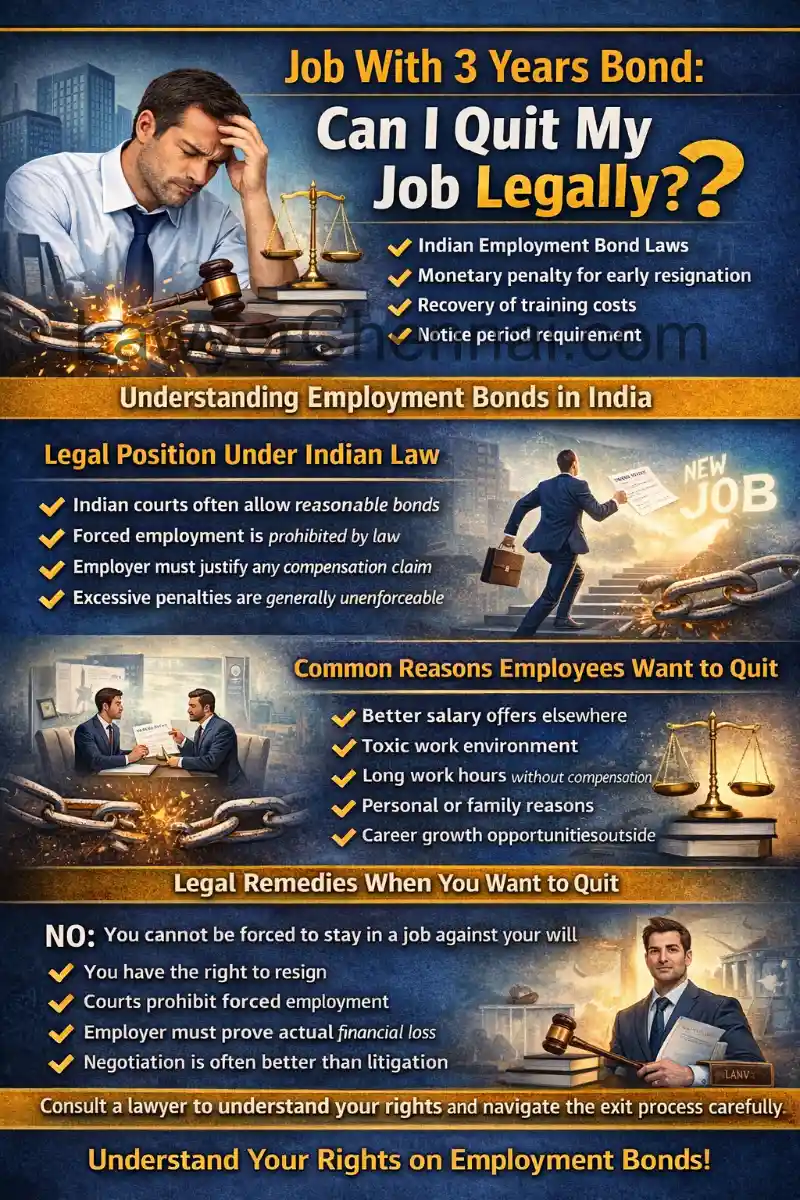
Key Characteristics of Employment Bonds
Employment bonds typically include several contractual conditions.
• Fixed service period such as two or three years
• Monetary penalty for early resignation
• Recovery of training expenses
• Mandatory notice period
• Non-compete or confidentiality clauses
Nevertheless, courts rarely allow arbitrary or excessive penalties.
Why Companies Impose Job Bonds
Employers implement job bonds primarily to protect business investment and project continuity. Large companies often spend significant amounts on training fresh graduates.
For instance, software firms invest months teaching coding frameworks, client processes, and proprietary technologies. Consequently, sudden resignations may disrupt project delivery.
Employers therefore use employment bonds as retention tools.
However, the law distinguishes reasonable protection from forced employment.
Companies cannot force employees to work against their will.
Therefore, a bond does not automatically prevent resignation.
Common Situations Where Employees Want to Quit
Employees often consider leaving bonded jobs due to various professional and personal reasons.
• Higher salary offers from competitors
• Toxic work environment or harassment
• Unreasonable working hours
• Career stagnation or skill mismatch
• Relocation or family circumstances
Moreover, many employees realize the bond terms appear unfair or legally questionable.
Consequently, they seek legal clarity before resigning.
Important Question: Is a 3-Year Bond Legal in India?
Indian courts generally allow employment bonds if they remain reasonable and compensate genuine loss.
However, judges invalidate bonds that resemble forced labour or excessive financial punishment.
Therefore, enforceability depends on multiple legal factors.
• Actual training expenses incurred by employer
• Duration of bond period
• Reasonableness of penalty amount
• Proof of financial loss
• Nature of employee role
Furthermore, courts repeatedly stress that employment contracts must respect personal freedom.
Quick Legal Insight
Indian law does not prohibit employment bonds entirely.
Yet courts strike down unfair bonds.
Therefore, employees may legally quit despite a bond under several circumstances.
Typical Legal Issues in Employment Bond Disputes
Employment bond disputes often lead to several legal conflicts.
• Employer sends legal notice demanding compensation
• Company withholds relieving letter or experience certificate
• Employer threatens civil recovery suit
• Employer withholds salary or documents
• Employee fears blacklisting in industry
However, employees possess legal remedies against unlawful employer actions.
Preliminary Legal Advice for Employees
Before resigning from a bonded job, employees should carefully examine the employment agreement.
They must also evaluate the following aspects.
- Review bond terms and penalty clauses carefully.
- Check whether training actually occurred.
- Verify if penalty equals genuine expenses.
- Assess notice period obligations.
- Consult an employment lawyer if required.
Moreover, documentation plays a critical role during legal disputes.
Therefore, employees should preserve offer letters, appointment letters, and bond agreements.
Indian Contract Act and Employment Bonds
Employment bonds operate within the framework of the Indian Contract Act, 1872. Every employment agreement must satisfy the legal requirements of a valid contract. Courts therefore analyze employment bonds using basic contract law principles.
A valid contract requires lawful consideration, free consent, competent parties, and lawful object. Consequently, a bond agreement must respect these requirements to remain enforceable.
However, employment bonds often face scrutiny under Section 27 of the Indian Contract Act. This provision declares agreements restraining trade as void. Employers therefore cannot impose restrictions that prevent professional mobility.
Nevertheless, courts recognize a narrow exception. Companies may protect legitimate business interests through reasonable restrictions.
Therefore, employment bonds linked to training investment sometimes survive judicial review.
However, excessive or punitive penalties usually fail in courts.
Key Legal Principles Governing Employment Bonds
Courts frequently rely on several legal principles while deciding employment bond disputes.
• Restriction must remain reasonable and limited.
• Employer must prove genuine financial loss.
• Bond period must not be excessive.
• Employee freedom to change employment must remain intact.
• Penalty clauses cannot become punitive.
Moreover, judges closely examine employer conduct and fairness.
Therefore, enforceability varies depending on factual circumstances.
Section 27: Restraint of Trade
Section 27 plays a central role in employment bond disputes.
The law states that agreements restraining lawful profession remain void. Consequently, employers cannot block employees from pursuing another job.
However, reasonable restrictions protecting training investment sometimes receive judicial approval.
Courts therefore draw a distinction between reasonable protection and absolute restraint.
A three-year bond often raises suspicion because it restricts employee mobility for a long duration.
However, courts examine the surrounding circumstances before deciding validity.
Reasonable vs Unreasonable Employment Bonds
Indian courts evaluate whether the bond remains reasonable.
Several factors influence this determination.
• Nature of employee training
• Duration of employment restriction
• Amount of compensation demanded
• Employer’s actual financial investment
• Market conditions in the industry
For example, a six-month training investment may justify a short bond period.
However, a three-year restriction without specialized training appears excessive.
Therefore, courts frequently reduce or reject unreasonable claims.
Liquidated Damages vs Penalty Clauses
Employment bonds usually contain a compensation clause for early resignation.
This clause may appear as liquidated damages or penalty.
Courts treat both concepts differently under Section 74 of the Indian Contract Act.
Liquidated damages represent a genuine pre-estimate of loss.
Penalty clauses, however, punish breach rather than compensate loss.
Therefore, courts enforce only reasonable compensation.
Employers cannot demand arbitrary amounts without evidence.
Courts Require Proof of Training Expenses
Many companies claim high training costs to justify employment bonds.
However, courts demand documentary proof of these expenses.
Employers must demonstrate the following elements.
• Actual training program conducted
• Expenses incurred on instructors and materials
• Duration and quality of training
• Benefit gained by the employee
Without such proof, courts rarely award compensation.
Consequently, several employer claims fail during litigation.
Important Court Judgments on Employment Bonds
Indian courts have repeatedly clarified the law regarding employment bonds.
These landmark rulings provide guidance to employees and employers.
- Niranjan Shankar Golikari vs Century Spinning (1967)
The Supreme Court upheld reasonable employment restrictions during active service. - Superintendence Company vs Krishan Murgai (1980)
The Supreme Court rejected unreasonable post-employment restraints. - Satyam Computer Services vs Ladella Ravichander
Courts emphasized proof of training costs. - Toshnial Brothers vs E. Eswarprasad
Reasonable compensation clauses received limited enforcement.
These cases highlight a consistent judicial approach.
Courts protect legitimate employer interests.
However, they strongly oppose forced employment.
Legal Interpretation of Three-Year Employment Bonds
A three-year employment bond often raises legal concerns.
Indian courts usually evaluate such bonds carefully.
The following issues frequently arise.
• Lack of substantial training investment
• Disproportionate penalty amount
• Restriction on employee career growth
• Absence of documented employer loss
Consequently, many three-year bonds struggle to survive judicial scrutiny.
However, enforceability still depends on case-specific facts.
Key Legal Takeaways for Employees
Employees must understand the practical legal position before resigning.
Several points deserve careful attention.
• Employment bonds do not guarantee enforceability.
• Companies must prove actual financial loss.
• Courts discourage forced employment relationships.
• Excessive penalties often fail legal scrutiny.
Therefore, employees should avoid panic when employers threaten legal action.
Most disputes resolve through negotiation or settlement.
Practical Risk Assessment Before Resignation
Employees should conduct a basic legal risk analysis.
This evaluation helps avoid unnecessary conflict.
- Review the employment bond carefully.
- Identify penalty clause details.
- Check whether training actually occurred.
- Assess employer behaviour and company policy.
- Consult a labour lawyer if dispute appears likely.
Moreover, professional legal advice often prevents escalation.
Therefore, employees should act strategically rather than emotionally.
Freedom to Resign Under Indian Law
Indian employment law strongly supports the freedom of workers to change jobs. Courts repeatedly emphasize that no employer can force an employee to continue working against their will. Consequently, employment bonds cannot convert a professional relationship into forced labour.
Article 19(1)(g) of the Constitution protects the right to practice any profession. Therefore, employees retain the freedom to resign even during a bond period. However, the employer may claim compensation if genuine financial loss occurs.
Companies sometimes threaten legal consequences to discourage resignations. Nevertheless, resignation itself does not become illegal. The dispute normally relates only to financial compensation.
Therefore, employees must distinguish between right to resign and liability to compensate.
Resignation remains lawful. Compensation liability depends on contract terms and evidence of loss.
Important Legal Position
Courts consistently reject any attempt to restrain employees from leaving a job.
Employers cannot legally:
• Force employees to continue working
• Block career opportunities
• Physically or legally detain employees
• Prevent resignation acceptance indefinitely
However, employers may initiate civil proceedings to recover training expenses.
Employer Actions After Early Resignation
When an employee resigns before completing a bond period, companies often adopt several strategies. These actions usually attempt to pressure the employee into continuing employment.
Common employer responses include the following.
• Issuing legal notice demanding bond compensation
• Withholding relieving letter or experience certificate
• Delaying final settlement payments
• Threatening legal recovery proceedings
• Informal blacklisting threats
However, many of these actions lack strong legal backing.
Courts frequently criticize employers who misuse employment bonds as intimidation tools.
Therefore, employees should remain calm and understand their legal position.
Can a Company File a Case Against an Employee?
Yes, companies may file a civil recovery suit if an employee violates a bond agreement. However, success depends entirely on evidence presented in court.
Employers must prove the following elements.
- A valid employment bond exists.
- The employee breached the agreement.
- The company suffered financial loss.
- The compensation amount remains reasonable.
Without proof of actual loss, courts usually reject recovery claims.
Therefore, litigation rarely produces huge damages against employees.
Criminal Cases and Employment Bonds
Many employees fear criminal cases after leaving bonded employment.
However, employment bond disputes remain purely civil matters.
Employers cannot file criminal charges for simple resignation.
Criminal law may apply only in extreme circumstances.
Examples include:
• Theft of company property
• Fraud or financial misconduct
• Disclosure of confidential information
• Data theft or intellectual property violation
Simple resignation does not trigger criminal liability.
Therefore, criminal threats from employers usually carry little legal merit.
Withholding Experience Letter or Relieving Letter
Some employers refuse to issue experience certificates after bond breach.
This practice often creates difficulties for employees joining new organizations.
However, courts increasingly view such conduct as unfair labour practice.
Employees may pursue legal remedies if companies deliberately withhold documents.
Possible actions include:
• Labour department complaint
• Legal notice demanding document release
• Civil suit for declaration and damages
Therefore, employees possess legal tools to protect professional reputation.
Salary Withholding and Final Settlement Issues
Employers sometimes hold pending salary or final settlement after early resignation.
However, salary earned for completed work cannot be withheld arbitrarily.
The law distinguishes between salary entitlement and bond compensation claims.
Therefore, companies cannot automatically deduct salary without proper justification.
Employees may challenge such deductions through legal channels.
Common legal remedies include:
• Labour commissioner complaint
• Payment of Wages Act claim
• Legal notice for recovery
• Civil recovery suit
Therefore, employees should track salary slips, bank statements, and employment documents carefully.
Notice Period Obligations
Even when a bond exists, notice period clauses remain important.
Employees must normally serve the contractual notice period before resignation.
However, employers sometimes demand both notice period compliance and bond compensation.
Courts examine whether these clauses remain reasonable and non-punitive.
Employees therefore have several options.
- Serve the full notice period.
- Pay salary in lieu of notice.
- Negotiate mutual separation.
Negotiation often resolves disputes quickly and avoids litigation.
Negotiation and Settlement Strategy
Many employment bond disputes resolve through negotiation rather than court proceedings.
Employees can approach the situation strategically.
• Initiate professional communication with HR.
• Offer partial compensation for training.
• Request early release through mutual agreement.
• Document every communication carefully.
Employers often prefer settlement rather than litigation.
Court proceedings consume time, money, and managerial attention.
Therefore, negotiation frequently produces a practical outcome.
Realistic Risk Assessment for Employees
Employees should evaluate the practical risks before resigning from bonded employment.
Several factors influence the outcome.
• Reputation of the employer
• Actual training investment
• Amount mentioned in bond
• Industry norms
• Company litigation history
Most employers avoid lengthy legal battles for small compensation amounts.
Consequently, threats of litigation often remain strategic pressure tactics.
When Legal Advice Becomes Necessary
Certain situations require professional legal consultation.
Employees should consult an employment lawyer when:
• Employer sends a legal notice
• Salary or documents remain withheld
• Bond penalty appears excessive
• Employer threatens litigation
Professional legal guidance ensures that employees respond correctly.
Early legal intervention often prevents escalation.
Legal Options Available to Employees
Employees often believe they must obey employment bonds without question. However, Indian law provides several remedies when employers impose unreasonable restrictions. Courts encourage fairness in employment contracts and discourage coercive practices.
Therefore, employees possess multiple legal strategies when leaving a bonded job. These remedies help protect career mobility, salary rights, and professional reputation.
Employees should first analyze the employment contract and supporting documents. Offer letters, appointment letters, training agreements, and email communications often become important evidence.
Legal remedies generally depend on employer conduct after resignation. Some companies behave reasonably and negotiate exit terms. Other organizations attempt intimidation through legal notices or document withholding.
Therefore, employees must adopt a structured approach.
Primary Legal Remedies for Employees
Employees facing employment bond disputes may consider the following legal options.
• Sending a legal reply to employer notice
• Negotiating settlement with the employer
• Filing complaint before Labour Commissioner
• Initiating civil proceedings for recovery of withheld salary
• Seeking declaration against unlawful bond enforcement
Each remedy serves a different strategic purpose.
Employees should choose the appropriate path after evaluating facts and risks.
Sending a Legal Notice to the Employer
A legal notice often becomes the first defensive step when disputes escalate.
Employees may send a notice through an employment lawyer explaining their legal position. This notice typically highlights the following issues.
• Unreasonable bond duration
• Lack of actual training investment
• Excessive penalty clause
• Illegal withholding of salary
• Denial of relieving documents
Such notices frequently discourage aggressive employer actions.
Companies often reconsider litigation when they receive a strong legal response.
Therefore, professional communication often resolves disputes quickly.
Filing a Complaint Before Labour Authorities
Employees may approach the Labour Commissioner when employers adopt unfair practices.
Labour authorities possess powers to examine employment disputes and initiate conciliation.
Common grievances submitted before labour authorities include:
• Salary withholding
• Refusal to issue relieving letter
• Forced recovery of bond penalty
• Harassment during resignation process
The labour department often encourages negotiation between employer and employee.
Consequently, many disputes settle during conciliation proceedings.
This approach usually saves time and legal expenses.
Filing Civil Suit for Declaration
Employees may file a civil suit seeking declaration that the bond remains unenforceable.
Courts examine contract fairness, penalty reasonableness, and employer conduct during such cases.
The court may grant relief such as:
• Declaration that bond clause remains void
• Permanent injunction against recovery claims
• Compensation for harassment or salary withholding
However, litigation requires time, documentation, and legal expenses.
Therefore, employees usually prefer negotiation before approaching courts.
Recovery of Salary or Experience Certificate
Employers sometimes refuse to release salary, relieving letter, or experience certificate.
Such conduct affects employee career progression and reputation.
Employees may pursue legal remedies to recover these entitlements.
Common legal routes include:
- Legal notice demanding document release.
- Labour complaint regarding unfair practice.
- Civil recovery suit for unpaid salary.
- Complaint under Payment of Wages Act.
Courts generally support employee rights in such situations.
Employers cannot use documents as pressure tools.
Injunction Against Employer Harassment
Some employers threaten employees with aggressive legal tactics after resignation.
Threats may include industry blacklisting or legal harassment.
Employees may seek court protection if such conduct continues.
Courts may grant injunction orders preventing harassment or unlawful communication.
Such orders protect employee reputation and professional prospects.
However, courts expect genuine evidence before granting injunction relief.
Therefore, employees should preserve communication records.
Importance of Documentation in Employment Bond Disputes
Documentation plays a decisive role in employment litigation.
Employees should maintain proper records from the beginning of employment.
Important documents include:
• Appointment letter and employment contract
• Employment bond agreement
• Training program details
• Salary slips and bank statements
• Email communication with HR
Strong documentation improves the chances of favourable legal outcomes.
Therefore, employees should avoid deleting important employment records.
Alternative Dispute Resolution Methods
Many employment disputes resolve through alternative dispute resolution methods.
Mediation and arbitration often provide faster outcomes than traditional litigation.
Employers sometimes include arbitration clauses in employment contracts.
Under such clauses, disputes may proceed before a private arbitrator.
Advantages of arbitration include:
• Faster resolution
• Confidential proceedings
• Flexible procedural rules
• Reduced court involvement
However, arbitration may also involve legal costs.
Employees should therefore review arbitration clauses carefully.
Strategic Exit Planning for Bonded Employees
Employees planning resignation should follow a careful exit strategy.
This approach minimizes conflict and legal risk.
Key steps include:
- Review employment bond terms carefully.
- Evaluate penalty clause reasonableness.
- Assess training investment claims.
- Serve proper notice period.
- Maintain professional communication with HR.
Strategic planning helps employees exit gracefully without unnecessary disputes.
Moreover, professional conduct often influences employer attitude.
Practical Advice From Employment Lawyers
Employment lawyers often advise employees to avoid panic when facing bond disputes.
Many employers issue legal threats but rarely pursue litigation.
Court proceedings require time, documentation, and legal resources.
Therefore, employers sometimes prefer negotiation instead of litigation.
However, employees must respond carefully to legal notices.
Ignoring formal legal communication may create complications.
Professional legal advice ensures correct response strategy.
Smart Strategies Before Leaving a Bonded Job
Employees often panic after receiving better job offers during a bond period. However, careful planning helps avoid unnecessary legal complications. A structured exit strategy protects both career growth and legal safety.
First, review the employment agreement and bond document carefully. Examine the bond duration, compensation clause, and training obligations. Many employees discover that the bond contains vague or unenforceable conditions.
Next, assess the actual training investment provided by the employer. Courts often reject bonds when companies fail to prove genuine expenses. Therefore, training documentation becomes important evidence.
Moreover, employees should maintain professional communication with the employer. Respectful resignation letters and proper notice periods often reduce conflict.
Consequently, a strategic approach prevents escalation and protects long-term professional reputation.
Essential Steps Before Submitting Resignation
Employees should complete several precautionary steps before leaving a bonded job.
• Carefully read the employment bond agreement.
• Evaluate penalty clauses and compensation amounts.
• Check the notice period requirements.
• Review company HR policies regarding early resignation.
• Preserve employment documents and communication records.
These steps reduce the risk of unnecessary disputes.
Professional Resignation Strategy
Employees should draft a clear and professional resignation letter. Emotional communication often worsens employer response.
A professional resignation message should include:
- Formal resignation statement.
- Last working day based on notice period.
- Commitment to project transition.
- Request for relieving letter and final settlement.
Such communication signals professionalism and cooperation.
Consequently, employers often respond more positively.
Negotiating Early Release From Bond
Negotiation remains the most practical solution for employment bond disputes. Many companies prefer settlement rather than legal confrontation.
Employees may propose a mutual exit agreement with the employer. Negotiation often involves partial compensation for training expenses.
Common negotiation strategies include:
• Offering partial reimbursement of training cost.
• Requesting waiver of bond due to personal circumstances.
• Proposing extended notice period instead of compensation.
• Requesting employer discretion for career growth reasons.
Employers often accept reasonable proposals.
When Employers Send Legal Notices
Some companies issue legal notices demanding bond compensation after resignation.
Employees should not ignore such notices.
Instead, they should consult an employment lawyer and send a formal reply.
A proper legal reply may include:
• Denial of unreasonable bond claims.
• Request for proof of training expenses.
• Assertion of constitutional right to employment mobility.
• Demand for release of salary and documents.
Such replies often discourage further action from employers.
Risks Employees Should Understand
Employees should realistically evaluate possible risks before leaving bonded employment.
Possible employer actions include:
• Legal notice demanding compensation
• Civil recovery suit for damages
• Delay in experience certificate issuance
• HR verification complications
However, many disputes settle before reaching court.
Employers rarely pursue lengthy litigation for moderate bond amounts.
Practical Example of Employment Bond Dispute
Consider a common situation in the IT industry.
A software engineer signs a three-year employment bond with ₹2,00,000 compensation clause. After one year, the employee receives a higher salary offer.
The engineer decides to resign and serve the required notice period.
The company issues a legal notice demanding full bond compensation.
However, the employer fails to prove training investment during legal consultation.
Consequently, the dispute resolves through negotiation with minimal compensation.
This scenario occurs frequently in Indian employment disputes.
Best Practices for Employees Leaving Bonded Jobs
Employees should follow best practices to minimize legal risk.
• Maintain professional conduct during resignation.
• Serve proper notice period whenever possible.
• Document all communication with the employer.
• Avoid confrontation with HR or management.
• Seek legal advice before responding to notices.
These practices strengthen employee credibility.
When Litigation Becomes Necessary
Some disputes escalate despite negotiation efforts.
Employees may consider litigation in the following circumstances.
• Employer withholds salary unlawfully.
• Company refuses to issue relieving letter.
• Employer demands unreasonable compensation.
• Harassment or intimidation occurs after resignation.
Courts generally evaluate employment bonds carefully.
Judges balance employer investment with employee career freedom.
Therefore, litigation often results in reasonable outcomes.
Role of Employment Lawyers in Bond Disputes
Employment lawyers help employees understand legal rights and practical strategies. Professional advice often prevents unnecessary legal complications.
Lawyers typically assist in several areas.
• Reviewing employment bond agreements
• Drafting legal notices and replies
• Negotiating settlements with employers
• Representing employees before courts or labour authorities
Early legal consultation often saves time and financial loss.
Frequently Asked Questions
Yes. Employees may resign anytime. However, employers may claim reasonable compensation for genuine training expenses.
Courts allow reasonable bonds linked to training costs. Excessive or unfair bonds often become unenforceable.
No. Indian law prohibits forced employment. Employers may only claim compensation through civil proceedings.
No. Employment bond disputes remain civil matters unless fraud or criminal misconduct occurs.
No. Salary for completed work remains payable. Employers cannot deduct arbitrary bond compensation without proof.
Usually not. Most employers focus on skills and experience rather than previous bond disputes.
Yes. Many disputes resolve through negotiation or partial settlement instead of litigation.
Employers should issue experience certificates. Employees may seek legal remedy if companies refuse.
Yes. Employers may file a civil recovery suit. However, they must prove actual financial loss.
Legal advice helps assess risk, respond to notices, and negotiate settlement effectively.
Read more
- Employment and Service Law
- Government Employee Benefits vs Private Company Employee Benefits in India
- Immigration
- Employee Rights in Unpaid Salary Cases in India – Complete Legal Guide
- Madras High Court Clarifies FIR Limitation Period: Final Report vs. FIR Registration Date
- Ministry of Labour & Employment: Home
- Supreme Court Guidance for High-Stakes International Arbitration Cases