
Challenging Family Court Divorce Decree in High Court – Complete Legal Process
A divorce decree from a Family Court can change a person’s life forever. It affects marriage status, children, property, maintenance, and future rights. Sometimes, however, the decision may feel unfair, rushed, or legally incorrect. In such situations, the law provides a remedy. A party can challenge the Family Court divorce decree before the High Court.
At LawyerChennai.com, we understand how emotionally and legally complex divorce matters can be. Therefore, we guide clients carefully through the complete legal process of challenging a Family Court decree, with clarity, compassion, and confidence.
Challenging Family Court Divorce Decree in High Court – Complete Legal Process: LawyerChennai.com
Understanding a Family Court Divorce Decree
A divorce decree is the final judgment passed by a Family Court after hearing both spouses. It legally dissolves the marriage and may include directions on:
- Child custody and visitation
- Maintenance or alimony
- Division of property
- Other matrimonial rights
Although Family Courts aim for fair outcomes, errors can happen. Therefore, Indian law allows an aggrieved party to approach the High Court for relief.
Can a Family Court Divorce Decree Be Challenged?
Yes. A Family Court divorce decree can be challenged before the High Court under the provisions of the Family Courts Act, 1984 and the Code of Civil Procedure.
However, the challenge must be based on valid legal grounds. The High Court does not re-try the case casually. Instead, it examines whether the Family Court committed legal or procedural errors.
Common Grounds for Challenging a Divorce Decree
Legal Errors in Judgment
If the Family Court misapplied the law or ignored binding legal principles, the decree can be challenged. For example, incorrect interpretation of divorce grounds may form a valid basis.
Lack of Proper Evidence Appreciation
Sometimes, courts may overlook key evidence or rely on weak proof. If the judgment is not supported by evidence on record, the High Court may interfere.
Violation of Natural Justice
If one party was not given a fair opportunity to present their case, cross-examine witnesses, or submit documents, the decree can be challenged for violating principles of natural justice.
Procedural Irregularities
Failure to follow proper legal procedure, such as improper service of notice or denial of hearing, can invalidate the decree.
Perverse or Unreasonable Findings
If the conclusions drawn by the Family Court are unreasonable or against common sense, the High Court may re-examine the findings.
Time Limit to Challenge a Divorce Decree
Time is critical. Generally, an appeal against a Family Court decree must be filed within 90 days from the date of the judgment.
Delay can weaken the case. However, in genuine circumstances, courts may condone delay if sufficient reasons are shown. Therefore, seeking early legal advice is always advisable.
Types of Challenges Before the High Court
Appeal Against Divorce Decree
An appeal is the most common remedy. It allows the High Court to examine the correctness of the Family Court’s judgment on facts and law.
Revision Petition
In limited cases, a revision petition may be filed where jurisdictional errors or serious procedural lapses exist.
Writ Petition
In exceptional circumstances involving violation of fundamental rights or grave injustice, writ jurisdiction may be invoked.
At LawyerChennai.com, we carefully assess which legal route suits each case best.
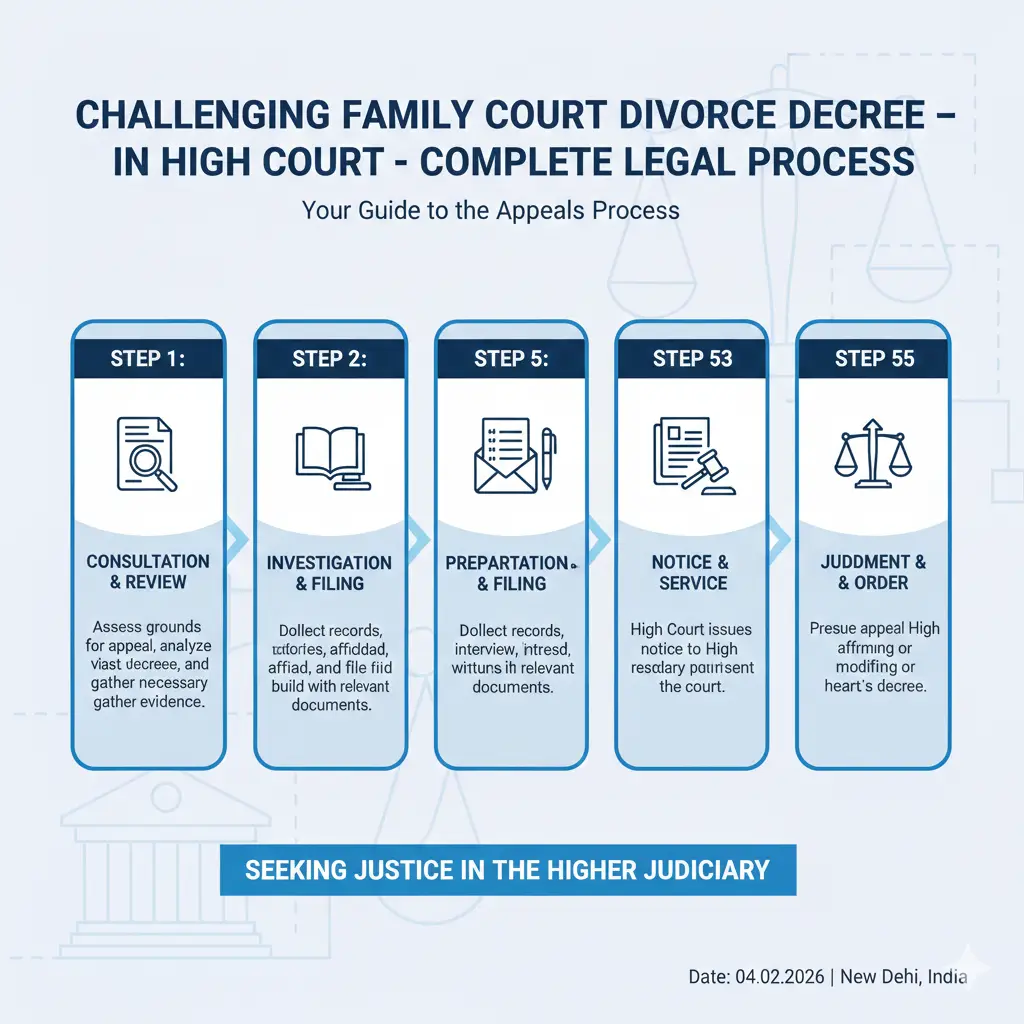
Step-by-Step Legal Process in the High Court
Step 1: Detailed Case Evaluation
First, our lawyers study the Family Court judgment, evidence, pleadings, and trial records. This step helps identify legal flaws and strengths.
Then, we advise clients honestly about chances, risks, and expected outcomes.
Step 2: Drafting the Appeal or Petition
Once grounds are identified, we draft a strong appeal or petition. This document clearly explains:
- Errors in the Family Court judgment
- Legal provisions violated
- Relief sought from the High Court
Clear drafting is crucial because the High Court relies heavily on written pleadings.
Step 3: Filing and Admission
After drafting, the appeal is filed before the appropriate High Court bench. The court then decides whether to admit the case.
If admitted, notices are issued to the opposite party.
Step 4: Stay of Divorce Decree (If Applicable)
In some cases, clients may seek a stay on the operation of the divorce decree or related orders, such as remarriage permissions or execution of maintenance.
The High Court may grant interim relief based on urgency and merits.
Step 5: Hearing and Arguments
During hearings, lawyers present legal arguments supported by case laws and records. The High Court examines whether interference is justified.
Unlike trial courts, the High Court focuses more on legal correctness than fresh evidence.
Step 6: Final Judgment
After hearing both sides, the High Court may:
- Uphold the Family Court decree
- Modify parts of the decree
- Set aside the decree
- Remand the matter back to the Family Court
The final outcome depends on facts, law, and judicial discretion.
Issues Commonly Raised Along with Divorce Appeals
Child Custody and Visitation
Many appeals involve disputes over child custody. The High Court prioritizes the child’s welfare above all else.
Maintenance and Alimony
Unfair or unrealistic maintenance orders are often challenged. Courts review income, liabilities, and living standards carefully.
Property and Asset Division
Incorrect findings regarding joint property or financial contributions can be corrected with proper legal arguments.
Importance of Strong Legal Representation
Challenging a divorce decree is not just a legal battle—it is an emotional journey. Therefore, having experienced advocates makes a real difference.
At LawyerChennai.com, we combine legal precision with human understanding. We ensure that clients feel heard, supported, and informed at every stage.
How LawyerChennai.com Helps You
Experienced Family Law Team
Our lawyers have extensive experience in Family Courts and High Courts. This experience helps us anticipate challenges and prepare strong strategies.
Clear and Honest Advice
We believe in transparency. Therefore, we explain legal options clearly and avoid false promises.
Personalized Legal Strategy
Every family dispute is unique. Hence, we design case strategies based on individual facts, not generic formulas.
Professional and Ethical Practice
We follow high ethical standards and respect client confidentiality at all times.
Alternative Options Alongside Appeals
In some cases, settlement or mediation may offer quicker relief. Therefore, we also explore negotiated solutions when appropriate.
However, if litigation is necessary, we pursue it with full commitment.
Key Things to Remember Before Challenging a Divorce Decree
- Act within the limitation period
- Preserve all court records and documents
- Avoid emotional decisions without legal advice
- Focus on legal grounds, not personal grievances
Proper preparation improves the chances of success.
Frequently Asked Questions
Yes, a Family Court divorce decree can be challenged before the High Court by filing an appeal under the Family Courts Act, 1984. The High Court examines whether the Family Court committed legal errors, procedural lapses, or ignored material evidence while passing the judgment.
Generally, an appeal against a Family Court divorce decree must be filed within 90 days from the date of the judgment. If there is a delay, the appellant must provide valid reasons. Courts may condone delay only if sufficient cause is shown.
A divorce decree can be challenged on grounds such as incorrect application of law, lack of proper appreciation of evidence, violation of principles of natural justice, procedural irregularities, or findings that are perverse or unreasonable based on the facts of the case.
Yes, the High Court has the power to grant interim relief, including staying the operation of the divorce decree or related orders. This depends on urgency, balance of convenience, and the merits of the case presented by the appellant.
LawyerChennai.com provides end-to-end legal support, including case evaluation, identifying valid grounds of challenge, drafting appeals, and representing clients before the High Court. The firm ensures clear communication, strategic planning, and dedicated advocacy throughout the process.
Conclusion: Protecting Your Rights Through Law
A Family Court divorce decree does not always mark the end of legal remedies. When injustice occurs, the High Court provides a powerful forum for correction.
At LawyerChennai.com, we help clients challenge unfair divorce decrees with confidence, care, and competence. From case evaluation to final arguments, we stand by you at every step.
Read More
- Virtual Hearings vs Transfer Petitions – Changing Judicial Approach
- Multiple Matrimonial Proceedings in Different States – Legal Solutions
- Transfer Petition by Husband – When Courts Allow It
- Grounds for Transfer of Divorce Proceedings – Legal Strategy Guide
- Transfer Petition in Matrimonial Cases – Supreme Court Jurisdiction Explained
- Department of Justice – Family Court Information (Government of India)