Legal Remedy for Recovery of Rent Arrears, Interest, and Restoration of Property to Original Condition in India

Landlords across India frequently face rent default and property misuse by tenants. Consequently disputes arise regarding unpaid rent and property damage. Property owners therefore seek reliable legal remedies through courts and statutory authorities. Indian law provides several mechanisms to recover rent arrears, claim interest, and restore damaged premises. Civil courts primarily handle recovery suits under the Civil Procedure Code. However criminal remedies also apply when tenants cause intentional property damage. Several statutes regulate landlord tenant relationships in different states. Tamil Nadu follows the Tamil Nadu Regulation of Rights and Responsibilities of Landlords and Tenants Act. Courts enforce contractual rights recorded within tenancy agreements. Furthermore landlords may claim compensation for structural damage caused by negligent tenants. Restoration of property condition also becomes a critical legal claim. Legal action generally combines civil recovery proceedings and eviction remedies. Proper legal strategy protects ownership rights and financial interests effectively.
Legal solution to Recover the Rent Arrears, Interest, and Restoration of Property to Original Condition
Property disputes related to rent arrears appear frequently before district courts and small causes courts. Consequently legal professionals must understand procedural and substantive remedies clearly. A landlord normally issues a demand notice before initiating court proceedings. The notice demands rent arrears with applicable interest under contractual terms. Additionally the notice may demand restoration of premises to the original condition. Failure to comply within the notice period creates a legal cause of action. Subsequently landlords file a recovery suit under Order IV of the Civil Procedure Code. Courts examine tenancy agreements, payment records, and property inspection evidence carefully. Landlords may also seek mesne profits for unauthorized occupation. Moreover courts award interest under Section 34 of the Civil Procedure Code. Damage claims require proof through photographs, expert inspection reports, and repair estimates. Proper documentation therefore strengthens the landlord’s claim significantly.
Modern legal strategies combine civil recovery suits with criminal complaints in serious cases. Tenants sometimes deliberately damage property before vacating the premises. Such conduct may attract criminal liability under the Bharatiya Nyaya Sanhita provisions. Police authorities investigate offences involving mischief or destruction of property. Landlords may file complaints before local police stations having territorial jurisdiction. For instance Chennai landlords approach stations like Mylapore Police Station or Adyar Police Station. Criminal proceedings often pressure tenants to settle outstanding rent liabilities quickly. Nevertheless civil remedies remain essential for monetary recovery. Courts evaluate contractual obligations and tenancy terms during trial proceedings. Interest claims arise from contractual clauses or equitable principles recognized by courts. Landlords also request mandatory injunctions directing tenants to restore damaged structures. Such relief ensures property remains usable for future tenancy arrangements.
India’s judicial framework offers several forums for resolving landlord tenant disputes efficiently. Small Causes Courts frequently handle rent recovery matters in metropolitan areas. However district civil courts exercise jurisdiction when claims exceed statutory limits. Rent control authorities also adjudicate eviction and arrears disputes under state laws. Tamil Nadu landlords may approach Rent Courts established under the tenancy regulation statute. Additionally consumer forums sometimes address disputes involving commercial lease services. Arbitration also becomes relevant where lease agreements contain arbitration clauses. Therefore landlords must examine contractual dispute resolution mechanisms carefully. Strategic selection of the proper forum accelerates dispute resolution significantly. Furthermore jurisdiction depends on property location and claim value. Lawyers analyze jurisdictional rules under the Civil Procedure Code carefully. Correct forum selection prevents unnecessary procedural delays.
Interest claims
Legal remedies for rent recovery often include several interconnected claims within one proceeding. Landlords generally seek recovery of rent arrears accumulated during tenancy. Interest claims compensate financial loss caused by delayed payment obligations. Courts may award contractual interest or statutory interest depending on circumstances. Property restoration claims address damage beyond normal wear and tear. Furthermore landlords claim repair expenses required to restore the premises. Compensation claims may also cover structural alterations made without permission. Such combined claims create comprehensive relief within a single civil suit. Therefore careful drafting of pleadings becomes essential for successful litigation. Lawyers prepare plaints containing detailed factual narratives and documentary evidence. Courts examine these pleadings during the initial scrutiny stage. A well structured legal strategy improves chances of favorable judicial orders.
Understanding Rent Arrears and Property Damage Disputes
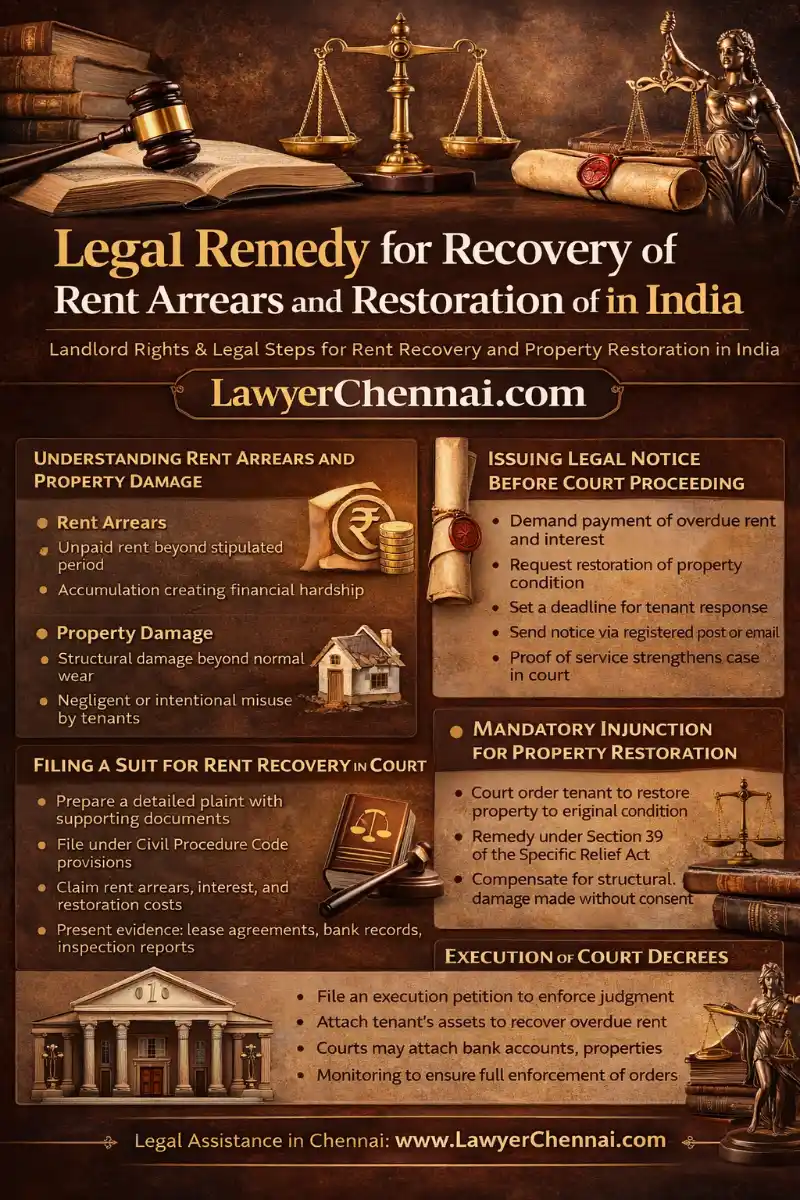
Rent arrears arise when tenants fail to pay agreed rent within the stipulated period. Landlords often tolerate temporary delays due to practical business relationships. However prolonged default creates financial hardship for property owners. Consequently legal remedies become necessary to enforce contractual obligations. Courts recognize rent arrears as legally recoverable debt obligations. Landlords therefore possess clear rights to pursue recovery proceedings. Interest claims also arise where tenancy agreements specify delayed payment penalties. Additionally courts award reasonable interest under equitable principles. Property damage disputes frequently accompany rent default cases. Tenants sometimes neglect maintenance responsibilities defined in lease agreements. Such negligence may damage flooring, walls, electrical systems, or plumbing infrastructure. Restoration costs therefore become recoverable damages in civil proceedings. Proper inspection reports strengthen such claims significantly.
Written lease agreements during adjudication
Tenancy agreements define rights and responsibilities between landlords and tenants clearly. Therefore courts heavily rely on written lease agreements during adjudication. Clauses regarding rent payment schedule play a crucial evidentiary role. Agreements also specify maintenance obligations and permitted property use. Violation of these terms creates enforceable legal claims for landlords. Courts analyze whether damage exceeds reasonable wear and tear standards. Landlords must prove that tenant negligence caused structural or aesthetic deterioration. Repair invoices and contractor estimates often support such claims effectively. Digital photographs recorded during possession delivery also become valuable evidence. Additionally witness testimony may confirm the property’s original condition. Proper documentation therefore determines success in restoration claims.
Indian courts often encounter disputes where tenants vacate premises leaving substantial damage. Consequently landlords must undertake expensive repairs before leasing again. Legal remedies ensure tenants bear financial responsibility for such conduct. Courts examine whether lease agreements imposed maintenance obligations upon tenants. Furthermore judges analyze inspection reports recorded during tenancy termination. Independent surveyors often prepare technical damage assessment reports. These reports quantify restoration costs required for returning property to original condition. Therefore courts rely on professional evidence rather than speculative estimates. Landlords should document property condition during initial possession delivery. Similarly exit inspection records provide strong comparative evidence. Effective documentation prevents tenants from denying responsibility later.
Common Legal Issues in Rent Recovery Cases
Rent recovery disputes involve multiple legal issues affecting landlord rights and tenant obligations. Courts frequently examine contractual interpretation and statutory protections. Legal practitioners therefore analyze tenancy agreements carefully before initiating proceedings. Some disputes arise from unpaid rent accumulated over several months. Other cases involve tenants refusing to vacate after lease expiry. Damage claims often appear when tenants misuse residential premises for commercial activities. Additionally structural alterations without consent create restoration liability. Courts assess evidence relating to property condition before awarding damages. Landlords must prove that tenant actions directly caused deterioration. Judges reject exaggerated claims unsupported by reliable documentation. Therefore legal preparation remains essential for successful rent recovery litigation.
Key legal issues generally appear in landlord tenant disputes across Indian jurisdictions. The following points highlight common litigation triggers frequently seen before civil courts.
- Non payment of monthly rent beyond contractual grace period.
- Unauthorized structural alterations damaging walls or flooring.
- Refusal to vacate premises after termination of tenancy.
- Failure to maintain electrical and plumbing installations.
- Commercial misuse of residential leased premises.
- Disputes regarding security deposit adjustment against rent arrears.
These issues usually combine within a single recovery suit. Therefore landlords must draft pleadings addressing each legal violation clearly. Courts expect precise claims supported by documentary evidence. Strong legal arguments significantly influence judicial outcomes in such disputes.
Jurisdiction of Courts Handling Rent Recovery
Jurisdiction determines which court possesses authority to hear landlord tenant disputes. Indian law follows territorial and pecuniary jurisdiction principles under the Civil Procedure Code. Territorial jurisdiction generally depends on the property location. Therefore courts within the property district exercise authority over disputes. Pecuniary jurisdiction depends on the monetary value of claims filed. Smaller claims often fall within Small Causes Court jurisdiction. Larger claims proceed before district civil courts. Chennai landlords commonly approach the Chennai Small Causes Court for rent recovery. However high value claims may reach the City Civil Court Chennai. Lawyers carefully evaluate jurisdiction before filing suits. Incorrect jurisdiction may lead to plaint rejection or return. Proper forum selection therefore prevents procedural complications during litigation.
The following table explains typical forums handling landlord tenant disputes in India.
| Forum | Nature of Dispute | Jurisdiction Basis |
|---|---|---|
| Small Causes Court | Rent arrears and eviction disputes | Lower pecuniary limits |
| District Civil Court | High value rent recovery suits | Higher monetary jurisdiction |
| Rent Court | Statutory tenancy disputes | State tenancy laws |
| High Court | Appeals and revisions | Supervisory jurisdiction |
Selecting the appropriate forum ensures faster case progress and enforceable judgments.
Role of Police Authorities in Property Damage Cases
Police authorities play an important role when tenants deliberately damage leased property. Such conduct may attract criminal liability under the Bharatiya Nyaya Sanhita. Mischief causing property damage constitutes a punishable criminal offence. Landlords therefore may lodge complaints before local police stations. Police officers investigate allegations and record witness statements. Evidence collection includes photographs, repair estimates, and forensic inspection reports. Criminal investigation sometimes compels tenants to negotiate settlement quickly. However criminal proceedings do not replace civil recovery remedies entirely. Landlords must still pursue civil suits to recover monetary compensation. Police involvement mainly addresses intentional destruction of property. Legal professionals therefore advise parallel civil and criminal strategies where necessary. Coordinated legal action strengthens landlord rights significantly.
Legal Framework Governing Recovery of Rent and Property Restoration
Indian law provides multiple statutory remedies for landlords facing rent default and property damage. Several statutes collectively regulate landlord tenant relationships across the country. Civil courts primarily handle rent recovery suits under the Civil Procedure Code. Additionally state tenancy statutes regulate eviction and rent dispute resolution. Tamil Nadu landlords rely upon the Tamil Nadu Regulation of Rights and Responsibilities of Landlords and Tenants Act. Courts also consider provisions under the Indian Contract Act during tenancy disputes. Furthermore criminal liability may arise when tenants intentionally damage leased property. The Bharatiya Nyaya Sanhita now governs criminal offences involving mischief and destruction. Police authorities therefore investigate serious property damage complaints. Meanwhile civil remedies remain necessary for monetary recovery and restoration orders. Lawyers often combine statutory provisions to strengthen landlord claims. Effective litigation strategy therefore depends upon careful legal analysis.
The Civil Procedure Code establishes procedural rules governing civil recovery suits. Courts rely upon these procedural provisions during every stage of litigation. Order IV CPC governs institution of civil suits before competent courts. Plaintiffs must present a properly drafted plaint supported by documentary evidence. Courts examine pleadings during the scrutiny process before numbering the suit. Order V CPC regulates service of summons upon the defendant tenant. Proper service ensures the defendant receives notice regarding the recovery claim. Order VII CPC also governs plaint requirements and cause of action details. Lawyers therefore draft pleadings describing rent arrears and property damage clearly. Supporting documents generally include lease agreements and payment records. Property inspection reports also become crucial documentary evidence. Procedural compliance therefore prevents unnecessary litigation delays.
Courts also rely on provisions under the Bharatiya Sakshya Adhiniyam for evidentiary evaluation. Documentary evidence plays a decisive role in rent recovery litigation. Lease agreements establish contractual obligations between landlords and tenants clearly. Bank transaction records also prove rent payment defaults effectively. Photographs and inspection reports demonstrate property damage caused by tenant misuse. Courts evaluate oral testimony alongside documentary evidence carefully. Judges generally prefer written documentation rather than unsupported oral claims. Therefore landlords should preserve evidence from the beginning of tenancy. Proper record keeping strengthens legal claims during trial proceedings. Lawyers therefore advise clients regarding evidence preservation strategies early. Well documented evidence significantly improves litigation success.
Criminal law provisions also support landlords facing intentional property damage. The Bharatiya Nyaya Sanhita criminalizes acts causing destruction of property intentionally. Police may register complaints under relevant mischief provisions. Investigation officers examine physical evidence and witness statements carefully. Criminal proceedings create pressure upon defaulting tenants to resolve disputes quickly. However civil suits remain necessary for monetary recovery. Courts award compensation and interest through civil decrees only. Therefore criminal complaints complement civil recovery strategies effectively. Lawyers therefore evaluate the severity of property damage before filing complaints. Strategic use of criminal remedies strengthens landlord bargaining power significantly.
Several government departments indirectly influence landlord tenant dispute resolution. Municipal authorities regulate building safety and structural compliance. Local bodies issue certificates confirming structural damage assessments. Electricity and water authorities also provide consumption records proving tenant occupancy. Such records become relevant evidence during litigation proceedings. Property tax records may also establish ownership rights clearly. Landlords therefore gather documents from relevant government departments. Courts appreciate reliable documentary evidence issued by public authorities. These documents strengthen factual claims made within the plaint. Therefore legal preparation often involves coordination with multiple departments. Effective evidence gathering improves the chances of judicial success significantly.
Issuing Legal Notice Before Filing Rent Recovery Suit
A legal notice usually represents the first step in rent recovery disputes. Landlords send formal notices demanding payment of outstanding rent arrears. Notices also demand interest according to contractual terms or statutory provisions. Additionally landlords may demand restoration of property damaged during tenancy. Such notices provide tenants an opportunity to resolve disputes voluntarily. Courts appreciate parties attempting settlement before initiating litigation. Lawyers therefore draft notices clearly describing the legal claims involved. Notice contents normally include tenancy details and outstanding rent calculations. Damage descriptions and estimated restoration expenses also appear within the notice. Tenants typically receive fifteen to thirty days to respond. Failure to respond creates a strong legal cause of action.
A properly drafted legal notice should contain the following important components.
- Complete details of landlord and tenant identification.
- Property address and lease agreement reference information.
- Total rent arrears calculation including monthly breakdown.
- Interest claim based upon contractual or statutory provisions.
- Description of property damage requiring restoration.
- Final deadline for payment and compliance.
- Warning regarding civil and criminal legal proceedings.
Lawyers normally send notices through registered post with acknowledgement due. Email communication may also supplement traditional notice delivery methods. Proof of service becomes valuable evidence during court proceedings.
Legal notices also demonstrate the landlord’s intention to enforce contractual rights formally. Courts examine notice contents when evaluating subsequent litigation claims. A well drafted notice therefore strengthens the legal foundation of the suit. Tenants sometimes settle disputes immediately after receiving legal notices. Consequently landlords avoid prolonged court proceedings and litigation expenses. However persistent tenants may ignore notices completely. In such circumstances landlords proceed with civil recovery suits before competent courts. Notice documents become part of the plaint evidence during litigation. Courts often consider tenant silence as adverse conduct. Therefore issuing legal notices remains an essential pre litigation strategy.
Suit for Recovery of Rent Arrears Under Civil Procedure Code
Civil suits remain the primary remedy for recovering unpaid rent arrears in India. Landlords file recovery suits before courts possessing appropriate territorial jurisdiction. Plaintiffs must clearly describe the cause of action within the plaint. Rent arrears calculations generally cover unpaid monthly rent amounts. Interest claims accompany principal rent recovery within the same suit. Courts may award interest under Section 34 of the Civil Procedure Code. Judges also examine contractual clauses specifying delayed payment interest rates. Lease agreements therefore play a crucial role during judicial evaluation. Plaintiffs must submit supporting documents along with the plaint. Courts verify whether the claim falls within pecuniary jurisdiction limits. Once satisfied courts register the suit and issue summons to the defendant.
The typical procedure followed in rent recovery suits includes the following steps.
- Preparation and filing of plaint before competent civil court.
- Scrutiny of plaint and court fee verification.
- Registration of suit and issuance of summons.
- Submission of written statement by defendant tenant.
- Framing of issues by the trial court.
- Recording of evidence from both parties.
- Final arguments before the presiding judge.
- Pronouncement of judgment and decree.
Each stage plays a crucial role during the litigation process. Lawyers must therefore monitor procedural compliance carefully.
Courts also consider claims relating to mesne profits when tenants continue occupying premises illegally. Mesne profits represent compensation for unauthorized property occupation after lease termination. Judges calculate mesne profits based upon prevailing market rent rates. Landlords must therefore present evidence regarding local rental values. Property valuation reports and comparable lease agreements often support such claims. Courts may appoint commissioners to assess property condition when necessary. Commissioners inspect premises and submit reports regarding structural damage. Such reports influence judicial findings regarding restoration expenses. Therefore mesne profit claims frequently accompany rent arrears recovery suits.
Claiming Interest on Rent Arrears and Compensation
Interest claims compensate landlords for financial loss caused by delayed rent payments. Lease agreements frequently include clauses specifying interest rates on overdue rent. Courts enforce such clauses when the rates appear reasonable and lawful. However judges may modify excessive interest rates based on equitable principles. Section 34 of the Civil Procedure Code empowers courts to award reasonable interest. Courts therefore exercise discretion while determining final interest amounts. Plaintiffs must clearly state interest claims within the plaint. Interest calculations usually begin from the date of default. Courts may also award future interest until the decree amount receives full payment.
The following table explains different types of financial claims commonly included in rent recovery litigation.
| Type of Claim | Legal Basis | Purpose |
|---|---|---|
| Rent Arrears | Lease Agreement | Recovery of unpaid rent |
| Interest | Section 34 CPC | Compensation for delayed payment |
| Mesne Profits | Property Law Principles | Compensation for unauthorized occupation |
| Repair Damages | Contractual Liability | Restoration of property condition |
Courts analyze each claim independently before awarding relief. Accurate calculations therefore become crucial within pleadings.
Landlords often combine monetary recovery claims with restoration orders. Courts may issue mandatory injunctions directing tenants to repair property damage. However courts more commonly award financial compensation for restoration expenses. Judges rely on expert repair estimates while determining compensation amounts. Structural damage reports from engineers or surveyors strengthen such claims effectively. Landlords should therefore obtain professional inspection reports immediately after tenancy termination. Evidence preservation becomes extremely important during property restoration litigation. Courts reject speculative claims unsupported by technical evidence. Therefore proper documentation remains the foundation of successful legal remedies.
Mandatory Injunction for Restoration of Property to Original Condition
Landlords frequently encounter tenants leaving premises in damaged or altered condition. Consequently property restoration becomes an essential legal remedy within civil litigation. Courts grant mandatory injunctions directing tenants to restore premises to the original condition. Section 39 of the Specific Relief Act empowers courts to issue such orders. Judges exercise this power when monetary compensation alone becomes inadequate. Lease agreements usually prohibit structural alterations without landlord consent. Therefore unauthorized changes create enforceable legal liability against tenants. Courts examine evidence proving that alterations occurred during tenancy. Photographs taken before possession often become critical comparative evidence. Surveyor inspection reports also strengthen restoration claims significantly. Landlords therefore must preserve documentary evidence regarding property condition. Mandatory injunctions ensure property usability for future tenants. Consequently landlords regain control over their investment assets effectively.
Courts carefully evaluate whether restoration orders remain practically enforceable before issuing injunctions. Judges examine structural alterations affecting safety and building integrity. Engineers often submit technical reports regarding feasibility of restoration work. Courts may appoint local commissioners to inspect property condition independently. These commissioners prepare detailed reports describing alterations and damage. Such reports assist judges in determining appropriate restoration measures. However courts sometimes prefer awarding financial compensation instead of mandatory injunctions. Monetary damages become practical when restoration appears technically difficult. Therefore landlords must present expert evidence demonstrating restoration feasibility. Strong technical evidence increases the probability of injunction orders significantly.
Landlords typically include restoration claims alongside rent arrears recovery suits. Combining remedies within one proceeding improves judicial efficiency considerably. Courts examine contractual obligations relating to property maintenance carefully. Lease agreements usually require tenants to maintain premises responsibly. Violation of such obligations creates liability for restoration expenses. Judges evaluate the extent of damage beyond ordinary wear and tear. Repair estimates from contractors help quantify restoration costs accurately. Photographic evidence also assists courts during comparative evaluation. Therefore landlords should document premises condition during possession delivery. Exit inspection reports provide strong evidence during litigation proceedings.
Criminal Remedies for Property Damage Under Bharatiya Nyaya Sanhita
Intentional destruction of property may constitute criminal misconduct under Indian law. The Bharatiya Nyaya Sanhita criminalizes acts involving mischief and property damage. Tenants sometimes damage premises deliberately before vacating disputed properties. Such conduct may attract criminal prosecution alongside civil liability. Landlords therefore may lodge complaints before the jurisdictional police station. Police authorities investigate allegations through evidence collection and witness examination. Investigation officers inspect damaged premises and document physical evidence. Forensic examination may also occur in severe property destruction cases. Criminal proceedings often create pressure upon tenants to settle disputes quickly. Nevertheless civil remedies remain necessary for recovering financial compensation. Criminal law primarily addresses the punitive aspect of misconduct. Therefore lawyers frequently pursue parallel civil and criminal strategies.
Common criminal offences relating to property damage may include the following legal issues.
- Intentional destruction of walls, flooring, or fixtures.
- Unauthorized removal of electrical wiring or plumbing installations.
- Vandalism causing structural deterioration of the building.
- Deliberate fire damage or sabotage of property utilities.
- Threats or intimidation preventing landlord property inspection.
Police authorities register First Information Reports when credible evidence appears available. Investigation reports later become useful evidence during civil proceedings. Therefore criminal complaints often strengthen landlord litigation strategies significantly.
Landlords in Chennai may approach nearby police stations for filing property damage complaints. Jurisdiction generally depends upon the location of the leased property. For example property owners near Mylapore approach Mylapore Police Station. Residents in Adyar jurisdiction may contact Adyar Police Station. Police officers record complaints and initiate preliminary investigation procedures. Officers may summon tenants for questioning during investigation stages. Evidence collection includes photographs, witness statements, and repair estimates. Police reports sometimes influence civil court findings significantly. Therefore landlords should cooperate fully during investigation proceedings. Effective coordination between civil litigation and criminal investigation strengthens legal outcomes.
Execution of Civil Court Decrees for Rent Recovery
Winning a civil suit represents only the first stage of legal recovery proceedings. Landlords must execute the court decree to obtain actual payment. The Civil Procedure Code provides detailed provisions governing decree execution. Order XXI CPC regulates execution proceedings before competent courts. Decree holders file execution petitions requesting enforcement of the judgment. Courts may attach movable or immovable property belonging to the judgment debtor. Bank accounts and salary income may also become subject to attachment. Such measures ensure recovery of rent arrears and awarded damages. Courts supervise execution proceedings carefully to prevent abuse of process. Therefore landlords must follow procedural requirements strictly during execution.
Execution proceedings may involve several enforcement mechanisms depending upon the circumstances. Courts possess broad powers for enforcing monetary decrees effectively.
- Attachment and sale of movable assets belonging to the tenant.
- Attachment of bank accounts holding tenant funds.
- Garnishee proceedings against debtors owing money to the tenant.
- Attachment and auction of immovable property owned by the tenant.
- Civil detention of judgment debtor in exceptional circumstances.
These remedies ensure that decree holders receive lawful compensation awarded by courts. Lawyers therefore monitor execution proceedings actively until full recovery occurs.
Courts also supervise execution when tenants fail to comply with restoration orders. Judges may authorize court officers to supervise restoration activities directly. Costs incurred during restoration become recoverable from the tenant. Courts sometimes appoint commissioners to oversee restoration compliance. These officers submit compliance reports to the executing court regularly. Non compliance may attract contempt proceedings in severe cases. Therefore tenants often comply with restoration orders to avoid legal consequences. Effective enforcement ensures landlords regain possession of properly restored premises.
Role of Tribunals, Rent Courts, and Appellate Forums
Modern tenancy regulation laws establish specialized tribunals and rent courts for dispute resolution. These forums aim to provide faster adjudication compared with regular civil courts. Tamil Nadu introduced Rent Courts under the tenancy regulation statute. Landlords may approach these forums for eviction and rent recovery disputes. Rent Courts follow simplified procedures to expedite hearings. Appeals from Rent Court decisions generally lie before Rent Tribunals. These appellate bodies review legal and factual issues arising from trial decisions. High Courts retain supervisory jurisdiction over tribunal proceedings. Therefore landlords possess multiple appellate remedies within the judicial system. Lawyers carefully evaluate forum advantages before initiating proceedings. Strategic forum selection influences case timelines significantly.
The following table outlines the hierarchy of forums dealing with landlord tenant disputes.
| Forum | Function | Nature of Proceedings |
|---|---|---|
| Rent Court | Primary dispute adjudication | Tenancy and eviction matters |
| Rent Tribunal | Appellate authority | Appeals against Rent Court orders |
| District Civil Court | General civil jurisdiction | High value recovery suits |
| High Court | Revisional and constitutional jurisdiction | Supervisory review |
Understanding this hierarchy helps landlords pursue remedies through appropriate legal channels.
Tribunal procedures generally emphasize efficiency and reduced procedural complexity. However parties must still present reliable evidence supporting their claims. Lease agreements and rent payment records remain essential documents. Property inspection reports also influence tribunal decisions significantly. Lawyers often prefer tribunal proceedings for quicker dispute resolution. Nevertheless civil courts remain necessary for complex monetary claims. Therefore landlords must analyze case facts before selecting the forum. Proper forum selection accelerates dispute resolution and reduces litigation costs.
Evidence Requirements Under Bharatiya Sakshya Adhiniyam
The Bharatiya Sakshya Adhiniyam governs admissibility and evaluation of evidence in Indian courts. Courts rely heavily on documentary evidence during rent recovery litigation. Lease agreements represent the primary document establishing contractual obligations. Bank statements also demonstrate rent payment defaults effectively. Courts examine such documents to determine the extent of arrears. Photographic evidence may prove property damage caused by tenant negligence. Courts often compare photographs taken before and after tenancy. Expert reports from engineers or surveyors strengthen restoration claims. Judges evaluate expert testimony under evidentiary standards defined by law. Therefore reliable documentary evidence becomes crucial during trial proceedings.
Digital evidence has also gained importance in modern landlord tenant disputes. Electronic communication often records rent payment reminders and tenant responses. Courts accept electronic records subject to statutory certification requirements. Therefore landlords should preserve emails and digital communication carefully. CCTV footage sometimes provides visual proof of property damage incidents. Courts examine such recordings alongside other documentary evidence. Digital photographs also help establish property condition before possession delivery. Reliable evidence therefore strengthens litigation claims significantly.
Witness testimony also plays a supportive role during trial proceedings. Neighbors or property managers may testify regarding tenant conduct. Contractors who repaired property damage may also appear as witnesses. Their testimony explains restoration expenses incurred by landlords. Courts analyze witness credibility alongside documentary evidence carefully. Judges prefer corroborated testimony supported by reliable documents. Therefore landlords should maintain detailed records throughout tenancy. Effective evidence management increases the probability of successful litigation outcomes.
Step by Step Legal Strategy for Landlords to Recover Rent and Restore Property
Landlords must follow a structured legal approach when tenants default on rent obligations. A systematic strategy improves recovery prospects and reduces litigation delays. Initially landlords should review the lease agreement carefully. The agreement defines payment obligations and maintenance responsibilities clearly. Next landlords calculate total rent arrears including interest liabilities. Documentary evidence such as bank statements should support these calculations. Property inspection must follow immediately after tenant default or vacation. Inspection helps identify structural damage beyond normal wear. Photographs and repair estimates provide crucial evidentiary support. Subsequently lawyers issue a formal legal notice demanding compliance. The notice clearly specifies rent arrears, interest, and restoration obligations. Tenants receive reasonable time to respond or settle claims voluntarily. Failure to comply creates a clear legal cause of action. Therefore landlords may proceed with civil litigation confidently.
After notice expiration landlords initiate civil recovery proceedings before the appropriate court. Lawyers prepare a detailed plaint describing tenancy obligations and tenant violations. Supporting documents accompany the plaint during court filing procedures. Courts verify jurisdiction and court fee compliance during scrutiny stages. Once the suit receives registration courts issue summons to the tenant defendant. Defendants then submit written statements responding to allegations. Subsequently courts frame issues identifying the core disputes between parties. Evidence presentation follows through documentary submissions and witness testimony. Courts analyze the evidence carefully before pronouncing judgment. Successful plaintiffs receive decrees awarding rent arrears and damages. Execution proceedings ensure practical enforcement of the decree.
The following numbered list summarizes the practical litigation roadmap for landlords.
- Examine lease agreement terms carefully.
- Calculate rent arrears and interest amounts.
- Inspect property and document damage evidence.
- Send formal legal notice demanding compliance.
- File civil recovery suit before competent court.
- Present documentary and witness evidence during trial.
- Obtain decree for arrears, interest, and damages.
- Initiate execution proceedings for recovery enforcement.
This structured strategy improves efficiency and strengthens legal claims significantly.
Government Authorities and Departments Involved in Property Disputes
Several government authorities indirectly influence landlord tenant dispute resolution processes. Municipal authorities regulate building safety and structural integrity compliance. These authorities issue inspection reports confirming property damage conditions. Local bodies also maintain building approval records and zoning information. Electricity distribution authorities maintain records regarding tenant electricity consumption. Water supply boards also maintain usage records confirming tenant occupation. Property tax departments provide official ownership verification documents. Registration departments maintain lease agreement registration records. Courts often rely upon such official documents during litigation proceedings. Therefore landlords must collect relevant records from government authorities promptly. Reliable official documentation strengthens legal claims significantly.
The following table summarizes key government authorities relevant to landlord tenant disputes.
| Authority | Role | Relevant Evidence |
|---|---|---|
| Municipal Corporation | Building inspection and safety compliance | Structural inspection reports |
| Electricity Board | Utility consumption records | Electricity billing statements |
| Water Supply Board | Water usage records | Water connection documents |
| Registration Department | Lease agreement registration | Registered tenancy documents |
| Revenue Department | Ownership and land records | Patta and property tax records |
These authorities provide documentary evidence supporting landlord claims during litigation.
Government records also help courts determine property ownership and tenancy legality. Courts frequently request certified copies of registration records. Municipal inspection reports may confirm tenant damage allegations. Utility records may demonstrate continuous tenant occupation. Therefore landlords must coordinate with government departments effectively. Timely documentation improves credibility before courts and tribunals. Lawyers therefore assist clients in obtaining certified records promptly. Reliable public records strengthen litigation outcomes significantly.
Types of Legal Support Available for Landlords
Landlords often require different forms of legal support during tenancy disputes. Legal consultation represents the first stage of dispute resolution. Lawyers analyze tenancy agreements and identify possible legal remedies. Pre litigation negotiation sometimes resolves disputes without court proceedings. However persistent defaults often require formal legal action. Litigation lawyers represent landlords before civil courts and tribunals. They draft pleadings and present evidence during trial proceedings. Criminal lawyers assist when property damage involves criminal misconduct. Police complaints and criminal investigation require legal guidance. Therefore coordinated legal strategy becomes essential for complex disputes.
Several types of professional legal support services exist for landlords facing rent disputes.
- Legal consultation regarding tenancy rights and obligations.
- Drafting and sending legal demand notices.
- Representation in civil recovery suits.
- Filing criminal complaints for property damage offences.
- Handling execution proceedings after court decrees.
- Advising regarding arbitration or mediation mechanisms.
Professional legal support ensures procedural compliance and strategic litigation planning.
Law firms specializing in property law frequently handle rent recovery disputes. Experienced advocates understand procedural complexities and evidentiary requirements clearly. They also analyze jurisdictional issues before initiating litigation. Strategic planning reduces procedural delays and strengthens legal claims. Lawyers also negotiate settlement agreements where appropriate. Therefore professional legal guidance significantly improves dispute resolution outcomes. Landlords benefit from early legal consultation when disputes arise. Preventive legal advice often avoids expensive litigation later.
Comprehensive Legal Remedies Available to Landlords in India
Indian law provides several remedies enabling landlords to enforce tenancy obligations effectively. Civil recovery suits represent the most common legal remedy. Courts award decrees ordering payment of rent arrears and interest. Mesne profit claims compensate unauthorized occupation after lease termination. Mandatory injunctions may direct tenants to restore property condition. Monetary damages compensate repair costs when restoration becomes impractical. Criminal prosecution may arise where tenants intentionally damage property. Police investigation may proceed under relevant criminal law provisions. Arbitration may resolve disputes when lease agreements include arbitration clauses. Therefore landlords possess multiple remedies depending on case circumstances.
The following list summarizes the principal legal remedies available to landlords.
- Civil suit for recovery of rent arrears.
- Claim for contractual or statutory interest.
- Mesne profit claim for illegal occupation.
- Mandatory injunction for property restoration.
- Compensation claim for repair expenses.
- Criminal complaint for intentional property damage.
- Execution proceedings for enforcement of court decree.
These remedies collectively protect landlord property rights under Indian law.
Effective use of these remedies requires careful legal strategy and documentation. Courts evaluate each claim according to evidence and statutory provisions. Therefore landlords must maintain proper records throughout tenancy periods. Lease agreements should clearly define obligations and responsibilities. Evidence preservation ensures successful litigation when disputes arise. Professional legal guidance further strengthens landlord positions during disputes. Consequently landlords can recover financial losses and restore property condition effectively.
Frequently Asked Questions
1. Can landlords recover unpaid rent through courts in India?
Yes. Landlords may file civil suits under the Civil Procedure Code seeking recovery of rent arrears and interest. Courts evaluate tenancy agreements and payment records before issuing decrees ordering tenants to pay outstanding rent liabilities.
2. Can landlords claim interest on delayed rent payments?
Courts may award interest when lease agreements contain interest clauses. Section 34 of the Civil Procedure Code also allows courts to grant reasonable interest when tenants delay rent payments unlawfully.
3. What evidence proves rent arrears in court?
Courts generally rely upon lease agreements, bank statements, payment receipts, and written communication between landlord and tenant. These documents establish the amount of unpaid rent and contractual obligations clearly.
4. Can landlords recover repair expenses for property damage?
Yes. Courts may award compensation when tenants damage property beyond normal wear. Landlords must present photographs, inspection reports, and repair estimates proving the extent of property damage.
5. What is a mandatory injunction in property disputes?
A mandatory injunction is a court order directing a tenant to restore property to its original condition. Courts grant this remedy when structural alterations violate lease agreement obligations.
6. Can criminal complaints be filed against tenants for property damage?
Yes. Intentional property destruction may constitute criminal mischief under the Bharatiya Nyaya Sanhita. Police may investigate such offences and initiate criminal prosecution against responsible tenants.
7. Which courts handle rent recovery disputes in India?
Small Causes Courts, District Civil Courts, and specialized Rent Courts usually handle rent disputes. Jurisdiction depends upon property location and monetary value of claims filed.
8. What are mesne profits in tenancy disputes?
Mesne profits represent compensation for unauthorized property occupation after tenancy termination. Courts calculate this compensation based on prevailing market rent values.
9. How long does rent recovery litigation usually take?
Case duration varies depending on evidence complexity and court workload. However tribunal procedures and mediation mechanisms sometimes resolve disputes faster than traditional civil trials.
10. Can landlords execute court decrees against defaulting tenants?
Yes. Courts allow decree holders to initiate execution proceedings. Enforcement measures may include attachment of property, bank accounts, or other assets belonging to the tenant.