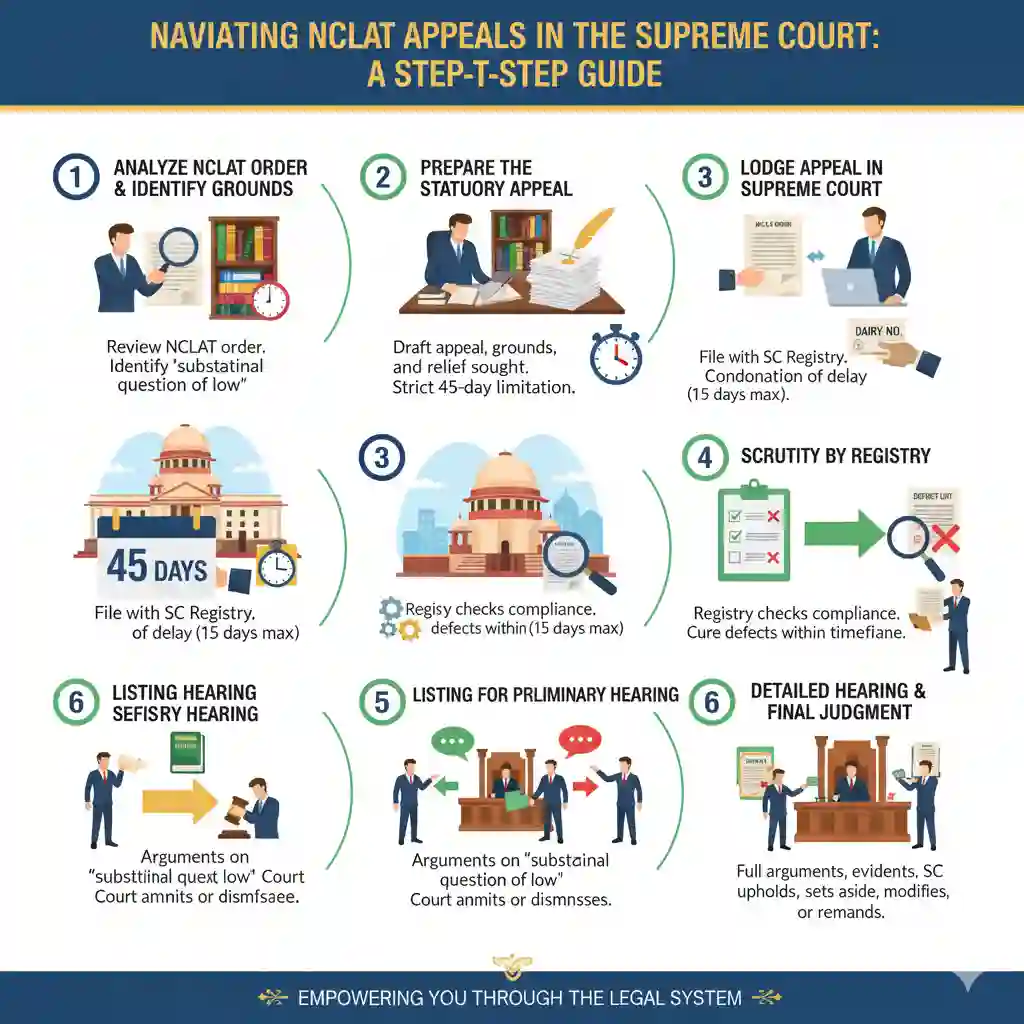
Navigating NCLAT Appeals in the Supreme Court: A Step-by-Step Guide

In India, the next level of appeal against NCLAT decisions lies before the Supreme Court of India. However, filing an appeal before the Supreme Court is not a simple process. It requires careful preparation, strict compliance with legal procedures, and expert legal representation.
At LawyerChennai.com – Best Lawyer Firm in Chennai India 24×7, we regularly assist clients in navigating complex appellate procedures. Our legal team helps businesses and individuals understand their rights, prepare appeals, and present strong legal arguments before the highest court in the country.
Navigating NCLAT Appeals in the Supreme Court: A Step-by-Step Guide – LawyerChennai.com – Best Lawyer Firm in Chennai India 24×7
Understanding the Role of NCLAT
Before discussing the appeal process, it is important to understand the role of the National Company Law Appellate Tribunal.
NCLAT functions as an appellate tribunal that hears appeals against decisions passed by the National Company Law Tribunal. These matters generally relate to company law disputes, insolvency proceedings, and competition law cases.
The tribunal reviews orders issued by the NCLT and decides whether those decisions were legally correct. However, if a party believes that the NCLAT order contains legal errors, they may approach the Supreme Court of India.
Legal Basis for Appealing to the Supreme Court
Appeals from the National Company Law Appellate Tribunal to the Supreme Court of India are permitted under the Insolvency and Bankruptcy Code, 2016 and the Companies Act, 2013.
However, the Supreme Court generally examines questions of law rather than factual disputes. In other words, the appeal must raise significant legal issues rather than merely challenging factual findings.
Therefore, legal strategy and careful drafting become extremely important when filing such appeals.
Step 1: Carefully Study the NCLAT Order
The first step in filing an appeal is to thoroughly examine the order issued by the National Company Law Appellate Tribunal.
Lawyers carefully analyze the judgment to identify possible legal errors. These errors may include:
- Incorrect interpretation of statutory provisions
- Violation of principles of natural justice
- Procedural irregularities
- Misapplication of legal precedents
After reviewing the order, the legal team determines whether the case has strong grounds for appeal.
Step 2: Assess the Legal Grounds for Appeal
The Supreme Court of India generally allows appeals when substantial legal questions arise.
Some common grounds include:
- Incorrect application of the Insolvency and Bankruptcy Code, 2016
- Misinterpretation of corporate law provisions
- Denial of fair hearing
- Improper exercise of tribunal powers
At LawyerChennai.com – Best Lawyer Firm in Chennai India 24×7, our advocates carefully evaluate whether the case meets the legal standards required for Supreme Court appeals.
Step 3: Observe the Limitation Period
One of the most important aspects of filing an appeal is complying with the limitation period.
Appeals from the National Company Law Appellate Tribunal to the Supreme Court of India must typically be filed within 45 days from the date of the NCLAT order.
However, in certain circumstances, the Supreme Court may allow a limited extension if valid reasons for delay are provided.
Because time limits are strict, it is advisable to begin legal preparations immediately after receiving the NCLAT order.
Step 4: Prepare the Appeal Petition
Once the legal grounds are established, the next step involves drafting the appeal petition.
The petition usually includes:
- Details of the parties involved
- Facts of the case
- Legal issues raised
- Grounds of appeal
- Relief requested from the court
The petition must clearly explain why the decision of the National Company Law Appellate Tribunal requires intervention by the Supreme Court of India.
Proper drafting is essential because the Supreme Court carefully reviews every petition before admitting the appeal.
Step 5: Compile Required Documents
Along with the appeal petition, several supporting documents must be submitted.
These documents usually include:
- Certified copy of the NCLAT judgment
- Relevant orders from the National Company Law Tribunal
- Case pleadings and evidence
- Affidavits and supporting statements
Organizing these documents accurately helps the court understand the complete history of the case.
Step 6: Filing the Appeal in the Supreme Court
After preparing the petition and supporting documents, the appeal must be filed before the Supreme Court of India.
The filing process involves:
- Submitting the appeal petition
- Paying required court fees
- Completing procedural formalities
Once filed, the registry of the Supreme Court reviews the documents to ensure compliance with procedural requirements.
If any defects are identified, they must be corrected before the case is listed for hearing.
Step 7: Admission Hearing
The next stage involves the admission hearing.
At this stage, the Supreme Court of India examines whether the appeal deserves detailed consideration.
The court may:
- Admit the appeal and proceed with the case
- Issue notice to the opposite party
- Dismiss the appeal if no substantial legal question exists
Strong legal arguments during this stage can significantly influence the outcome.
Step 8: Detailed Court Proceedings
If the appeal is admitted, the case proceeds to detailed hearings.
During this stage:
- Both parties present legal arguments
- Lawyers cite relevant laws and precedents
- Judges examine legal interpretations
Because cases before the Supreme Court of India often involve complex corporate matters, experienced legal representation becomes crucial.
Step 9: Final Judgment
After hearing both sides, the Supreme Court of India delivers its final judgment.
The court may:
- Uphold the NCLAT decision
- Modify the tribunal’s order
- Set aside the decision and provide new directions
Once the Supreme Court issues its judgment, the decision becomes binding on all parties.
Importance of Experienced Legal Representation
Appeals before the Supreme Court of India require deep knowledge of corporate law, insolvency regulations, and appellate procedures.
Professional legal representation ensures that:
- Appeals are filed within the correct time limits
- Legal grounds are properly framed
- Documents are accurately prepared
- Court arguments are effectively presented
At LawyerChennai.com – Best Lawyer Firm in Chennai India 24×7, our legal team has extensive experience handling complex corporate appeals and tribunal matters.
Challenges in NCLAT Appeals
Although the legal framework allows appeals, several challenges may arise.
First, the Supreme Court accepts only cases involving significant legal questions. Therefore, not every dispute qualifies for appeal.
Second, corporate litigation often involves extensive documentation and technical legal arguments.
Third, strict procedural rules must be followed during filing and hearings.
Because of these challenges, careful planning and professional guidance become essential.
Tips for Businesses and Individuals
Parties involved in NCLAT appeals should keep several practical points in mind.
First, always review the tribunal order immediately after it is issued.
Second, consult experienced legal professionals without delay.
Third, collect all relevant documents and evidence related to the case.
Finally, ensure that appeal petitions clearly highlight important legal issues.
These steps can significantly improve the chances of success before the Supreme Court of India.
How LawyerChennai.com Supports Clients
At LawyerChennai.com – Best Lawyer Firm in Chennai India 24×7, we provide comprehensive legal services for corporate litigation and appellate matters.
Our services include:
- Legal consultation on NCLAT orders
- Preparation of appeal petitions
- Strategic legal planning
- Representation before the Supreme Court of India
We focus on providing clear legal guidance and strong advocacy to protect our clients’ interests.
Frequently Asked Questions
An NCLAT appeal refers to a legal challenge against an order passed by the National Company Law Appellate Tribunal. If a party believes that the tribunal has made an error in interpreting the law or has violated legal principles, they may approach the Supreme Court of India for further review. .
Generally, an appeal from the National Company Law Appellate Tribunal to the Supreme Court of India must be filed within 45 days from the date of the NCLAT order. However, in certain circumstances, the Supreme Court may allow a limited extension if the appellant provides valid reasons for the delay.
To file an appeal, several important documents must be prepared and submitted. These typically include the certified copy of the NCLAT judgment, copies of relevant orders from the National Company Law Tribunal, pleadings filed during earlier proceedings, supporting affidavits, and the appeal petition itself.
Yes, the Supreme Court of India has the authority to reject an appeal at the admission stage if it finds that the case does not involve a significant legal question. The Court carefully examines whether the appeal raises substantial issues related to law or procedure. If the Court believes that the NCLAT decision is legally sound, it may dismiss the appeal without proceeding to a detailed hearing.
Appeals before the Supreme Court of India involve complex corporate laws and strict procedural rules. Experienced lawyers help analyze the tribunal’s judgment, identify valid legal grounds, prepare strong appeal petitions, and present effective arguments before the Court. Professional legal representation improves the chances of successfully challenging or modifying the order issued by the National Company Law Appellate Tribunal.
Conclusion
Appealing a decision from the National Company Law Appellate Tribunal to the Supreme Court of India is a complex but important legal process. It allows businesses and individuals to challenge tribunal decisions that may significantly affect their rights or financial interests.
However, successful appeals require careful legal analysis, timely filing, and strong courtroom representation. With proper guidance and experienced legal support, parties can navigate the appellate process confidently and pursue justice before the highest court in India.
At LawyerChennai.com – Best Lawyer Firm in Chennai India 24×7, we remain committed to assisting clients at every stage of the legal journey, ensuring that their rights are protected and their cases are presented with clarity and strength.
Read More
- Can I Claim Flats Which Are in My Step Brother’s Name?
- Expert Supreme Court Lawyers for NCLAT Appeals and Corporate Disputes
- Legal Remedy for Recovery of Rent Arrears, Interest, and Restoration of Property to Original Condition in India
- Online Job Fraud: Seeking Legal Counsel and Assistance in India
- Overturning NCLAT Decisions: Supreme Court Representation You Can Trust
- National Company Law Appellate Tribunal – Official Website