
Securing Anticipatory Bail: Supreme Court Insights and Legal Assistance
Securing Anticipatory Bail – When someone fears arrest in a criminal case, one of the most powerful legal protections available is anticipatory bail. It allows a person to apply for bail even before being taken into custody. This provision protects personal liberty, prevents unnecessary harassment, and ensures that justice is balanced with fairness.
At LawyerChennai.com – Best Lawyer Firm in Chennai, we understand how stressful it can be when someone faces the threat of arrest. Our experienced criminal lawyers offer professional guidance and strong representation to help clients secure anticipatory bail efficiently, while ensuring that their constitutional rights remain protected.
Securing Anticipatory Bail: Supreme Court Insights and Legal Assistance – LawyerChennai.com
Understanding Anticipatory Bail Under Indian Law
Anticipatory bail is governed by Section 438 of the Code of Criminal Procedure (CrPC), 1973. It empowers the Sessions Court or High Court to grant bail to a person who has reason to believe that they may be arrested on accusations of a non-bailable offence.
This legal remedy was introduced to prevent the misuse of arrest powers and to uphold an individual’s right to liberty under Article 21 of the Indian Constitution. It is particularly valuable in cases involving false accusations, political vendettas, or business rivalries.
Unlike regular bail, which is sought after an arrest, anticipatory bail serves as a protective measure before arrest takes place. Once granted, it prevents the police from detaining the person unless the court decides otherwise.
The Supreme Court’s Interpretation of Anticipatory Bail
The Supreme Court of India has clarified and strengthened anticipatory bail laws through several landmark judgments. These rulings have shaped how courts interpret Section 438 and apply it fairly.
1. Gurbaksh Singh Sibbia v. State of Punjab (1980)
This historic judgment established the foundation for anticipatory bail in India. The Supreme Court ruled that anticipatory bail should not be limited by strict conditions or time frames. It reaffirmed that granting bail depends on the facts of each case, not on a rigid formula.
2. Siddharam Satlingappa Mhetre v. State of Maharashtra (2011)
The Court emphasized that personal liberty is a fundamental right and that anticipatory bail should be granted generously when there is no risk of the accused fleeing or tampering with evidence.
3. Sushila Aggarwal v. State (NCT of Delhi) (2020)
In this major decision, a Constitution Bench held that anticipatory bail does not automatically expire after a fixed period unless the court specifically mentions it. This ruling clarified that once granted, anticipatory bail remains valid until the trial concludes, unless it is cancelled for valid reasons.
Together, these judgments ensure that anticipatory bail continues to serve as a powerful safeguard against arbitrary arrest and misuse of law.
Who Can Apply for Anticipatory Bail?
Any person who apprehends arrest in a non-bailable offence can apply for anticipatory bail. This includes:
- Businesspersons facing false financial or corporate crime allegations.
- Professionals or public servants accused of corruption or misconduct.
- Individuals caught in family or property disputes with criminal elements.
- NRIs and others fearing arrest due to personal or political enmity.
Our firm regularly assists individuals across these categories, preparing robust bail applications that highlight innocence, cooperation, and credibility.
The Step-by-Step Process to Secure Anticipatory Bail
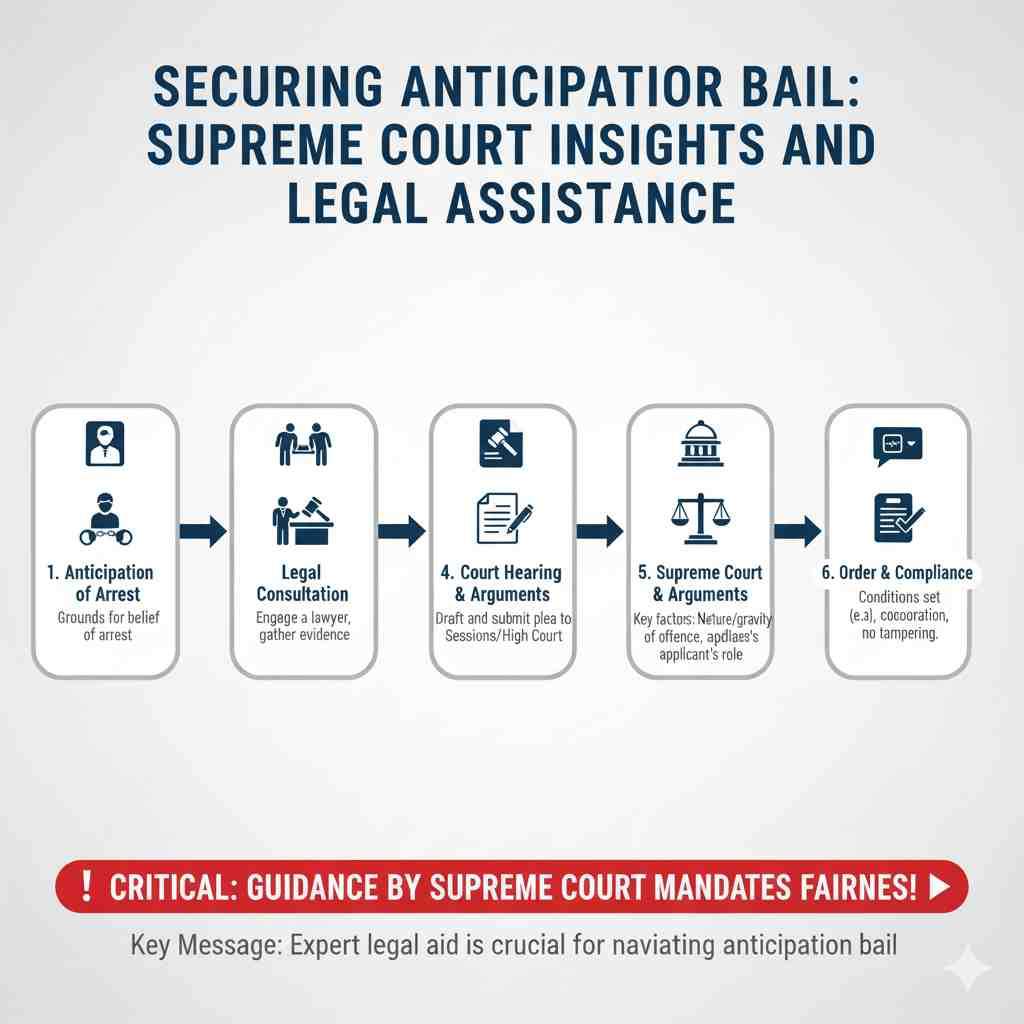
At LawyerChennai.com, we follow a clear and strategic process to help clients obtain anticipatory bail:
Step 1: Case Analysis
We begin by understanding the full background—FIR details, nature of allegations, and available evidence. This helps us identify the strength of the prosecution’s case.
Step 2: Drafting the Bail Petition
Our lawyers prepare a detailed anticipatory bail application, supported by facts, precedents, and evidence showing that the client is not likely to abscond or misuse bail.
Step 3: Filing Before the Court
The petition is filed before the Sessions Court or directly before the High Court, depending on the seriousness of the allegations.
Step 4: Arguing Before the Judge
Our advocates represent the client in court, emphasizing factors like clean antecedents, cooperation with investigation, and the absence of malafide intent.
Step 5: Grant of Bail and Compliance
Once bail is granted, we ensure all conditions are followed—such as regular court appearances or surrendering a passport—so that the client remains fully compliant with the law.
Grounds on Which Anticipatory Bail Can Be Granted
Courts consider several key factors before granting anticipatory bail, such as:
- The nature and gravity of the accusation.
- The applicant’s past conduct and criminal record.
- The likelihood of the accused fleeing justice.
- The potential for tampering with evidence or influencing witnesses.
- The credibility of the prosecution’s claims.
By addressing these points in detail, our attorneys increase the chances of a favorable bail order.
Conditions Attached to Anticipatory Bail
While granting anticipatory bail, the court may impose certain conditions, such as:
- The person must cooperate fully with the investigation.
- They cannot influence witnesses or tamper with evidence.
- They may need to surrender their passport or attend police inquiry sessions.
- They must appear before the trial court whenever required.
These conditions aim to balance the rights of the accused with the interests of justice.
When Can Anticipatory Bail Be Rejected or Cancelled?
Even though anticipatory bail is a legal right, it is not guaranteed in all cases. Courts may reject or cancel bail if:
- The accusations involve serious crimes like murder, terrorism, or sexual assault.
- The accused fails to comply with bail conditions.
- New evidence emerges suggesting guilt or risk to public safety.
In such cases, our legal team helps clients file for reconsideration or appeal before higher courts to ensure fair treatment.
Supreme Court’s Humanitarian Approach
The Supreme Court has repeatedly reminded lower courts to adopt a humane approach when dealing with anticipatory bail applications. It has stated that the law should not become a weapon of oppression but a tool of justice.
In its judgments, the Court has emphasized that arrest should never be mechanical or punitive. The aim should be to secure cooperation in investigation, not to humiliate or harass individuals.
This perspective has influenced courts nationwide to treat anticipatory bail as a fundamental protection of liberty.
Role of LawyerChennai.com in Anticipatory Bail Cases
At LawyerChennai.com – Best Lawyer Firm in Chennai, we have a dedicated criminal law team that handles anticipatory bail matters with precision and care. Our lawyers are well-versed in the nuances of bail law, Supreme Court precedents, and procedural safeguards.
We provide:
- Strategic Legal Advice: Detailed assessment of case merits before filing for bail.
- Professional Drafting: Well-prepared bail applications that align with the latest Supreme Court rulings.
- Strong Court Representation: Effective argumentation before Sessions, High, and Supreme Courts.
- Post-Bail Compliance: Guidance to ensure the client follows all bail terms properly.
Our focus is always on protecting our clients’ dignity, freedom, and peace of mind.
Anticipatory Bail for NRIs and Business Professionals
Many NRIs and professionals face legal troubles in India due to disputes, family conflicts, or business disagreements. Often, false FIRs are filed to exert pressure. For such individuals, anticipatory bail is a crucial safeguard.
We assist NRIs by coordinating with local police and courts, managing paperwork, and representing them even in their absence. Our team ensures smooth communication across time zones, minimizing disruption to personal and professional life.
Preventive Legal Advice: Staying Ahead of Legal Risks
In addition to representation, we believe in preventive legal assistance. By offering early consultation and legal advice, we help clients identify potential risks and take timely action before matters escalate.
Whether it’s a financial dispute, a corporate issue, or a family conflict that could lead to criminal complaints, early legal intervention often prevents arrest and unnecessary litigation.
The Importance of Legal Assistance in Anticipatory Bail
Securing anticipatory bail is not merely about legal procedure—it’s about restoring peace and confidence during a stressful time. An experienced lawyer can identify weaknesses in the prosecution’s case, cite relevant precedents, and present arguments convincingly.
At LawyerChennai.com, our approach is both empathetic and practical. We understand the emotional impact of criminal allegations, and we treat every case with discretion and urgency.
Frequently Asked Questions
Anticipatory bail is a legal remedy under Section 438 of the Criminal Procedure Code (CrPC) that allows a person to seek bail before arrest. It is applicable when an individual believes they might be arrested in a non-bailable offence. This safeguard ensures protection from unnecessary detention and harassment while allowing cooperation with the investigation.
The Supreme Court has clarified the law through several rulings. In Gurbaksh Singh Sibbia v. State of Punjab (1980), the Court held that anticipatory bail should not have rigid limitations. In Siddharam Satlingappa Mhetre (2011), it emphasized that liberty must be protected. Later, in Sushila Aggarwal v. State (2020), the Court confirmed that anticipatory bail does not automatically expire unless the court states otherwise.
Our firm analyzes each case carefully, drafts persuasive bail petitions, and presents strong arguments before Sessions, High, or Supreme Courts. We ensure clients comply with all bail conditions while protecting their rights and reputation. Our lawyers also handle anticipatory bail for NRIs and business professionals facing false accusations.
Yes, anticipatory bail can be cancelled if the accused violates bail conditions, tampers with evidence, or intimidates witnesses. However, such cancellation requires valid reasons and judicial approval.
Applicants should provide a copy of the FIR, identity proof, supporting evidence, and any documents showing cooperation or false implication. A well-prepared petition drafted by experienced lawyers greatly improves the chances of success.
Conclusion: Liberty Protected, Justice Ensured
Anticipatory bail is one of the cornerstones of personal freedom under Indian law. It ensures that no one is arrested unjustly or humiliated without reason. However, securing it requires deep legal knowledge, careful preparation, and strong advocacy.
The Supreme Court of India has repeatedly emphasized that anticipatory bail should be granted liberally, especially when the accusations appear motivated or exaggerated. Still, each case depends on how effectively it is presented before the court.
That’s where LawyerChennai.com – Best Lawyer Firm in Chennai stands apart. Our team of seasoned criminal lawyers ensures that your rights are fully protected, your case is handled with integrity, and your freedom is never compromised.
Read More
- Supreme Court Lawyers for Complex Divorce and Custody Battles in India
- Navigating Matrimonial Issues: Custody and Maintenance Representation at Supreme Court
- Alimony & Maintenance Lawyers in Chennai: Securing Your Financial Future
- Top Divorce Advocates in Chennai: Expert Legal Representation
- Expert Family Court Lawyers: LawyerChennai.com – Attorney Helpline in Chennai India
- India Code full PDF of the CrPC