
Divorce Appeal vs Revision Petition: Correct Legal Remedy Explained
Divorce Appeal vs Revision Petition – When a Family Court passes a divorce order, many people feel confused, hurt, or even shocked. Sometimes, they believe the judgment is unfair. At that stage, an important legal question arises: Should you file an appeal or a revision petition?
Although both remedies challenge a court order, they are not the same. In fact, choosing the wrong remedy can delay justice and even harm your case. Therefore, understanding the difference between a divorce appeal and a revision petition is extremely important.
At LawyerChennai.com, we regularly guide clients through this critical decision. In this article, we explain the difference in simple words so that you can clearly understand the correct legal remedy.
Divorce Appeal vs Revision Petition: Correct Legal Remedy Explained – LawyerChennai.com
Understanding the Concept of Legal Remedies
Before we go deeper, let us first understand what a legal remedy means.
When a court passes an order, the affected party has a right to challenge it before a higher court. However, the type of challenge depends on:
- The nature of the order
- The stage of the case
- The legal provisions under which the order was passed
Accordingly, the law provides two major remedies in matrimonial matters:
- Appeal
- Revision Petition
Now, let us examine both in detail.
What Is a Divorce Appeal?
A divorce appeal is a formal request made to a higher court to review and reconsider the judgment of a lower court.
Under the Family Courts Act, 1984, an appeal against a divorce decree passed by a Family Court generally lies before the High Court.
When Can You File a Divorce Appeal?
You can file an appeal when:
- The Family Court grants divorce and you disagree with it.
- The Family Court dismisses your divorce petition.
- The court passes a final decree regarding divorce.
- There is a serious error in appreciation of evidence.
In simple terms, an appeal is filed against a final judgment or decree.
Key Features of a Divorce Appeal
Let us understand the main characteristics:
1. Appeal Is a Statutory Right
An appeal is a legal right provided under statute. If the law allows it, you can file it as a matter of right.
2. Full Re-Examination of Case
In an appeal, the higher court can:
- Re-examine evidence
- Reconsider facts
- Review legal findings
- Even allow additional evidence in certain cases
Therefore, the appellate court has wide powers.
3. Time Limit
Usually, an appeal must be filed within 90 days from the date of judgment (subject to limitation rules). However, delay can sometimes be condoned with valid reasons.
What Is a Revision Petition?
Now, let us move to revision.
A revision petition is filed when a lower court has committed a jurisdictional error, legal irregularity, or procedural mistake.
Unlike an appeal, revision is not a matter of right. Instead, it is a discretionary remedy.
Under Section 115 of the Civil Procedure Code (CPC) or under Article 227 of the Constitution of India, parties may approach the High Court for revision.
When Is Revision Filed in Divorce Matters?
A revision petition is generally filed when:
- The Family Court passes an interlocutory order (not final).
- The court exceeds its jurisdiction.
- The court fails to exercise jurisdiction properly.
- There is a serious procedural irregularity.
For example:
- Wrong rejection of evidence
- Improper interim maintenance orders
- Procedural violations
In such cases, revision may be appropriate.
Key Features of a Revision Petition
1. Not a Matter of Right
Unlike appeal, revision is discretionary. The High Court may or may not interfere.
2. Limited Scope
In revision, the High Court does not usually re-examine evidence. Instead, it checks:
- Whether the lower court acted within its authority
- Whether there is legal perversity
- Whether justice has been seriously affected
Therefore, the scope is narrower than an appeal.
3. Focus on Jurisdictional Error
Revision mainly corrects errors of jurisdiction, not factual findings.
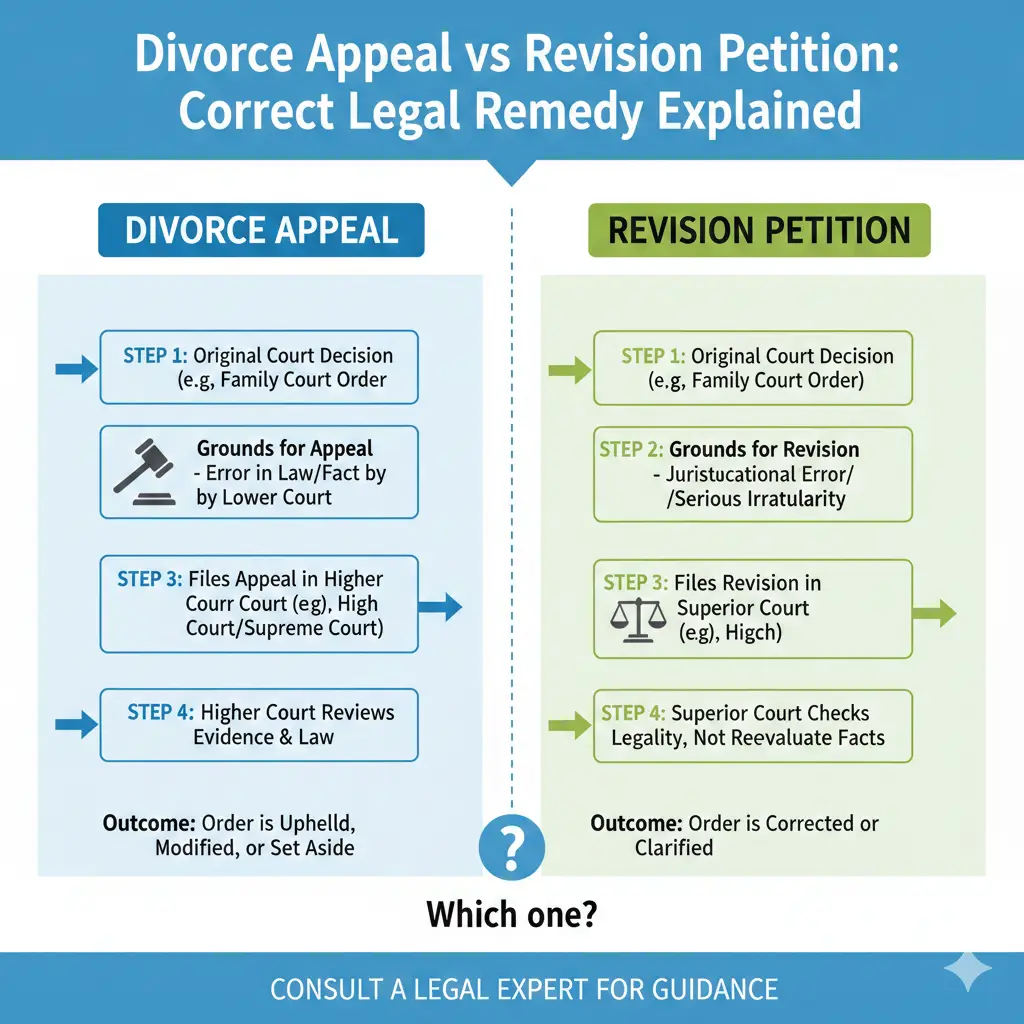
Major Differences Between Appeal and Revision
Let us clearly compare both remedies.
1. Nature of Right
- Appeal: Statutory right
- Revision: Discretionary remedy
2. Against Which Orders?
- Appeal: Final decree or judgment
- Revision: Interlocutory or jurisdictional errors
3. Scope of Review
- Appeal: Reconsideration of facts and law
- Revision: Limited to jurisdictional or legal errors
4. Power of Court
- Appeal: Wide powers
- Revision: Restricted powers
Clearly, both remedies serve different purposes.
Practical Example for Better Understanding
Let us consider two situations:
Situation 1:
The Family Court grants divorce on grounds of cruelty. You believe the evidence was misinterpreted and the judgment is wrong.
👉 In this case, you should file an appeal.
Situation 2:
During divorce proceedings, the Family Court refuses to allow you to submit important documents without valid reason.
👉 Here, you may file a revision petition challenging that procedural order.
Thus, the nature of grievance decides the remedy.
Common Mistakes People Make
Unfortunately, many litigants:
- File revision instead of appeal
- File appeal against non-appealable orders
- Miss limitation periods
- Approach wrong forums
As a result, valuable time gets wasted.
Therefore, professional legal advice becomes essential.
At LawyerChennai.com, we carefully examine the order and advise the correct remedy to protect your legal rights.
Can Both Appeal and Revision Be Filed Together?
Generally, no.
If appeal is available, revision is not maintainable. Courts usually dismiss revision when an appeal remedy exists.
However, in rare circumstances, constitutional powers under Article 227 may still be invoked. But such cases require expert legal handling.
Role of High Court in Divorce Appeals and Revisions
The High Court plays a crucial role in matrimonial disputes.
In appeals, it can:
- Confirm the divorce
- Set aside the decree
- Remand the case
- Modify the judgment
In revision, it can:
- Correct jurisdictional mistakes
- Set aside illegal procedural orders
- Direct proper trial procedure
Therefore, both remedies ensure justice but operate differently.
Importance of Timely Action
Time is critical in matrimonial litigation.
If you delay filing an appeal, your divorce decree may become final. Similarly, delay in challenging procedural errors may weaken your case.
Hence, act immediately after receiving the certified copy of the judgment.
Strategic Considerations Before Filing
Before choosing a remedy, consider:
- Is the order final or interim?
- Is there factual error or jurisdictional error?
- What is the limitation period?
- What relief do you want?
Legal strategy plays a major role. Filing blindly may create complications.
At LawyerChennai.com, we combine legal knowledge with practical strategy to ensure effective representation before the High Court.
Divorce Appeal Under Family Courts Act
Under Section 19 of the Family Courts Act:
- Appeal lies to the High Court
- Appeal must be filed within prescribed time
- No appeal lies from certain interlocutory orders
Therefore, reading the statute carefully becomes important before filing.
Revision Under Article 227 of Constitution
Article 227 gives High Courts supervisory powers over lower courts.
However, courts use this power cautiously. They interfere only when:
- There is gross injustice
- There is patent illegality
- The order shocks judicial conscience
Thus, revision is not meant to substitute appeal.
Impact on Stay of Divorce Decree
If you file an appeal, you can also request a stay of operation of the divorce decree.
Without stay, remarriage may become legally permissible after appeal period.
Therefore, filing appeal along with stay petition becomes strategically important.
In revision, stay depends on nature of order.
Why Correct Remedy Matters
Choosing the wrong remedy can:
- Lead to dismissal
- Cause delay
- Increase legal costs
- Create procedural complications
On the other hand, choosing correctly:
- Saves time
- Strengthens your case
- Ensures proper hearing
- Protects your rights
Therefore, clarity is power in litigation.
How LawyerChennai.com Can Help
At LawyerChennai.com, we provide:
- Detailed order analysis
- Strategic legal advice
- Drafting of appeal or revision
- Filing before High Court
- Stay applications
- Complete representation
We understand that divorce cases involve emotional and financial stress. Therefore, we act swiftly, carefully, and strategically.
Frequently Asked Questions
A divorce appeal challenges a final judgment or decree passed by a Family Court. In an appeal, the High Court can re-examine facts, evidence, and legal findings. On the other hand, a revision petition challenges jurisdictional errors or serious procedural irregularities. The High Court does not normally re-evaluate evidence in revision. Instead, it checks whether the lower court acted within its legal authority. Therefore, an appeal has a wider scope, while revision has a limited scope.
You should file a divorce appeal when you are dissatisfied with a final divorce decree or dismissal of your petition. If you believe the court wrongly appreciated evidence, misunderstood facts, or misapplied the law, an appeal is the correct remedy. Generally, appeals must be filed within the prescribed limitation period, usually 90 days, subject to applicable laws.
A revision petition is appropriate when the Family Court passes an interim or procedural order that suffers from jurisdictional error or legal irregularity. For example, if the court refuses to accept evidence without valid reason or exceeds its authority, revision may be filed before the High Court.
No, generally you cannot file both for the same order. If an appeal is available, revision is usually not maintainable. Courts discourage using revision as a substitute for appeal.
No, filing an appeal does not automatically stay the decree. You must file a separate stay petition requesting the High Court to suspend the operation of the divorce order until the appeal is decided.
Conclusion
To sum up, a divorce appeal challenges a final decree and allows full re-examination of facts and law. In contrast, a revision petition challenges jurisdictional or procedural errors and has limited scope. Although both remedies aim to correct injustice, they serve different purposes. Therefore, understanding their difference is essential before taking legal action. If you have received an unfavorable divorce order, do not panic. Instead, seek professional advice immediately.
Read More
- Anton Piller Orders in India | Search & Seizure Remedies in IP Litigation
- John Doe Suit and Orders in India | Quia Timet & Dynamic Injunctions Explained
- Errors by Family Courts That Justify Appellate Interference in Divorce Cases
- Ex Parte Divorce Decree: Remedy Before High Court and Supreme Court
- Supreme Court Jurisdiction in Matrimonial Appeals Under Article 136 – Practical Guide
- Family Courts Act, 1984 – Section 19 (Appeal)