Ex Parte Divorce Decree: Remedy Before High Court and Supreme Court
Divorce itself is emotionally difficult. However, the situation becomes even more painful when a court passes a divorce decree without hearing one side. This is known as an ex parte divorce decree.
Many spouses suddenly discover that their marriage has been legally dissolved without their participation. They feel shocked, helpless, and confused. Fortunately, Indian law provides strong remedies. With proper legal guidance, affected parties can challenge such decrees before the High Court and even the Supreme Court of India. At LawyerChennai.com, we help clients understand their rights and take effective legal action against unjust ex parte divorce decrees.
Ex Parte Divorce Decree: Remedy Before High Court and Supreme Court – LawyerChennai.com
What Is an Ex Parte Divorce Decree?
An ex parte divorce decree is passed when one spouse does not appear before the family court, and the court proceeds based only on the other spouse’s evidence.
Usually, courts pass such orders when:
- The respondent fails to appear repeatedly
- Summons are assumed to be served
- The respondent is unaware of the proceedings
Although courts follow procedure, mistakes often occur. Improper service of notice or lack of real opportunity to be heard can result in injustice.
Why Ex Parte Divorce Decrees Are Common
Ex parte decrees are more common than people realize.
In many cases, the respondent lives in another city or country. In others, summons are sent to the wrong address. Sometimes, one spouse deliberately avoids proper service to obtain a quick divorce.
As a result, courts proceed believing the respondent is intentionally absent. This is where legal remedies become crucial.
Immediate Impact of an Ex Parte Divorce Decree
An ex parte divorce decree has serious consequences.
It legally dissolves the marriage. It affects remarriage rights, property claims, maintenance, child custody, and social status. For NRIs, it can also impact immigration and foreign legal proceedings.
Therefore, immediate legal action is essential.
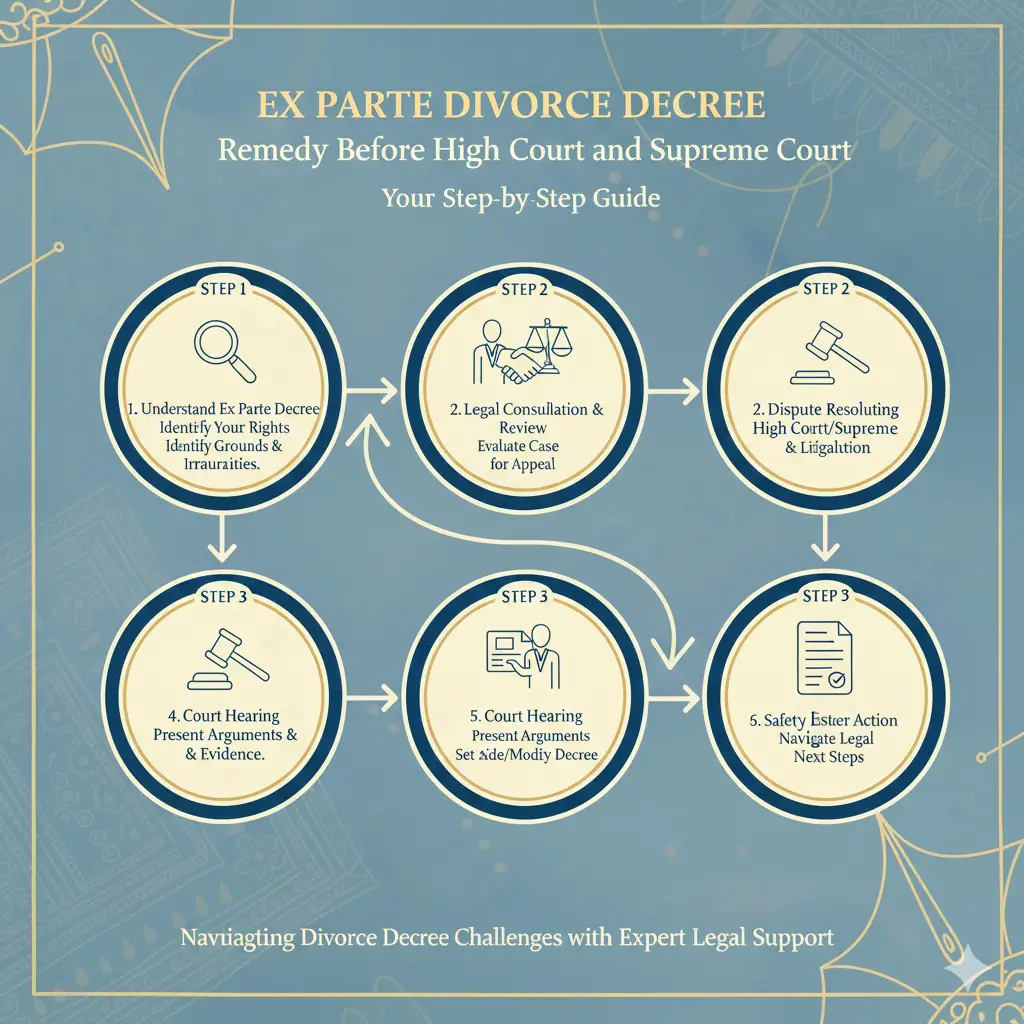
First Remedy: Application to Set Aside Ex Parte Decree
The first remedy lies before the same family court.
Under Order IX Rule 13 of the Civil Procedure Code, the affected spouse can apply to set aside the ex parte decree. The applicant must show sufficient cause for non-appearance.
Common valid reasons include:
- No proper service of summons
- Medical emergencies
- Living abroad without notice
- Lack of knowledge about the case
If the court is satisfied, it can reopen the case and hear both sides.
When Family Court Relief Is Not Enough
Sometimes, the family court dismisses the application.
This may happen if the court believes service was valid or delay was unjustified. In such situations, higher judicial remedies become necessary.
This is where the High Court plays a vital role.
Approaching the High Court: Legal Options
The High Court has wide powers to correct injustice.
An aggrieved spouse can approach the High Court through:
- Civil Revision Petition
- Writ Petition
- Appeal, depending on circumstances
The High Court examines whether principles of natural justice were violated. If notice was improper or opportunity was denied, the court can set aside the decree.
At LawyerChennai.com, we carefully evaluate which remedy best suits each case.
Grounds on Which High Court Interferes
The High Court does not interfere lightly. However, it intervenes when:
- Summons were not properly served
- Fraud or suppression of facts occurred
- Natural justice was violated
- Family court acted mechanically
The focus remains on fairness and justice, not technicalities.
Role of Supreme Court in Ex Parte Divorce Matters
In rare but serious cases, parties may approach the Supreme Court of India.
Under Article 136 of the Constitution, the Supreme Court can grant special leave to appeal. It exercises this power when grave injustice is evident.
The Supreme Court has repeatedly held that matrimonial matters require sensitivity and fair hearing.
Supreme Court’s Approach to Matrimonial Justice
The Supreme Court prioritizes substance over procedure.
If a spouse was denied a real opportunity to defend, the court steps in. It may restore the case, set aside the decree, or issue directions for fresh hearings.
Thus, even the highest court remains accessible when justice demands intervention.
Time Limit and Delay: Can You Still Challenge?
Many clients worry about delay.
While limitation periods apply, courts often condone delay if reasons are genuine. Matrimonial cases receive liberal consideration because personal rights are involved.
Therefore, delay alone should not stop you from seeking justice.
Ex Parte Divorce Decree and NRIs
NRIs face unique challenges.
They often miss proceedings due to distance, visa issues, or lack of communication. Indian courts recognize these difficulties.
Both High Courts and the Supreme Court have protected NRI spouses from unfair ex parte decrees passed without proper notice.
Legal representation becomes especially important in such cases.
Effect on Maintenance, Custody, and Property Rights
An ex parte divorce decree does not end all rights.
Maintenance claims, child custody, and property disputes can still be pursued. Moreover, if the decree itself is set aside, all connected issues revive.
Thus, legal remedies restore not only marital status but also associated rights.
Importance of Strong Legal Representation
Challenging an ex parte decree requires strategy.
Courts examine documents, service records, timelines, and conduct. A minor mistake can weaken the case.
Experienced legal representation ensures proper drafting, strong arguments, and effective presentation before higher courts.
Why Choose LawyerChennai.com
LawyerChennai.com brings deep experience in family and appellate litigation.
We understand the emotional and legal complexity of ex parte divorce cases. Our approach remains client-focused, strategic, and result-oriented.
From family courts to High Courts and the Supreme Court, we guide clients at every stage.
Frequently Asked Questions
An ex parte divorce decree is passed when one spouse does not appear before the family court despite case proceedings. The court decides the divorce based only on the petitioner’s evidence. Such decrees often occur due to improper service of notice, distance, or lack of awareness about the case by the respondent spouse.
The first remedy is filing an application under Order IX Rule 13 of the Civil Procedure Code before the same family court. The applicant must show sufficient cause for non-appearance, such as no proper notice, medical emergency, or residence abroad. If accepted, the court can set aside the decree.
If the family court rejects the application or serious procedural injustice exists, the aggrieved spouse can approach the High Court. The High Court examines violations of natural justice, improper service of summons, or abuse of legal process, and can restore the case for fresh hearing.
Yes, the Supreme Court can intervene under Article 136 of the Constitution. It does so in exceptional cases involving grave injustice or denial of fair hearing. The Court emphasizes fairness in matrimonial disputes and may set aside unjust ex parte divorce decrees.
Strong legal representation is crucial because courts examine timelines, service records, and conduct of parties. An experienced lawyer ensures proper drafting, correct legal strategy, and effective arguments before higher courts. Professional guidance increases the chances of restoring marital and related legal rights. Timely action improves outcomes and protects legal rights.
Restoring Justice Through Law
An ex parte divorce decree may feel final, but the law offers hope. With timely action and expert legal guidance, injustice can be corrected. Courts at every level remain committed to fairness and due process. If you or your loved ones face an ex parte divorce decree, remember that remedies exist. LawyerChennai.com stands ready to protect your rights and restore justice—because every voice deserves to be heard.
Read More
- Supreme Court Jurisdiction in Matrimonial Appeals Under Article 136 – Practical Guide
- Challenging Family Court Divorce Decree in High Court – Complete Legal Process
- Virtual Hearings vs Transfer Petitions – Changing Judicial Approach
- Multiple Matrimonial Proceedings in Different States – Legal Solutions
- Transfer Petition by Husband – When Courts Allow It
- Supreme Court of India – Official Website