CBIC Cadre Restructuring 2026 Latest Updates: Impact on Promotions & Legal Rights

CBIC Cadre Restructuring 2026 – The Central Board of Indirect Taxes and Customs (CBIC) plays a vital role in India’s tax system. It manages GST, customs, and central excise administration. However, over the years, officers have faced issues like stagnation, delayed promotions, and unclear seniority rules. Therefore, cadre restructuring has become a critical reform area.
In 2026, CBIC restructuring discussions gained fresh momentum due to administrative delays and pending promotions. These changes directly affect thousands of officers across India. Moreover, they influence morale, efficiency, and legal rights within the department. At LawyerChennai.com, we closely track such developments to guide affected professionals and stakeholders.
CBIC Cadre Restructuring 2026 Latest Updates: Impact on Promotions & Legal Rights – LawyerChennai.com – Best Lawyer Firm in Chennai India 24×7
What is Cadre Restructuring in CBIC?
Cadre restructuring refers to reorganizing posts, ranks, and responsibilities within a government department. It aims to improve efficiency, remove bottlenecks, and ensure fair career progression.
In CBIC, restructuring focuses on balancing workload after GST implementation. It also addresses issues like insufficient promotions and uneven distribution of officers. Historically, many officers received only one promotion in decades.
Therefore, restructuring aims to create more posts and provide better growth opportunities. It also seeks to align administrative structures with modern tax systems.
Latest Updates on CBIC Cadre Restructuring 2026
Recent developments show significant administrative challenges in implementing restructuring. In 2025, the government approved ad-hoc promotions for 944 officers to Assistant Commissioner level. However, these promotions were given on an “in-situ” basis.
This means officers received higher rank but continued in the same position. Consequently, many officers remain without proper postings even in 2026. Reports indicate over 1,000 officers are waiting for placement decisions.
Additionally, restructuring proposals have been sent to authorities like the Department of Personnel and Training. However, delays in approvals and consultations have slowed progress.
Therefore, while reforms are underway, implementation remains incomplete and complex.
Impact on Promotions: Opportunities and Challenges
Cadre restructuring directly affects promotions within CBIC. Ideally, restructuring should increase promotional avenues. It should also reduce stagnation among officers.
However, the current situation presents mixed results. On one hand, ad-hoc promotions indicate progress. On the other hand, delays in posting create uncertainty. Officers hold higher ranks without corresponding responsibilities.
This situation affects career growth and job satisfaction. Moreover, it impacts departmental efficiency. Field formations may lack experienced leadership due to pending placements.
Therefore, while restructuring promises improvement, execution challenges continue to affect promotions significantly.
Seniority Disputes and Legal Complications
Seniority plays a crucial role in promotions and postings. However, CBIC restructuring has triggered several disputes related to seniority.
In some cases, authorities attempted to revise seniority lists based on court judgments. However, such actions raised legal concerns. Courts have clarified that certain judgments must apply prospectively.
Therefore, retrospective changes in seniority may violate legal principles. Officers often approach tribunals and courts to protect their rights.
Consequently, legal disputes around seniority remain a major challenge in restructuring.
Legal Rights of CBIC Officers During Restructuring
CBIC officers enjoy several legal rights under Indian law. These rights protect them from arbitrary decisions and unfair treatment.
Firstly, officers have the right to fair promotion based on merit and seniority. Secondly, they can challenge wrongful orders before tribunals like the Central Administrative Tribunal (CAT).
Additionally, principles of natural justice apply in all administrative actions. Authorities must provide proper reasons for decisions. They must also give affected officers an opportunity to be heard.
Moreover, officers can seek judicial review in High Courts if administrative remedies fail. Therefore, legal safeguards ensure transparency and accountability in restructuring processes.
Role of Courts and Tribunals
Courts and tribunals play a crucial role in resolving disputes arising from cadre restructuring. The Central Administrative Tribunal handles service-related cases involving government employees.
High Courts exercise writ jurisdiction under Article 226 of the Constitution. They review administrative decisions and ensure legality. The Supreme Court acts as the final authority in significant cases.
Therefore, officers often approach these forums to challenge promotion delays, seniority changes, or wrongful postings. Legal precedents also guide future administrative actions.
Consequently, judicial oversight remains essential in ensuring fair implementation of restructuring policies.
Administrative Challenges Affecting Implementation
Several administrative issues have slowed CBIC restructuring. One major issue is leadership gaps within the board. Reports suggest delays due to vacant positions like Member (Administration).
Additionally, coordination between departments such as the Finance Ministry and DoPT creates procedural delays. Policy approvals require multiple levels of clearance.
Moreover, workload pressures on senior अधिकारियों affect decision-making. For instance, CBIC leadership handles multiple responsibilities, including GST and customs reforms.
Therefore, administrative inefficiencies remain a key barrier to effective restructuring.
Impact on Tax Administration and Revenue
Cadre restructuring does not only affect officers. It also impacts tax administration and revenue collection.
When senior officers remain without postings, field operations may suffer. This can reduce efficiency in monitoring and compliance. Consequently, revenue collection may face challenges.
Moreover, delays in restructuring affect implementation of policy reforms. CBIC plays a crucial role in economic growth and tax governance.
Therefore, timely restructuring becomes essential for maintaining a strong tax administration system.
Legal Remedies Available to Affected Officers
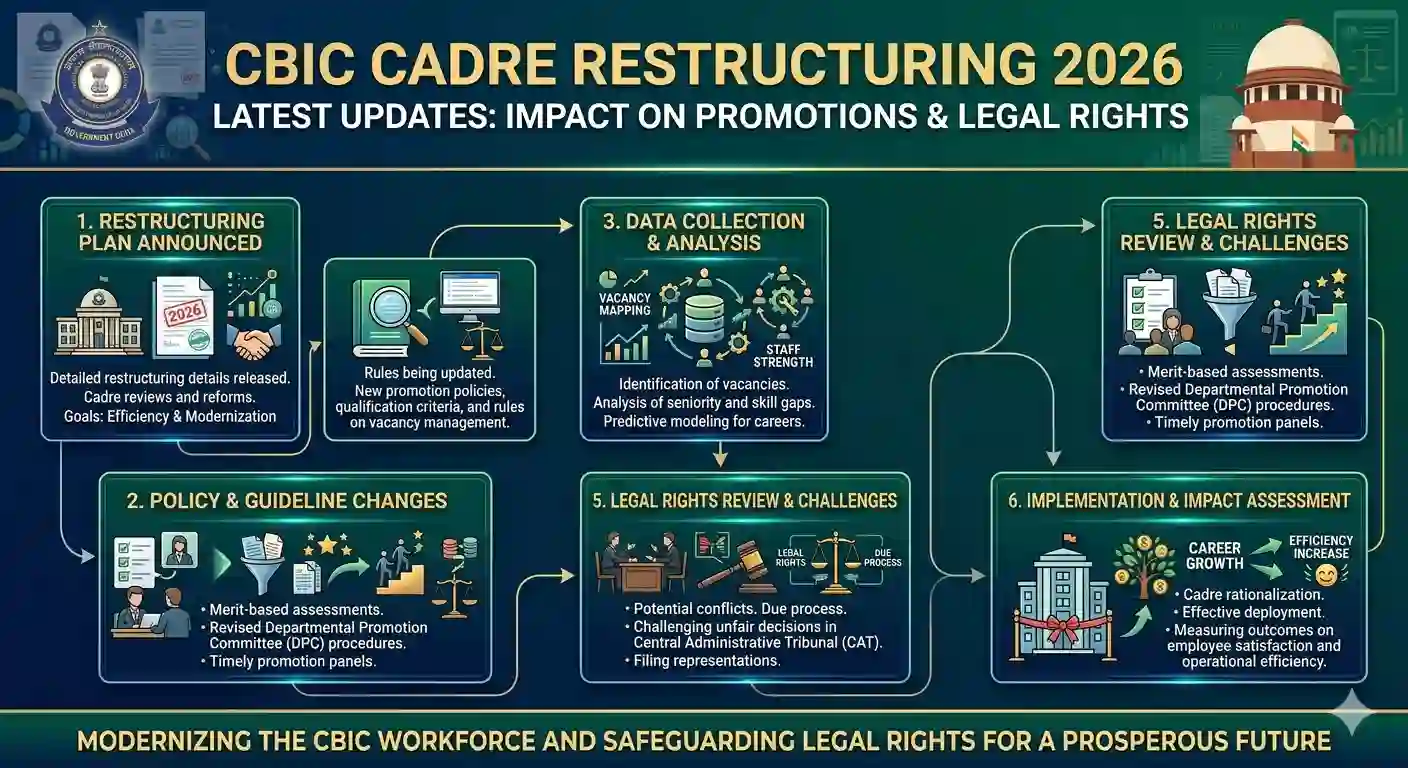
Officers affected by restructuring have several legal remedies. They can file representations before departmental authorities.
If grievances remain unresolved, they can approach the Central Administrative Tribunal. The tribunal provides relief in cases of unfair promotions or postings.
Additionally, officers can file writ petitions in High Courts. These petitions challenge arbitrary or illegal administrative actions.
In some cases, officers may seek interim relief to prevent adverse decisions. Therefore, legal remedies provide effective protection against unfair restructuring outcomes.
Role of Legal Experts and Law Firms
Legal experts play an important role in handling restructuring disputes. They analyze service rules, policies, and judicial precedents.
Lawyers also assist in drafting representations and legal petitions. They represent officers before tribunals and courts.
At LawyerChennai.com, we provide specialized legal support in service law matters. We help clients understand their rights and choose the best legal strategy.
Therefore, professional legal assistance ensures better outcomes in complex restructuring cases.
Future Outlook: What Lies Ahead?
CBIC cadre restructuring is still evolving. The government aims to improve efficiency and remove bottlenecks. However, implementation challenges must be addressed.
In the future, authorities may introduce clearer guidelines and timelines. Digital systems may also improve administrative processes.
Moreover, stakeholder consultation can enhance transparency and acceptance. Therefore, reforms must focus on fairness, efficiency, and accountability.
Consequently, the success of restructuring depends on effective execution and legal compliance.
Frequently Asked Questions
CBIC cadre restructuring reorganizes posts, ranks, and responsibilities within the tax department. In 2026, it remains important because it aims to reduce stagnation, improve promotions, and align manpower with GST-era workloads.
The restructuring creates more promotional posts; however, delays in implementation have caused uncertainty. Many officers received ad-hoc promotions without proper postings, which affects career growth, responsibilities, and overall job satisfaction.
Yes, officers can challenge unfair promotions or seniority revisions before the Central Administrative Tribunal or High Courts. Legal remedies ensure that administrative decisions follow service rules and principles of natural justice.
Officers have the right to fair promotion, transparent seniority determination, and protection against arbitrary decisions. They also have the right to be heard and to seek judicial review if administrative remedies fail.
Officers should first submit representations to department authorities. If issues remain unresolved, they should seek legal advice and approach tribunals or courts. Early action helps protect rights and prevents long-term career setbacks.
Conclusion: Balancing Reform and Rights
CBIC cadre restructuring 2026 represents an important step toward modernizing tax administration. It aims to improve promotions, reduce stagnation, and enhance efficiency. However, delays and disputes have created challenges. Officers face uncertainty regarding promotions and postings. Legal issues around seniority further complicate the situation.
Therefore, balancing administrative reforms with legal rights becomes essential. Authorities must ensure transparency and fairness in all decisions. At LawyerChennai.com – Best Lawyer Firm in Chennai India 24×7, we remain committed to protecting the legal rights of affected individuals. We provide expert guidance in service law, tribunals, and court proceedings.
Read More
- CBIC DPC 2026: Zone of Consideration, Seniority List & Legal Challenges Explained
- DPC Promotion Procedure IRS C&CE Officers 2026: Seniority Disputes & CAT Appeals
- SPARROW CBIC Module: Missing APAR / IPR Issues & Legal Solutions for Promotion
- How to File Cyber Crime Complaint in Chennai: Step-by-Step Guide 2024
- How to Challenge Adverse APAR Entries in SPARROW Module – CBIC Officers 2026
- Central Board of Indirect Taxes and Customs