Banking Dispute Appeals: Appealing banking and financial issues

Banking Dispute Appeals – Banking has become an essential part of our daily lives. From saving money to taking loans, we depend on banks for almost every financial activity. However, sometimes things do not go as planned. Customers may face issues like unauthorized transactions, loan disputes, incorrect charges, or delays in services. When such problems arise, it becomes important to take action.
At first, customers usually file a complaint with the bank. But what happens if the bank does not resolve the issue properly? This is where banking dispute appeals come into the picture. Appealing a banking decision allows you to seek justice through higher authorities or legal channels.
In this article, we will explain banking dispute appeals in a simple and practical way. We will also guide you on how to handle such issues effectively with the help of legal experts.
Banking Dispute Appeals: Appealing Banking and Financial Issues – LawyerChennai.com – Best Lawyer Firm in Chennai India 24×7
Understanding Banking Disputes
Before discussing appeals, it is important to understand what banking disputes are. In simple terms, a banking dispute arises when there is a disagreement between a customer and a bank regarding financial matters.
These disputes can occur due to various reasons. For example, a customer may notice unauthorized withdrawals from their account. Similarly, a bank may wrongly impose charges or reject a loan application without valid reasons. In some cases, technical errors may also lead to disputes.
Therefore, banking disputes can be both simple and complex. While some issues can be resolved quickly, others may require legal intervention.
Common Types of Banking Disputes
There are several types of banking disputes that customers commonly face. Let us look at a few important ones.
Unauthorized Transactions
Firstly, unauthorized transactions are one of the most common issues. Customers may find money deducted from their accounts without their knowledge. This could happen due to fraud, phishing, or system errors.
Loan and Credit Disputes
Secondly, disputes related to loans and credit cards are very common. For instance, customers may face issues with interest rates, hidden charges, or incorrect billing.
Service Deficiencies
In addition, poor customer service can also lead to disputes. Delays in processing transactions, failure to respond to complaints, or negligence by bank staff can cause frustration.
Incorrect Charges and Fees
Moreover, banks sometimes charge extra fees without proper explanation. These charges can include penalties, maintenance fees, or processing fees.
ATM and Online Banking Issues
Finally, ATM failures or online banking errors can also result in disputes. For example, money may be debited without dispensing cash.
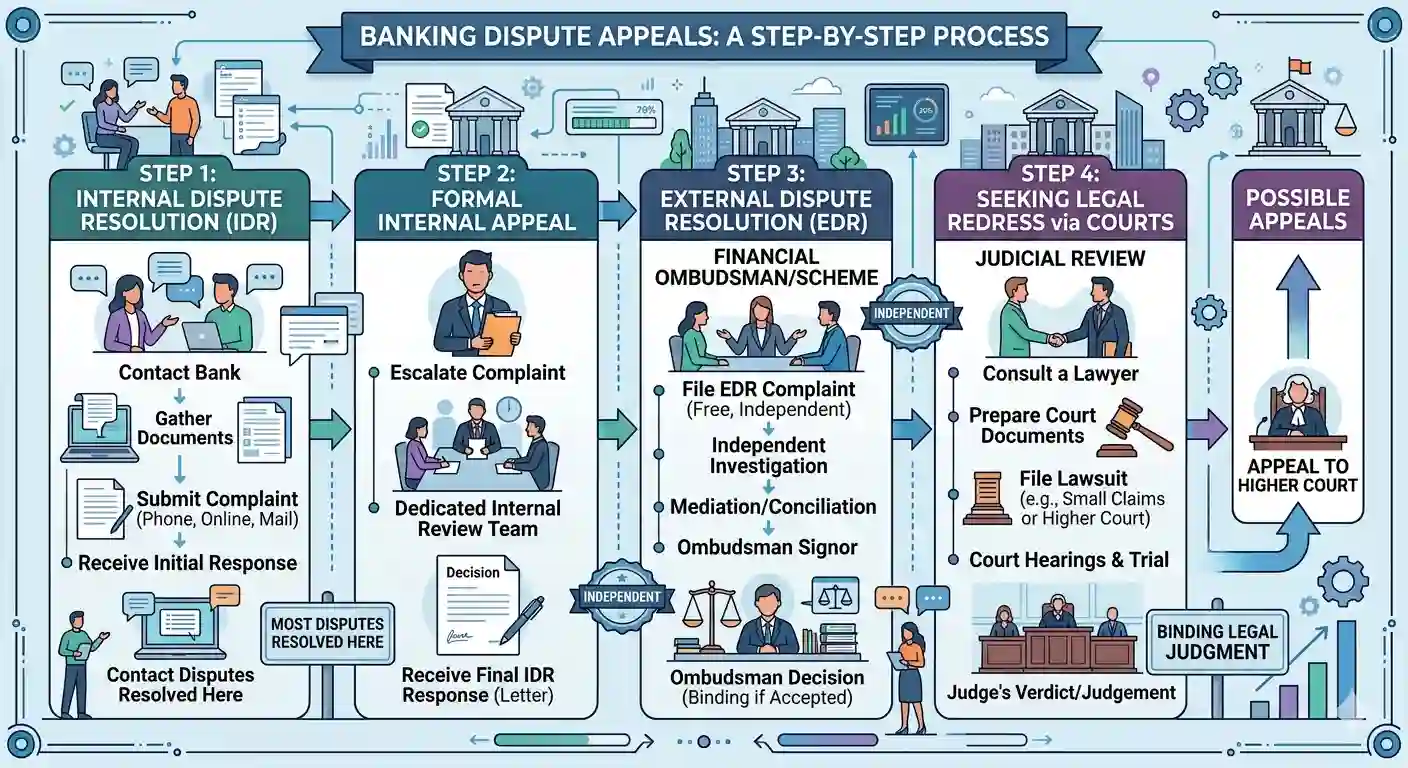
First Step: Filing a Complaint with the Bank
Before filing an appeal, it is always necessary to approach the bank directly. This is the first and most important step.
You should submit a written complaint to the bank, clearly explaining the issue. Make sure to include all relevant details such as account number, transaction details, and supporting documents.
Most banks have a grievance redressal system. Therefore, they are required to respond within a specific time frame. In many cases, the issue gets resolved at this stage itself.
However, if the bank fails to provide a satisfactory response, you can move to the next level.
What is a Banking Dispute Appeal?
A banking dispute appeal is the process of challenging the decision made by the bank. In other words, if you are not satisfied with the bank’s response, you can escalate the matter to a higher authority.
This appeal can be made to regulatory bodies, tribunals, or courts, depending on the nature of the dispute.
Importantly, an appeal gives you a second chance to present your case. It also ensures that your complaint is reviewed fairly and independently.
Authorities for Banking Appeals in India
In India, there are several authorities where you can file an appeal against banking issues. Each authority has its own role and jurisdiction.
Banking Ombudsman
Firstly, the Banking Ombudsman is one of the most effective platforms for resolving disputes. It is a simple and cost-free mechanism for customers.
You can approach the Ombudsman if the bank does not respond within 30 days or if you are not satisfied with the response.
Reserve Bank of India (RBI)
Secondly, the Reserve Bank of India plays a crucial role in regulating banks. Customers can escalate complaints through RBI’s complaint management system.
Consumer Courts
In addition, you can file a case in consumer courts if the dispute involves deficiency in service. Consumer courts provide compensation for losses suffered by customers.
Civil Courts
Finally, for complex or high-value disputes, civil courts may be the appropriate option. These cases usually require legal representation.
Step-by-Step Process of Filing an Appeal
Now, let us understand how to file a banking dispute appeal step by step.
Step 1: Gather Evidence
First of all, collect all relevant documents. This includes bank statements, emails, transaction records, and complaint copies.
Step 2: Review the Bank’s Response
Next, carefully review the response given by the bank. Identify the reasons why you are not satisfied.
Step 3: Choose the Right Authority
Then, decide where to file the appeal. For simple issues, the Ombudsman is suitable. For serious matters, courts may be better.
Step 4: Draft the Appeal
After that, prepare a clear and concise appeal. Mention all facts, supporting evidence, and the relief you are seeking.
Step 5: Submit the Appeal
Finally, submit the appeal through the appropriate channel. Keep a copy of all documents for future reference.
Importance of Legal Assistance
Although individuals can file appeals on their own, having legal support can make a big difference. Legal experts understand the law and procedures involved in banking disputes.
At LawyerChennai.com – Best Lawyer Firm in Chennai India 24×7, we provide professional guidance for handling banking disputes. Our team ensures that your case is presented effectively and your rights are protected.
Moreover, lawyers can help in drafting strong appeals, gathering evidence, and representing you before authorities. This increases the chances of a favorable outcome.
Challenges in Banking Dispute Appeals
While appealing a banking dispute, customers may face several challenges.
Firstly, the process can be time-consuming. Secondly, legal procedures may seem complicated for individuals. Thirdly, banks often have strong legal teams, which can make the process difficult.
However, with proper guidance and persistence, these challenges can be overcome.
Tips for a Successful Appeal
To improve your chances of success, follow these simple tips.
- Always keep proper records of all transactions and communications.
- Act quickly and do not delay filing complaints or appeals.
- Be clear and specific in your statements.
- Avoid emotional language and focus on facts.
- Seek legal advice whenever necessary.
By following these steps, you can handle your case more effectively.
Role of Technology in Banking Disputes
In today’s digital age, technology plays a major role in banking disputes. Online banking, mobile apps, and digital payments have made transactions easier. However, they have also increased the risk of fraud and errors.
At the same time, technology also provides solutions. Customers can now file complaints online, track their status, and receive updates instantly.
Therefore, understanding digital tools can help you manage disputes more efficiently.
Why Choose LawyerChennai.com?
When dealing with banking disputes, choosing the right legal partner is very important.
At LawyerChennai.com – Best Lawyer Firm in Chennai India 24×7, we offer:
- Expert legal advice
- Quick response and support
- Transparent communication
- Strong representation in appeals
- 24×7 assistance for urgent matters
We understand the stress caused by financial disputes. Therefore, we focus on providing practical and effective solutions.
Frequently Asked Questions
A banking dispute appeal is the process of challenging a bank’s decision when you are not satisfied with its response to your complaint. After raising the issue with the bank, if the resolution is delayed or unfair, you can escalate it to higher authorities like the Banking Ombudsman or consumer courts. This ensures your complaint is reviewed independently and fairly.
You should file an appeal if the bank does not respond within a reasonable time, usually 30 days, or if the response provided is unsatisfactory. Additionally, if you believe the bank has acted negligently, imposed unfair charges, or failed to resolve your issue properly, it is the right time to escalate the matter.
To file an appeal, you need to gather all relevant documents. These include your written complaint to the bank, the bank’s reply, account statements, transaction details, emails, and any supporting evidence. Proper documentation strengthens your case and improves your chances of success during the appeal process.
Yes, you can file a banking appeal on your own, especially before the Banking Ombudsman or consumer forums. However, for complex or high-value disputes, legal assistance is highly recommended. A lawyer can help you prepare strong arguments, organize evidence, and represent you effectively, increasing the likelihood of a favorable outcome.
The time required to resolve a banking dispute appeal depends on the authority and complexity of the case. Ombudsman cases may take a few weeks to months, while court cases can take longer. Therefore, it is important to act promptly, provide complete information, and follow up regularly for faster resolution.
Conclusion
Banking disputes can be stressful, but they are not impossible to resolve. By understanding your rights and following the proper steps, you can effectively handle such issues. First, always try to resolve the matter with the bank. If that does not work, do not hesitate to file an appeal. Use the available legal channels to seek justice.
Most importantly, consider professional legal assistance to strengthen your case. With the right support, you can protect your financial interests and achieve a fair outcome. In the end, staying informed and proactive is the key to successfully handling banking dispute appeals.
Read More
- Patent Disputes in SC: Handling patent-related appeals
- Forced religious conversion for Marriage in India: Legal Remedies, Criminal Laws, and Victim Protection Guide
- Supreme Court Advocacy for NCLAT Appeals: Corporate Dispute Expertise
- Share Purchase Agreement in India: Complete Legal Guide to Strategic Acquisitions (2026)
- How can i recover my lost money from Cryptocurrency investment scams?
- Reserve Bank of India – Complaint Management System (CMS)