
Forced religious conversion for Marriage in India: Legal Remedies, Criminal Laws, and Victim Protection Guide
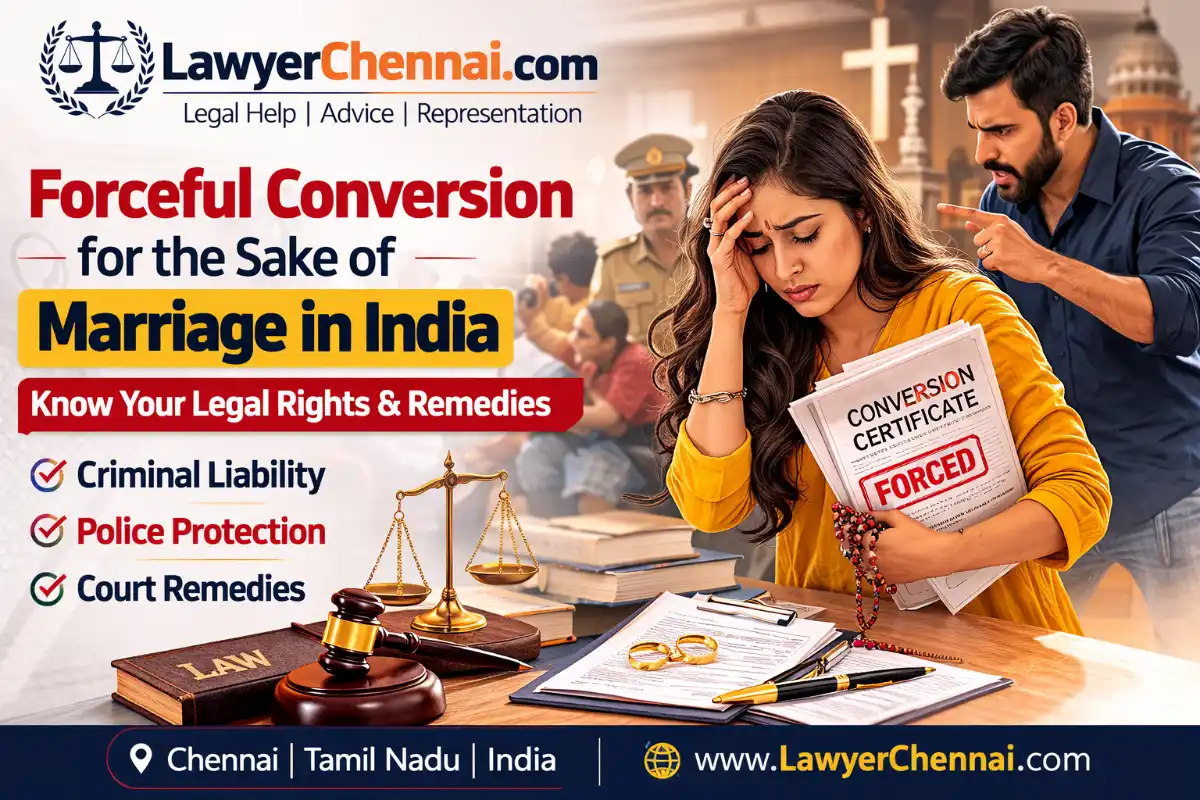
Forced religious conversion connected with marriage creates serious legal conflicts across India today. Many victims approach lawyers in Chennai seeking urgent legal protection. The Constitution guarantees freedom of religion and personal liberty. However coercion or deception invalidates genuine consent in marriage decisions. Therefore courts examine circumstances surrounding conversion carefully. Families often allege emotional manipulation, financial pressure, or intimidation before marriage ceremonies. Consequently victims pursue criminal complaints and civil remedies. The Bharatiya Nyaya Sanhita criminalizes intimidation, cheating, and conspiracy associated with fraudulent relationships. Additionally the Bharatiya Nagarik Suraksha Sanhita governs investigation and criminal procedure. Courts rely upon the Bharatiya Sakshya Adhiniyam while evaluating electronic evidence. Lawyers advise victims to preserve digital communication immediately. Messages, recordings, and financial records often reveal coercive conduct. Therefore early evidence preservation significantly strengthens litigation strategy. Chennai legal practitioners frequently combine criminal prosecution with matrimonial remedies. Such coordinated legal strategy protects victims while preserving constitutional freedoms.
Forceful Conversion for the Sake of Marriage in India: Legal Remedies, Criminal Liability, and Victim Protection
Understanding Forced Religious Conversion in Marriage Disputes
Interfaith relationships remain lawful because Indian constitutional law protects personal liberty strongly. Nevertheless forced religious conversion before marriage raises serious criminal allegations. Courts differentiate voluntary conversion from coercion using careful judicial analysis. Therefore judges examine the intention behind conversion decisions. Victims frequently describe psychological pressure from partners or relatives. Moreover social isolation and emotional manipulation often accompany such disputes. Lawyers therefore analyze communication history carefully. Digital evidence frequently reveals repeated demands for religious conversion. Common indicators of coercion include:
Threats regarding family reputation
- False promises of marriage security
- Financial dependency pressure
- Restrictions on family communication
Such conduct may constitute criminal intimidation or cheating. Consequently victims may register First Information Reports at nearby police stations. Early legal consultation therefore becomes extremely important.
Constitutional Protection of Religious Freedom
The Constitution of India guarantees freedom of religion through Article twenty five. Citizens possess the right to practice and propagate faith voluntarily. However coercive conversion violates constitutional principles and criminal law simultaneously. Courts therefore examine whether genuine consent existed during religious change. Lawyers frequently cite constitutional protections during litigation involving interfaith marriage disputes. Judges evaluate both personal liberty and protection against manipulation carefully. Consequently constitutional jurisprudence influences criminal investigations significantly. Victims may also approach High Courts through writ petitions seeking immediate protection. Habeas corpus petitions sometimes arise when families suspect unlawful confinement. Courts then verify whether the individual acted voluntarily. Judicial scrutiny therefore balances liberty and protection carefully. Lawyers must present clear evidence demonstrating coercion or deception. Therefore constitutional arguments play an important role during litigation.
Legal Framework Governing Conversion and Marriage
Indian legal systems regulate marriage and criminal conduct through several statutes. The Bharatiya Nyaya Sanhita defines offences including cheating, intimidation, and wrongful confinement. Meanwhile the Bharatiya Nagarik Suraksha Sanhita governs criminal investigation procedures. Courts apply the Bharatiya Sakshya Adhiniyam while evaluating documentary and electronic evidence. Additionally the Code of Civil Procedure regulates civil remedies and injunctions. Lawyers often initiate both criminal and civil proceedings simultaneously. Such strategy protects victims comprehensively. Civil courts may grant injunctions preventing harassment or threats. Criminal courts evaluate evidence and determine punishment. Consequently victims receive both protection and accountability through combined litigation. Legal practitioners therefore analyze jurisdiction carefully before filing cases.
Common Legal Issues in Conversion Marriage Cases
Forced conversion disputes usually involve multiple legal issues simultaneously. Lawyers identify these issues before initiating litigation strategy. Courts evaluate allegations based on evidence and witness testimony.
Common legal issues include:
- Coercive pressure for religious conversion
- Fraudulent concealment of religious identity
- Forgery of conversion certificates
- Threats against family members
- Financial exploitation connected with marriage
Digital evidence frequently supports such allegations. Therefore lawyers advise victims to preserve communication records carefully. Courts rely heavily upon electronic evidence under modern evidence law. Consequently litigation success often depends upon proper evidence preservation.
Legal Remedies for Victims of Forced Conversion in Marriage Disputes
Victims facing forced religious conversion possess several legal remedies under Indian law today. Lawyers in Chennai usually recommend immediate legal action to prevent further coercion. Therefore victims should approach nearby police stations without delay. Criminal complaints may be registered under provisions of the Bharatiya Nyaya Sanhita. These provisions address intimidation, cheating, conspiracy, and wrongful confinement. Additionally victims may approach magistrate courts seeking protective orders. Courts often issue directions preventing further harassment from accused individuals. Lawyers frequently combine criminal complaints with civil injunction petitions. Consequently victims receive immediate protection through judicial orders. Furthermore family courts may examine allegations during matrimonial litigation. Therefore coordinated legal strategy strengthens victim safety significantly. Victims should maintain detailed records of threats and communication. Digital evidence usually strengthens criminal investigation and prosecution. Therefore lawyers advise early documentation of all incidents connected with coercive conversion demands.
Legal remedies also include constitutional petitions before the High Court. Victims or family members sometimes file habeas corpus petitions alleging unlawful confinement. Courts then verify whether the individual remains under coercive influence. Judges interact directly with the concerned individual during such proceedings. Therefore courts determine whether consent exists freely. Additionally courts may direct police authorities to provide protection. Lawyers frequently seek interim relief during urgent situations. Consequently judicial intervention often prevents escalation of threats. Victims may also approach civil courts seeking injunctions against harassment. Civil remedies become useful where intimidation occurs repeatedly. Therefore legal practitioners frequently combine criminal prosecution with civil protection. This integrated strategy strengthens victim security effectively. Courts generally respond swiftly when credible evidence of coercion exists.
Checklist of Legal Actions for Victims
- Document threats, conversations, and digital communication immediately.
- File a written complaint at the nearest police station.
- Preserve digital evidence including messages and call recordings.
- Consult an experienced criminal lawyer in Chennai.
- Approach the magistrate court if police delay FIR registration.
- Seek police protection where threats appear serious.
- File annulment or divorce petitions where marriage already occurred.
Victims facing forced conversion disputes should follow a structured legal response immediately. Lawyers often prepare a checklist ensuring comprehensive legal protection. The following actions usually form the initial legal strategy:
Madras High Court Approach to Conversion Marriage Disputes
The Madras High Court frequently hears petitions involving interfaith relationships and conversion allegations. Judges emphasize adult autonomy and constitutional liberty strongly. However courts also investigate allegations of coercion carefully. Therefore judicial scrutiny focuses on voluntary consent during conversion decisions. Habeas corpus petitions often arise when parents allege unlawful confinement. During such proceedings judges interact directly with the concerned individual. Consequently courts determine whether conversion occurred voluntarily. If consent appears genuine courts protect the relationship. However credible evidence of coercion triggers police investigation. Judges may also direct protection for individuals fearing retaliation. Therefore High Court jurisdiction plays an important protective role. Lawyers frequently approach the court during urgent situations involving threats or confinement.
Judges also analyze documentary and electronic evidence presented during hearings. Digital communication often reveals emotional pressure or threats. Therefore lawyers present call recordings and message transcripts carefully. Courts examine authenticity of such evidence under the Bharatiya Sakshya Adhiniyam. Additionally judges may direct police authorities to conduct investigation. High Court supervision therefore ensures accountability during sensitive disputes. Consequently victims receive protection from coercion while personal liberty remains preserved. Judicial balance between liberty and protection defines the court approach clearly.
Police Complaint Procedure in Chennai
Filing a clear police complaint significantly improves the chances of criminal investigation. Victims should present factual information supporting allegations of coercion or fraud. Lawyers usually assist clients while drafting detailed complaints. Important elements generally include:
- Identity details of accused individuals.
- Name and address of complainant.
- Description of threats or pressure for conversion.
- Details of proposed or completed marriage.
- Evidence supporting allegations.Request for FIR registration.
Victims may submit complaints at police stations such as Mylapore, Adyar, or T Nagar. Additionally complaints may reach the Chennai Police Commissioner office. Proper documentation often encourages prompt investigation.
Police officers evaluate complaints before registering the First Information Report. Investigators then collect statements from victims and witnesses. Digital devices sometimes undergo forensic examination during investigation. Therefore evidence authenticity remains extremely important. If police delay registration victims may approach the magistrate court. Courts possess authority to direct police investigation under criminal procedure law. Consequently victims retain legal remedies even when police response appears slow. Lawyers often monitor investigation progress closely. Therefore strategic legal guidance improves the chances of successful prosecution.
Evidence Required to Prove Forced Conversion
Evidence plays a decisive role during litigation involving forced religious conversion disputes. Courts rely upon documentary, oral, and electronic evidence carefully. Therefore victims must preserve evidence immediately after threats occur. Important evidence categories usually include:
| Evidence Type | Purpose |
|---|---|
| Chat Messages | Demonstrate coercion or emotional manipulation |
| Call Recordings | Reveal threats or intimidation |
| Witness Testimony | Confirm pressure from partners or relatives |
| Financial Records | Show exploitation connected with marriage |
Lawyers usually compile such evidence systematically before filing cases. Consequently courts receive a clear factual narrative supporting the allegations.
Criminal Liability for Forced Religious Conversion in Marriage Cases
Forced religious conversion connected with marriage may attract criminal liability under modern Indian criminal law. The Bharatiya Nyaya Sanhita defines offences such as cheating, intimidation, and conspiracy clearly. Victims often describe threats intended to compel religious conversion before marriage ceremonies. Therefore investigators examine communication records carefully. Courts analyze whether deception influenced the victim’s decision. Additionally psychological pressure sometimes appears during relationships involving financial dependence. Lawyers therefore evaluate circumstances surrounding the conversion demand. Where evidence indicates fraud or coercion, criminal prosecution may follow. Police investigators usually collect digital evidence, witness statements, and documentary records. These materials help establish unlawful influence during trial proceedings. Consequently courts may impose imprisonment and financial penalties upon conviction. Criminal liability therefore discourages manipulation within intimate relationships. Victims should report threats promptly to strengthen investigation.
Criminal prosecution generally begins with registration of a First Information Report at a police station. Investigators subsequently record statements from victims and witnesses. Police may seize digital devices containing relevant communication evidence. Therefore forensic examination often becomes necessary during investigation. Courts supervise the investigation process through periodic hearings. Prosecutors later file charge sheets where sufficient evidence exists. Judges then conduct trial proceedings evaluating witness testimony and documentary proof. Lawyers representing victims assist investigators while organizing evidence chronologically. Consequently prosecutors present coherent narratives before the court. Judicial scrutiny determines whether coercion or deception occurred during the relationship. Courts ultimately deliver judgment based upon admissible evidence. Therefore evidence preservation remains essential throughout litigation.
Special Marriage Act as a Legal Alternative
The Special Marriage Act provides a lawful alternative to religious conversion before marriage. This statute permits civil marriage between partners belonging to different religions. Therefore individuals need not abandon personal faith to marry legally. Lawyers frequently recommend this statutory route during interfaith relationships. Couples must submit a marriage notice before the Marriage Officer. Authorities publish the notice for a statutory waiting period. Interested parties may raise objections during this period. However objections must relate to legal eligibility conditions. After the waiting period expires, the Marriage Officer solemnizes the marriage. Consequently the marriage receives legal recognition without religious conversion. Courts often highlight this law during disputes involving coercion. Therefore individuals possess a safe legal pathway for interfaith marriage.
Legal disputes sometimes arise when one partner insists upon conversion despite the civil marriage option. Courts therefore examine whether such insistence indicates manipulation or coercion. Lawyers frequently highlight the availability of the Special Marriage Act during litigation. Judges evaluate whether the accused deliberately avoided this lawful alternative. Such analysis may reveal fraudulent intention behind conversion demands. Therefore the Act plays an important role in judicial reasoning. Legal professionals encourage couples to understand these rights clearly. Consequently awareness of civil marriage laws reduces religious conflicts significantly.
Protection Laws for Women Facing Coercion
Women frequently become victims of coercive demands connected with conversion and marriage disputes. Therefore Indian law provides several protective legal remedies. Domestic violence legislation protects women from emotional and psychological abuse. Courts may issue protection orders preventing harassment by partners or relatives. Additionally women may seek residence rights and financial maintenance. Lawyers frequently combine these remedies with criminal complaints. Consequently victims receive both protection and accountability simultaneously. Police authorities also maintain women protection cells addressing harassment complaints. Victims may approach these units for assistance and counseling. Officers may initiate investigation where intimidation appears serious. Therefore coordinated intervention by police and courts strengthens victim safety effectively.
Family courts also examine allegations of coercion during matrimonial proceedings. Judges analyze evidence demonstrating emotional manipulation or intimidation. Therefore women may seek divorce or annulment based upon cruelty or fraud. Lawyers usually compile communication records supporting these claims. Courts evaluate psychological pressure carefully before delivering judgments. Consequently legal remedies extend beyond criminal prosecution alone. Victims may pursue civil and matrimonial remedies simultaneously. Such integrated legal strategy improves long term protection.
Role of Cyber Evidence in Conversion Disputes
Modern relationships frequently involve communication through smartphones and social media platforms. Therefore cyber evidence plays a critical role in conversion disputes. Victims often possess chat messages revealing repeated pressure for religious conversion. Lawyers carefully preserve these communications before filing complaints. Digital evidence may include messages, emails, and social media posts. Investigators analyze metadata confirming authenticity of such records. Consequently digital forensic analysis often strengthens criminal prosecution significantly. Courts recognize electronic evidence under the Bharatiya Sakshya Adhiniyam. However proper certification remains necessary for admissibility. Lawyers therefore coordinate with forensic experts during litigation preparation. Digital evidence frequently exposes patterns of manipulation and threats clearly. Consequently courts rely heavily upon such evidence.
Cyber manipulation sometimes involves concealment of religious identity during online relationships. Individuals may present false personal information to gain trust. Later such deception leads to conversion pressure before marriage. Courts examine whether identity fraud influenced the relationship formation. Lawyers therefore investigate social media history carefully. This investigation helps establish fraudulent intention during trial proceedings. Consequently digital evidence significantly shapes judicial conclusions.
Government Authorities and Legal Support Systems
Several government institutions assist victims facing coercion connected with marriage and religious conversion disputes. Police departments remain the primary law enforcement authority investigating criminal complaints. Victims may approach nearby police stations such as Mylapore, Adyar, or T Nagar. Additionally the Chennai Police Commissioner office accepts written complaints and electronic submissions. District Legal Services Authorities provide legal aid to eligible individuals seeking representation. These authorities often assign advocates for victims lacking financial resources. Women commissions also examine complaints involving harassment and coercive relationships. Furthermore family courts address matrimonial disputes including annulment and divorce petitions. High Courts exercise constitutional jurisdiction through writ petitions and habeas corpus proceedings. Consequently victims possess several institutional avenues for legal protection. Lawyers frequently coordinate with these authorities while representing clients. Therefore coordinated institutional support strengthens victim safety significantly.
Government agencies also conduct legal awareness programs regarding marriage rights and religious freedom. These programs educate citizens about lawful marriage procedures and legal protections. Therefore individuals gain awareness regarding available remedies before disputes escalate. Lawyers frequently participate in such awareness initiatives organized by legal services authorities. Public knowledge of rights prevents exploitation and manipulation within relationships. Consequently awareness programs play an important preventive role in society. Communities benefit when citizens understand lawful marriage options clearly.
Civil Remedies Under the Code of Civil Procedure
Civil remedies under the Code of Civil Procedure complement criminal prosecution during conversion disputes. Victims sometimes seek injunction orders preventing harassment or threats from accused individuals. Civil courts possess authority to issue temporary injunctions during urgent situations. Lawyers usually file suits seeking protective orders and declaratory relief. Courts examine evidence demonstrating intimidation or interference with personal liberty. Consequently civil injunctions often prevent further coercive conduct. Victims may also seek damages for financial exploitation during relationships. Additionally courts may grant declarations regarding invalid conversion or fraudulent conduct. Civil remedies therefore strengthen overall litigation strategy significantly. Lawyers frequently combine civil suits with criminal complaints strategically.
Civil courts also evaluate contractual disputes arising from fraudulent marriage promises. Financial exploitation sometimes accompanies coercive conversion relationships. Therefore victims may recover losses through civil litigation. Courts examine documentary records such as financial transfers and agreements. Lawyers therefore compile financial evidence carefully before filing suits. Consequently civil litigation may complement criminal prosecution effectively.
Strategic Legal Planning for Victims
Effective litigation strategy requires careful coordination between criminal, civil, and constitutional remedies. Lawyers generally begin with evidence preservation and legal consultation. Victims should maintain detailed records of communication and financial transactions. Thereafter lawyers evaluate available legal remedies under criminal and civil statutes. Strategic litigation may include the following actions:
Register criminal complaints under Bharatiya Nyaya Sanhita provisions.File civil injunction suits under the Code of Civil Procedure.Approach the High Court through writ petitions.Initiate annulment or divorce proceedings before family courts.Seek police protection through judicial orders.
This coordinated legal strategy protects victims from intimidation while ensuring accountability. Therefore experienced legal representation remains extremely important.
Lawyers often guide victims through each stage of litigation carefully. Early consultation helps identify appropriate legal remedies immediately. Consequently victims avoid procedural mistakes that could weaken their case. Courts also respond more effectively when legal documentation remains organized. Therefore strategic planning improves the chances of successful legal outcomes.
Read More
- Removal of Directors: Expert Guide to forced exit of Directors
- How can i recover my lost money from Cryptocurrency investment scams?
- RELIGIOUS INSTITUTIONS: How to find the Best Advocates?
- Frequently Asked Legal Questions and Answers
- Beware! WfH, Online ‘Trade’ Are Newest Baits Laid by Cybercriminals
Frequently Asked Questions
Yes. Coercion, fraud, or intimidation connected with conversion may attract criminal liability.
Family courts usually handle annulment proceedings involving coercion or fraud.
Yes. Victims may file complaints at nearby police stations.
No. The Special Marriage Act permits civil marriage without conversion.
Yes. Habeas corpus petitions may be filed before the High Court.
Yes. Electronic records are admissible under the Bharatiya Sakshya Adhiniyam.
Courts may direct police authorities to provide protection where threats exist.