
How can i recover my lost money from Cryptocurrency investment scams?

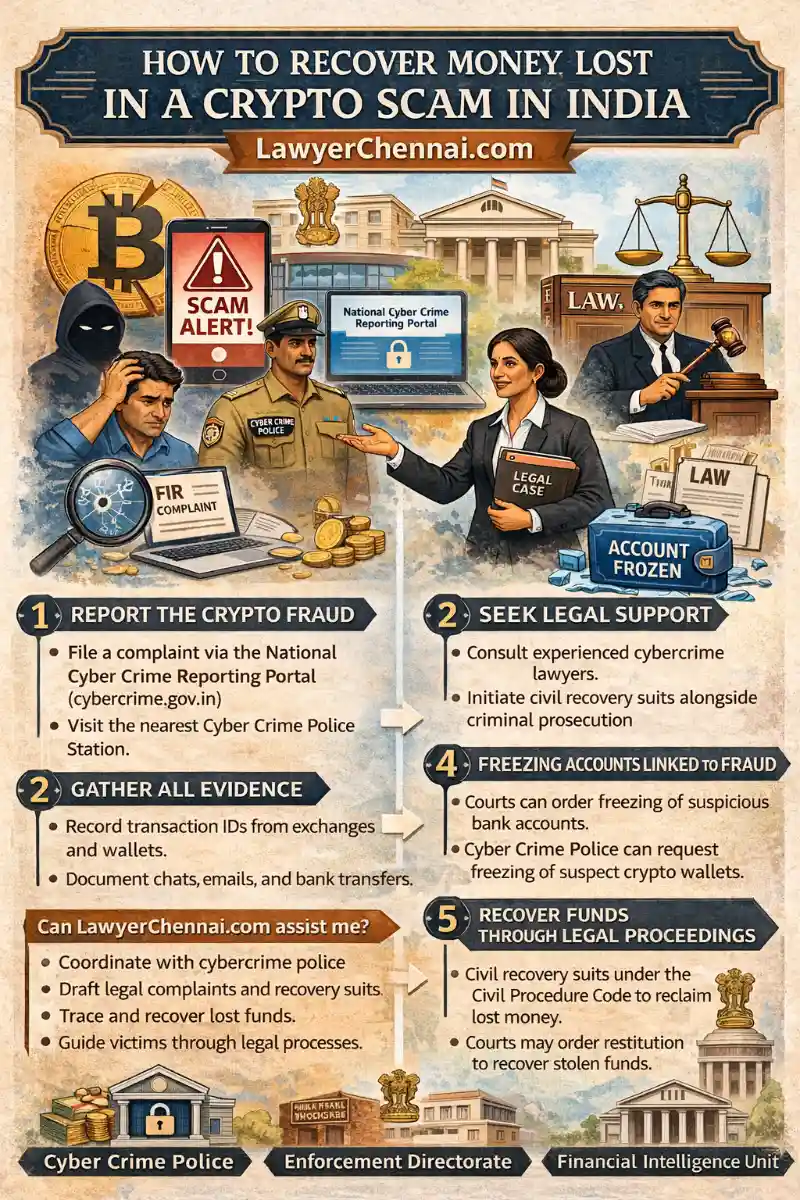
Cryptocurrency investment scams have increased rapidly across India, especially within technology-driven cities like Chennai. Many investors transfer funds to digital wallets expecting legitimate trading profits. However, fraudsters frequently disappear after receiving cryptocurrency payments or bank transfers. Consequently, victims often ask how they can recover their lost money from a crypto scam. Indian law provides several remedies through cybercrime investigations, criminal prosecution, and civil recovery proceedings. Moreover, authorities such as Cyber Crime Police, Enforcement Directorate, and financial intelligence units investigate digital fraud cases. Victims may file complaints through the National Cyber Crime Reporting Portal and nearby cyber police stations. Additionally, courts may order freezing of bank accounts and cryptocurrency wallets linked to fraudulent transactions. Therefore, timely legal action significantly improves the chances of tracing stolen funds. Experienced cybercrime lawyers assist victims by preserving digital evidence, coordinating with investigators, and initiating recovery proceedings before competent courts. LawyerChennai.com provides structured legal assistance to victims seeking recovery of cryptocurrency scam losses through lawful remedies across India.
How Can I Recover My Lost Money From a Crypto Scam? Can Your Firm Assist Me?
Understanding Crypto Scam Recovery and Legal Remedies in India
Cryptocurrency scams have increased rapidly across India, especially within urban technology markets like Chennai. Investors often transfer funds through exchanges, wallets, or peer-to-peer platforms expecting legitimate trading profits. However, fraudulent operators frequently disappear after collecting deposits. Consequently, victims immediately search for methods to recover their lost money. Indian law provides several remedies through criminal complaints, civil recovery suits, and cybercrime investigations. Moreover, victims can pursue asset tracing through exchanges and financial institutions. The following legal avenues generally assist recovery efforts:
- Cyber Crime Police complaints under BNSS procedures
- Criminal prosecution under Bharatiya Nyaya Sanhita provisions
- Civil recovery suits under the Civil Procedure Code
- Complaints through the National Cyber Crime Reporting Portal
- Freezing suspicious bank accounts through investigative agencies
Therefore, early legal action significantly improves recovery prospects. Delay often allows fraudsters to transfer cryptocurrency across multiple wallets. However, coordinated legal strategies frequently produce effective results. A structured legal approach combines investigation, evidence preservation, and asset recovery procedures. Law firms specializing in cyber fraud litigation guide victims through these complex steps. Furthermore, experienced advocates communicate with investigating officers and digital platforms. As a result, victims increase the probability of tracing funds and initiating recovery actions.
Why Crypto Scam Victims Must Act Immediately
Crypto fraud investigations depend heavily on digital transaction trails. Therefore, time plays a decisive role in successful recovery. Fraudsters typically move funds across multiple wallets quickly. Consequently, tracing becomes difficult when victims delay reporting the incident. Immediate action allows law enforcement agencies to freeze suspicious accounts before funds disappear. Victims should gather all available transaction evidence before filing complaints. Essential evidence includes:
- Transaction IDs from crypto exchanges
- Wallet addresses used by scammers
- Chat conversations with fraudsters
- Email communications and screenshots
- Bank transfer records and payment receipts
Subsequently, victims must approach the nearest cybercrime police station. Officers initiate investigations under relevant provisions of BNS and BNSS. In addition, complaints can be registered through the Government cybercrime portal. Early reporting enables investigators to send freezing requests to banks and exchanges. Furthermore, legal notices may be issued to suspected entities. Prompt action frequently prevents further transfers. Therefore, victims must consult experienced cybercrime lawyers immediately after discovering the fraud.
Legal Framework Governing Crypto Fraud in India
India regulates financial fraud through several criminal and civil statutes. Crypto scams often involve cheating, criminal breach of trust, and identity fraud. These offences fall under the Bharatiya Nyaya Sanhita, which replaced the earlier Indian Penal Code. Additionally, cybercrime investigation procedures follow the Bharatiya Nagarik Suraksha Sanhita. Evidence collection and admissibility rely on the Bharatiya Sakshya Adhiniyam. Together, these statutes create a structured legal framework for prosecution and recovery. Common criminal provisions applied in crypto scams include:
| Law | Relevant Section | Purpose |
|---|---|---|
| Bharatiya Nyaya Sanhita | Cheating and Fraud | Criminal prosecution against scammers |
| Bharatiya Nagarik Suraksha Sanhita | Investigation Procedures | Police powers for seizure and arrest |
| Bharatiya Sakshya Adhiniyam | Digital Evidence | Admissibility of electronic records |
| Civil Procedure Code | Money Recovery Suits | Civil recovery of fraudulently transferred funds |
Therefore, victims possess both criminal and civil remedies. Criminal prosecution punishes offenders and deters future scams. Civil proceedings aim to recover financial losses. Consequently, combining both strategies often produces stronger results.
Common Types of Cryptocurrency Scams Targeting Investors
Crypto scammers employ various sophisticated techniques to attract unsuspecting investors. Many schemes promise guaranteed profits or exclusive trading signals. However, these claims typically conceal fraudulent investment platforms. Recognizing scam patterns helps victims understand how fraud occurred. Moreover, awareness prevents future losses. Common scam models include:
- Fake cryptocurrency investment platforms
- Ponzi schemes using digital tokens
- Phishing attacks targeting exchange accounts
- Fake wallet applications stealing private keys
- Romance scams involving crypto transfers
For example, scammers often create professional-looking trading websites. These platforms display fabricated profit charts to convince victims. Eventually, withdrawal requests become impossible. Therefore, victims realize the fraud only after significant losses. Investigators then analyze blockchain transaction trails. Lawyers assist victims by compiling digital evidence for law enforcement agencies. Consequently, courts may order freezing of suspect accounts. Understanding scam mechanisms improves legal recovery strategies.
Jurisdiction and Authorities Handling Crypto Fraud Complaints
Several government authorities investigate crypto fraud cases across India. Victims generally approach cybercrime police units first. However, other agencies may participate depending on case complexity. These authorities collaborate to trace funds across digital networks. Key institutions include:
- State Cyber Crime Police Stations
- Central Bureau of Investigation in major fraud cases
- Enforcement Directorate for money laundering investigations
- Financial Intelligence Unit for suspicious transaction monitoring
- Reserve Bank of India for financial regulatory oversight
Victims in Chennai can approach the Cyber Crime Police Station in Egmore or nearby jurisdictions. Officers register First Information Reports and initiate digital investigations. Additionally, courts may supervise asset recovery proceedings. Therefore, jurisdiction depends on transaction location and victim residence. Experienced legal professionals coordinate with these authorities to accelerate investigations.
Step-by-Step Legal Process to Recover Crypto Scam Losses
Recovering money lost in cryptocurrency scams requires systematic legal action. Victims should follow structured steps immediately after detecting fraud. The process typically involves criminal investigation and civil recovery proceedings. A typical legal strategy includes the following steps:
- Collect transaction records and digital evidence
- File a cybercrime complaint through the national portal
- Submit a written complaint at the nearest cyber police station
- Engage a cybercrime lawyer for legal representation
- Initiate civil recovery proceedings if assets are identified
Moreover, lawyers often send legal notices to exchanges and intermediaries. These notices request preservation of transaction records. Consequently, investigators obtain valuable evidence for tracing wallets. Courts may later order asset seizure or compensation. A coordinated legal strategy significantly improves recovery possibilities.
Filing a Cybercrime Complaint Through the Government Portal
The Government of India operates the National Cyber Crime Reporting Portal for digital fraud complaints. Victims can submit complaints online before approaching local police. This portal automatically forwards cases to the relevant cybercrime police unit. Therefore, victims should prepare detailed information before submitting reports. Required information usually includes:
- Victim identification details
- Transaction history and wallet addresses
- Scammer communication records
- Exchange platform details
- Bank account information used for payment
Once submitted, the complaint generates an acknowledgement number. Victims should preserve this reference for future legal proceedings. Subsequently, police officers contact the complainant for additional evidence. Lawyers often assist victims in drafting precise complaints. Consequently, clear documentation strengthens the investigation process.
Criminal Prosecution of Crypto Scammers Under Indian Laws
Criminal prosecution plays a major role in combating cryptocurrency fraud. Investigating officers register FIRs under relevant provisions of the Bharatiya Nyaya Sanhita. These cases typically involve offences such as cheating, impersonation, and criminal breach of trust. After registration, investigators trace digital wallet transactions. Important investigative actions may include:
- Seizure of electronic devices
- Tracing IP addresses and wallet transfers
- Freezing suspect bank accounts
- Issuing notices to cryptocurrency exchanges
- Conducting forensic blockchain analysis
Courts supervise these investigations through remand and bail proceedings. Prosecutors present digital evidence before the court. Consequently, convicted offenders may face imprisonment and fines. Although criminal prosecution focuses on punishment, it often leads to asset recovery orders.
Civil Recovery Suits for Crypto Scam Victims
Victims may file civil suits to recover financial losses from identifiable parties. Civil courts exercise jurisdiction under the Civil Procedure Code. Plaintiffs seek compensation, restitution, and damages through these suits. Civil proceedings often complement criminal investigations. Essential elements of civil recovery suits include:
| Stage | Description |
|---|---|
| Filing of Plaint | Victim files claim detailing fraud and financial loss |
| Interim Applications | Requests for freezing assets or bank accounts |
| Evidence Stage | Submission of digital records and transaction logs |
| Final Judgment | Court orders compensation or restitution |
Therefore, civil litigation offers a structured path toward financial recovery. Courts may order defendants to repay stolen funds. In addition, attachment orders may secure assets during proceedings.
How LawyerChennai.com Assists Crypto Scam Victims
Professional legal assistance significantly improves recovery prospects after crypto fraud. LawyerChennai.com provides structured legal support to victims across India. The firm combines cybercrime investigation knowledge with litigation expertise. Services typically include:
- Legal consultation and case evaluation
- Drafting cybercrime complaints and FIR representations
- Coordinating with cybercrime police officers
- Issuing legal notices to exchanges and intermediaries
- Filing civil recovery suits in appropriate courts
Furthermore, lawyers guide clients through complex digital evidence procedures. They also communicate with investigative agencies and regulators. Consequently, victims gain professional representation throughout the recovery process. Structured legal strategies increase the likelihood of asset tracing and restitution.
Read More
- Crypto Clarity: Navigating Cryptocurrency Disputes with the Best Ranking Lawyers
- Beware! WfH, Online ‘Trade’ Are Newest Baits Laid by Cybercriminals
- Online Cybercrime Complaint in Chennai | Expert Legal Guidance
- QR Code Scam: What You Need to Know?
- Domestic Violence Against Men: How to get Expert Legal Remedies?
Frequently Asked Questions
1. Can crypto scam money be recovered legally?
Yes. Victims may recover funds through cybercrime investigations, civil recovery suits, and court-ordered asset freezing.
2. Where should I report a cryptocurrency scam in India?
Report the fraud through the National Cyber Crime Reporting Portal and the nearest cybercrime police station.
3. Which laws apply to crypto scams in India?
Crypto fraud cases commonly involve Bharatiya Nyaya Sanhita, Bharatiya Nagarik Suraksha Sanhita, and Civil Procedure Code provisions.
4. Can police trace cryptocurrency transactions?
Yes. Investigators use blockchain analytics and exchange records to trace wallet transfers.
5. How long does crypto recovery litigation take?
Recovery timelines vary depending on evidence, jurisdiction, and court proceedings.
6. Can courts freeze crypto wallets?
Courts may order exchanges to freeze suspicious wallets during investigation or civil litigation.
7. Should victims file both criminal and civil cases?
Yes. Combining criminal prosecution with civil recovery suits often strengthens recovery prospects.
8. What evidence helps recover crypto scam losses?
Transaction IDs, wallet addresses, chat records, payment receipts, and exchange logs assist investigations.
9. Do lawyers assist with cybercrime complaints?
Yes. Cybercrime lawyers prepare complaints, coordinate with police, and represent victims in court.
10. Can international crypto scams be prosecuted in India?
Yes. Indian courts may exercise jurisdiction when victims reside in India or transactions originate here.