High Court Orders Review: Seeking review of HC orders
High Court Orders Review – High Court review petitions provide an important remedy for correcting limited judicial errors. Therefore, parties must understand review principles before approaching the High Court. LawyerChennai.com – Best Lawyer Firm in Chennai India 24×7 assists individuals, companies, NGOs, and NRIs seeking review remedies. Lawyers evaluate judgments, orders, evidence, and applicable laws before filing review petitions. Article 226 and Article 227 of the Constitution influence High Court supervisory jurisdiction. CPC Order XLVII governs civil review procedures. Criminal review principles follow strict judicial limitations. BSA governs evidence evaluation where new material evidence becomes relevant.
High Court Orders Review: Seeking Review of HC Orders – LawyerChennai.com
Important review issues include:
- Error apparent on record.
- Discovery of new evidence.
- Misinterpretation of law.
- Procedural irregularity.
- Judicial oversight.
Courts allow reviews only in exceptional circumstances. Proper legal analysis improves chances of obtaining appropriate relief.
Legal Framework Governing High Court Order Reviews
High Court review jurisdiction operates within defined constitutional and statutory boundaries. Accordingly, review petitions cannot function as ordinary appeals. Courts examine whether apparent mistakes require correction without re-hearing the entire matter. CPC provisions apply mainly to civil proceedings. Criminal matters follow established judicial principles and limited review powers. Moreover, Article 226 enables writ jurisdiction, while Article 227 provides supervisory authority over subordinate courts. Relevant legal provisions include:
| Law | Purpose |
|---|---|
| CPC Order XLVII | Civil review petitions |
| Constitution Article 226 | Writ jurisdiction |
| Constitution Article 227 | Supervisory jurisdiction |
| BSA | Evidence assessment |
| BNSS | Criminal procedure |
Therefore, advocates must select appropriate remedies according to case nature and jurisdiction.
Grounds for Filing Review Petition Before High Courts
A review petition requires specific legal grounds supported by records. Therefore, petitioners should identify mistakes visible from existing court materials. High Courts generally reject reviews seeking fresh arguments or complete reconsideration. Lawyers examine judgments carefully before preparing petitions. Common grounds include:
- Apparent error in judgment.
- Important evidence discovered later.
- Mistake in legal interpretation.
- Failure to consider relevant material.
- Procedural injustice.
Additionally, courts require petitioners to explain why the error affected the final decision. Proper drafting improves judicial consideration. Advocates prepare review petitions with supporting documents, precedents, and factual explanations. Strategic filing prevents unnecessary rejection and protects valuable legal rights.
Error Apparent on Record in High Court Orders
An error apparent on record forms a primary ground for review petitions. Therefore, applicants must demonstrate an obvious mistake without extensive argument. Courts distinguish between legal errors and simple disagreements with judgments. A review cannot replace an appeal process. Lawyers analyze judgments to identify genuine mistakes affecting outcomes. Examples of apparent errors include:
- Ignoring statutory provisions.
- Overlooking binding precedents.
- Incorrect calculation.
- Failure to consider admitted facts.
- Procedural mistakes.
Moreover, High Courts require clear proof from existing records. New interpretations alone usually do not justify review. Experienced advocates prepare concise arguments highlighting visible errors. Proper legal presentation improves the possibility of obtaining corrective relief from the High Court.
Review Based on Discovery of New Evidence
New evidence may support review petitions when parties satisfy strict legal requirements. Therefore, applicants must prove that evidence existed earlier but remained unavailable despite reasonable efforts. Courts carefully examine authenticity, relevance, and importance of newly discovered materials. BSA principles guide evidence assessment during proceedings. Relevant new evidence may include:
- Previously unavailable documents.
- Government records.
- Official certificates.
- Important communications.
- Material facts affecting decisions.
Additionally, courts avoid reopening cases without exceptional justification. Lawyers verify documents before presenting them before the High Court. Proper explanation regarding delayed discovery strengthens review applications. Strategic evidence presentation helps courts determine whether reconsideration serves justice.
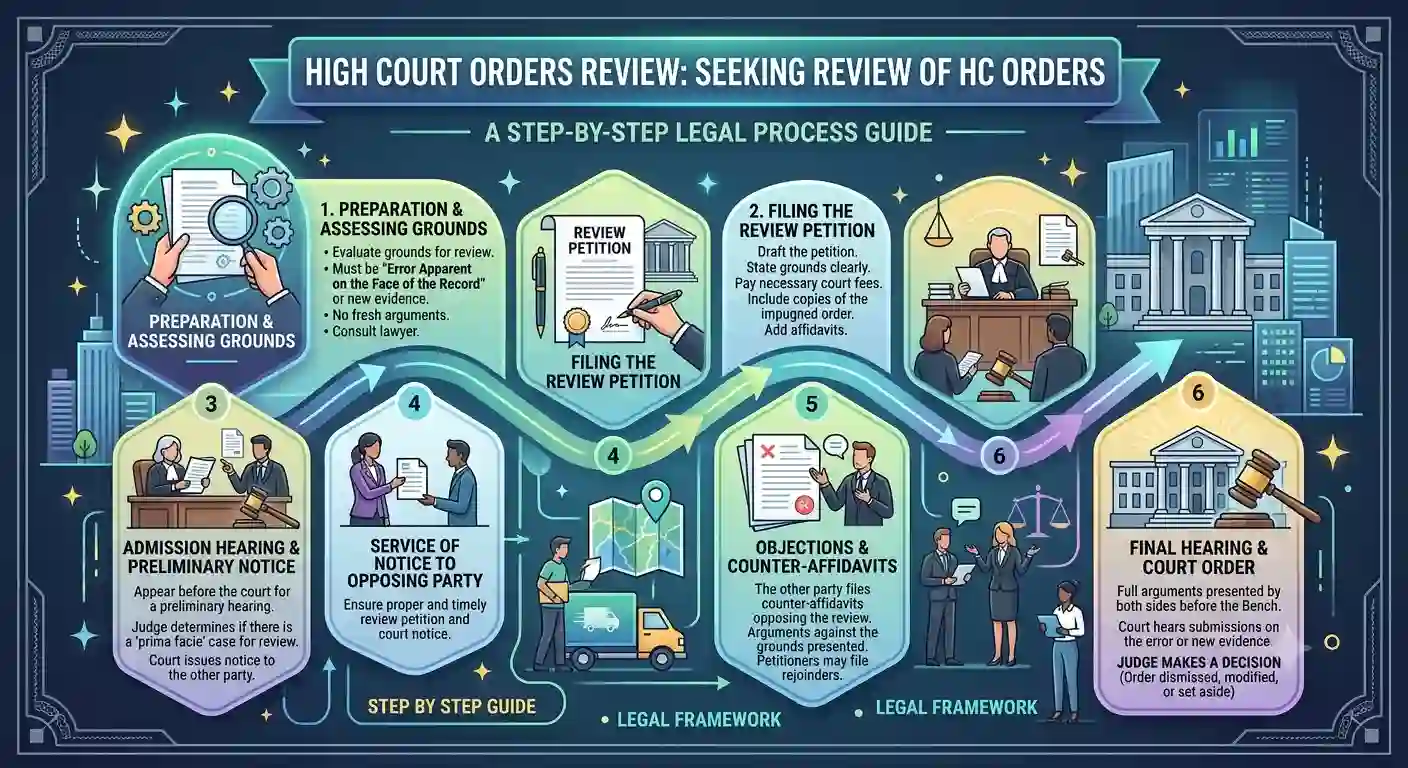
Procedure for Filing a High Court Review Petition
A review petition requires careful compliance with procedural rules and limitation requirements. Therefore, petitioners should seek legal advice before initiating proceedings. Lawyers examine the judgment, applicable statutes, court rules, and judicial precedents before drafting the petition. Every application should clearly identify the review grounds supported by relevant records. Courts reject vague or repetitive pleadings lacking legal merit. Filing within the prescribed limitation period remains essential. Typical filing steps include:
- Review the High Court order.
- Identify statutory review grounds.
- Prepare supporting affidavit.
- Attach relevant documents.
- File before the competent High Court Bench.
Court registries scrutinize procedural compliance before listing matters. Accurate drafting significantly improves judicial consideration and reduces avoidable objections.
Difference Between Review, Appeal, and Revision
Review, appeal, and revision serve different legal purposes under Indian procedural law. Accordingly, litigants should choose the correct remedy after evaluating the nature of the grievance. Appeals generally challenge findings on facts or law before a higher forum. Review petitions request the same court to correct limited errors. Revision proceedings address jurisdictional or procedural irregularities where statutes permit. Key distinctions include:
| Remedy | Primary Purpose |
|---|---|
| Review | Correct apparent error |
| Appeal | Challenge judgment |
| Revision | Correct jurisdictional error |
| Writ Petition | Enforce legal rights |
| Special Leave Petition | Supreme Court remedy |
Proper remedy selection prevents unnecessary delays and strengthens litigation strategy before competent judicial forums.
Representation Before the Madras High Court
Professional representation improves procedural compliance and effective legal advocacy. Therefore, parties should engage experienced High Court advocates before filing review petitions. Lawyers analyze judgments, prepare written submissions, and present structured legal arguments. The Madras High Court examines review petitions according to statutory provisions and binding precedents. BSA principles govern evidentiary issues whenever additional material becomes relevant. Professional legal services include:
- Judgment analysis.
- Review petition drafting.
- Affidavit preparation.
- Court representation.
- Compliance review.
- Hearing assistance.
Advocates also advise clients regarding alternative remedies whenever review jurisdiction appears unavailable. Strategic legal planning protects procedural rights while improving litigation efficiency.
Alternative Legal Remedies When Review Is Not Maintainable
Not every High Court order qualifies for review jurisdiction. Therefore, litigants should evaluate alternative remedies before pursuing further proceedings. Appeals remain available where statutes expressly permit appellate review. Special Leave Petitions before the Supreme Court may arise in appropriate cases. Writ remedies, revisions, or curative procedures may also apply depending upon legal circumstances. Available legal remedies include:
| Legal Issue | Possible Remedy |
|---|---|
| Review rejected | Appeal where permitted |
| Constitutional issue | Writ jurisdiction |
| Serious legal error | Special Leave Petition |
| Jurisdictional defect | Revision |
| Procedural violation | Appropriate statutory remedy |
Experienced legal advice ensures litigants pursue the most suitable remedy within the prescribed limitation period.
Review Petitions in Civil and Criminal Matters
Review principles differ between civil and criminal proceedings. Consequently, lawyers assess the governing legal framework before recommending appropriate action. Civil review petitions primarily follow CPC Order XLVII. Criminal proceedings follow limited judicial review principles developed through statutes and precedents. BNSS governs criminal procedure after replacing the earlier procedural code. BNS defines criminal offences where substantive criminal law becomes relevant. Important considerations include:
- Nature of proceedings.
- Applicable statute.
- Limitation requirements.
- Available evidence.
- Judicial precedents.
Accurate legal assessment prevents misuse of review jurisdiction. Well-prepared petitions improve the prospects of obtaining appropriate judicial relief before the High Court.
Protecting Legal Rights Through Timely High Court Review Petitions
Timely legal action protects valuable rights after an adverse High Court order. Therefore, parties should immediately obtain professional legal advice before limitation periods expire. LawyerChennai.com – Best Lawyer Firm in Chennai India 24×7 provides strategic representation in civil, criminal, constitutional, commercial, service, tax, property, and writ matters. The legal team evaluates judgments, identifies review grounds, and recommends suitable remedies. Moreover, advocates assist clients before the Madras High Court, other High Courts, tribunals, appellate authorities, and the Supreme Court. They also prepare review petitions, affidavits, written submissions, and supporting documents. Comprehensive legal support includes:
- Judgment review.
- Review petition drafting.
- Court representation.
- Limitation advice.
- Evidence evaluation.
- Appeal guidance.
- Writ petition assistance.
Early legal consultation improves procedural compliance and enhances opportunities for obtaining lawful judicial relief.
Why Choose LawyerChennai.com – Best Lawyer Firm in Chennai India 24×7
LawyerChennai.com – Best Lawyer Firm in Chennai India 24×7 delivers experienced representation for review petitions and related litigation. The firm advises individuals, companies, NGOs, and NRIs across diverse legal matters. Lawyers carefully examine High Court orders, statutory provisions, judicial precedents, and procedural requirements before recommending legal strategies. Furthermore, the team represents clients before the Madras High Court, tribunals, appellate forums, and the Supreme Court. Advocates also assist with appeals, revisions, writ petitions, Special Leave Petitions, and constitutional remedies where appropriate. Every matter receives detailed legal analysis based on facts and applicable law. Professional guidance reduces procedural errors and strengthens case presentation. Strategic representation helps clients pursue appropriate judicial remedies efficiently while protecting their legal rights and commercial interests.
Frequently Asked Questions
1. What is a High Court review petition?
A review petition requests the same High Court to correct an apparent error, consider eligible new evidence, or address a limited judicial oversight.
2. Can every High Court judgment be reviewed?
No. Courts entertain review petitions only on limited legal grounds. A review cannot replace a statutory appeal or rehearing of the entire case.
3. What are the main grounds for seeking a review?
Common grounds include an apparent error on record, discovery of important new evidence, procedural mistakes, or failure to consider material facts.
4. What is the difference between a review and an appeal?
A review seeks correction by the same court. An appeal challenges the judgment before a higher court where the law permits.
5. Can new evidence support a review petition?
Yes. However, the applicant must show the evidence remained unavailable despite reasonable diligence and materially affects the original decision.
6. How can LawyerChennai.com assist with High Court review matters?
The firm provides judgment analysis, review petition drafting, court representation, appellate advice, writ remedies, and strategic litigation support before the Madras High Court and Supreme Court.
Read More
- Financial Regulation Appeals: Appealing financial regulation decisions
- Public Administrative Law Appeals: Handling administrative law cases
- Civil Liability Appeals: Challenging civil liability judgments
- Urban Planning Disputes: Appealing urban planning decisions
- Rural Land Disputes: Handling disputes in rural land matters
- Department of Justice, Ministry of Law and Justice