
CBIC DPC 2026: Zone of Consideration, Seniority List & Legal Challenges Explained
CBIC DPC 2026 – In the Indian indirect tax administration system, the Central Board of Indirect Taxes and Customs (CBIC) plays a very important role. It manages customs, GST enforcement, and various field formations across the country. Naturally, promotions within CBIC are highly structured and strictly governed by rules.
In this context, the Departmental Promotion Committee (DPC) for 2026 becomes extremely important for officers waiting for career advancement. However, issues like zone of consideration, seniority lists, eligibility, and legal disputes often create confusion and challenges.
At LawyerChennai.com – Best Lawyer Firm in Chennai India 24×7, we regularly handle service matters related to promotions and departmental disputes. Therefore, in this article, we explain CBIC DPC 2026 in simple terms so that officers, legal professionals, and stakeholders clearly understand the process. Moreover, we also highlight common legal challenges and remedies available under service law.
CBIC DPC 2026: Zone of Consideration, Seniority List & Legal Challenges Explained – LawyerChennai.com
Understanding CBIC DPC 2026 in Simple Terms
To begin with, a Departmental Promotion Committee (DPC) is a committee that evaluates eligible employees for promotion. In CBIC, promotions happen based on:
- Seniority
- Eligibility criteria
- Performance records
- Vacancy availability
- Service rules
For 2026, the CBIC DPC will review officers across various cadres such as Inspectors, Superintendents, and other Group A and Group B posts.
Furthermore, the DPC does not act randomly. Instead, it follows strict government guidelines issued by the DoPT (Department of Personnel and Training) and CBIC recruitment rules.
As a result, transparency and fairness become essential parts of the process.
What is Zone of Consideration in CBIC DPC?
The “zone of consideration” is one of the most important concepts in promotion law.
Simply put, it refers to the list of eligible officers who are considered for promotion by the DPC.
Usually, the number of candidates in the zone depends on the number of vacancies. For example:
- For 1 vacancy → about 5 eligible officers
- For multiple vacancies → proportionally more officers
However, this is not fixed in all cases. It depends on rules and government instructions.
Why is it important?
Firstly, it ensures fairness in selection.
Secondly, it prevents unnecessary overcrowding of candidates.
Moreover, it allows the committee to evaluate only relevant officers.
However, disputes often arise when officers feel wrongly excluded from the zone. Therefore, proper preparation of the zone of consideration becomes legally critical.
Seniority List and Its Legal Importance
The seniority list is the backbone of the entire promotion system in CBIC.
It contains the ranking of officers based on their date of appointment, confirmation, and service rules.
How seniority is determined
Generally, seniority is decided based on:
- Date of joining service
- Date of confirmation
- Departmental rules
- Court judgments (in disputed cases)
However, complications often arise when:
- Promotions are delayed
- Temporary postings are confused with permanent service
- Reservation roster issues affect ranking
Therefore, seniority disputes are one of the most common legal issues in CBIC DPC cases.
At LawyerChennai.com, we often see cases where even a small correction in seniority can completely change promotion outcomes.
How CBIC DPC 2026 Process Works
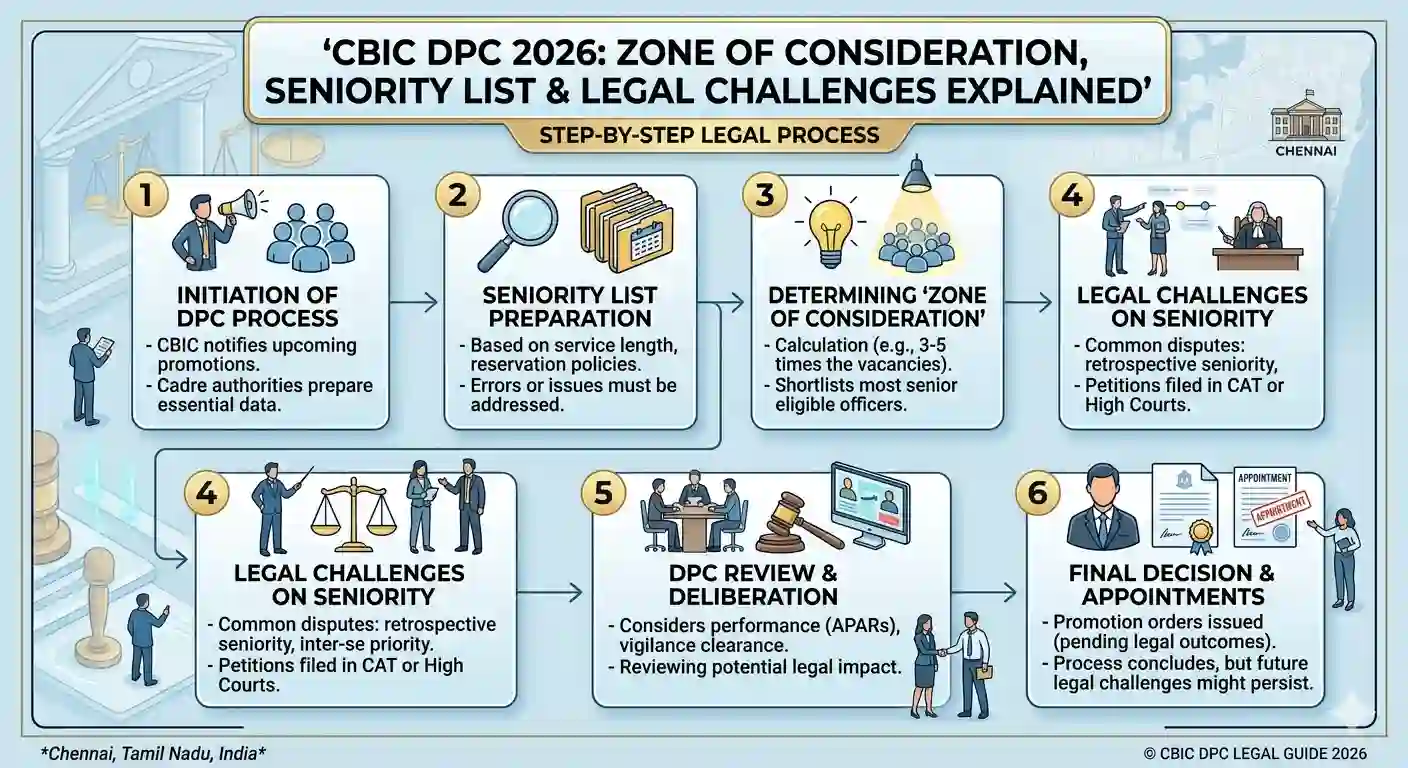
To understand the system better, let us break it down step by step.
Firstly, the department identifies vacancies for the year 2026.
Secondly, it prepares the seniority list of eligible officers.
Thirdly, the zone of consideration is finalized.
After that, ACRs/APARs (performance reports) are collected.
Then, the DPC committee evaluates each officer.
Finally, a select list is prepared for promotion.
Moreover, the recommendations of the DPC are usually binding unless there is a legal or procedural error.
However, delays often occur due to litigation or administrative corrections.
Common Legal Challenges in CBIC DPC 2026
Although the system looks structured, several legal issues arise in real situations.
1. Disputes in Seniority
Many officers challenge their position in the seniority list. As a result, promotions get delayed. Courts often intervene to correct errors.
2. Incorrect Zone of Consideration
Sometimes, eligible officers are left out. Conversely, ineligible officers may be included. This creates legal disputes and representation cases.
3. APAR Grading Issues
Annual Performance Appraisal Reports play a major role in promotion. However, officers often challenge:
- Low grading
- Unfair remarks
- Non-communication of entries
Therefore, APAR disputes frequently reach tribunals.
4. Reservation and Roster Conflicts
CBIC follows reservation rules for SC, ST, and OBC categories. However, roster implementation mistakes often lead to legal challenges.
5. Delay in Conducting DPC
Sometimes, DPC meetings are delayed due to administrative reasons or court orders. This affects career progression and creates legal claims for notional promotion.
6. Violation of Natural Justice
If an officer is not given proper opportunity or if records are not fairly considered, courts may treat it as a violation of natural justice.
Judicial Remedies Available for Officers
When disputes arise, officers can approach legal forums.
Generally, the following remedies are available:
- Representation to department
- Appeal before administrative authorities
- Filing case in Central Administrative Tribunal (CAT)
- Writ petition in High Court
- Supreme Court appeal in rare cases
Moreover, courts often ensure that promotion processes remain fair and transparent.
Therefore, timely legal action becomes very important.
Impact of Legal Disputes on Promotions
Legal disputes in CBIC DPC 2026 can have serious consequences.
Firstly, promotions get delayed for many officers.
Secondly, seniority positions may change after court orders.
Moreover, financial benefits like arrears may be affected.
In addition, long litigation affects departmental efficiency.
Therefore, both officers and departments try to resolve issues early through internal corrections.
Role of Legal Experts in CBIC DPC Matters
Service law is highly technical. Therefore, expert legal guidance becomes essential.
At LawyerChennai.com – Best Lawyer Firm in Chennai India 24×7, we assist clients in:
- Challenging wrong seniority lists
- Filing CAT petitions
- Representing officers in promotion disputes
- Drafting legal representations
- Handling APAR-related cases
Moreover, we focus on practical solutions rather than lengthy litigation wherever possible.
As a result, many disputes get resolved faster and more efficiently.
Why CBIC DPC 2026 Matters for Officers
CBIC DPC 2026 is not just a routine administrative process. Instead, it directly affects:
- Career growth
- Financial benefits
- Retirement position
- Professional reputation
Therefore, every stage of the process becomes legally and professionally important.
Furthermore, even small errors can lead to long-term consequences.
Hence, officers must remain informed and proactive.
How to Avoid Legal Problems in Promotion Process
Although disputes are common, many issues can be avoided with proper steps.
For example:
- Regularly checking seniority lists
- Reviewing APAR entries on time
- Submitting timely representations
- Maintaining service records carefully
Moreover, seeking legal advice at an early stage can prevent major disputes later.
Therefore, awareness plays a key role in smooth promotion processing.
Frequently Asked Questions
CBIC DPC 2026 is the Departmental Promotion Committee process conducted by the Central Board of Indirect Taxes and Customs to evaluate eligible officers for promotion. It is important because it directly impacts career growth, seniority position, and financial benefits of officers working under CBIC across different cadres.
The zone of consideration refers to the list of eligible officers who are shortlisted for promotion by the DPC. It is prepared based on vacancies and seniority rules. Only officers within this zone are considered for evaluation, and exclusion from it can lead to legal disputes and representations.
The seniority list is prepared based on official service rules such as date of appointment, confirmation in service, and applicable DoPT guidelines. It may also be affected by reservation rosters and court decisions. Any mistake in this list can significantly affect promotion eligibility and lead to legal challenges.
Common legal challenges include incorrect seniority lists, improper zone of consideration, disputes over APAR grading, reservation roster errors, and delays in conducting DPC meetings. These issues often result in cases before the Central Administrative Tribunal or High Courts for correction and relief.
Aggrieved officers can first submit departmental representations. If unresolved, they may approach the Central Administrative Tribunal or file a writ petition in the High Court. In some cases, appeals may reach the Supreme Court. Legal experts like LawyerChennai.com assist in handling such service law disputes effectively.
Conclusion
In conclusion, CBIC DPC 2026 is a crucial event for many officers in the indirect tax system. It involves complex processes like zone of consideration, seniority list preparation, and performance evaluation.
However, despite clear rules, legal challenges often arise due to administrative errors, interpretation issues, and procedural delays. Therefore, understanding the system becomes very important for every officer.
At LawyerChennai.com – Best Lawyer Firm in Chennai India 24×7, we provide strong legal support in service law matters, especially in promotion and seniority disputes. Moreover, we believe that timely legal action and proper representation can protect careers and ensure fair justice.
Read More
- DPC Promotion Procedure IRS C&CE Officers 2026: Seniority Disputes & CAT Appeals
- SPARROW CBIC Module: Missing APAR / IPR Issues & Legal Solutions for Promotion
- How to File Cyber Crime Complaint in Chennai: Step-by-Step Guide 2024
- How to Challenge Adverse APAR Entries in SPARROW Module – CBIC Officers 2026
- Property Title Verification Process in Chennai | Legal Due Diligence Lawyers
- Central Board of Indirect Taxes and Customs (CBIC)