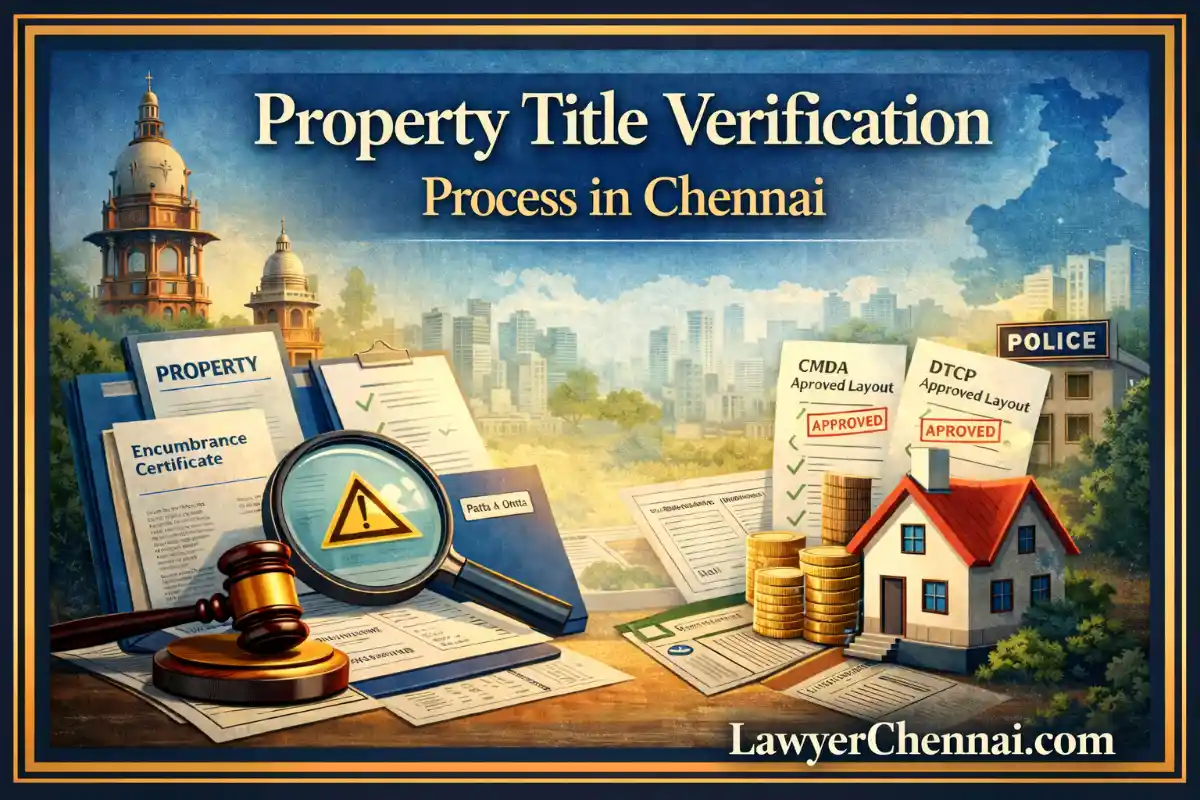
Property Title Verification Process in Chennai | Legal Due Diligence Lawyers
Property title verification represents the cornerstone of secure real estate transactions in Chennai. This legal process validates ownership rights, identifies encumbrances, and prevents future disputes. Moreover, comprehensive verification protects buyers from fraudulent transactions and financial losses. The process involves examining multiple government records, court databases, and revenue documents. Consequently, engaging a property title verification lawyer Chennai ensures thorough scrutiny of all legal aspects. According to recent statistics, over 35% of property disputes arise from inadequate title verification. Furthermore, the Bharatiya Nyaya Sanhita (BNS) criminalizes property fraud under Section 316. Therefore, professional legal due diligence services become essential before any property purchase. Additionally, Chennai’s rapid urbanization demands stringent verification protocols. The Sub-Registrar Office Chennai maintains crucial ownership records. Tamil Nadu’s revenue system requires careful navigation by experienced advocates. Ultimately, proper verification safeguards your investment and ensures peaceful possession.
Understanding Property Title Verification in Chennai
What Property Title Verification Entails
Legal due diligence for property purchase in Chennai encompasses multiple verification layers. First, ownership chain examination traces property history through decades of transactions. Second, encumbrance certificate analysis reveals outstanding loans, mortgages, or legal claims. Third, municipal approval verification confirms compliance with CMDA and DTCP regulations. Additionally, litigation searches across District Courts and Madras High Court uncover pending disputes. The process also includes verification of tax payment records with Chennai Corporation. Furthermore, RERA registration status must be confirmed for under-construction properties. Property due diligence lawyers Chennai systematically examine parent documents dating back thirty years. This includes sale deeds, gift deeds, partition deeds, and succession certificates. Moreover, physical inspection ensures boundary alignment with revenue records. The verification extends to checking property tax receipts and water connection documents. Subsequently, advocates prepare comprehensive legal reports highlighting risks and recommendations. Finally, title insurance options are evaluated for additional protection.
Essential Documents Required for Verification
Comprehensive property verification requires specific documentation from multiple government authorities. The primary documents include original sale deed, previous chain of title documents, and encumbrance certificate. Additionally, Patta and Chitta extracts from Taluk Office establish revenue ownership. Field Measurement Book (FMB) sketches confirm survey numbers and boundaries. Furthermore, A-Register extracts validate cultivation or occupation details in rural areas. Building plan approvals from CMDA or DTCP demonstrate construction legality. Property tax receipts from Chennai Corporation prove tax compliance history. Moreover, latest survey certificates prevent boundary disputes with adjacent properties. Non-Agricultural (NA) conversion orders are essential for agricultural land transactions. Khata certificates show property tax assessment and ownership records. Subsequently, legal heir certificates become necessary when sellers inherited the property. No Objection Certificates from housing societies establish clearance of dues. Finally, recent photographs and location maps support physical verification processes.
Parent Document Analysis Framework
Parent document scrutiny forms the foundation of title verification in Chennai. Legal risk assessment services begin by examining the root of title document. This includes original grant deeds, government sale certificates, or royal patents. Subsequently, each subsequent transaction document undergoes careful legal analysis. Advocates verify execution dates, registration numbers, and stamp duty payments. The chain must remain unbroken from original owner to current seller. Additionally, partition deeds require verification of all co-owner consents and shares. Gift deeds need scrutiny under Transfer of Property Act provisions. Furthermore, will-based transfers demand probate or succession certificate verification. Relinquishment deeds must show clear renunciation of rights by all parties. Moreover, exchange deeds require valuation analysis and consideration verification. Court decree-based transfers need certified copies from court records. Subsequently, adverse possession claims require twenty-year continuous possession proof. Finally, government acquisition and de-notification orders demand comprehensive verification.
Encumbrance Certificate Deep Dive
The Encumbrance Certificate (EC) reveals all registered transactions affecting property title. This document lists mortgages, sale agreements, leases, and legal notices. Property title verification lawyer Chennai obtains EC from Sub-Registrar Office for specified periods. Typically, thirty-year EC coverage ensures comprehensive transaction history visibility. Moreover, gaps in EC periods raise red flags requiring detailed investigation. Each entry must be cross-verified with original registered documents. Subsequently, mortgage entries require confirmation of discharge or payment satisfaction. Lease agreements shown in EC need tenure and renewal verification. Furthermore, legal notices registered against property indicate potential litigation risks. Sale agreement entries without subsequent sale deeds suggest incomplete transactions. The EC also reveals property tax default notices and attachment orders. Additionally, partition suit notices indicate ongoing inheritance disputes among family members. Government acquisition proceedings appear through specific entries requiring immediate attention. Finally, EC authenticity verification through digital signature prevents fraudulent document submission.
Revenue Records Verification Process
Tamil Nadu revenue records provide crucial ownership and land classification information. The Patta document establishes revenue ownership and property identification details. Chitta extracts show current possession, cultivation rights, and property boundaries. Furthermore, A-Register maintains historical ownership transitions and land revenue payment records. Village Administrative Officer (VAO) certification authenticates these revenue documents. Moreover, survey number verification prevents confusion with adjacent or similar properties. Field Measurement Book sketches confirm exact property boundaries and dimensions. Subsequently, resurvey records update old survey numbers with modern mapping systems. Poramboke land identification protects buyers from purchasing government-owned common lands. Tank and canal buffer zone verification ensures compliance with irrigation regulations. Additionally, prohibited land categories include temple properties and cremation grounds. Government land sale requires specific documentation and legal scrutiny protocols. Finally, disputed survey numbers appearing in revenue records demand immediate legal intervention.
Legal Due Diligence Services Framework
Comprehensive legal due diligence services extend beyond basic document verification procedures. This systematic process evaluates legal, financial, and regulatory compliance aspects thoroughly. Property due diligence lawyers Chennai conduct multi-layered investigation across government databases. First, ownership legitimacy verification confirms seller’s legal capacity to transfer property. Second, financial encumbrance analysis identifies loans, mortgages, or outstanding dues. Third, regulatory compliance assessment ensures adherence to building and zoning laws. Additionally, environmental clearance verification becomes mandatory for specific property categories. The framework includes examining developer credentials for under-construction apartment purchases. Furthermore, society registration verification under Tamil Nadu Cooperative Societies Act proves essential. Litigation history search across civil, criminal, and revenue courts uncovers disputes. Moreover, tax compliance verification includes property tax, income tax, and capital gains. Subsequently, possession verification through physical inspection confirms ground reality matches documentation. Finally, legal opinion preparation summarizes findings with actionable recommendations for clients.
Ownership Chain Verification Methodology
Legal risk assessment before buying property India requires meticulous ownership chain analysis. The verification traces property ownership backward through minimum thirty-year period. Each transaction document undergoes scrutiny for legal validity and proper execution. Moreover, seller’s capacity assessment includes age, mental soundness, and authority verification. Power of attorney transactions demand careful examination of authorization scope and validity. Subsequently, corporate sellers require board resolution, MOA, and AOA verification. Trust properties need trustee authority confirmation and beneficiary consent documentation. Furthermore, minor’s property sales require court permission and guardian appointment orders. Inherited properties demand legal heir certificate and succession certificate verification. Family settlement deeds need all legal heir signatures and relinquishment documentation. Additionally, adverse possession claims require continuous twenty-year possession with tax payments. Government land purchases need sale certificate and consideration payment proof. Finally, auction purchases require court order confirmation and upset price payment evidence.
Litigation Search Across Forums
Comprehensive litigation search protects buyers from purchasing properties under legal disputes. This investigation covers District Courts, Madras High Court, and Supreme Court records. Property verification lawyer Chennai accesses court databases through advocate login credentials. Civil suits including specific performance, injunction, and partition demands require verification. Moreover, criminal cases under BNS Section 316 involving property fraud need investigation. Revenue Court cases regarding patta, survey number, or boundary disputes require scrutiny. Furthermore, RERA Tribunal complaints against builders and developers demand detailed examination. Consumer Court cases involving property transactions and deficiency allegations need checking. Additionally, Debt Recovery Tribunal (DRT) proceedings reveal mortgage and loan default situations. National Company Law Tribunal (NCLT) cases uncover corporate insolvency affecting property ownership. Subsequently, Family Court partition suits indicate ongoing inheritance disputes among heirs. Writ petitions in High Court challenging government orders require immediate attention. Finally, pending execution proceedings reveal decree enforcement against the property.
Mortgage and Charge Verification
Financial encumbrance verification ensures the property remains free from undisclosed liabilities. Bank mortgages must show either discharge certificate or No Objection Certificate. Subsequently, CERSAI (Central Registry of Securitisation Asset Reconstruction) database search reveals charges. Financial institution loans require confirmation through encumbrance certificate and lender verification. Moreover, private mortgages need documentation verification and lender contact confirmation. Hypothecation of apartment units demands checking with housing finance companies. Furthermore, construction finance liens affect builder properties requiring detailed investigation. Government dues including property tax arrears and water charges need clearance verification. Additionally, society maintenance dues for apartment units require clearance certificates. Electricity bill arrears can lead to connection disconnection affecting property value. Subsequently, pending litigation costs and decree amounts require clearance before transaction. Court attachment orders under Civil Procedure Code freeze property transfer rights. Finally, revenue recovery proceedings for land tax arrears demand immediate clearance.
Government Authority Verification Process
Interaction with multiple government authorities ensures comprehensive title verification in Chennai. The Sub-Registrar Office Chennai provides encumbrance certificates and document copies. Revenue Department Tamil Nadu supplies Patta, Chitta, and A-Register extracts. Moreover, Chennai Metropolitan Development Authority (CMDA) confirms building plan approvals. Directorate of Town and Country Planning (DTCP) verifies layout approvals outside CMDA limits. Furthermore, Chennai Corporation provides property tax records and assessment details. Tamil Nadu Slum Clearance Board approves tenement sales in specific areas. Additionally, Tamil Nadu Housing Board clearances become necessary for board-developed properties. Greater Chennai Corporation zoning verification confirms commercial or residential land classification. Subsequently, Pollution Control Board clearances apply to industrial property transactions. Archaeological Survey of India (ASI) permission prevents purchasing protected monument adjacent properties. Forest Department clearances protect buyers from prohibited forest land purchases. Finally, Airport Authority of India restrictions affect properties near Chennai Airport.
Legal Risk Assessment in Property Transactions
Legal risk assessment services identify potential pitfalls before property purchase completion. This proactive approach prevents financial losses and lengthy litigation battles. Due diligence lawyers in Chennai evaluate title defects, fraud indicators, and compliance gaps. Moreover, risk categorization helps clients make informed investment decisions. High-risk properties demand additional investigation or transaction abandonment altogether. Medium-risk situations require specific conditions or indemnities before proceeding. Furthermore, low-risk transactions proceed with standard documentation and registration processes. The assessment includes evaluating seller credibility through background verification. Additionally, property location analysis identifies development restrictions or future acquisition possibilities. Market value comparison prevents overpayment through independent valuation reports. Subsequently, future marketability assessment ensures easy resale or mortgage possibilities. Legal opinion documents comprehensively detail identified risks with mitigation strategies. Finally, client counseling sessions explain legal complexities in understandable terms.
Fraud Detection Mechanisms
Avoid property fraud Chennai lawyer services by understanding common fraudulent transaction patterns. Impersonation fraud involves fake sellers claiming ownership through forged documents. Subsequently, duplicate sale fraud occurs when property sells to multiple buyers simultaneously. Benami transaction fraud conceals actual ownership through name-lender arrangements. Moreover, encroachment fraud involves selling government or others’ land as private property. Power of attorney misuse occurs when agents exceed authorization or forge documents. Furthermore, forged document fraud uses fabricated sale deeds and revenue records. Deceased person property fraud involves transactions showing dead persons as sellers. Additionally, minor’s property fraud occurs without proper court permission and guardianship. Partnership property fraud happens without all partner consents and firm resolutions. Subsequently, trust property fraud involves unauthorized trustee actions without beneficiary approval. Society property fraud occurs through unauthorized office-bearer actions without member consent. Finally, ancestral property fraud involves sales without all legal heir permissions.
Fake Document Identification Techniques
Check fake property documents India using scientific verification and expert examination. Original document inspection reveals paper quality, ink consistency, and printing patterns. Moreover, registration stamp verification through Sub-Registrar Office confirms document authenticity. Seal and signature comparison with registrar specimen signatures detects forgeries. Furthermore, registration number cross-verification with office records prevents duplicate document fraud. Paper aging analysis identifies recently created documents claiming old dates. Additionally, typeface and font analysis reveals anachronistic document creation methods. Erasure and overwriting detection under ultraviolet light exposes document alterations. Subsequently, digital verification through Tamil Nadu Registration Department online portal confirms registrations. Revenue seal authentication prevents fake Patta and Chitta document submissions. Watermark verification on stamp paper ensures genuine government stationery usage. Moreover, photograph substitution detection prevents identity fraud in registered documents. Finally, expert forensic document examination provides conclusive authenticity reports.
Title Defect Categories
Prevent land disputes Chennai through early identification of common title defects. Defective execution includes improper witness signatures or insufficient stamp duty payment. Subsequently, void transfers involve sales by legally incapacitated persons or prohibited transactions. Voidable transfers occur through fraud, misrepresentation, or undue influence situations. Moreover, incomplete chain of title shows gaps in ownership transfer documentation. Adverse possession claims create competing ownership rights requiring legal resolution. Furthermore, prescriptive easements grant third-party rights over property portions. Encroachment issues involve unauthorized occupation by neighbors or public. Additionally, boundary disputes arise from survey discrepancies or unclear demarcation. Zoning violations create legal non-conforming use requiring municipal regularization. Subsequently, building violations include unauthorized construction or plan deviations. Co-owner consent deficiencies affect partition property sales without all owner approvals. Finally, probate deficiencies occur when will-based transfers lack court confirmation.
Litigation Risk Indicators
Legal help for risky property purchase involves recognizing warning signs early. Seller urgency for quick sale without reasonable explanation suggests potential problems. Moreover, unusually low pricing compared to market rates indicates possible title defects. Multiple ownership claims with conflicting documentation demand detailed investigation. Furthermore, recent property mutations just before sale require scrutiny of previous transactions. Gaps in encumbrance certificate periods hide potentially problematic intermediate transactions. Additionally, seller reluctance to provide complete documentation raises serious red flags. Absence of original documents with only photocopies available suggests document loss or fraud. Subsequently, power of attorney sales without principal presence require enhanced verification. Property under tenancy without proper tenant consent creates future possession difficulties. Pending notice periods under rent control laws affect vacant possession delivery. Moreover, property tax payment gaps indicate potential municipal attachment or recovery proceedings. Finally, seller family disputes or succession uncertainties predict future legal challenges.
Legal Remedies and Forum Navigation
Understanding available legal remedies protects property buyer rights under Indian law. Civil remedies under Civil Procedure Code (CPC) provide compensation and specific relief. Criminal complaints under Bharatiya Nyaya Sanhita (BNS) punish fraudulent sellers and intermediaries. Moreover, evidence presentation under Bharatiya Sakshya Adhiniyam (BSA) establishes legal claims. Procedural compliance under Bharatiya Nagarik Suraksha Sanhita (BNSS) ensures proper complaint handling. Furthermore, injunction applications prevent property alienation during litigation pendency. Specific performance suits compel reluctant sellers to complete agreed transactions. Additionally, declaratory suits establish title ownership when disputes arise. Cancellation suits void fraudulent or defective property transactions completely. Subsequently, damages suits compensate buyers for losses from seller misrepresentation. Restitution orders return purchase money when transactions fail or prove void. Moreover, partition suits divide co-owned properties among joint owners equitably. Finally, consumer complaints address builder deficiency and unfair trade practices.
Civil Procedure Code Remedies
The Civil Procedure Code provides comprehensive procedural framework for property dispute resolution. Order 39 Rules 1 and 2 grant temporary injunctions preventing property alienation. Moreover, Order 7 Rule 11 allows document-based suit rejection without trial. Order 21 governs decree execution and property attachment procedures efficiently. Furthermore, Order 41 establishes appeal procedures against adverse first instance judgments. Section 9 permits court attachment of defendant property securing decree amounts. Additionally, Section 51 provides various execution modes including property sale and delivery. Order 6 Rule 17 allows amendment of pleadings correcting factual or legal errors. Subsequently, Order 23 Rule 3 governs compromise decree recording settlement agreements. Order 26 governs commission appointment for property inspection and boundary verification. Moreover, Section 80 mandates notice before suing government authorities and corporations. Order 1 Rule 10 allows adding necessary parties during suit pendency. Finally, Order 20 Rule 18 ensures judgment contains findings on material issues.
Criminal Remedies Under BNS
Bharatiya Nyaya Sanhita criminalizes various property fraud and cheating offenses severely. Section 316 punishes cheating involving property dishonestly inducing delivery or destruction. Moreover, Section 318 addresses cheating by personation using false identity. Section 336 covers forgery for purposes of cheating including fake documents. Furthermore, Section 340 punishes using forged documents as genuine knowing forgery. Section 318 specifically addresses criminal breach of trust by fiduciaries. Additionally, Section 319 covers dishonest or fraudulent property removal or concealment. Section 331 punishes counterfeiting government stamps used in property documents. Subsequently, Section 464 addresses making false documents with intent to cause damage. Section 465 covers making false entries in public registers and records. Moreover, Section 420 punishes criminal conspiracy to commit property fraud. Section 3 establishes general explanation of dishonest intention and wrongful gain. Finally, cognizable and non-bailable nature ensures serious treatment of property crimes.
Evidence Rules Under BSA
Bharatiya Sakshya Adhiniyam governs evidence admissibility in property litigation proceedings. Section 3 defines documentary evidence including sale deeds and revenue records. Moreover, Section 63 establishes primary evidence as original documents presented in court. Section 65 allows secondary evidence when original documents remain unavailable. Furthermore, Section 67 requires document proof through examining attesting witnesses. Section 68 governs proof of execution for documents requiring attestation. Additionally, Section 73 allows handwriting comparison for signature verification purposes. Section 74 permits court opinion on handwriting genuineness without expert testimony. Subsequently, Section 79 creates presumption about certified copies from public offices. Section 81 establishes presumptions about properly executed and registered documents. Moreover, Section 114 allows court to presume common course of natural events. Section 118 creates presumption of consideration in negotiable instruments. Finally, burden of proof principles require claimants to establish facts supporting claims.
Forum Selection Strategy
Selecting appropriate legal forum significantly affects property dispute resolution outcomes. Civil courts exercise jurisdiction over property title, ownership, and possession disputes. Moreover, criminal courts handle cheating, forgery, and fraud cases under BNS. Revenue courts adjudicate patta, survey number, and land classification matters. Furthermore, RERA Tribunals resolve builder-buyer disputes for registered projects exclusively. Consumer courts address deficiency of service and unfair trade practice complaints. Additionally, Debt Recovery Tribunals handle mortgage and loan recovery proceedings. National Company Law Tribunal resolves corporate property ownership and insolvency issues. Subsequently, High Court writ jurisdiction challenges illegal government actions and orders. Arbitration forums resolve contractual disputes when parties agreed arbitration clauses. Moreover, mediation centers facilitate settlement through neutral third-party intervention. Lok Adalat provides quick resolution for compoundable and settled disputes. Finally, forum selection depends on relief sought, transaction value, and urgency.
Government Authority Interaction Protocols
Effective interaction with government authorities expedites property title verification processes. The Sub-Registrar Office Chennai maintains registration records and provides certified copies. Revenue Department Tamil Nadu controls patta, chitta, and survey record maintenance. Moreover, Chennai Metropolitan Development Authority approves building plans within city limits. Directorate of Town and Country Planning regulates layout approvals outside CMDA jurisdiction. Furthermore, Chennai Corporation assesses and collects property taxes maintaining ownership records. Tamil Nadu Registration Department digitizes documents enabling online verification services. Additionally, Survey and Settlement Department conducts resurveys updating outdated revenue records. Land Administration Department oversees land revenue collection and dispute resolution. Subsequently, Information Technology Department provides online services for document verification. Right to Information Act enables citizens obtaining information from government offices. Moreover, Tamil Nadu Land Reforms Act governs agricultural land ownership and transfers. Finally, proper documentation and procedure compliance ensures smooth authority interactions.
Sub-Registrar Office Procedures
The Sub-Registrar Office serves as primary repository for property transaction documents. Document registration under Registration Act 1908 provides legal notice and evidentiary value. Moreover, compulsory registration applies to sale deeds, gift deeds, and lease exceeding one year. Encumbrance certificate issuance reveals thirty-year property transaction history comprehensively. Furthermore, certified document copies authenticate registered transaction records for legal purposes. Online appointment booking through Tamil Nadu Registration Department portal reduces waiting time. Additionally, stamp duty calculation based on guideline value or market value whichever higher. Document scrutiny by registrar ensures legal compliance before registration acceptance. Subsequently, biometric authentication of executants prevents impersonation and identity fraud. Witnesses must appear personally confirming document execution and understanding. Moreover, translation services available for documents in languages other than Tamil or English. Refusal to register empowers registrar rejecting legally defective or invalid documents. Finally, appeal procedures exist challenging registrar refusal orders before District Registrar.
Revenue Department Document Access
Revenue Department provides crucial ownership and land classification documentation for verification. Patta document issuance follows proper application to Village Administrative Officer concerned. Moreover, Chitta extract application requires survey number and village identification details. Field Measurement Book access helps verify property boundaries and adjacent survey numbers. Furthermore, A-Register extracts show historical ownership transitions and revenue payment records. Mutation applications update revenue records reflecting ownership changes post-transaction. Additionally, subdivision applications divide larger survey numbers into smaller parcels officially. Conversion applications change land classification from agricultural to non-agricultural status. Subsequently, rectification applications correct errors in patta holder names or survey numbers. Encroachment removal applications initiate action against unauthorized occupation of government lands. Moreover, disputed land entries prevent transactions until dispute resolution through proper channels. Revenue Court appeals challenge adverse orders from Village Administrative Officer or Tahsildar. Finally, digitization initiatives enable online access reducing physical office visit requirements.
CMDA and DTCP Approval Verification
Building plan approvals from CMDA or DTCP establish construction legality and compliance. Chennai Metropolitan Development Authority regulates construction within Chennai city corporation limits. Moreover, Directorate of Town and Country Planning governs areas outside CMDA jurisdiction. Building plan approval requires submission of architectural drawings and ownership documents. Furthermore, occupancy certificate issuance confirms completion as per approved plan. Deviation regularization addresses minor construction variations through compounding fee payment. Additionally, layout approval for residential plots ensures compliance with development regulations. Unauthorized construction demolition follows due process with adequate notice and hearing. Subsequently, planning permission transfer requires new owner application with sale deed proof. Building bye-laws prescribe setback requirements, coverage ratio, and floor area ratio. Moreover, coastal regulation zone restrictions affect constructions near seashore requiring special permissions. Heritage building regulations protect historically significant structures from alteration or demolition. Finally, appeals lie before appellate authority challenging adverse CMDA or DTCP orders.
RERA Compliance Verification
Real Estate Regulatory Authority compliance ensures builder accountability and buyer protection. Project registration becomes mandatory for developments exceeding 500 square meters or eight apartments. Moreover, builder disclosure requirements include project details, approvals, and financial information. Carpet area definition standardizes measurement preventing builder manipulation of saleable area. Furthermore, escrow account maintenance ensures fund utilization only for registered project. Possession delay compensation entitles buyers to interest for timeline violations. Additionally, structural defect liability extends five years from possession date. Complaint filing procedures enable buyers addressing grievances through online portal. Subsequently, conciliation attempts precede adjudication promoting amicable dispute settlement. Appellate Tribunal hears appeals against RERA Authority orders within sixty days. Moreover, penalty provisions punish non-compliance through fines and project deregistration. Model sale agreement protects buyer interests preventing one-sided contractual terms. Finally, agent registration ensures accountability of intermediaries facilitating property transactions.
Police Authority Interaction for Fraud Cases
Police complaint becomes necessary when property fraud involves criminal elements. First Information Report (FIR) registration initiates criminal investigation under BNSS provisions. Moreover, jurisdictional police station determined by fraud occurrence or document execution location. Cognizable offense classification under BNS Section 316 enables arrest without warrant. Furthermore, investigation powers include witness examination, document seizure, and site inspection. Non-cognizable offense requires magistrate order before police investigation commencement. Additionally, complaint copy submission to police station initiates preliminary inquiry process. Zero FIR facility allows complaint filing at any police station with transfer to jurisdictional station. Subsequently, online complaint filing through Tamil Nadu Police website provides alternative access. Anticipatory bail applications prevent arrest during investigation for non-cognizable offenses. Moreover, chargesheet filing within sixty or ninety days depending on offense severity. Closure report submission when investigation reveals insufficient evidence for prosecution. Finally, victim complaint to magistrate initiates private prosecution when police refuse FIR registration.
Cost and Timeline Analysis
Understanding property title verification cost and timeline helps planning transaction schedules. Professional legal fees vary based on property value, complexity, and investigation depth. Moreover, government fee components include encumbrance certificate, patta copy, and document search charges. Title verification timeline typically ranges from two weeks to two months. Furthermore, rural property verification consumes more time than urban property verification. Complex ownership chains or litigation history extend investigation duration significantly. Additionally, advocate fees structure includes consultation charges, documentation fees, and opinion charges. Due diligence report preparation requires comprehensive analysis before final submission. Subsequently, urgent verification services available at premium charges for time-sensitive transactions. Government office processing delays affect overall timeline requiring buffer period allocation. Moreover, online verification services reduce physical visit requirements expediting process. Multiple property verification attracts package pricing reducing per-property cost. Finally, retainer arrangements with law firms provide ongoing verification services at negotiated rates.
Fee Structure Components
Professional fee structure for property verification services includes multiple components transparently. Consultation charges cover initial client meeting and preliminary advice sessions. Moreover, document scrutiny fees depend on title chain length and complexity. Investigation charges include field visits, government office visits, and authority interactions. Furthermore, litigation search fees cover court database access and case status verification. Legal opinion preparation charges reflect advocate expertise and report comprehensiveness. Additionally, registration assistance fees cover document drafting and registration supervision. Stamp duty and registration fee calculation based on property guideline value. Subsequently, document procurement charges include government fee and service charges. Travel expenses apply for outstation property verification requiring advocate travel. Moreover, urgent processing premium applies when quick turnaround becomes essential. Retainer fee arrangements provide ongoing legal support at fixed monthly charges. Finally, success fee components apply when transaction successfully completes post-verification.
Timeline Expectations
Property verification timeline depends on property location, complexity, and government office efficiency. Initial document collection from client requires one to three working days. Moreover, encumbrance certificate procurement from Sub-Registrar takes three to seven days. Revenue record collection from Taluk Office consumes five to ten working days. Furthermore, litigation search across courts requires seven to fourteen days depending on digitization. Building plan verification from CMDA or DTCP takes three to five days. Additionally, physical property inspection and boundary verification requires one to two days. Document analysis and legal opinion preparation consumes five to seven working days. Subsequently, client presentation and discussion sessions scheduled within two working days. Clarification queries and additional investigation extends timeline by three to five days. Moreover, final report preparation including risk assessment takes two to three days. Rush processing available reducing timeline by fifty percent at premium charges. Finally, post-verification registration assistance continues until transaction completion.
Value Proposition
Professional property title verification delivers substantial value beyond cost considerations. Risk mitigation prevents future litigation saving legal fees and mental stress. Moreover, fraud prevention protects entire investment amount from potential total loss. Title defect identification enables negotiation leverage with sellers for price reduction. Furthermore, informed decision-making based on comprehensive legal analysis ensures transaction confidence. Peaceful possession assurance through proper verification prevents possession disputes post-purchase. Additionally, easy financing facilitation as banks require clear title for mortgage approvals. Future marketability enhancement through verified clear title attracts buyers and better pricing. Subsequently, legal compliance confirmation prevents municipal and regulatory penalties post-purchase. Insurance facilitation becomes easier with proper title verification documentation. Moreover, inheritance planning simplified when ownership chain remains clear and documented. Tax planning benefits through proper capital gains calculation and exemption claims. Finally, professional relationship development with law firm enables future legal support.
Frequently Asked Questions
Read More
- Legal Due Diligence Services in Chennai | Property & Corporate Due Diligence Lawyers | Risk Assessment Experts
- Real Estate & Property Law
- Land Document Verification Chennai – Avoid Fraud & Get Legal Opinion Before Buying
- Draft Sale Deed: What Is the Fee for Drafting and Registering It in the Sub-Registrar Office?
- Applying for SC Certificate for the New 1st Generation Certificate in India
- Legal Due Diligence Services in Chennai | Property & Corporate Due Diligence Lawyer
Conclusion
Property title verification represents indispensable investment protection for Chennai real estate transactions. Comprehensive legal due diligence services prevent fraud, identify risks, and ensure peaceful ownership. Moreover, professional property due diligence lawyers Chennai provide expertise navigating complex government systems. The verification process encompasses parent document scrutiny, encumbrance analysis, and litigation searches. Furthermore, interaction with Sub-Registrar Office Chennai, Revenue Department, CMDA, and DTCP ensures complete verification. Legal risk assessment services identify defects enabling informed transaction decisions. Additionally, remedies under Civil Procedure Code, Bharatiya Nyaya Sanhita, and Bharatiya Sakshya Adhiniyam protect buyer rights. Timeline expectations and cost structures provide transparency for planning purposes. Subsequently, value proposition extends beyond immediate transaction to long-term ownership security. The digital revolution in government services improves accessibility while professional expertise remains essential. Finally, engaging experienced advocates from established law firms like LawyerChennai.com ensures comprehensive protection. Contact LawyerChennai.com for expert property title verification services in Chennai today.
LawyerChennai.com – Your Trusted Partner for Property Legal Services