
Supreme Court Guidance for High-Stakes Anticipatory Bail Applications
Facing the possibility of arrest can be one of the most stressful experiences in anyone’s life. Whether the allegations are false, exaggerated, or politically motivated, an arrest can damage your reputation, career, and peace of mind. In such situations, Supreme Court Guidance in anticipatory bail becomes a vital legal safeguard.
At LawyerChennai.com – Trusted Lawyers & Legal Experts in Chennai, our experienced criminal lawyers specialize in handling high-stakes anticipatory bail applications before the High Courts and the Supreme Court of India. With strategic planning, legal precision, and deep understanding of judicial precedents, we help clients protect their liberty and reputation even in complex cases.
Supreme Court Guidance for High-Stakes Anticipatory Bail Applications : LawyerChennai.com
Understanding Anticipatory Bail
What is Anticipatory Bail?
Anticipatory bail is a legal protection granted to an individual who fears arrest for a non-bailable offense. It allows the person to seek bail before being arrested. The concept was introduced under Section 438 of the Code of Criminal Procedure (CrPC), 1973, to ensure that innocent persons are not harassed or detained unnecessarily.
This provision upholds the fundamental right to personal liberty, ensuring that no person is deprived of freedom without due process of law.
Purpose of Anticipatory Bail
The main objective is to prevent misuse of the arrest process. It helps individuals who believe that they are being falsely implicated, often due to personal enmity, family disputes, or business rivalries. By obtaining anticipatory bail, a person can avoid the trauma of custody and focus on defending their case with dignity.
The Role of the Supreme Court in Anticipatory Bail Matters
Over the years, the Supreme Court of India has played a crucial role in shaping the principles governing anticipatory bail. Its judgments provide clarity on when and how courts should grant or deny such bail.
The Supreme Court emphasizes that anticipatory bail should not be seen as a right, but as a discretionary relief granted in deserving cases. However, the Court also warns against denying it mechanically, especially when the arrest appears unnecessary or politically motivated.
At LawyerChennai.com, our legal team closely follows the Supreme Court’s evolving guidelines to prepare strong and persuasive anticipatory bail petitions.
Key Supreme Court Judgments on Anticipatory Bail
1. Gurbaksh Singh Sibbia vs. State of Punjab (1980)
This landmark judgment laid the foundation for anticipatory bail jurisprudence in India. The Supreme Court held that the power to grant anticipatory bail is extraordinary but necessary to protect personal freedom. The Court stated that each case must be considered based on its facts, and no fixed rules can restrict judicial discretion.
2. Siddharam Satlingappa Mhetre vs. State of Maharashtra (2010)
In this case, the Supreme Court reiterated that arrest should not be a punishment and that anticipatory bail should be granted when there is no need for custodial interrogation. The Court also stressed that personal liberty is a constitutional right that must not be violated lightly.
3. Arnesh Kumar vs. State of Bihar (2014)
This judgment significantly influenced arrest procedures. The Supreme Court ruled that police officers must justify the need for arrest and should not arrest automatically. The Court directed that bail should be the rule and jail the exception.
4. Sushila Aggarwal vs. State (NCT of Delhi) (2020)
In this constitutional bench decision, the Supreme Court held that anticipatory bail need not be time-bound. It clarified that protection under Section 438 CrPC can continue till the trial’s conclusion unless the court decides otherwise. This ruling reinforced individual liberty and provided long-term relief to those facing false charges.
These cases collectively form the foundation of the Supreme Court’s approach — balancing personal liberty with societal interest.
When to File an Anticipatory Bail Application
An individual should consider filing an anticipatory bail application if:
- They receive credible information about a possible FIR or complaint being filed against them.
- They are involved in business, financial, or family disputes where false allegations could arise.
- They face political or professional vendetta leading to fabricated charges.
- The offense alleged is non-bailable and carries potential arrest.
Timing is critical. Filing early demonstrates genuine apprehension and allows the court to intervene before the police act.
At LawyerChennai.com, we analyze every aspect — from FIR details to the complainant’s motive — to determine the right time and strategy for filing anticipatory bail petitions.
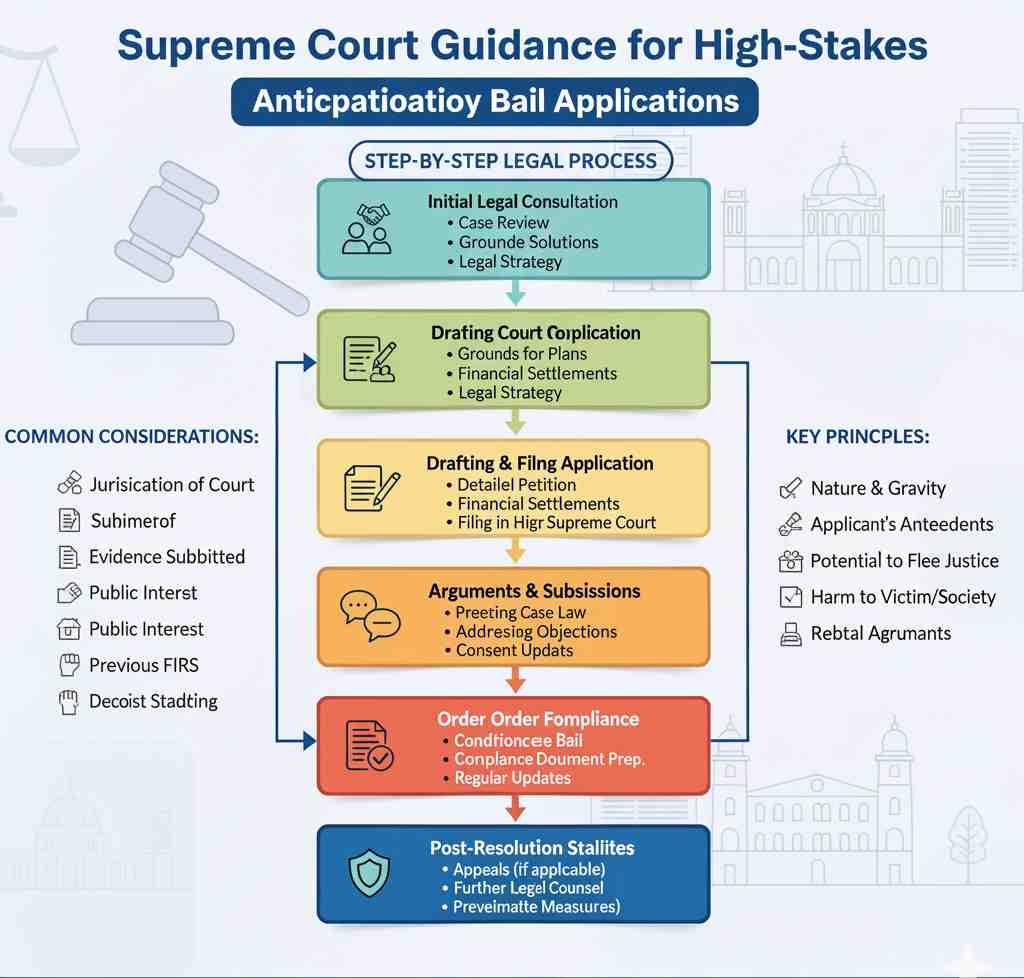
Procedure for Seeking Anticipatory Bail
1. Drafting the Petition
The process begins with drafting a well-structured petition stating facts, grounds for apprehension, and reasons for seeking bail. It includes supporting documents like FIR copies, legal precedents, and personal affidavits.
2. Filing Before the Appropriate Court
An anticipatory bail application can be filed before the Sessions Court or the High Court. In high-stakes or complex matters, the Supreme Court may be approached directly under special circumstances.
3. Notice to Public Prosecutor
The court usually issues a notice to the Public Prosecutor or the concerned police station to hear both sides before granting relief.
4. Interim Protection
In urgent cases, the court may grant interim protection from arrest until the final hearing.
5. Final Hearing and Order
After hearing arguments, the court decides whether to grant anticipatory bail, impose conditions, or reject the plea.
Our firm’s lawyers handle every stage — from filing and arguing in lower courts to escalating matters before the Supreme Court — with precision and diligence.
Conditions Imposed by Courts in Anticipatory Bail
While granting anticipatory bail, courts may impose certain conditions to ensure cooperation with the investigation. Common conditions include:
- The applicant must cooperate with the investigation and appear when summoned.
- The applicant shall not threaten or influence witnesses.
- The applicant must not leave the country without permission.
- The applicant may be required to surrender their passport.
At LawyerChennai.com, we negotiate fair and reasonable conditions so that our clients’ professional and personal lives remain minimally affected.
Supreme Court’s Balanced Approach
The Supreme Court emphasizes that anticipatory bail should not shield criminals but protect the innocent. It recognizes that false accusations can destroy lives, yet it also warns that granting bail in serious crimes must be done cautiously.
Courts assess factors such as:
- Nature and gravity of the accusation
- Criminal history (if any)
- Possibility of fleeing from justice
- Chances of evidence tampering
- Social and economic background of the accused
Our advocates meticulously address these factors in every petition to strengthen the client’s case and build judicial confidence.
Challenges in High-Stakes Anticipatory Bail Cases
High-stakes cases — such as those involving financial fraud, corruption, or public officials — attract intense scrutiny. Challenges may include:
- Complex investigations by multiple agencies (ED, CBI, or police).
- Strong opposition from prosecution.
- Media influence and public opinion pressure.
- Sensitive political or corporate contexts.
In such scenarios, strategic preparation and precise legal drafting are essential. LawyerChennai.com has a proven track record of handling sensitive, high-profile anticipatory bail cases with confidentiality, discretion, and success.
Strategic Legal Assistance by LawyerChennai.com
Our firm offers end-to-end support for clients seeking anticipatory bail. Our services include:
- Case Assessment: Detailed analysis of FIRs, allegations, and evidence.
- Legal Research: Referencing relevant Supreme Court precedents.
- Drafting and Filing: Crafting persuasive anticipatory bail petitions.
- Court Representation: Presenting arguments effectively in Sessions, High, and Supreme Courts.
- Post-Bail Support: Ensuring compliance with conditions and defending against subsequent legal actions.
We believe in proactive advocacy — anticipating risks, planning strategically, and protecting clients’ liberty with utmost professionalism.
Recent Supreme Court Developments
The Supreme Court continues to refine anticipatory bail principles. Key observations include:
- Arrests should be made only when necessary for investigation.
- Custodial interrogation should not be used to intimidate the accused.
- Bail conditions must be reasonable and not punitive.
- Courts should discourage frivolous FIRs intended to harass individuals.
These guidelines underline that anticipatory bail is not a loophole but a constitutional shield protecting citizens from arbitrary arrest.
Tips for a Strong Anticipatory Bail Application
- Act Early: File before arrest or chargesheet submission.
- Be Transparent: Disclose all relevant facts honestly.
- Engage Skilled Lawyers: Experienced counsel can anticipate prosecution arguments.
- Prepare Evidence: Show cooperation and clean records.
- Follow Conditions: Adhere strictly to court directions to avoid cancellation.
Our attorneys at LawyerChennai.com prepare each case with foresight and accuracy to maximize the chances of success.
Why Choose LawyerChennai.com
- Experienced Criminal Law Specialists: Our lawyers have decades of courtroom experience in anticipatory bail matters.
- Strategic Case Handling: We combine legal knowledge with tactical planning.
- 24×7 Legal Assistance: We provide emergency bail support at all hours.
- Client Confidentiality: All discussions remain strictly private.
- Proven Success Rate: We have successfully represented clients before the Supreme Court, High Courts, and lower courts across India.
When liberty is at stake, you need a legal team that responds swiftly, thinks strategically, and acts decisively — that’s exactly what we deliver.
Frequently Asked Questions
Anticipatory bail is a pre-arrest legal protection under Section 438 of the Criminal Procedure Code (CrPC). It can be sought by anyone who believes they may be arrested for a non-bailable offense. This relief allows the person to remain free while cooperating with the investigation. It is especially useful when false or motivated complaints are filed.
The Supreme Court has made it clear that anticipatory bail protects personal liberty and should be granted when the arrest is unnecessary. In key judgments like Gurbaksh Singh Sibbia (1980) and Sushila Aggarwal (2020), the Court ruled that anticipatory bail should not be time-bound and must be decided on a case-by-case basis. The Court’s guidance ensures fairness and prevents misuse of power.
The Court considers the seriousness of the allegations, evidence presented, criminal history, and chances of tampering with witnesses. It also examines whether custodial interrogation is required. The goal is to balance the rights of the accused with the interests of justice.
Yes. If the accused violates bail conditions, interferes with witnesses, or misuses liberty, the prosecution can request cancellation. Courts have the power to withdraw protection if misconduct is proven.
High-stakes cases involve complex investigations and sensitive issues. Expert legal counsel, like LawyerChennai.com – Trusted Lawyers & Legal Experts in Chennai, helps draft strong petitions, cite relevant precedents, and present persuasive arguments to secure anticipatory bail effectively.
Conclusion
Anticipatory bail is more than a legal remedy — it’s a lifeline for those facing false accusations or politically motivated cases. The Supreme Court’s guidance ensures that this protection remains balanced, fair, and firmly rooted in the principles of justice.
At LawyerChennai.com – Trusted Lawyers & Legal Experts in Chennai, we understand the urgency and sensitivity of high-stakes anticipatory bail applications. Our team works tirelessly to protect your rights, prevent arrest, and guide you through every legal challenge with integrity and care.
Read More
- Anticipatory Bail Petitions: Strategies for Supreme Court Representation
- Securing Anticipatory Bail: Supreme Court Insights and Legal Assistance
- Supreme Court Lawyers for Complex Divorce and Custody Battles in India
- Navigating Matrimonial Issues: Custody and Maintenance Representation at Supreme Court
- Alimony & Maintenance Lawyers in Chennai: Securing Your Financial Future
- Supreme Court – Case Category page