
Emerging Trends in Cybersecurity Law: Protecting Data and Privacy in the Digital Age

Cybersecurity law shapes modern digital safety for businesses, governments, and citizens. Today, data flows through cloud networks, mobile devices, and financial platforms continuously. Consequently, cybercriminals target vulnerabilities across websites, payment gateways, and enterprise servers. Indian businesses therefore face rising threats like ransomware, phishing attacks, identity theft, and financial fraud. Cybersecurity law provides structured remedies through statutes, courts, investigative agencies, and regulatory bodies. The Information Technology Act, digital evidence rules, and data protection policies govern cyber disputes. Moreover, modern procedural laws like the Bharatiya Nagarik Suraksha Sanhita regulate investigation processes. Indian courts increasingly hear disputes involving online fraud, corporate espionage, and data privacy violations. Businesses must therefore establish cybersecurity governance and compliance strategies. Legal protection includes civil remedies, criminal prosecution, regulatory reporting obligations, and compensation claims. Lawyers also assist clients in digital evidence collection, cybercrime complaints, and regulatory representation. The digital economy therefore demands legal awareness alongside technological safeguards.
Cybersecurity Law: Protecting Data and Privacy in the Digital Age
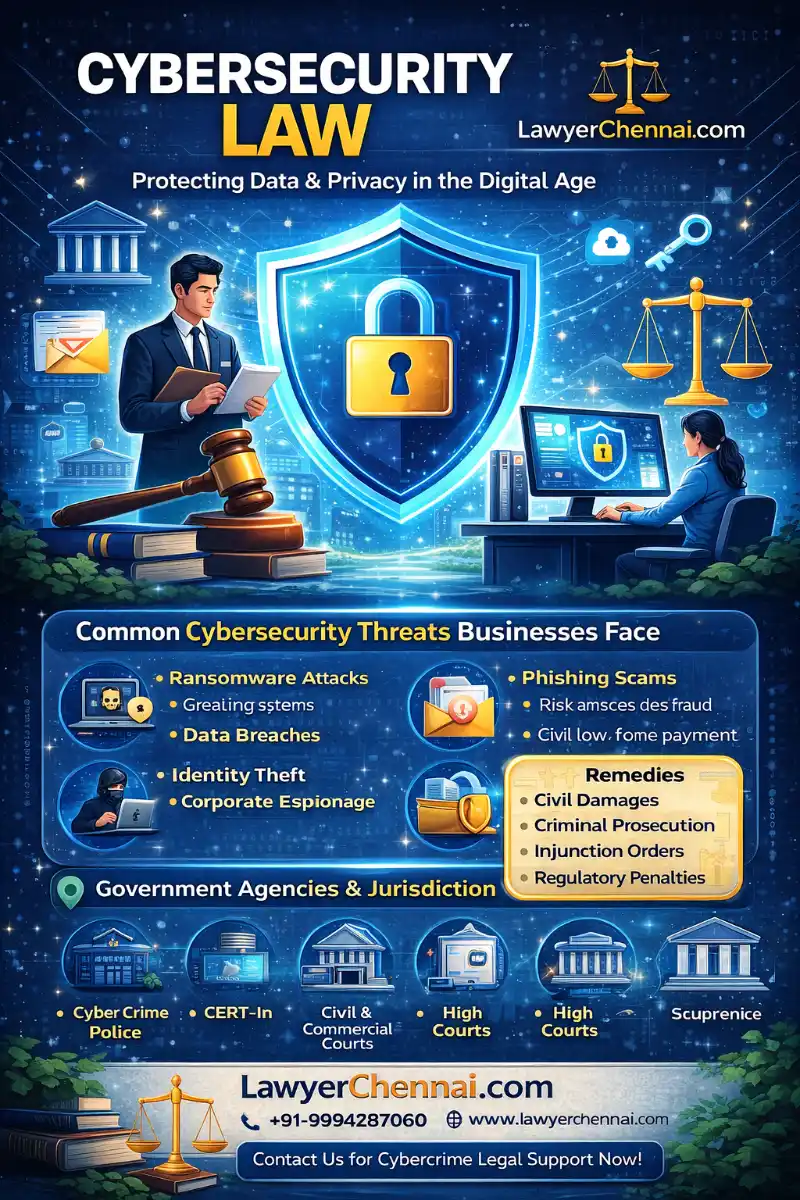
Understanding Cybersecurity Legal Risks in the Digital Economy
Businesses operate through digital platforms that store sensitive commercial and personal information daily. However, cyber threats continuously evolve and challenge conventional security controls. Hackers exploit weak authentication systems, outdated software, and unsecured databases frequently. Consequently, cyber incidents trigger severe financial losses and reputational damage for organizations. Indian cybersecurity law addresses offences through criminal provisions under the Information Technology Act and Bharatiya Nyaya Sanhita. Moreover, civil remedies remain available under the Civil Procedure Code for damages and injunctions. Digital fraud complaints can reach cybercrime police stations or specialized investigative units. Victims may also approach courts for compensation and recovery of financial losses. Cybersecurity governance therefore requires both technological and legal preparedness. Consider the following common cyber threats businesses face:
- Ransomware attacks targeting corporate databases
- Phishing scams affecting financial transactions
- Data breaches exposing customer information
- Online identity theft and impersonation fraud
- Corporate espionage through network infiltration
Organizations must implement compliance policies while consulting cybersecurity lawyers regularly. Early legal intervention therefore reduces liability and protects organizational assets.
Major Cybersecurity Legal Issues Affecting Businesses
Cybersecurity disputes often involve complex intersections between technology law, criminal law, and regulatory compliance. Companies frequently confront allegations regarding unauthorized data access, privacy violations, and digital fraud. Courts increasingly examine digital evidence like server logs, email trails, and blockchain records. Furthermore, cyber incidents may trigger investigations by police cybercrime cells and regulatory agencies. Businesses must therefore respond quickly with legal strategies and forensic evidence preservation. Several legal issues dominate cybersecurity litigation across India.
| Legal Issue | Possible Consequences | Relevant Authorities |
|---|---|---|
| Data breach | Regulatory penalties and compensation claims | Cybercrime Police, Courts |
| Online financial fraud | Criminal investigation and asset freezing | Police Cyber Cell |
| Corporate data theft | Civil damages and injunction orders | Civil Courts |
| Identity theft | Criminal prosecution under BNS | Magistrate Courts |
Companies must therefore implement legal compliance frameworks that combine cybersecurity infrastructure with proactive risk management policies.
Cybercrime Investigation and Police Authorities
Cybercrime investigations often begin through complaints filed at specialized cybercrime police stations. Chennai residents commonly approach the Cyber Crime Wing of the Greater Chennai Police. However, victims may also file complaints through the national cybercrime reporting portal. Investigators analyze digital devices, transaction records, and IP address trails during cyber investigations. Consequently, forensic experts assist police authorities in recovering deleted files and tracing financial transfers. Criminal offences may arise under the Information Technology Act and Bharatiya Nyaya Sanhita provisions. Investigations follow procedures under the Bharatiya Nagarik Suraksha Sanhita for arrests and evidence seizure. Moreover, courts rely heavily on digital evidence governed by the Bharatiya Sakshya Adhiniyam. Businesses should cooperate with investigators while protecting corporate confidentiality rights. Legal counsel often supervises digital evidence preservation and compliance with procedural safeguards.
- Cyber Crime Police Station Chennai
- State Cyber Crime Investigation Cells
- Central agencies like CERT-In
- Judicial Magistrate Courts
Early reporting improves recovery chances and strengthens legal claims against cyber offenders.
Civil Remedies for Cybersecurity Violations
Cyber incidents often cause financial losses, business disruption, and reputational damage. Therefore, civil remedies provide powerful legal tools for affected individuals and organizations. Victims may file civil suits seeking damages, injunctions, and recovery of stolen digital assets. Courts frequently grant urgent interim injunctions to stop ongoing cyber intrusions. Civil litigation generally follows procedures established under the Civil Procedure Code. Plaintiffs must present documentary evidence, expert reports, and digital forensic findings. Moreover, courts increasingly rely on electronic records governed by the Bharatiya Sakshya Adhiniyam. Businesses often seek injunctions against former employees involved in corporate data theft. Legal practitioners therefore prepare detailed pleadings supported by technical evidence. Civil courts may also order compensation when negligence leads to customer data breaches.
- File civil suit for damages and injunction
- Submit electronic evidence and forensic reports
- Request interim injunction against data misuse
- Seek compensation for financial loss
Strategic litigation therefore protects intellectual property, trade secrets, and confidential customer information.
Role of Courts and Tribunals in Cybersecurity Litigation
Indian courts increasingly adjudicate complex disputes involving cybersecurity breaches and digital fraud. High Courts often interpret statutory provisions governing electronic evidence and online offences. Trial courts examine technical expert testimony regarding hacking methods and digital authentication systems. Furthermore, specialized tribunals occasionally address sector-specific regulatory disputes involving telecommunications and financial technology. Businesses may approach courts for injunctions preventing ongoing cyber intrusions or intellectual property theft. Judicial authorities also evaluate liability for negligence when organizations fail to protect customer data. Courts therefore shape the evolving jurisprudence surrounding cybersecurity law in India. Lawyers must present technical evidence clearly to help judges understand complex digital mechanisms.
| Forum | Type of Cyber Dispute |
|---|---|
| Magistrate Courts | Cybercrime prosecution |
| Civil Courts | Compensation and damages |
| High Courts | Writ petitions and appeals |
| Supreme Court | Constitutional digital privacy cases |
Legal expertise therefore becomes essential while navigating multi-forum cybersecurity litigation.
Government Cybersecurity Agencies and Regulatory Authorities
Government agencies play a critical role in maintaining national cybersecurity infrastructure. India operates several institutions that monitor threats and coordinate responses to cyber incidents. The Indian Computer Emergency Response Team analyzes threats and issues cybersecurity advisories. Regulatory authorities also enforce compliance obligations across banking, telecommunications, and digital platforms. Businesses must promptly report significant cyber incidents to relevant authorities. Failure to report breaches may attract regulatory penalties and reputational consequences. Legal advisors therefore assist organizations in managing compliance with cybersecurity reporting obligations.
- Indian Computer Emergency Response Team (CERT-In)
- Cyber Crime Coordination Centre
- Reserve Bank cybersecurity compliance units
- Telecommunications regulatory authorities
Effective collaboration between regulators and organizations strengthens digital resilience across India’s rapidly expanding technology ecosystem.

Legal Framework Governing Cybersecurity and Data Protection in India
India’s cybersecurity legal framework combines technology statutes, criminal law provisions, and procedural rules. The Information Technology Act establishes liability for unauthorized access, hacking, and digital identity theft. Meanwhile, the Bharatiya Nyaya Sanhita criminalizes cyber fraud, impersonation, and online cheating activities. Courts rely on the Bharatiya Sakshya Adhiniyam to evaluate electronic records and digital evidence authenticity. Moreover, the Bharatiya Nagarik Suraksha Sanhita regulates investigation procedures involving cybercrime arrests and digital seizures. Regulators such as the Indian Computer Emergency Response Team monitor cyber incidents affecting national infrastructure. Businesses therefore must maintain security systems that comply with statutory obligations and regulatory advisories. Indian courts increasingly interpret privacy rights within the constitutional framework established by landmark judgments. Consequently, cybersecurity law now intersects with fundamental rights such as informational privacy and data protection. Organizations handling personal data therefore face legal duties involving consent, disclosure transparency, and breach reporting obligations.
Key Statutes Governing Cybercrime and Digital Evidence
Cybersecurity litigation frequently involves multiple statutes operating simultaneously across criminal and civil jurisdictions. Investigating agencies rely heavily on statutory provisions that criminalize unauthorized access and digital fraud. Courts also examine electronic records produced through forensic analysis of computer systems and mobile devices. Furthermore, companies must follow compliance obligations regarding cybersecurity governance and breach notification. Legal practitioners therefore analyze statutory provisions carefully before initiating litigation strategies.
| Statute | Key Purpose | Legal Relevance |
|---|---|---|
| Information Technology Act | Cybercrime regulation | Hacking and data theft offences |
| Bharatiya Nyaya Sanhita | Criminal prosecution | Online fraud and cheating |
| Bharatiya Nagarik Suraksha Sanhita | Criminal procedure | Investigation powers |
| Bharatiya Sakshya Adhiniyam | Evidence law | Admissibility of digital records |
| Civil Procedure Code | Civil litigation rules | Damages and injunction suits |
Consequently, cybersecurity disputes require lawyers who understand both technological evidence and procedural litigation frameworks.
Electronic Evidence and Digital Forensics in Cybercrime Trials
Courts increasingly depend on electronic evidence during cybersecurity investigations and litigation proceedings. Digital evidence includes emails, server logs, metadata records, blockchain entries, and device storage files. Investigators collect this evidence using forensic imaging tools and certified digital analysis software. However, courts require strict compliance with statutory authentication standards before accepting electronic records. The Bharatiya Sakshya Adhiniyam therefore regulates admissibility of electronic evidence and digital documentation. Lawyers must ensure proper certification of electronic records produced during litigation. Forensic experts frequently testify regarding data extraction processes and device examination techniques. Moreover, courts evaluate integrity checks such as hash verification and timestamp validation. Cybercrime prosecutions therefore rely heavily on technical expertise and reliable forensic methodologies.
- Server log analysis
- Mobile device forensic extraction
- Email metadata verification
- Blockchain transaction tracing
- Financial digital trail analysis
Proper digital evidence preservation significantly strengthens prosecution cases and civil claims for compensation.
Data Privacy Regulations and Personal Information Protection
Personal data protection represents a core objective of modern cybersecurity law across jurisdictions. Organizations increasingly collect sensitive information such as financial details, biometric identifiers, and communication records. Consequently, governments establish regulatory frameworks to protect citizens from unauthorized data misuse. India recognizes informational privacy as a constitutional right under Article 21 jurisprudence. Businesses therefore must adopt transparent data processing policies and obtain informed user consent. Data protection frameworks also require organizations to implement cybersecurity safeguards and breach reporting mechanisms. Regulators may impose penalties when companies fail to secure personal information adequately. Furthermore, cross-border data transfers introduce complex jurisdictional questions regarding applicable legal standards. Companies operating international platforms must therefore comply with multiple regulatory regimes simultaneously.
| Data Type | Risk Level | Legal Safeguard |
|---|---|---|
| Financial records | High | Encryption and compliance audits |
| Biometric data | Very high | Strict access controls |
| Contact information | Moderate | Consent-based storage |
Therefore, organizations must integrate cybersecurity policies with strong data governance and compliance management systems.
Corporate Cybersecurity Compliance and Governance Policies
Corporate cybersecurity governance requires strategic planning, risk management, and continuous monitoring mechanisms. Businesses must establish internal policies that regulate employee access, system monitoring, and incident response procedures. Effective governance frameworks reduce exposure to cyber attacks and regulatory penalties. Moreover, compliance policies ensure that organizations follow statutory obligations and industry standards. Many companies appoint cybersecurity officers responsible for monitoring information security programs. These professionals coordinate with legal advisors and technology experts during cyber incident responses. Businesses should therefore adopt structured compliance frameworks covering several operational aspects.
- Periodic cybersecurity risk assessment audits
- Employee training on phishing and digital fraud awareness
- Secure password and authentication policies
- Incident response and breach reporting systems
- Vendor cybersecurity compliance verification
Strong governance policies significantly reduce the probability of costly data breaches and legal disputes.
Cybersecurity Responsibilities of Financial and Technology Companies
Financial institutions and technology companies manage enormous volumes of sensitive digital data daily. Consequently, regulators impose strict cybersecurity obligations upon these industries. Banks must follow cybersecurity frameworks issued by the Reserve Bank of India and financial regulators. Technology companies operating cloud services also face responsibilities regarding customer data protection. Regulatory bodies require continuous monitoring of networks, encryption systems, and user authentication protocols. Moreover, fintech companies must maintain secure payment gateways to prevent fraudulent transactions. Cyber incidents affecting financial institutions may trigger regulatory investigations and heavy penalties. Businesses must therefore coordinate with cybersecurity lawyers, auditors, and digital forensic experts regularly.
- Continuous network vulnerability monitoring
- Customer data encryption systems
- Two factor authentication mechanisms
- Incident reporting to regulators
- Cyber insurance risk coverage
Proactive compliance programs therefore protect companies from reputational harm and regulatory enforcement actions.
Emerging Technologies and Cybersecurity Legal Challenges
Technological innovation constantly reshapes cybersecurity threats and regulatory challenges worldwide. Emerging technologies such as artificial intelligence, blockchain systems, and connected devices introduce complex legal questions. These technologies improve efficiency and digital connectivity but also expand potential cyber vulnerabilities. For instance, connected devices create large networks that hackers may exploit remotely. Artificial intelligence systems sometimes produce automated decisions affecting privacy and consumer rights. Blockchain technology enables secure transactions but also raises questions regarding jurisdiction and regulatory oversight. Courts therefore increasingly analyze cases involving algorithmic decision making and decentralized networks. Governments continue drafting regulatory frameworks that address technological risks while encouraging innovation. Businesses adopting advanced technologies must therefore integrate cybersecurity safeguards into product design stages. Lawyers specializing in cybersecurity law help organizations evaluate legal exposure before launching digital platforms.
Cybercrime Categories and Legal Consequences in India
Cybercrime categories continue expanding as digital infrastructure connects banking, healthcare, commerce, and communication systems. Hackers target vulnerable networks to steal financial data, trade secrets, and personal identities. Consequently, the legal system recognizes various categories of cyber offences that attract criminal prosecution. The Information Technology Act criminalizes unauthorized system access, identity theft, and digital impersonation activities. Meanwhile, the Bharatiya Nyaya Sanhita penalizes cheating, fraud, extortion, and criminal breach of trust through electronic platforms. Courts therefore evaluate cybercrime allegations by examining both technological evidence and criminal intent. Law enforcement agencies rely on digital forensic laboratories and specialized cyber investigation units. Cybercrime victims must report incidents quickly because digital trails often disappear rapidly. Businesses therefore maintain security monitoring tools that detect suspicious network activities. Effective legal responses combine technical investigation with strategic litigation. The following list illustrates common cyber offences affecting individuals and corporate organizations.
- Phishing and online banking fraud
- Ransomware attacks demanding cryptocurrency payments
- Corporate database hacking
- Identity theft and impersonation crimes
- Social media account hijacking
- Online extortion and blackmail
Therefore, cybersecurity compliance and rapid legal action remain essential tools for protecting digital assets.
Phishing Fraud and Financial Cybercrime Litigation
Phishing attacks represent one of the most widespread cybercrime threats affecting banking customers and businesses. Criminals send deceptive emails or text messages that imitate legitimate financial institutions. Victims unknowingly reveal passwords, card numbers, or banking authentication credentials. Consequently, hackers transfer funds from victim accounts through unauthorized transactions. Cybercrime police frequently investigate these cases using transaction trails and digital communication records. Banks must implement fraud detection systems and customer awareness programs. However, liability disputes sometimes arise when customers claim negligence by financial institutions. Courts evaluate evidence such as transaction logs, IP addresses, and authentication records. Victims may file complaints at cybercrime police stations or online reporting portals. Civil litigation also remains available for recovering financial losses through compensation claims.
| Fraud Method | Impact | Legal Remedy |
|---|---|---|
| Phishing emails | Bank account theft | Cybercrime complaint |
| Fake banking websites | Credential theft | Criminal prosecution |
| Malicious mobile apps | Unauthorized transfers | Civil damages claim |
Consequently, early complaint registration significantly improves the chances of fund recovery and criminal prosecution.
Ransomware Attacks and Corporate Cyber Extortion
Ransomware attacks disrupt businesses by encrypting digital files and demanding payments for restoration access. Hackers infiltrate corporate networks through malware attachments, weak passwords, or compromised remote servers. Consequently, organizations lose operational control over databases, financial records, and internal communications. Cybercriminals often demand payment in cryptocurrency to avoid financial traceability. Companies facing ransomware attacks must immediately isolate affected systems and notify cybersecurity professionals. Legal advisors also guide organizations regarding regulatory reporting obligations and criminal complaints. Investigators analyze network intrusion logs and malware signatures to identify perpetrators. Courts may issue injunction orders preventing further distribution of stolen data. Moreover, law enforcement agencies cooperate with international partners when ransomware gangs operate across borders.
- Isolate compromised systems immediately
- Preserve digital forensic evidence
- File complaint with cybercrime authorities
- Notify regulators where necessary
- Engage cybersecurity recovery experts
Corporate incident response planning therefore becomes essential for minimizing operational disruption and legal liability.
Jurisdiction and Courts Handling Cybersecurity Disputes
Cybersecurity disputes often involve complex jurisdictional questions because digital transactions cross geographical boundaries instantly. Courts determine jurisdiction by examining server locations, victim residence, and transaction origins. Indian law allows victims to file complaints at locations where the offence occurred or caused harm. Consequently, cybercrime police stations investigate offences affecting victims across different states. Civil disputes regarding cybersecurity breaches usually reach district courts or commercial courts. High Courts exercise writ jurisdiction when fundamental privacy rights or regulatory actions become disputed. The Supreme Court occasionally hears constitutional cases involving digital privacy protections. Lawyers must therefore analyze jurisdictional factors carefully before initiating litigation proceedings. Jurisdictional clarity prevents procedural delays and strengthens the enforceability of judicial orders.
| Forum | Jurisdiction | Typical Cyber Matters |
|---|---|---|
| Cyber Crime Police | Criminal investigation | Online fraud and hacking |
| District Courts | Civil suits | Compensation claims |
| High Courts | Appeals and writ petitions | Privacy and data disputes |
| Supreme Court | Constitutional review | Digital rights cases |
Strategic jurisdiction selection therefore plays a significant role in successful cybersecurity litigation.
Cybercrime Reporting Portals and Police Assistance
Cybercrime victims in India can report offences through specialized digital complaint systems. The National Cyber Crime Reporting Portal allows citizens to submit fraud complaints online. This portal automatically routes complaints to state cybercrime police units. Victims may also visit local cybercrime police stations for immediate assistance. Police investigators review financial transaction details, digital communication records, and device data during investigations. Early reporting significantly increases the possibility of freezing fraudulent bank transfers. Financial institutions frequently cooperate with law enforcement agencies to trace suspicious transactions. Businesses affected by cyber attacks must preserve server logs and security alerts as evidence. Legal counsel often assists victims in preparing structured complaints supported by documentary proof.
- National Cyber Crime Reporting Portal
- State Cyber Crime Police Stations
- Digital forensic laboratories
- Financial fraud investigation units
Timely reporting strengthens the evidentiary foundation for criminal prosecution and financial recovery proceedings.
Legal Remedies Available for Cybersecurity Violations
Cybersecurity law offers multiple legal remedies that protect victims from financial loss and reputational damage. Victims may pursue criminal prosecution, civil compensation claims, or regulatory complaints depending on circumstances. Criminal prosecution punishes offenders through imprisonment, fines, and asset confiscation orders. Civil litigation allows victims to recover damages caused by cyber intrusions or data breaches. Courts often grant interim injunctions preventing misuse of confidential information. Regulatory authorities may also impose penalties against organizations that neglect cybersecurity obligations. Legal practitioners therefore evaluate the most effective strategy based on available evidence and financial loss. Businesses frequently combine criminal complaints with civil recovery proceedings.
| Remedy Type | Legal Forum | Outcome |
|---|---|---|
| Criminal prosecution | Magistrate Court | Imprisonment and fines |
| Civil damages suit | Civil Court | Financial compensation |
| Injunction orders | Commercial Court | Stop ongoing cyber misuse |
| Regulatory complaints | Government agencies | Compliance penalties |
Comprehensive legal strategies therefore help victims recover losses and prevent repeated cyber offences.
Artificial Intelligence, IoT, and Blockchain Cybersecurity Legal Risks
Emerging technologies continue reshaping cybersecurity challenges across global digital ecosystems. Artificial intelligence systems analyze massive datasets and automate complex decision processes rapidly. However, malicious actors exploit algorithm vulnerabilities to manipulate automated platforms and steal sensitive information. Internet of Things devices create interconnected networks linking homes, vehicles, medical devices, and industrial equipment. Consequently, insecure IoT devices often become entry points for hackers targeting enterprise networks. Blockchain technology provides decentralized transaction systems that increase transparency and security. Nevertheless, blockchain networks also create regulatory challenges regarding jurisdiction, data protection obligations, and financial oversight. Courts increasingly examine disputes involving automated systems and decentralized applications. Lawyers therefore analyze contractual liability, regulatory compliance, and consumer protection implications carefully. Organizations deploying advanced technologies must integrate cybersecurity safeguards within system design architecture. Responsible innovation therefore requires collaboration between legal experts, cybersecurity engineers, and regulatory authorities.
Artificial Intelligence Governance and Legal Accountability
Artificial intelligence increasingly drives decision systems across banking, healthcare, transportation, and digital commerce platforms. Companies deploy AI algorithms to evaluate creditworthiness, medical diagnostics, fraud detection, and consumer behavior patterns. However, algorithmic errors or manipulated datasets may produce harmful decisions affecting individuals and businesses. Consequently, cybersecurity law addresses accountability issues surrounding automated decision-making processes. Courts analyze whether companies implemented adequate safeguards preventing data manipulation or unauthorized system access. Organizations must therefore maintain transparent algorithm governance frameworks and security monitoring systems. Legal compliance requires documentation describing how algorithms process personal data and generate outcomes. Regulators also emphasize fairness, transparency, and accountability within AI governance policies.
- Algorithm transparency policies
- Data integrity protection systems
- Independent cybersecurity audits
- Human oversight in automated decisions
Consequently, responsible AI governance strengthens trust between technology companies, regulators, and digital consumers.
Internet of Things Security and Liability Risks
The Internet of Things connects billions of smart devices that communicate continuously across digital networks. Smart cameras, home automation systems, wearable health monitors, and industrial sensors operate through interconnected platforms. However, weak device authentication and outdated firmware expose IoT systems to cyber intrusions. Hackers sometimes compromise smart devices to launch distributed denial-of-service attacks against major networks. Consequently, manufacturers face legal liability when defective device security enables large-scale cyber incidents. Businesses deploying IoT systems must therefore implement encryption protocols, authentication mechanisms, and secure firmware updates. Regulators increasingly require manufacturers to design cybersecurity features within product architecture. Courts evaluate whether companies exercised reasonable care while protecting consumer data and network integrity.
| IoT Risk | Legal Concern | Mitigation Strategy |
|---|---|---|
| Weak authentication | Unauthorized access | Multi-factor login systems |
| Outdated firmware | Network vulnerability | Automatic security updates |
| Data interception | Privacy violations | Strong encryption protocols |
Secure product design therefore reduces liability exposure and protects consumer trust.
Cybersecurity Best Practices and Compliance Strategies for Businesses
Organizations operating in the digital economy must implement strong cybersecurity governance frameworks. Effective cybersecurity compliance combines technological safeguards, employee awareness, and legal oversight mechanisms. Businesses therefore conduct regular risk assessments to identify vulnerabilities across networks and digital infrastructure. Security policies should regulate employee access privileges and sensitive data management procedures. Cybersecurity training programs help employees recognize phishing attacks and fraudulent communications. Companies must also maintain incident response plans that address data breaches quickly. Legal advisors guide organizations regarding statutory reporting obligations and litigation risks. Continuous monitoring systems detect suspicious network activity and unauthorized access attempts. Corporate governance therefore integrates cybersecurity within strategic business planning.
- Conduct periodic cybersecurity vulnerability assessments
- Implement multi-factor authentication policies
- Encrypt sensitive financial and customer data
- Train employees regarding cyber fraud risks
- Develop structured incident response procedures
Comprehensive compliance programs significantly reduce cyberattack risks and regulatory penalties.
Internal Legal Resources and Further Reading
Businesses seeking cybersecurity legal guidance should consult specialized technology lawyers and digital compliance experts. Organizations may review detailed legal resources discussing cybersecurity compliance strategies and regulatory obligations. Readers may also explore additional insights through the following legal resources available on LawyerChennai.com.
- Expert Cybersecurity Legal Support to Protect Your Business
- Data Protection: How to find the Best IT Advocates?
- Latest Advocates News and Legal Events
- Law Career and Job Opportunities
For government cybersecurity advisories and digital policy initiatives, readers may also refer to Digital India initiatives. These resources provide valuable insights into evolving cybersecurity frameworks.
Conclusion
Cybersecurity law plays a crucial role in protecting data, digital infrastructure, and individual privacy rights. Rapid technological innovation continues transforming how businesses store and process sensitive information. Consequently, cyber threats now affect financial systems, healthcare platforms, government networks, and social media ecosystems. Legal frameworks such as the Information Technology Act and modern criminal statutes address emerging cyber offences. Courts increasingly interpret constitutional privacy principles in digital environments. Businesses must therefore integrate cybersecurity governance, legal compliance, and risk management strategies. Proactive legal consultation enables organizations to respond effectively to cyber incidents and regulatory requirements. LawyerChennai.com provides specialized legal guidance for cybersecurity disputes, digital evidence analysis, and compliance advisory services. Organizations that invest in cybersecurity law and technological safeguards protect their reputation and operational stability. Therefore, cybersecurity awareness and legal preparedness remain essential pillars of the modern digital economy.
Frequently Asked Questions
1. What is cybersecurity law?
Cybersecurity law regulates protection of digital systems, data privacy, and online transactions. It penalizes hacking, identity theft, cyber fraud, and unauthorized access activities.
2. Which law governs cybercrime in India?
Cybercrime regulation primarily arises under the Information Technology Act, Bharatiya Nyaya Sanhita, and procedural rules under Bharatiya Nagarik Suraksha Sanhita.
3. Where can cybercrime victims file complaints?
Victims may file complaints through the National Cyber Crime Reporting Portal or at specialized cybercrime police stations across India.
4. What remedies exist for cybersecurity violations?
Victims may pursue criminal prosecution, civil compensation suits, injunction orders, or regulatory complaints depending on the nature of the cyber offence.
5. What evidence proves cybercrime?
Digital evidence includes server logs, IP records, transaction trails, emails, device data, and forensic reports authenticated under evidence laws.
6. Can businesses claim damages for cyberattacks?
Yes. Businesses may file civil suits seeking compensation, injunctions, and recovery of financial losses caused by cyber intrusions.
7. What role do courts play in cybersecurity disputes?
Courts interpret cybersecurity laws, evaluate digital evidence, grant injunction orders, and impose penalties for cybercrime violations.
8. Why do companies need cybersecurity compliance policies?
Compliance policies reduce cyberattack risks, satisfy regulatory requirements, and protect sensitive customer and financial information.
9. What agencies investigate cybercrime in India?
Cybercrime police stations, digital forensic laboratories, and national cybersecurity agencies investigate hacking, fraud, and data breaches.
10. How can LawyerChennai.com assist cybersecurity victims?
LawyerChennai.com provides legal consultation, cybercrime complaint assistance, civil litigation representation, and cybersecurity compliance advisory services.