
Land Document Verification Chennai – Avoid Fraud & Get Legal Opinion Before Buying

Property transactions in Chennai demand rigorous scrutiny and professional legal guidance. Consequently, land document verification serves as the cornerstone of safe real estate investments. Furthermore, numerous buyers face litigation due to incomplete verification processes. The Tamil Nadu Registration Department maintains critical property records across Chennai’s sub-registrar offices. Additionally, the Inspector General of Registration oversees document authentication throughout the state. Therefore, engaging experienced legal professionals becomes essential before finalizing any property purchase. LawyerChennai.com provides comprehensive verification services protecting buyers from fraudulent transactions. Moreover, our team examines title deeds, encumbrance certificates, and municipal records thoroughly. Subsequently, clients receive detailed legal opinions identifying potential risks and recommending remedial measures.
Understanding Land Document Verification Process in Chennai
Essential Documents Required for Property Verification
Comprehensive verification requires multiple documents from various government departments across Chennai. Initially, sellers must provide original sale deeds establishing their ownership rights clearly. Subsequently, mother deeds tracing property history for minimum thirty years become necessary. Meanwhile, encumbrance certificates from sub-registrar offices confirm absence of pending liabilities. Additionally, tax receipts from Greater Chennai Corporation demonstrate regular payment compliance. Furthermore, approved building plans from Chennai Metropolitan Development Authority validate construction legality. The Revenue Department provides patta and chitta documents confirming land ownership records. Moreover, survey numbers and subdivision details require verification through Directorate of Survey and Settlement. Therefore, collecting these documents forms the foundation of thorough legal examination.
- Sale deed with registration details
- Encumbrance certificate (30-year chain)
- Property tax receipts (current year)
- Patta and chitta extracts
- Approved building plans (CMDA/Corporation)
- Survey sketches and FMB extracts
- No Objection Certificates (NOCs) from authorities
- Possession certificate documents
Sub-Registrar Offices Handling Property Registrations Across Chennai
Chennai comprises forty-six sub-registrar offices managing property registrations within designated jurisdictional boundaries. Specifically, Ambattur sub-registrar office handles properties in West Mogappair and surrounding areas. Similarly, George Town sub-registrar office manages registrations for properties in central business districts. Additionally, Egmore, Mylapore, and T.Nagar offices serve their respective jurisdictions efficiently. Furthermore, buyers must identify correct sub-registrar offices based on property location before verification. The Inspector General of Registration maintains centralized records accessible through official portals. Moreover, Document Writer Offices assist in preparing necessary paperwork for registration procedures. Therefore, understanding jurisdictional boundaries prevents procedural delays and ensures proper documentation. Consequently, our legal team guides clients to appropriate offices based on property locations.
Jurisdictional Boundaries of Major Sub-Registrar Offices
Ambattur Sub-Registrar Office covers Mogappair, Ambattur Industrial Estate, and Padi localities comprehensively. Meanwhile, Aminjikarai office handles Anna Nagar, Kilpauk, and Choolaimedu property transactions regularly. Furthermore, Saidapet office manages Guindy, Adyar, and portions of southern Chennai effectively. Additionally, Royapuram office oversees North Chennai properties including Perambur and Vyasarpadi areas. The Chengalpattu Sub-Registrar Office handles peripheral areas beyond city limits efficiently. Moreover, each office maintains specific document requirements and processing timelines for registrations. Therefore, consulting legal experts ensures submission of correct documentation at appropriate offices. Subsequently, this approach minimizes rejection risks and expedites registration completion smoothly.
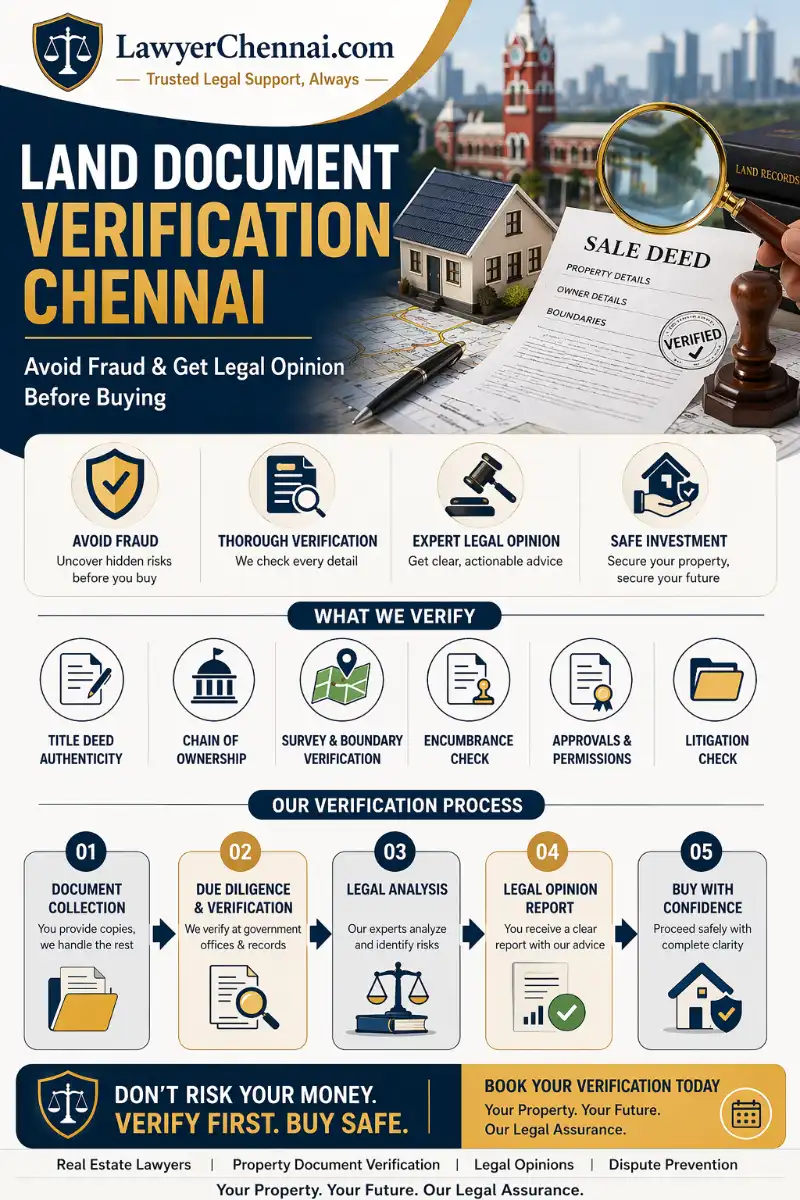
Title Verification and Chain of Ownership Analysis
Title verification establishes legitimate ownership rights through comprehensive historical document examination systematically. Initially, lawyers trace property ownership backwards for minimum thirty years through sale deeds. Subsequently, each transfer must show proper execution, registration, and stamp duty payment compliance. Meanwhile, gaps in ownership chain indicate potential disputes or fraudulent documentation requiring investigation. Additionally, partition deeds, settlement agreements, and will documents require careful scrutiny for validity. Furthermore, relinquishment deeds and family arrangements need verification ensuring all legal heirs consented. The Registration Act, 1908 mandates compulsory registration of property transactions exceeding certain values. Moreover, unregistered documents lack legal enforceability in courts under Indian Evidence Act provisions. Therefore, thorough title examination prevents future litigation and protects buyer interests comprehensively.
Common Title Defects Found During Verification Process
Incomplete ownership chains represent the most prevalent defect discovered during professional verifications regularly. Additionally, disputed properties involve pending litigation in City Civil Court or High Court Chennai. Furthermore, forged signatures on sale deeds constitute criminal offenses under Bharatiya Nyaya Sanhita, 2023. Meanwhile, unauthorized constructions violate CMDA regulations and municipal building bylaws simultaneously. Moreover, properties under attachment orders from revenue authorities or courts cannot transfer legally. Encroachments by neighboring properties create boundary disputes requiring survey department intervention frequently. Subsequently, undivided family properties need proper partition deeds before individual member sales. Therefore, identifying these defects early prevents financial losses and legal complications effectively.
| Title Defect Type | Legal Consequence | Remedial Forum |
| Incomplete ownership chain | Title disputes and litigation | City Civil Court Chennai |
| Forged documents | Criminal prosecution under BNS | Economic Offences Wing, Chennai |
| Pending litigation | Sale voidable or void | High Court of Madras |
| Revenue department attachments | Transfer legally invalid | Tahsildar Office/Revenue Court |
| Encroachment issues | Boundary disputes | Survey Settlement Office |
Legal Implications of Defective Titles Under Current Laws
Purchasing property with defective titles attracts serious legal consequences under multiple statutory provisions. Specifically, Section 55 of Transfer of Property Act, 1882 imposes seller obligations regarding clear titles. Furthermore, fraudulent concealment of title defects constitutes cheating under BNS Section 316 provisions. Additionally, buyers can invoke specific performance remedies under Specific Relief Act, 1963 for valid agreements. Meanwhile, Criminal Procedure Code provisions allow filing complaints at Economic Offences Wing, Chennai Police. Moreover, civil remedies include suit for declaration, cancellation, and damages in City Civil Court. The Consumer Protection Act, 2019 provides additional remedies when builders sell defective properties. Therefore, comprehensive verification protects buyers from criminal liability and financial losses simultaneously.
Encumbrance Certificate Examination and Interpretation
Encumbrance certificates reveal all registered transactions affecting properties during specified periods comprehensively. Typically, these certificates cover thirty-year periods establishing complete transaction history transparently. Subsequently, lawyers examine mortgages, charges, leases, and other encumbrances affecting property rights. Meanwhile, existing mortgages require clearance certificates from lending institutions before sale completion. Additionally, unregistered agreements create equitable interests affecting title despite registration absence technically. Furthermore, court-ordered attachments appear in encumbrance certificates alerting buyers to pending disputes. The Tamil Nadu Registration Department issues these certificates upon application with prescribed fees. Moreover, online portals enable encumbrance certificate downloads expediting verification processes significantly. Therefore, careful interpretation identifies hidden liabilities protecting buyer investments effectively.
Government Authorities and Departments Involved in Property Verification
Greater Chennai Corporation Records and Approvals
Greater Chennai Corporation maintains crucial records regarding property taxation and construction approvals systematically. Initially, property tax assessments indicate ownership details and property classification for taxation purposes. Subsequently, building plan approvals confirm construction compliance with municipal regulations and development guidelines. Meanwhile, completion certificates validate finished constructions meeting safety and structural standards prescribed. Additionally, occupancy certificates permit legal habitation after thorough inspection by corporation officials. Furthermore, violation notices indicate unauthorized constructions attracting penalties and demolition orders potentially. The Chennai City Municipal Corporation Act governs property taxation and construction regulation comprehensively. Moreover, fifteen zonal offices handle approvals and inspections across different city areas efficiently. Therefore, verifying corporation records prevents purchasing properties with pending violations or unapproved constructions.
Zonal Offices of Greater Chennai Corporation
Zone I office covers Thiruvottiyur, Manali, and surrounding northern suburban areas comprehensively. Similarly, Zone II handles Ambattur, Mogappair, and industrial estates in northwestern Chennai. Furthermore, Zone III manages Anna Nagar, Kilpauk, and central northern residential localities. Additionally, Zone IV oversees Tondiarpet, Royapuram, and harbor-adjacent commercial zones. Meanwhile, Zone V handles Egmore, Nungambakkam, and prime central business districts. Moreover, Zones VI through XV cover remaining areas including Adyar, Besant Nagar, and Sholinganallur. Each zonal office maintains independent records requiring separate verification for comprehensive due diligence. Therefore, identifying correct zonal jurisdiction ensures accurate record retrieval and verification completion.
- Zone I: Thiruvottiyur, Manali
- Zone II: Ambattur, Padi, Mogappair
- Zone III: Anna Nagar, Kilpauk
- Zone IV: Tondiarpet, Royapuram
- Zone V: Egmore, Nungambakkam
- Zone VI: Teynampet, Mylapore
- Zone VII: Adyar, Besant Nagar
- Zone VIII: Kodambakkam, Saidapet
Chennai Metropolitan Development Authority (CMDA) Regulations
CMDA regulates urban planning and development across Chennai Metropolitan Area covering multiple districts. Specifically, development permissions require CMDA approval for constructions exceeding certain height or area thresholds. Subsequently, master plan compliance ensures constructions align with designated land use classifications. Meanwhile, setback violations attract penalties and rectification notices from CMDA enforcement wings. Additionally, layout approvals validate residential and commercial subdivision developments comprehensively. Furthermore, environmental clearances become mandatory for large-scale constructions affecting ecological balance. The Chennai Metropolitan Development Authority Act, 1974 governs planning and development control mechanisms. Moreover, Second Master Plan for Chennai Metropolitan Area provides development guidelines till 2026. Therefore, verifying CMDA approvals prevents purchasing properties violating planning regulations or development controls.
Master Plan Zoning Classifications for Chennai Properties
Residential zones permit dwelling constructions following prescribed floor area ratio and density norms. Meanwhile, commercial zones allow business establishments, offices, and retail developments subject to regulations. Furthermore, industrial zones accommodate manufacturing units, warehouses, and processing facilities with environmental compliance. Additionally, mixed-use zones enable combined residential and commercial developments within specified parameters. Moreover, agricultural zones restrict non-agricultural uses protecting food production areas from urbanization. Special zones include IT parks, institutional areas, and recreational spaces with specific regulations. The Master Plan classifies each survey number determining permissible land uses comprehensively. Therefore, verifying zoning classification ensures purchased properties suit intended usage legally.
Floor Area Ratio (FAR) and Development Control Rules
FAR determines maximum permissible construction area relative to plot size across different zones. Specifically, residential zones typically permit 1.5 to 2.0 FAR depending on location and infrastructure. Meanwhile, commercial areas allow higher FAR ranging from 2.0 to 3.0 for intensive development. Furthermore, road width influences permissible FAR with wider roads allowing increased construction potential. Additionally, setback requirements mandate minimum distances from plot boundaries ensuring adequate spacing. Moreover, height restrictions prevent excessive vertical development affecting neighborhood character and sunlight access. CMDA Development Control Rules specify these parameters preventing over-development and maintaining planned growth. Therefore, verifying FAR compliance prevents purchasing properties with unauthorized constructions exceeding permissible limits.
Revenue Department Records and Land Revenue Administration
Revenue Department maintains fundamental land ownership records through village administrative offices across Chennai. Initially, patta documents establish government recognition of ownership rights for taxation purposes. Subsequently, chitta extracts provide survey-wise ownership details and land classification information comprehensively. Meanwhile, Field Measurement Book (FMB) sketches show precise boundaries, measurements, and adjacent survey numbers. Additionally, Adangal records track agricultural land usage, crop patterns, and cultivation details annually. Furthermore, A-Register maintains chronological records of all ownership transfers and mutations. The Tamil Nadu Land Revenue Manual governs revenue administration and record maintenance procedures. Moreover, Tahsildar offices handle mutation applications and patta issuance within their jurisdictional limits. Therefore, verifying revenue records confirms government-recognized ownership and prevents disputes over boundaries.
Mutation Process and Patta Transfer Procedures
Mutation transfers ownership records in revenue registers following property sale or inheritance transactions. Initially, buyers submit mutation applications to concerned Tahsildar offices with supporting sale documents. Subsequently, revenue inspectors conduct field verification confirming physical possession and boundary details. Meanwhile, notices publish in village notice boards allowing objections from interested parties. Additionally, Tahsildar conducts hearings addressing objections before approving mutation applications finally. Furthermore, successful mutation results in patta issuance reflecting new ownership in government records. The Tamil Nadu Revenue Manual prescribes time limits and procedural requirements for mutation completion. Moreover, delays in mutation create discrepancies between registration and revenue records causing complications. Therefore, completing mutation immediately after purchase ensures government record accuracy.
Tahsildar Offices Across Chennai District
Ambattur Taluk Office manages revenue administration for Ambattur, Padi, and Mogappair areas comprehensively. Similarly, Saidapet Taluk Office handles Guindy, Adyar, and southern Chennai revenue matters. Furthermore, Mambalam-Guindy Taluk oversees properties in Kodambakkam, Nungambakkam, and adjoining localities. Additionally, Mylapore Taluk Office manages central Chennai properties including Triplicane and Royapuram areas. Each Tahsildar office maintains independent records requiring separate verification for properties within jurisdiction. Moreover, revenue courts attached to Tahsildar offices resolve disputes regarding patta, chitta, and boundaries. Therefore, approaching correct Tahsildar offices ensures efficient mutation processing and record verification.
Legal Framework Governing Property Transactions in Tamil Nadu
Registration Act, 1908 and Compulsory Registration Requirements
The Registration Act, 1908 mandates compulsory registration for property sale deeds exceeding ₹100 value. Specifically, Section 17 lists documents requiring mandatory registration including conveyances and lease deeds. Subsequently, unregistered documents lack admissibility as evidence in courts under Section 49 provisions. Meanwhile, registration provides constructive notice to world about property transactions preventing fraudulent claims. Additionally, stamp duty payment constitutes prerequisite for registration under Indian Stamp Act, 1899. Furthermore, time limits apply for presenting documents with penalties for delayed registrations. The Inspector General of Registration supervises registration offices ensuring procedural compliance statewide. Moreover, electronic presentation of documents enables online registration expediting transaction completion significantly. Therefore, proper registration protects buyer rights and establishes legally enforceable ownership.
Stamp Duty and Registration Charges in Tamil Nadu
Stamp duty rates vary based on property location, transaction type, and buyer characteristics. Typically, urban areas attract 7% stamp duty on market value or guideline value. Meanwhile, women buyers receive concessions with reduced rates promoting women’s property ownership. Additionally, registration charges constitute 1% of property value subject to maximum limits. Furthermore, guideline values published by Registration Department determine minimum taxable transaction values. Moreover, undervaluation attracts penalties and reassessment by authorities during registration process. The Tamil Nadu Stamp Act governs stamp duty provisions and exemptions comprehensively. Therefore, accurate valuation and proper stamp duty payment prevent registration rejection and legal complications.
| Property Type | Stamp Duty Rate | Registration Charges |
| Residential (Male buyer) | 7% of value | 1% (max limit) |
| Residential (Female buyer) | 6% of value | 1% (max limit) |
| Commercial properties | 8% of value | 1% (max limit) |
| Agricultural lands | 4% of value | 1% (max limit) |
| Gift deeds (family) | 1% of value | 1% (max limit) |
Transfer of Property Act, 1882 and Seller Obligations
Transfer of Property Act governs property transfers between living persons establishing rights and obligations. Specifically, Section 54 defines sale as transfer of ownership in exchange for price consideration. Subsequently, Section 55 imposes seller duties including disclosure of title defects and material facts. Meanwhile, marketable title obligation requires sellers to provide clear ownership without encumbrances. Additionally, peaceful possession delivery constitutes essential seller obligation after sale completion legally. Furthermore, sellers must bear costs of title verification unless agreement stipulates otherwise. The Act also governs mortgages, leases, gifts, and exchanges comprehensively through specific provisions. Moreover, conditional transfers and restraints on alienation receive special treatment under statutory provisions. Therefore, understanding seller obligations enables buyers to demand proper documentation and clear titles.
Doctrine of Caveat Emptor in Property Purchases
Caveat emptor principle places verification responsibility primarily on buyers rather than sellers traditionally. Specifically, buyers must conduct thorough due diligence before finalizing property purchases independently. Subsequently, ignorance of title defects does not excuse buyers from bearing adverse consequences. Meanwhile, sellers must disclose latent defects not discoverable through reasonable inspection efforts. Additionally, fraudulent concealment of material facts attracts legal liability despite caveat emptor principles. Furthermore, modern consumer protection laws moderate harsh caveat emptor applications in builder-buyer transactions. The Supreme Court recognizes buyer protection needs balancing traditional property law principles. Therefore, professional legal assistance becomes crucial for comprehensive verification protecting buyer interests.
Exceptions to Caveat Emptor Doctrine
Fraudulent misrepresentation by sellers nullifies caveat emptor protection allowing buyers rescission rights. Similarly, active concealment of material defects creates seller liability despite buyer verification obligations. Furthermore, latent defects undiscoverable through reasonable inspection impose seller disclosure duties. Additionally, statutory warranties in builder-buyer agreements override traditional caveat emptor applications. Moreover, consumer protection statutes provide remedies against defective properties and unfair trade practices. Courts recognize increased seller sophistication in modern transactions warranting enhanced buyer protections. Therefore, buyers retain remedies against fraudulent sellers despite verification responsibilities.
Bharatiya Nyaya Sanhita, 2023 (BNS) Provisions for Property Fraud
BNS replaced Indian Penal Code, 1860 introducing updated provisions for property-related offenses. Specifically, Section 316 addresses cheating by personation and fraudulent property transactions comprehensively. Subsequently, Section 318 covers cheating with delivery of property attracting imprisonment and fines. Meanwhile, forgery provisions under Sections 336-340 apply to fabricated property documents extensively. Additionally, criminal breach of trust under Section 316 governs misappropriation of entrusted properties. Furthermore, conspiracy provisions enable prosecution of multiple persons involved in fraudulent transactions. The Bharatiya Nagarik Suraksha Sanhita, 2023 (BNSS) provides procedural framework for investigation and prosecution. Moreover, Economic Offences Wing, Chennai Police specializes in investigating property fraud cases. Therefore, criminal remedies complement civil litigation deterring fraudulent property transactions effectively.
Police Stations Handling Property Fraud Complaints in Chennai
Economic Offences Wing, Chennai handles sophisticated property fraud cases involving substantial financial values. Meanwhile, local police stations accept initial complaints forwarding serious cases to specialized wings. Additionally, Cyber Crime Police Station investigates online property fraud and document forgery cases. Furthermore, Central Crime Branch assists in inter-district property fraud investigations requiring coordination. Each police station maintains jurisdiction based on offense location under BNSS provisions. Moreover, complaint filing requires supporting documents including sale agreements and payment proofs. Subsequently, First Information Reports (FIRs) initiate formal investigation by police authorities. Therefore, prompt complaint filing preserves evidence and enables effective investigation.
- Economic Offences Wing, Egmore
- Central Crime Branch, Chennai
- Cyber Crime Police Station, Chennai
- Ambattur Police Station (West Mogappair jurisdiction)
- George Town Police Station (Central Chennai)
- Mylapore Police Station
- T.Nagar Police Station
- Adyar Police Station
Common Legal Issues in Chennai Property Transactions
Fraudulent Documentation and Forgery Cases
Forged sale deeds constitute serious criminal offenses attracting prosecution under BNS forgery provisions. Typically, fraudsters create fake documents using stolen identity proofs and forged signatures. Subsequently, unsuspecting buyers pay substantial amounts before discovering documentation fraud through verification. Meanwhile, signature verification through forensic experts helps establish forgery in disputed transactions. Additionally, handwriting experts provide opinions comparing disputed signatures with admitted genuine signatures. Furthermore, cross-verification with sub-registrar office records reveals discrepancies indicating potential forgery. The Bharatiya Sakshya Adhiniyam, 2023 (BSA) governs admissibility of expert evidence in courts. Moreover, title insurance policies provide financial protection against losses from forged documents. Therefore, expert verification before purchase prevents financial losses from fraudulent documentation.
Forensic Document Examination Services
Forensic Science Laboratory, Chennai provides document examination services for suspected forgery cases. Specifically, handwriting experts analyze signatures, alterations, and document authenticity using scientific methods. Subsequently, detailed reports comparing questioned documents with specimen signatures aid legal proceedings. Meanwhile, private forensic consultants offer quicker examination services for urgent verification needs. Additionally, courts appoint independent experts when parties dispute document authenticity during litigation. Furthermore, preservation of original documents remains crucial for effective forensic examination and analysis. Therefore, obtaining expert opinions strengthens legal positions in forgery-related disputes significantly.
Evidence Collection for Forgery Prosecution
Original documents require careful preservation as primary evidence in forgery prosecutions under BSA. Similarly, specimen signatures from admitted genuine sources establish comparison standards for expert analysis. Furthermore, witness statements from registration office staff confirm document presentation circumstances. Additionally, CCTV footage from sub-registrar offices may capture persons presenting forged documents. Moreover, financial transaction records prove payment flows and identify beneficiaries of fraudulent transactions. Digital forensics help trace electronic document manipulation and creation timelines. Therefore, comprehensive evidence collection strengthens prosecution chances and deters future fraud.
Multiple Sale and Benami Transaction Issues
Multiple sales occur when sellers execute separate sale deeds for identical properties to different buyers. Typically, unscrupulous sellers exploit registration delays executing subsequent sales before initial registration completion. Subsequently, competing buyers file suits for specific performance creating complex litigation situations. Meanwhile, prior registered sale deed generally prevails over subsequent unregistered agreements under registration law. Additionally, buyers paying consideration first may claim priority based on equity principles sometimes. Furthermore, criminal prosecution for cheating complements civil remedies against fraudulent multiple sellers. The Prohibition of Benami Property Transactions Act, 1988 addresses properties held nominally by persons. Moreover, Income Tax Department investigates benami transactions involving tax evasion and money laundering. Therefore, verification of recent encumbrance certificates reveals potential multiple sale attempts.
Priority Rules in Competing Property Claims
Registration priority generally determines competing claim resolution under Registration Act principles established judicially. Specifically, first registered document prevails over subsequent registrations for identical property interests. Meanwhile, unregistered documents lose priority despite earlier execution dates compared to registered documents. Additionally, actual notice of prior unregistered transaction affects priority in specific circumstances. Furthermore, constructive notice through registration protects subsequent bona fide purchasers without actual knowledge. Courts balance equitable considerations with statutory registration requirements when determining priorities. Therefore, immediate registration after agreement execution protects buyer interests against competing claims.
Encroachment and Boundary Disputes
Boundary disputes arise from unclear demarcations, survey errors, or deliberate encroachments by neighbors. Typically, FMB sketches from Survey Department establish official boundary positions and measurements. Subsequently, resurvey by authorized surveyors resolves discrepancies between ground reality and official records. Meanwhile, adverse possession claims require continuous, open, and hostile possession for twelve years. Additionally, prescriptive easements grant rights to use neighboring property portions after twenty years. Furthermore, partition suits create boundary issues when joint properties divide among co-owners inadequately. The Specific Relief Act permits mandatory injunctions preventing continuing encroachment or trespass. Moreover, civil courts grant damages compensating losses from wrongful encroachment by neighbors. Therefore, survey verification before purchase prevents boundary dispute complications after acquisition.
Survey and Settlement Office Procedures
Directorate of Survey and Settlement maintains authoritative land survey records across Tamil Nadu. Specifically, Joint Director offices conduct resurveys resolving boundary disputes through field measurements. Subsequently, owners file applications requesting resurveys providing reasons for discrepancy resolution needs. Meanwhile, notice to adjacent owners ensures participation in resurvey proceedings preventing future disputes. Additionally, approved resurvey results become binding creating updated FMB sketches and records. Furthermore, objections to resurvey findings require filing within prescribed time limits with supporting evidence. Therefore, utilizing official survey services resolves boundary uncertainties definitively.
Legal Remedies for Encroachment Removal
Permanent injunction suits prevent continuing encroachment by neighbors under Specific Relief Act provisions. Similarly, mandatory injunctions compel encroachment removal restoring rightful possession to affected owners. Furthermore, criminal trespass complaints under BNS Section 329 enable police intervention in forceful encroachments. Additionally, municipal authorities remove encroachments on public properties through summary eviction proceedings. Moreover, adverse possession defenses require continuous possession proving title acquisition through limitation period. Courts grant mesne profits compensating losses from unauthorized occupation during encroachment periods. Therefore, multiple legal remedies address encroachment issues based on specific factual circumstances.
Legal Remedies and Forums for Property Disputes
Civil Courts Handling Property Litigation
City Civil Court, Chennai handles property disputes within Chennai city limits exercising original jurisdiction. Specifically, suits for declaration, possession, partition, and specific performance fall under civil court jurisdiction. Subsequently, District Courts handle appeals from subordinate court decisions following Civil Procedure Code provisions. Meanwhile, jurisdictional limits based on property value determine appropriate court for filing suits. Additionally, interim injunctions prevent alienation or alteration of disputed properties during litigation pendency. Furthermore, commercial courts established under Commercial Courts Act handle high-value commercial property disputes. The Code of Civil Procedure, 1908 governs procedural aspects of civil litigation comprehensively. Moreover, expedited trial procedures under CPC Order XXXVIIA reduce litigation delays significantly. Therefore, approaching appropriate courts ensures efficient dispute resolution within legal frameworks.
Court Fee Structure for Property Suits
Court fees for property suits depend on property valuation under Tamil Nadu Court Fees Act. Typically, ad valorem fees apply calculating percentages based on claimed property values. Meanwhile, fixed fees apply for specific reliefs like permanent injunctions or declarations. Additionally, stamp paper fees apply for filing written statements and other court documents. Furthermore, indigent persons can file suits in forma pauperis avoiding court fee payment initially. Moreover, unsuccessful parties bear opponent’s litigation costs under CPC provisions generally. Therefore, understanding fee structures helps budget litigation expenses appropriately before filing suits.
| Suit Type | Court Fee Calculation | Forum |
| Declaration of title | Based on property value | City Civil Court, Chennai |
| Specific performance | Based on contract value | City Civil Court, Chennai |
| Partition suit | Based on share value | District Court |
| Possession recovery | Based on property value | City Civil Court, Chennai |
| Permanent injunction | Fixed fee applicable | City Civil Court, Chennai |
High Court of Madras Jurisdiction
High Court of Madras exercises appellate jurisdiction over civil court decisions besides original jurisdiction. Specifically, writ petitions challenge government actions affecting property rights under Article 226 provisions. Subsequently, letters patent appeals lie against single judge decisions before division benches. Meanwhile, original side jurisdiction handles high-value commercial disputes and specific statutory matters. Additionally, civil revision petitions enable High Court review of subordinate court decisions. Furthermore, suo motu powers permit High Court intervention in cases of grave injustice. The Madras High Court operates from Chennai with Madurai bench handling southern district cases. Moreover, specialized benches handle taxation, intellectual property, and company law matters efficiently. Therefore, High Court provides effective oversight ensuring justice in property disputes.
Writ Jurisdiction for Property Rights Protection
Writ of mandamus compels government authorities to perform statutory duties regarding property matters. Similarly, prohibition writs prevent authorities from exceeding jurisdiction in property-related proceedings. Furthermore, certiorari writs enable quashing of illegal orders affecting property ownership or possession. Additionally, habeas corpus protections ensure liberty when wrongful detention occurs in property disputes. Moreover, quo warranto challenges unauthorized assumption of office by revenue or municipal officials. Constitutional courts protect fundamental rights ensuring fair treatment in property administration. Therefore, writ remedies provide quick relief against arbitrary government actions affecting properties.
Filing Procedure for Writ Petitions
Writ petitions require drafting following prescribed formats specifying grounds and reliefs sought clearly. Initially, petitioners must demonstrate locus standi showing direct interest in challenged government action. Subsequently, supporting documents and affidavits substantiate factual allegations made in writ petitions. Meanwhile, vakalatnama authorizing advocate representation requires proper execution and filing. Additionally, listing applications request early hearing for urgent matters requiring immediate judicial intervention. Furthermore, interim orders pending final disposal provide temporary relief preventing irreparable losses. Therefore, expert legal assistance ensures proper writ petition presentation and effective relief.
Alternative Dispute Resolution Mechanisms
Arbitration provides faster dispute resolution avoiding prolonged court litigation in contractual property disputes. Specifically, arbitration clauses in sale agreements enable disputes referral to private arbitrators. Subsequently, Arbitration and Conciliation Act, 1996 governs arbitration proceedings and award enforcement. Meanwhile, mediation facilitates negotiated settlements with neutral mediators assisting parties reach agreements. Additionally, Lok Adalats organized by Legal Services Authority settle pending disputes through compromise. Furthermore, mandatory mediation under CPC requires parties attempting settlement before trial commencement. The Tamil Nadu State Legal Services Authority operates mediation centers across Chennai district. Moreover, institutional arbitration through ICADR provides structured dispute resolution services efficiently. Therefore, ADR mechanisms reduce litigation burden while ensuring quicker dispute resolution.
Mediation Centers in Chennai
District Legal Services Authority operates mediation centers attached to courts facilitating settlement attempts. Similarly, independent mediation centers provide services for private dispute resolution without court involvement. Furthermore, qualified mediators trained under Legal Services Authority programs conduct mediation sessions. Additionally, confidentiality provisions protect settlement discussions preventing disclosure in subsequent litigation. Moreover, successful mediation results in settlement agreements having legal enforceability through court orders. Therefore, mediation offers cost-effective alternatives to expensive and time-consuming court litigation.
Advantages of Arbitration in Property Disputes
Arbitration proceedings conclude faster than court litigation reducing dispute resolution timelines significantly. Similarly, parties choose arbitrators with property law expertise ensuring informed decision-making processes. Furthermore, confidentiality protections prevent public disclosure of sensitive commercial information during proceedings. Additionally, limited appeal grounds ensure arbitral award finality avoiding prolonged appellate litigation. Moreover, institutional arbitration provides administrative support and procedural frameworks ensuring efficient proceedings. International enforcement treaties enable cross-border award enforcement facilitating foreign investment protection. Therefore, arbitration suits complex commercial property disputes requiring specialized expertise and confidentiality.
Professional Legal Opinion Services by LawyerChennai.com
Comprehensive Title Search and Verification Services
LawyerChennai.com provides thorough title examination covering thirty-year ownership chain verification systematically. Initially, our team collects all relevant documents from sellers and government departments. Subsequently, lawyers analyze sale deeds, encumbrance certificates, and revenue records identifying potential defects. Meanwhile, physical site inspection confirms actual possession and property condition beyond document examination. Additionally, neighboring property verification prevents boundary disputes and encroachment issues after purchase. Furthermore, detailed legal opinion reports highlight risks and suggest remedial measures before transaction. Our services cover properties across Chennai including Ambattur, George Town, and surrounding areas. Moreover, we coordinate with government offices expediting document collection and verification processes. Therefore, clients receive comprehensive protection through professional legal examination before investment decisions.
Documents Examined During Title Verification
Original sale deed with registration endorsements receives primary examination confirming seller ownership rights. Subsequently, mother deeds tracing backward thirty years establish complete ownership chain comprehensively. Meanwhile, encumbrance certificates reveal mortgages, liens, and other charges affecting title clarity. Additionally, patta and chitta documents confirm revenue department recognition of ownership claims. Furthermore, tax receipts demonstrate regular payment indicating genuine ownership and possession. Survey department FMB sketches provide boundary details preventing future encroachment disputes. Moreover, building plan approvals validate construction legality under municipal and CMDA regulations. Therefore, comprehensive document examination covers all ownership aspects ensuring complete title verification.
- Sale deed (current transaction)
- Mother deeds (30-year chain)
- Encumbrance certificate
- Patta and chitta extracts
- Survey FMB sketches
- Property tax receipts
- Building plan approvals
- Possession certificates
- NOCs from authorities
- Legal heir certificates (if applicable)
Legal Opinion Report and Risk Assessment
Detailed legal opinion reports identify title defects, pending litigation, and regulatory compliance issues. Specifically, opinions classify risks into critical, moderate, and minor categories guiding decision-making. Subsequently, recommendations suggest remedial actions addressing identified defects before transaction finalization. Meanwhile, opinions confirm marketable title status enabling confident purchase decisions by clients. Additionally, reports highlight future litigation risks based on document analysis and legal research. Furthermore, opinions address tax implications, stamp duty calculations, and registration requirements comprehensively. Our experienced advocates provide opinions based on thorough legal research and practical experience. Moreover, opinions serve as due diligence evidence for lending institutions processing property loans. Therefore, professional legal opinions protect investments and prevent future legal complications effectively.
Risk Classification in Legal Opinions
Critical risks include defective titles, pending litigation, and forged documents requiring immediate attention. Specifically, these risks warrant transaction abandonment unless sellers address issues satisfactorily beforehand. Subsequently, moderate risks involve technical defects requiring remedial actions but not preventing transactions. Meanwhile, minor risks constitute procedural irregularities easily rectifiable through administrative applications. Additionally, opinions suggest specific remedies for each identified risk category enabling informed decisions. Furthermore, cost-benefit analysis helps clients evaluate remediation expenses against property values. Therefore, risk classification enables prioritized attention to serious issues protecting client interests.
Components of Comprehensive Legal Opinion Reports
Executive summary provides concise overview of verification findings and final recommendations clearly. Subsequently, detailed analysis section examines each document systematically identifying specific defects comprehensively. Meanwhile, legal framework section explains applicable laws and regulations governing property transactions. Additionally, risk assessment categorizes identified issues with severity ratings guiding client decisions. Furthermore, remedial recommendations suggest specific actions addressing each identified defect effectively. Annexures include copies of examined documents, encumbrance certificates, and government records. Moreover, advocate certification authenticates opinion validity for bank and regulatory purposes. Therefore, structured reports provide complete information enabling informed investment decisions.
Transaction Assistance and Documentation Support
Beyond verification, LawyerChennai.com assists clients through entire transaction completion process. Initially, we negotiate sale agreement terms protecting client interests through appropriate clauses. Subsequently, lawyers draft sale deeds incorporating necessary covenants and warranties comprehensively. Meanwhile, we coordinate with registration offices ensuring smooth document presentation and registration. Additionally, our team assists in stamp duty calculation and payment through online portals. Furthermore, post-registration mutation applications receive preparation and filing support from our office. We also handle property tax transfer applications ensuring timely completion of administrative formalities. Moreover, clients receive guidance regarding possession transfer and physical handover procedures. Therefore, comprehensive transaction support ensures hassle-free property acquisition from verification to possession.
Sale Agreement Drafting Services
Professional sale agreement drafting protects buyer interests through appropriate protective clauses inclusion. Specifically, representations and warranties clauses obligate sellers to confirm title clarity and possession. Subsequently, indemnity provisions protect buyers against undisclosed liabilities or defects discovered later. Meanwhile, specific performance clauses enable legal enforcement compelling reluctant sellers honoring commitments. Additionally, delayed possession penalty clauses compensate buyers for seller-caused possession delays. Furthermore, termination clauses permit agreement cancellation if conditions precedent remain unfulfilled. Our advocates incorporate legal precedents and best practices ensuring comprehensive protection. Therefore, professionally drafted agreements prevent future disputes and litigation risks significantly.
Essential Clauses in Property Sale Agreements
Title warranty clauses obligate sellers to guarantee clear marketable titles without encumbrances. Similarly, possession delivery clauses specify exact timelines for vacant physical possession transfer. Furthermore, payment terms detail installment schedules linking payments to milestone completions. Additionally, default clauses specify consequences and remedies for party breaches during execution. Moreover, dispute resolution clauses establish arbitration or mediation mechanisms avoiding direct litigation. Force majeure provisions address unforeseeable events affecting performance obligations temporarily. Therefore, comprehensive clause inclusion protects parties and provides clear performance roadmaps.
Litigation Support and Court Representation
When disputes arise despite precautions, LawyerChennai.com provides expert litigation support. Initially, we assess case merits advising clients regarding litigation prospects realistically. Subsequently, our advocates file suits in appropriate courts following procedural requirements precisely. Meanwhile, interim application filing secures temporary injunctions protecting client interests during litigation. Additionally, we represent clients in hearings, trials, and appeal proceedings before various forums. Furthermore, settlement negotiations receive priority attempting amicable dispute resolution when possible. Our team handles cases in City Civil Court, District Courts, and High Court Chennai. Moreover, we coordinate with police authorities in criminal complaints involving property fraud. Therefore, comprehensive litigation support protects client rights through legal proceedings when necessary.
Court Representation Services Across Chennai
Our advocates appear regularly before City Civil Court Chennai handling property dispute matters. Similarly, we represent clients in High Court of Madras for writ petitions and appeals. Furthermore, revenue court appearances address patta, mutation, and land revenue disputes effectively. Additionally, consumer forum representation handles builder disputes and defective property complaints. Moreover, our team coordinates with advocates in subordinate courts across Chennai district. Therefore, comprehensive court representation ensures effective advocacy protecting client interests throughout litigation.
- City Civil Court, Chennai (Property suits)
- High Court of Madras (Appeals and writs)
- District Courts (Partition and title suits)
- Revenue Courts (Patta and mutation disputes)
- Consumer Forums (Builder-buyer disputes)
- Arbitration Tribunals (Contractual disputes)
- Mediation Centers (Settlement negotiations)
Our Office Locations in Chennai
Our West Mogappair office serves clients in Ambattur, Padi, and northwestern Chennai conveniently. Additionally, George Town office handles matters for clients in central Chennai business districts. Both offices maintain complete legal libraries and research facilities supporting comprehensive legal services. Furthermore, consultation appointments enable detailed discussions regarding property verification and transaction needs. Moreover, clients receive prompt responses to queries through phone, email, and in-person consultations. Therefore, dual office locations ensure accessibility for clients across Chennai metropolitan area.
Preventive Measures and Best Practices for Property Buyers
Pre-Purchase Due Diligence Checklist
Systematic due diligence following comprehensive checklists prevents oversight of critical verification aspects. Initially, verify seller identity through government-issued identification documents and address proofs. Subsequently, confirm seller ownership through registered sale deeds and revenue department records. Meanwhile, obtain encumbrance certificates covering minimum thirty years from registration offices. Additionally, verify property tax payment status through Greater Chennai Corporation records. Furthermore, check approved building plans and completion certificates from municipal authorities. Survey department verification confirms boundaries preventing future encroachment disputes with neighbors. Moreover, physical inspection reveals actual property condition beyond document verification scope. Therefore, checklist-based verification ensures comprehensive coverage of all critical aspects.
Physical Inspection Guidelines
Physical site visits reveal ground realities not apparent from document examination alone. Specifically, boundary verification using survey sketches identifies encroachments or measurement discrepancies. Subsequently, construction quality assessment determines maintenance requirements and structural soundness. Meanwhile, neighborhood inspection reveals environmental factors affecting property value and livability. Additionally, utility connectivity verification confirms water, electricity, and drainage facility availability. Furthermore, access road condition assessment determines property accessibility during monsoons and emergencies. Therefore, physical inspection complements document verification providing complete property assessment.
Red Flags During Physical Inspection
Unauthorized constructions indicate potential municipal violations attracting penalties or demolition orders. Similarly, visible encroachments by neighbors suggest ongoing boundary disputes requiring legal intervention. Furthermore, tenant occupation without disclosure creates possession delivery complications after purchase. Additionally, structural cracks or seepage indicate construction defects requiring expensive repairs. Moreover, non-functional utilities increase occupancy costs and cause immediate inconvenience. Therefore, identifying red flags during inspection enables renegotiation or transaction withdrawal.
Engaging Professional Services Early
Early legal consultation before agreement execution prevents costly mistakes and transaction complications. Initially, lawyers identify potential issues enabling advance remediation or deal restructuring. Subsequently, professional verification reports satisfy lending institution due diligence requirements expediting loans. Meanwhile, tax advisors provide guidance regarding stamp duty calculations and optimization strategies. Additionally, chartered accountants assist with income tax implications of property investments. Furthermore, valuers provide independent market value assessments preventing overpayment for properties. Engaging multiple professionals creates comprehensive advisory teams protecting investment interests. Therefore, professional service costs constitute prudent investments preventing substantial future losses.
Timing of Professional Engagement
Ideally, engage lawyers before signing initial sale agreements or paying advance amounts. Specifically, verification during negotiation stage enables leveraging findings for price adjustments. Subsequently, professional opinions inform agreement clause drafting protecting buyer interests comprehensively. Meanwhile, post-agreement verification limits negotiation leverage but prevents proceeding with defective purchases. Therefore, early engagement maximizes professional advice value and protection scope.
Professional Fee Structures
Legal verification fees typically range based on property value and transaction complexity. Similarly, fixed fees apply for standard residential property verifications within city limits. Furthermore, percentage-based fees suit high-value commercial properties requiring extensive examination. Additionally, consultation fees apply for preliminary advice before formal verification engagement. Moreover, litigation fees follow court-approved scales or negotiated arrangements based on case complexity. Therefore, understanding fee structures enables budget planning for professional service costs.
Insurance and Protection Mechanisms
Title insurance provides financial protection against losses from undiscovered title defects after purchase. Specifically, insurance companies compensate buyers for losses from forgery, fraud, or title defects. Subsequently, one-time premium payment provides coverage throughout ownership period without renewal requirements. Meanwhile, property insurance protects against fire, earthquake, and other physical damage risks. Additionally, construction all-risk insurance covers properties under development or renovation phases. Furthermore, legal expenses insurance reimburses litigation costs arising from property disputes. Therefore, appropriate insurance coverage provides financial safety nets against unforeseen losses.
Title Insurance Coverage Details
Coverage includes losses from forged documents, undisclosed heirs, and survey errors affecting ownership. Similarly, insurance covers legal expenses defending title against third-party claims. Furthermore, coverage extends to unmarketability rendering properties unsaleable due to title defects. Additionally, policies exclude known defects disclosed before purchase or issues arising post-purchase. Moreover, premium calculations consider property value, location, and verification report findings. Therefore, title insurance supplements legal verification providing additional protection layers.
Frequently Asked Questions (FAQs)
Read More
- Real Estate & Property Law
- Draft Sale Deed: What Is the Fee for Drafting and Registering It in the Sub-Registrar Office?
- Applying for SC Certificate for the New 1st Generation Certificate in India
- Property law
- Property Title Verification Process in Chennai | Legal Due Diligence Lawyers
- Real Estate Disputes Litigation: The Best Property Lawyers
- sale deed registration
- Legal Due Diligence Services in Chennai | Property & Corporate Due Diligence Lawyer
Conclusion
Property investment in Chennai demands meticulous verification protecting buyers from fraud and litigation risks. Consequently, engaging experienced legal professionals ensures comprehensive document examination and title verification. Furthermore, understanding legal frameworks, government departments, and dispute resolution forums empowers informed decision-making. LawyerChennai.com provides end-to-end legal services from verification through transaction completion. Moreover, our experienced team handles litigation when disputes arise despite preventive measures. Therefore, professional legal guidance constitutes essential investment protection preventing costly mistakes and ensuring smooth transactions. Contact our offices in West Mogappair or George Town for comprehensive property verification services.
For professional land document verification and legal opinion services in Chennai, contact LawyerChennai.com. Our experienced advocates provide comprehensive title examination protecting your property investments from fraud and legal complications.