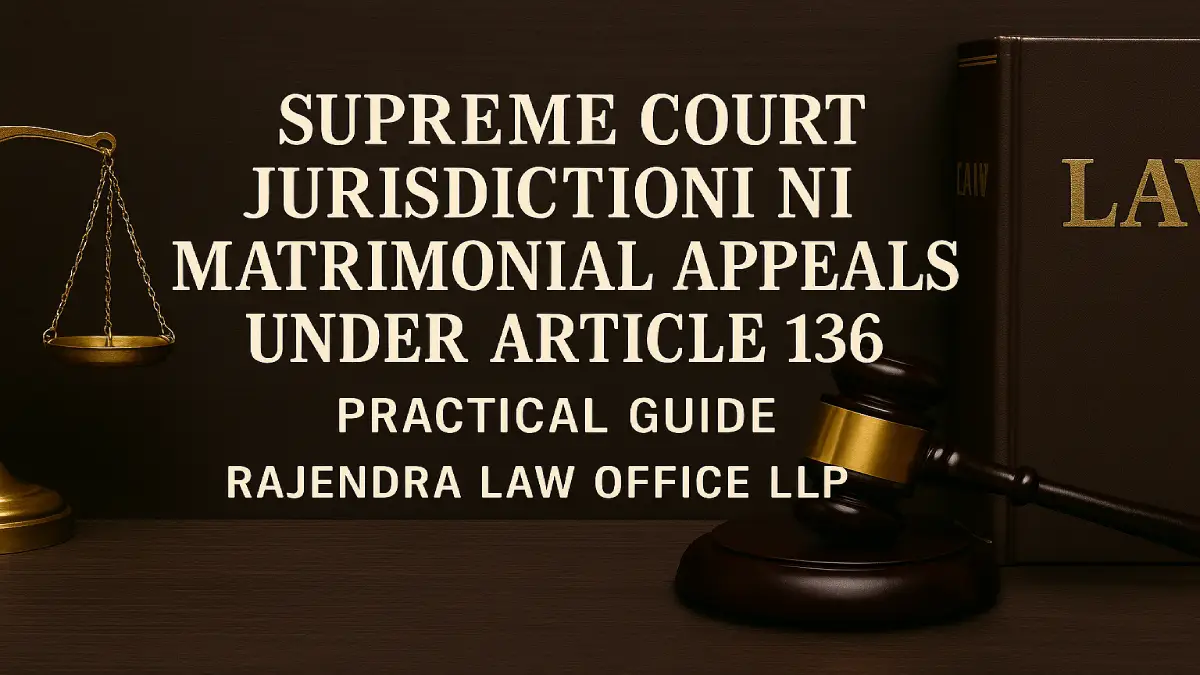
Supreme Court Jurisdiction in Matrimonial Appeals Under Article 136 – Practical Guide
Jurisdiction in Matrimonial Appeals – Matrimonial disputes often begin with hope for resolution but end in prolonged litigation. Cases move from Family Courts to High Courts, and sometimes, even after years of struggle, justice still feels incomplete. At that stage, parties begin to ask an important question: Can the Supreme Court intervene?
Article 136 of the Indian Constitution provides an answer. It grants the Supreme Court special power to hear appeals against judgments passed by any court or tribunal in India. In matrimonial matters, this power becomes especially important when lower courts fail to deliver fair or consistent justice.
At LawyerChennai.com, we regularly advise clients on whether their matrimonial disputes qualify for Supreme Court intervention under Article 136. This guide explains the concept in clear and practical terms.
Supreme Court Jurisdiction in Matrimonial Appeals Under Article 136 – Practical Guide: LawyerChennai.com
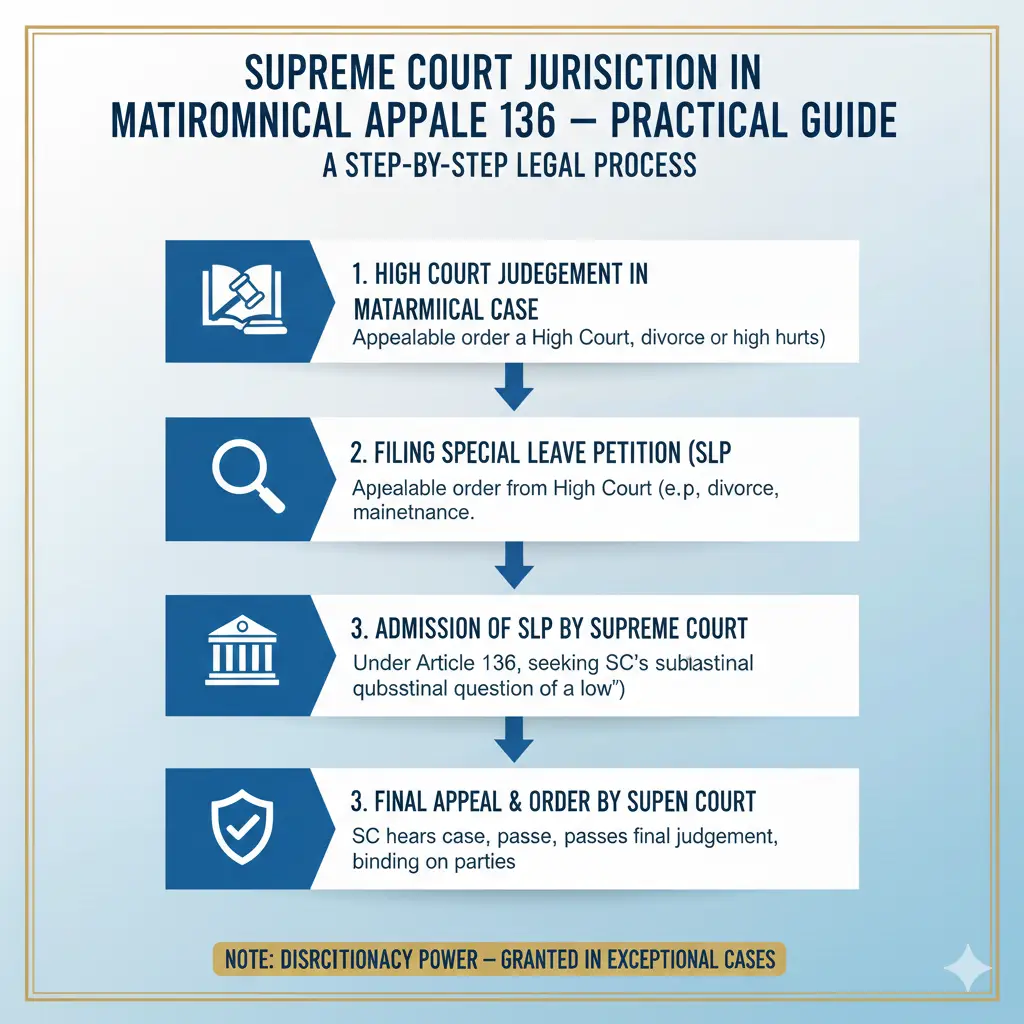
Understanding Article 136 in Simple Language
To begin with, Article 136 gives the Supreme Court discretionary appellate jurisdiction. This means there is no automatic right to appeal. Instead, the Supreme Court decides whether a case deserves its attention.
In practical terms, a party files a Special Leave Petition (SLP). If the Court finds merit, it grants leave, and the case becomes a civil appeal. If not, the petition is dismissed at the threshold.
Therefore, Article 136 is not a routine remedy. It exists to correct grave injustice, serious legal errors, or violations of fundamental principles.
Why Article 136 Matters in Matrimonial Appeals
Matrimonial cases involve personal liberty, dignity, family life, and child welfare. Unfortunately, errors at lower levels can deeply affect lives.
Article 136 matters because it allows the Supreme Court to:
- Correct miscarriage of justice
- Ensure uniform interpretation of matrimonial laws
- Protect vulnerable parties
- Resolve conflicting judgments
As a result, Article 136 acts as a constitutional safety net.
Types of Matrimonial Orders Challenged Under Article 136
Not all matrimonial orders qualify for Supreme Court scrutiny. However, certain types frequently reach the Court.
These include:
- Divorce and annulment decrees
- Maintenance and permanent alimony orders
- Child custody and visitation decisions
- Domestic violence relief orders
- Property and settlement disputes
Each case is examined on its own facts and legal importance.
When Does the Supreme Court Interfere?
The Supreme Court does not interfere merely because a party disagrees with the outcome. Instead, it looks for serious legal or factual errors.
Common grounds include:
- Perverse or arbitrary findings
- Misinterpretation of law
- Violation of natural justice
- Ignoring material evidence
- Inconsistent application of legal principles
Thus, the focus is on justice, not re-trial.
Concurrent Findings: A Major Practical Hurdle
One of the biggest challenges in matrimonial appeals is concurrent findings. When both the Family Court and High Court reach the same conclusion, the Supreme Court becomes extremely cautious.
However, intervention is still possible if:
- Findings are clearly unreasonable
- Evidence is misread
- Law is wrongly applied
Therefore, strong legal drafting becomes critical.
Maintenance and Alimony Appeals Under Article 136
Maintenance disputes are among the most common matrimonial appeals. Often, parties feel maintenance amounts are unfair or unsustainable.
The Supreme Court intervenes when:
- Maintenance is fixed without evidence
- Income is wrongly assessed
- Orders are arbitrary or excessive
- Legal principles are ignored
That said, the Court also ensures that dependents are not left helpless.
Child Custody and Welfare Matters
In custody cases, the Supreme Court places the child’s welfare above all else. Even under Article 136, the Court adopts a sensitive and humane approach.
Intervention occurs when:
- Child welfare is ignored
- Custody orders are mechanical
- Emotional and psychological factors are overlooked
The Court focuses on stability, care, and long-term well-being.
Divorce Appeals and Breakdown of Marriage
In divorce matters, the Supreme Court examines whether the marriage has completely broken down. While Article 136 itself does not dissolve marriages, it allows the Court to review unjust refusals or grants of divorce.
Often, such cases overlap with Article 142, where complete justice becomes necessary.
Procedural Discipline in Filing SLPs
Procedure plays a crucial role in Article 136 matters. Even strong cases fail due to technical errors.
Key practical requirements include:
- Filing within limitation period
- Proper documentation
- Certified copies of judgments
- Clear statement of legal questions
At LawyerChennai.com, we emphasize procedural precision to avoid dismissal at the admission stage.
Discretion of the Supreme Court: A Reality Check
It is important to understand that Article 136 is entirely discretionary. Even meritorious cases may not be admitted due to docket pressure or policy considerations.
Therefore, realistic legal advice is essential. Clients must understand both possibilities—admission and dismissal.
Can Article 136 Be Used as a Second Appeal?
A common misconception is that Article 136 works like a second appeal. This is incorrect.
The Supreme Court:
- Does not re-examine facts routinely
- Avoids acting as a regular appellate court
- Focuses on substantial justice
Hence, Article 136 is exceptional, not repetitive.
Interim Reliefs During Pendency
While hearing matrimonial SLPs, the Supreme Court may grant interim reliefs such as:
- Stay of execution
- Modification of maintenance
- Temporary custody arrangements
These reliefs protect parties until final adjudication.
Role of Experienced Matrimonial Advocates
Navigating Article 136 requires deep legal insight and strategic thinking. Drafting must clearly highlight injustice without emotional exaggeration.
Experienced advocates:
- Identify maintainable grounds
- Frame substantial legal questions
- Present concise arguments
- Manage client expectations
At LawyerChennai.com, we combine legal precision with practical wisdom.
Costs, Time, and Emotional Preparedness
Supreme Court litigation involves cost, time, and emotional resilience. Clients must weigh benefits against burdens.
Therefore, informed decision-making is essential before invoking Article 136.
Frequently Asked Questions
Article 136 grants discretionary appellate power to the Supreme Court to hear appeals against judgments of any court in India. In matrimonial matters, it allows parties to challenge High Court or Family Court decisions when there is serious legal error, injustice, or violation of principles of law, rather than routine disagreement.
No, Article 136 does not provide an automatic right to appeal. Parties must file a Special Leave Petition, and the Supreme Court decides whether the case deserves consideration. The Court interferes only when substantial questions of law, grave injustice, or perversity in findings are clearly demonstrated through legal grounds.
Orders related to divorce decrees, maintenance, permanent alimony, child custody, visitation rights, and matrimonial property disputes can be challenged. However, the Supreme Court examines whether the issue affects justice or legal interpretation, and it avoids re-examining pure factual findings unless they are clearly unreasonable.
In maintenance matters, the Court checks fairness, evidence of income, and adherence to legal principles. In custody cases, the child’s welfare is the primary consideration. The Court intervenes only when lower courts ignore material factors or pass mechanical or arbitrary orders affecting dignity and welfare.
Article 136 proceedings are highly technical and discretionary. Expert advocates help identify maintainable grounds, ensure procedural compliance, and present arguments. Legal guidance improves the chances of admission while helping clients understand risks, timelines, and outcomes before approaching the Supreme Court confidently.
Conclusion: Article 136 as a Tool of Constitutional Balance
In conclusion, Article 136 is a powerful but limited remedy. In matrimonial matters, it exists to correct injustice—not to prolong conflict.
When used responsibly, it restores fairness, dignity, and legal balance. However, success depends on facts, law, and skilled advocacy. LawyerChennai.com remains committed to guiding clients through Supreme Court matrimonial appeals with clarity, honesty, and strategic strength.
Read More
- Challenging Family Court Divorce Decree in High Court – Complete Legal Process
- Virtual Hearings vs Transfer Petitions – Changing Judicial Approach
- Multiple Matrimonial Proceedings in Different States – Legal Solutions
- Transfer Petition by Husband – When Courts Allow It
- Grounds for Transfer of Divorce Proceedings – Legal Strategy Guide
- Supreme Court of India – Official Government Portal