

Data privacy and GDPR compliance have become urgent legal priorities for businesses across India. Consequently, organisations handling personal data face growing regulatory scrutiny from multiple authorities. India’s Digital Personal Data Protection Act (DPDPA) 2023 marks a transformative shift in national data governance. Moreover, global businesses must simultaneously comply with the EU General Data Protection Regulation (GDPR). Legal violations in data privacy attract significant civil penalties and criminal liability. Therefore, businesses and individuals need expert legal guidance to navigate this complex regulatory landscape. Additionally, the Bharatiya Nyaya Sanhita (BNS) 2023 introduces new cyber offence provisions directly affecting data privacy. The Bharatiya Sakshya Adhiniyam (BSA) 2023 governs digital evidence in all data-related court proceedings. Furthermore, courts across India increasingly handle data breach litigation, writ petitions, and consumer complaints. The Data Protection Board of India will adjudicate disputes arising under DPDPA 2023 provisions. LawyerChennai.com provides authoritative legal information connecting clients with expert data privacy advocates. Visit today for specialised legal support on all data protection matters in Chennai.
Data Privacy Laws in India: What You Must Know Today
India’s data privacy legal framework has undergone a fundamental transformation in recent years. The Digital Personal Data Protection Act (DPDPA) 2023 received Presidential assent on 11 August 2023. Moreover, this landmark legislation replaces fragmented IT Act provisions with a comprehensive modern framework. Businesses collecting, storing, or processing personal data must register as Data Fiduciaries under DPDPA. Therefore, every organisation handling citizen data must build robust internal compliance systems immediately. Additionally, the Ministry of Electronics and Information Technology (MeitY) oversees national DPDPA 2023 implementation. Simultaneously, the EU GDPR applies to any Indian company processing data of EU residents. Furthermore, non-compliance with GDPR attracts penalties up to €20 million or 4% of global turnover. The Information Technology Act 2000, as amended in 2008, continues to apply to legacy data protection matters. Therefore, legal advisors must analyse both DPDPA and IT Act provisions together simultaneously. LawyerChennai.com connects clients with advocates who specialise in data privacy compliance and litigation today.
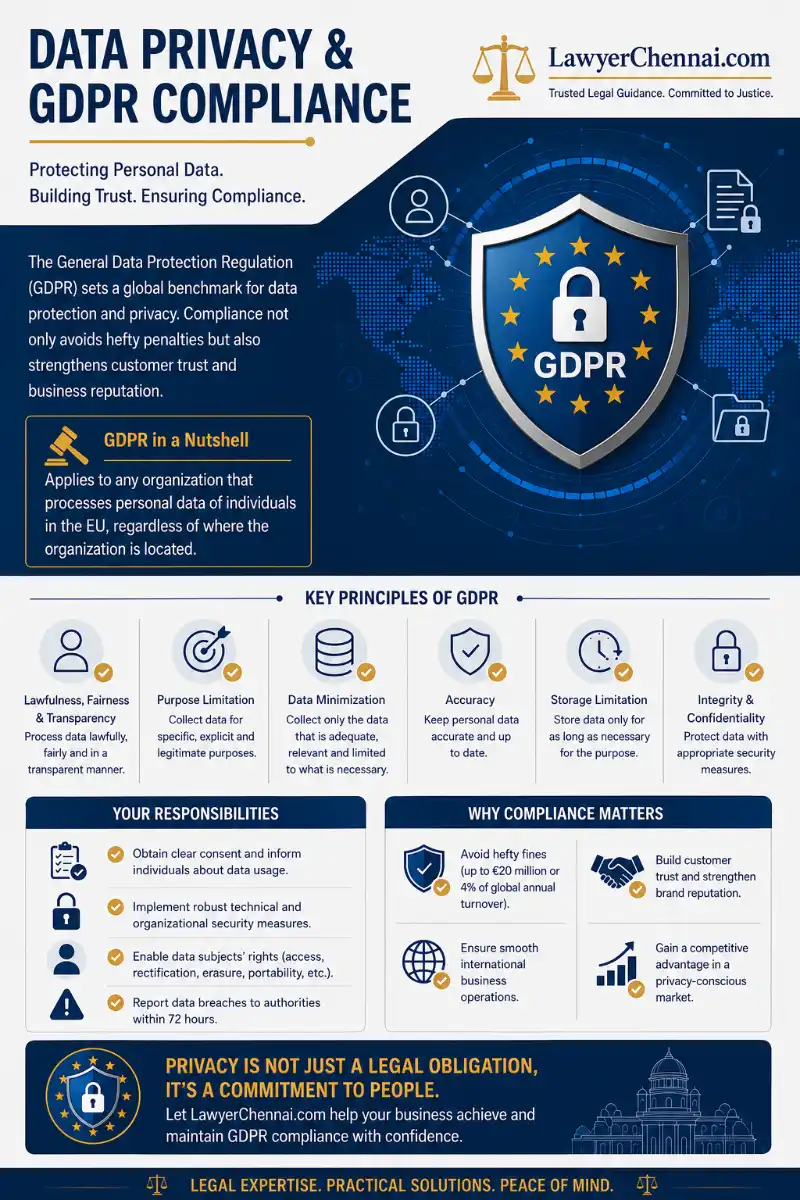
GDPR Compliance for Indian Businesses Operating Globally
Indian businesses processing personal data of EU residents must comply with GDPR mandatorily. Consequently, this applies even if the Indian business has no physical presence in Europe. GDPR establishes seven core data protection principles that every data controller must follow. Moreover, these principles include lawfulness, fairness, transparency, purpose limitation, and data minimisation. Therefore, Indian IT companies, exporters, and BPO firms face direct GDPR compliance obligations today. Additionally, GDPR mandates that certain organisations appoint a Data Protection Officer (DPO) formally. The DPO must monitor internal compliance, train staff, and liaise with supervisory authorities effectively. Furthermore, Indian companies must execute Standard Contractual Clauses (SCCs) for lawful data transfers internationally. Data subjects in the EU enjoy extensive rights including erasure, portability, and objection. Regulators in EU member states actively investigate non-compliant Indian companies through formal inquiries. Therefore, proactive legal advice from experienced data privacy advocates is absolutely essential. LawyerChennai.com helps Indian businesses understand and implement GDPR compliance requirements effectively today.
Rights of Data Principals Under DPDPA 2023
India’s DPDPA 2023 grants Data Principals comprehensive, legally enforceable rights over their personal data. Moreover, these rights fundamentally change how organisations must manage and process personal information. Therefore, businesses must build compliance systems that accommodate every data principal right effectively. DPDPA 2023 recognises the following rights for every individual Data Principal in India:
- Right to Access – Know what personal data the Data Fiduciary holds about you
- Right to Correction – Correct inaccurate, incomplete, or outdated personal data promptly
- Right to Erasure – Request deletion of personal data upon withdrawal of consent
- Right to Grievance Redressal – File complaints with the Data Fiduciary’s Grievance Officer first
- Right to Nominate – Nominate another individual to exercise rights upon death or incapacity
- Right to Compensation – Claim compensation for unlawful data processing under DPDPA 2023
Furthermore, Data Fiduciaries must respond to data principal requests within a prescribed timeframe. Additionally, refusal to honour these rights triggers complaint rights before the Data Protection Board. LawyerChennai.com connects clients with data privacy advocates who enforce these rights effectively today.
IT Act 2000 and Sensitive Personal Data Protection Rules 2011
The Information Technology Act 2000 remains the foundational cyber law governing data protection in India. Moreover, Section 43A of the IT Act creates civil liability for negligent data protection failures. Consequently, bodies corporate handling sensitive personal data must implement reasonable security practices. The IT (Reasonable Security Practices) Rules 2011 define what constitutes sensitive personal data under Indian law. Sensitive personal data includes passwords, financial information, health data, and biometric data. Therefore, any breach involving sensitive data triggers mandatory notification and compensation obligations. Additionally, corporate bodies must maintain documented security practices and publish privacy policies publicly. Their privacy policy must specify the type of data collected and its stated purpose. Furthermore, Indian courts have applied IT Act provisions in landmark data breach cases across sectors. The IT Act also empowers CERT-In to direct organisations to report cyber incidents within six hours. Therefore, legal compliance with IT Act and SPDI Rules 2011 remains non-negotiable for all businesses. LawyerChennai.com provides detailed legal analysis of IT Act compliance requirements for businesses today.
CERT-In Compliance and Cyber Incident Reporting Obligations
CERT-In (Computer Emergency Response Team India) operates under MeitY and issues binding directions to all organisations. Moreover, CERT-In directions issued in April 2022 mandate strict cyber incident reporting timelines. Consequently, all organisations must report cyber incidents to CERT-In within six hours of detection. Therefore, data breaches, ransomware attacks, and unauthorised data access all trigger CERT-In reporting duties. Key CERT-In compliance obligations include the following mandatory requirements:
- Mandatory six-hour cyber incident reporting timeline to CERT-In
- Synchronisation of all ICT systems with the NIC time server
- Maintenance of server logs for 180 days within Indian jurisdiction
- Designation of a Point of Contact for all CERT-In coordination activities
- VPN providers and data centres must retain user logs for five years
Furthermore, non-compliance with CERT-In directions attracts punishment under Section 70B of the IT Act. Additionally, CERT-In conducts periodic audits of critical sector organisations across India. LawyerChennai.com assists businesses in understanding and fully meeting their CERT-In compliance obligations today.
GDPR Obligations for Data Controllers and Processors
GDPR creates distinct legal obligations for Data Controllers and Data Processors operating globally. Moreover, Indian IT companies, BPO firms, and analytics companies often serve as Data Processors for EU clients. Therefore, they must execute Data Processing Agreements (DPAs) compliant with GDPR Article 28 provisions. Additionally, Data Controllers must demonstrate a lawful basis for every single data processing activity. GDPR recognises six lawful bases for processing personal data under its framework:
- Consent – Freely given, specific, informed, and unambiguous agreement from the data subject
- Contractual Necessity – Processing required to perform a contract directly with the data subject
- Legal Obligation – Processing necessary to comply with an applicable legal requirement
- Vital Interests – Processing needed to protect someone’s life or physical safety
- Public Task – Processing required for official governmental functions or public interest tasks
- Legitimate Interests – Processing justified by the controller’s overriding legitimate business interest
Furthermore, organisations must maintain Records of Processing Activities (RoPA) under Article 30 GDPR. Additionally, Data Protection Impact Assessments (DPIAs) must be conducted for all high-risk processing activities. LawyerChennai.com guides Indian businesses through complete GDPR Article 28 compliance requirements efficiently today.
Data Breach Liability Under BNS 2023 and IT Act
Data breaches now attract criminal liability under multiple overlapping legal frameworks across India. Consequently, the Bharatiya Nyaya Sanhita (BNS) 2023 contains provisions relevant to data theft and cyber offences. Moreover, BNS Section 316 covers cheating by personation, which applies to identity theft from data breaches. Therefore, companies experiencing data breaches may face criminal complaints under BNS alongside civil claims. Additionally, Section 66C of the IT Act specifically criminalises identity theft using stolen digital data. Section 66 of the IT Act further punishes dishonest and fraudulent computer-related offences comprehensively. Furthermore, victims of data breaches can file FIRs at Cyber Crime Police Stations under BNSS 2023 provisions. The Bharatiya Nagarik Suraksha Sanhita (BNSS) 2023 governs the investigation procedure for all cyber crime FIRs. Additionally, companies failing to prevent foreseeable data breaches face civil liability under Section 43A IT Act. Therefore, businesses must implement robust technical and organisational security measures proactively without delay. LawyerChennai.com connects data breach victims with qualified advocates for immediate legal assistance today.
Digital Evidence and BSA 2023 in Privacy Litigation
The Bharatiya Sakshya Adhiniyam (BSA) 2023 governs admissibility of evidence in all court proceedings. Moreover, BSA replaces the Indian Evidence Act 1872 with modernised provisions for digital evidence. Consequently, data privacy litigation increasingly relies on electronic records as primary courtroom evidence. Therefore, proper preservation and authentication of digital evidence is critical in data breach litigation. Additionally, BSA Section 63 sets clear standards for admissibility of electronic records in courts. Common types of digital evidence used in data privacy litigation include the following:
- Server logs and access records extracted from breached information systems
- Email communications demonstrating data misuse or unlawful consent withdrawal
- WhatsApp and messaging app data related to unauthorised data sharing
- CCTV footage from data centres as physical security corroboration
- Digital forensic reports from certified cyber investigators under BSA 2023
- Certificate of authenticity for all electronic records under BSA Section 63
Furthermore, courts increasingly rely on properly authenticated digital evidence in data privacy disputes. Additionally, BSA compliance failures can render crucial electronic evidence entirely inadmissible before courts. LawyerChennai.com helps clients preserve and authenticate digital evidence correctly for Chennai court proceedings today.
India’s Digital Personal Data Protection Act 2023 Explained
The Digital Personal Data Protection Act (DPDPA) 2023 represents India’s most comprehensive data privacy legislation ever enacted. Moreover, the Act establishes a structured framework governing consent, processing, storage, and transfer of personal data. Consequently, every business collecting personal data from Indian residents must comply with DPDPA provisions now. The Act identifies two key regulated entity categories: Data Fiduciaries and Data Processors. Therefore, understanding your organisation’s role under DPDPA determines your specific legal compliance obligations. Additionally, Significant Data Fiduciaries (SDFs) face heightened obligations including mandatory data protection impact assessments. MeitY will notify which organisations qualify as SDFs based on data volume and sensitivity criteria. Furthermore, DPDPA creates the Data Protection Board of India as an independent adjudicatory body. The Board will receive complaints, conduct inquiries, and impose financial penalties for violations. Penalties under DPDPA can reach up to ₹250 crore per violation for significant data breaches. Therefore, early compliance investment is far more cost-effective than facing regulatory penalties. LawyerChennai.com connects clients with expert DPDPA compliance advocates across Chennai immediately.
Filing Complaints Before the Data Protection Board of India
The Data Protection Board of India (DPBI) will serve as the primary adjudicatory forum for DPDPA violations. Consequently, Data Principals may approach the Board after exhausting the Data Fiduciary’s internal grievance process. Moreover, the Board will conduct all proceedings digitally and follow principles of natural justice. Therefore, understanding the complaint procedure before the DPBI is essential for every aggrieved individual. The complete complaint process before the Data Protection Board involves the following steps:
- File a formal grievance with the Data Fiduciary’s designated Grievance Officer first
- Wait for a response within the prescribed period under DPDPA 2023 Rules
- Approach the Data Protection Board if the grievance remains unresolved satisfactorily
- Submit a digital complaint through the Board’s official online portal
- Attend Board proceedings conducted virtually as per DPDPA procedures
- Receive the Board’s final order including penalties or compliance directions
Furthermore, Board orders can be challenged before the Telecom Disputes Settlement and Appellate Tribunal (TDSAT). Additionally, High Court writ jurisdiction under Article 226 remains available for constitutional challenges against Board orders. LawyerChennai.com guides clients through the complete DPBI complaint and appeal procedure effectively.
Consumer Forum Complaints for Data Privacy Violations
Consumer Forums provide an accessible and affordable legal remedy for all data privacy violations. Consequently, individuals whose personal data is misused by service providers can file consumer complaints. Moreover, the Consumer Protection Act 2019 recognises data privacy violations as a deficiency in service. Therefore, victims can file complaints at the District Consumer Disputes Redressal Commission in Chennai. Additionally, e-commerce platforms, fintech companies, and social media providers qualify as covered service providers. Common data privacy violations actionable before Consumer Forums in Chennai include:
- Unauthorised sharing of personal data with third-party advertisers without consent
- Failure to maintain reasonable security practices resulting in a data breach
- Refusal to delete personal data upon a valid consumer erasure request
- Unsolicited marketing communications continued after documented consent withdrawal
- Inaccurate data processing causing measurable financial or reputational harm
- Denial of data access requests without valid legal justification provided
Furthermore, Consumer Forums can award compensation, direct data deletion, and impose financial penalties. Additionally, appeals from District Forums proceed to the Tamil Nadu State Consumer Disputes Redressal Commission. LawyerChennai.com connects data privacy victims with consumer law advocates across Chennai today.
Chennai Cyber Crime Police Stations and FIR Registration
Chennai Cyber Crime Police Stations handle all data privacy and cyber offence complaints efficiently. Consequently, victims of data breaches, identity theft, and unauthorised data access must approach the correct station. Moreover, Tamil Nadu Police operates dedicated Cyber Crime Cells across Chennai for thorough investigation. Therefore, registering an FIR at the correct station ensures proper BNSS 2023-compliant investigation procedures. Additionally, BNSS mandates that police acknowledge complaints and register FIRs promptly without delay. Key cyber crime investigation points accessible to Chennai data privacy complainants include:
- Tamil Nadu Cyber Crime Cell – Commissioner of Police Office, Chennai
- Economic Offences Wing (EOW) – For large-scale data fraud investigations
- Cyber Crime Police Station, Anna Nagar – North Chennai
- Cyber Crime Police Station, Egmore – Central Chennai
- Central Crime Branch (CCB) Chennai – Complex cyber crime matters
- National Cyber Crime Reporting Portal – cybercrime.gov.in (Online FIR)
Furthermore, victims can simultaneously file online complaints at cybercrime.gov.in without visiting a police station. Additionally, CERT-In and the Data Protection Board coordinate with police in major breach investigations. LawyerChennai.com assists clients in navigating the FIR registration and cyber crime complaint process today.
Cyber Crime and Data Breach Proceedings Under BNS and BNSS
Cyber crime and data breach matters have emerged as critical areas of legal practice across India. Moreover, the BNS 2023 and BNSS 2023 introduce significantly updated frameworks for handling cyber offences. Consequently, advocates handling data privacy matters must thoroughly master these new statutory provisions. The BNSS 2023 governs investigation procedures, trial timelines, and rights of accused persons comprehensively. Therefore, data breach victims must follow correct legal procedures when reporting cyber crimes to police. Additionally, the BNSS mandates that police complete investigations within specific statutory time periods. Cyber crime cases now benefit from improved digital forensic investigation standards under BNSS provisions. Furthermore, courts apply BSA 2023 standards rigorously to evaluate digital evidence in all data breach trials. Victims of data privacy violations can approach Cyber Crime Police Stations across Chennai for FIR registration. Additionally, the National Cyber Crime Reporting Portal at cybercrime.gov.in accepts online complaints for data privacy violations. LawyerChennai.com provides legal guidance on filing and pursuing cyber crime data privacy complaints effectively today.
Legal Remedies for Data Privacy Violations in Chennai Courts
Multiple legal remedies exist for data privacy violations across Indian courts and adjudicatory forums. Moreover, victims must identify the correct remedy based on the nature and severity of their violation. Consequently, legal strategy in data privacy cases requires careful analysis of all available options. Civil courts, consumer forums, cyber crime courts, and constitutional courts all handle different dispute aspects. Therefore, a coordinated multi-forum legal strategy often produces the best outcomes for aggrieved data subjects. Additionally, Madras High Court regularly entertains writ petitions challenging data privacy violations by government bodies. The High Court exercises Article 226 jurisdiction to direct government agencies to comply with data protection law. Furthermore, civil suits under CPC remain available for damages arising from contractual data protection breaches. The Code of Civil Procedure allows interim injunctions to prevent ongoing data misuse immediately. Additionally, the BNS 2023 allows criminal complaints for data theft and identity fraud offences. LawyerChennai.com provides comprehensive legal guidance on choosing the right data privacy remedy across Chennai courts.
Civil Remedies Under CPC for Data Privacy Violations
The Code of Civil Procedure provides important civil remedies for all data privacy violation victims. Moreover, data subjects suffering financial or reputational harm from data breaches can file civil suits. Consequently, courts can award monetary compensation, injunctions, and declaratory relief in appropriate cases. Therefore, civil litigation remains a powerful remedy alongside regulatory complaints under DPDPA 2023. The following table outlines key civil remedies available under CPC for data privacy violations:
| Civil Remedy | CPC / Statutory Provision | Nature of Relief | Who Can File |
|---|---|---|---|
| Interim Injunction | Order 39, CPC | Stop ongoing data misuse | Affected Data Subject |
| Damages (Compensation) | Section 9, CPC | Monetary compensation awarded | Individual or Business |
| Declaratory Relief | Section 34, Specific Relief Act | Legal rights determination | Any Aggrieved Party |
| Permanent Injunction | Order 39, Rule 4, CPC | Long-term data protection | Successful Plaintiff |
| Civil Liability (Breach) | Section 43A, IT Act 2000 | Compensation from data handler | Affected Individual |
Additionally, courts can issue ex-parte interim injunctions in urgent data breach matters without prior notice. Furthermore, civil suits may be filed in appropriate Civil Courts or before Madras High Court directly. LawyerChennai.com connects clients with civil litigation advocates handling data privacy cases across Chennai today.
IT Appellate Tribunal and High Court Writ Jurisdiction
The IT Appellate Tribunal (ITAT) hears appeals against orders passed by the Adjudicating Officer under the IT Act. Moreover, aggrieved persons must file ITAT appeals within the prescribed statutory timeline. Consequently, ITAT provides a formal appellate remedy for businesses penalised under IT Act provisions. Therefore, experienced legal representation before ITAT significantly improves your appeal outcome. The following table outlines all key data privacy adjudicatory forums in India:
| Forum | Jurisdiction | Applicable Law | Appeal Forum |
|---|---|---|---|
| Data Protection Board | DPDPA 2023 Complaints | DPDPA 2023 | TDSAT |
| IT Adjudicating Officer | IT Act Violations | IT Act 2000 | IT Appellate Tribunal |
| IT Appellate Tribunal | IT Act Appeals | IT Act 2000 | High Court |
| District Consumer Forum | Service Deficiency | Consumer Protection Act 2019 | State Commission |
| Madras High Court | Writ Petitions | Article 226, Constitution | Division Bench / SC |
Furthermore, TDSAT hears appeals against Data Protection Board orders under DPDPA 2023 provisions. Additionally, Madras High Court remains accessible for urgent constitutional challenges against any data privacy authority order. LawyerChennai.com guides clients through every appellate forum for data privacy disputes effectively and efficiently.
Cross-Border Data Transfer Restrictions Under GDPR and DPDPA
Cross-border data transfer is a critical compliance challenge for Indian businesses operating internationally. Consequently, both GDPR and DPDPA 2023 impose distinct restrictions on transferring personal data across borders. Moreover, GDPR prohibits transfer of personal data to countries without adequate data protection frameworks. Therefore, India currently negotiates an adequacy decision with the European Commission for smoother data flows. Additionally, DPDPA 2023 empowers the Indian Government to restrict data transfers to specific countries. The Central Government will Allowlist countries for lawful cross-border data transfers under DPDPA. Key cross-border data transfer compliance mechanisms include the following measures:
- Standard Contractual Clauses (SCCs) for GDPR-compliant international data transfers
- Binding Corporate Rules (BCRs) for multinational group internal data transfers
- Data Processing Agreements incorporating DPDPA 2023 compliance obligations
- Transfer Impact Assessments evaluating third-country data protection framework adequacy
- Explicit informed consent mechanisms for all cross-border personal data sharing activities
Furthermore, Indian IT companies providing services to EU clients must address both GDPR and DPDPA simultaneously. Additionally, non-compliance with cross-border transfer rules attracts penalties under both regulatory frameworks. LawyerChennai.com connects businesses with advocates who specialise in cross-border data compliance today.
How LawyerChennai.com Supports Data Privacy Legal Cases
LawyerChennai.com serves as Chennai’s leading independent legal information platform for data privacy matters. Moreover, its curated resources connect individuals and businesses with experienced data privacy advocates efficiently. Consequently, clients gain access to legal experts handling GDPR compliance, DPDPA matters, and cyber crime litigation. Therefore, whether you need regulatory compliance advice or litigation support, LawyerChennai.com provides the right expert connection. Their data privacy legal support services cover the following comprehensive areas:
- DPDPA 2023 compliance audit, advisory, and gap assessment services
- GDPR compliance gap analysis for Indian businesses serving EU clients
- Data breach legal response support and crisis communication management
- Consumer Forum complaint filing for all data privacy violations
- FIR registration assistance at Chennai Cyber Crime Police Stations
- Writ petition filing at Madras High Court for data privacy challenges
- Representation before the Data Protection Board of India and TDSAT
- IT Act adjudication proceedings and ITAT appeal representation
Additionally, their network of advocates handles both advisory mandates and contentious data privacy litigation. Furthermore, they assist startups, SMEs, and large corporations with proportionate compliance frameworks. Visit LawyerChennai.com today to find a qualified data privacy advocate in Chennai immediately.