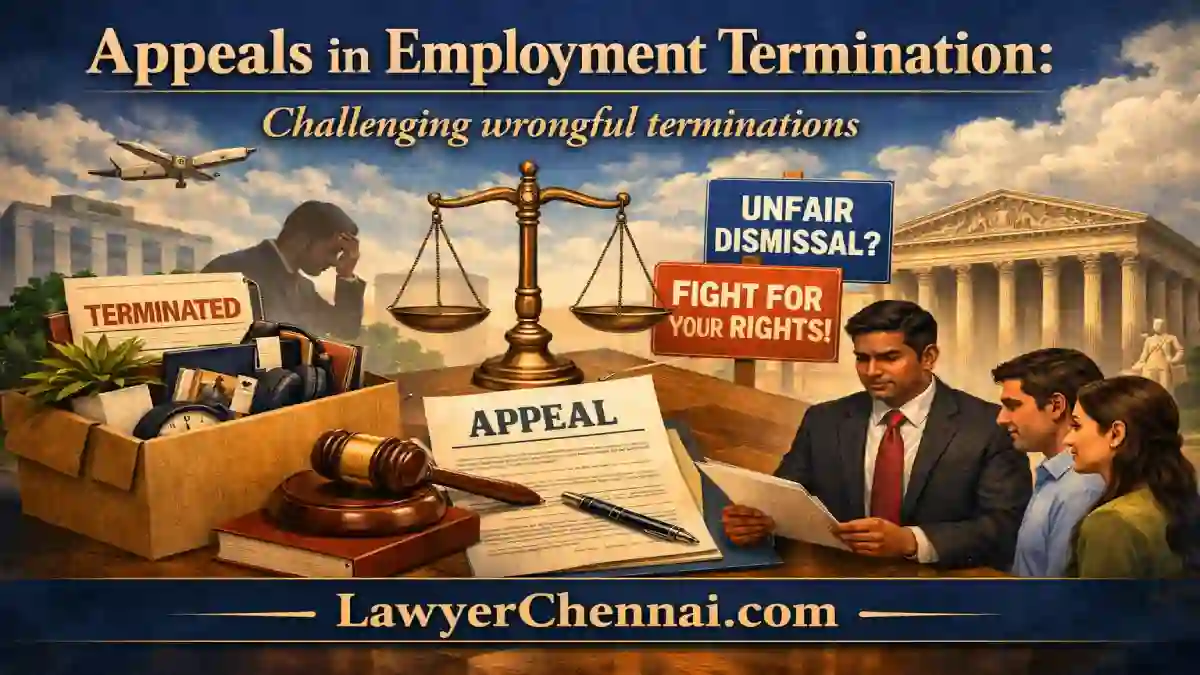
Appeals in Employment Termination: Challenging wrongful terminations
Appeals in Employment Termination – Employment termination appeals protect employees against wrongful dismissal, unfair labour practices, and contractual breaches. LawyerChennai.com – Best Lawyer Firm in Chennai India 24×7 assists employees and employers under Indian labour laws and constitutional remedies. Moreover, disputes often arise under Industrial Disputes Act, Shops and Establishments Act, and service rules. Jurisdiction commonly includes Labour Courts in Chennai, Industrial Tribunals, and Madras High Court under Article 226. Additionally, remedies involve reinstatement, back wages, compensation, and declaration of illegal termination.
Employment Termination Appeals Overview – LawyerChennai.com
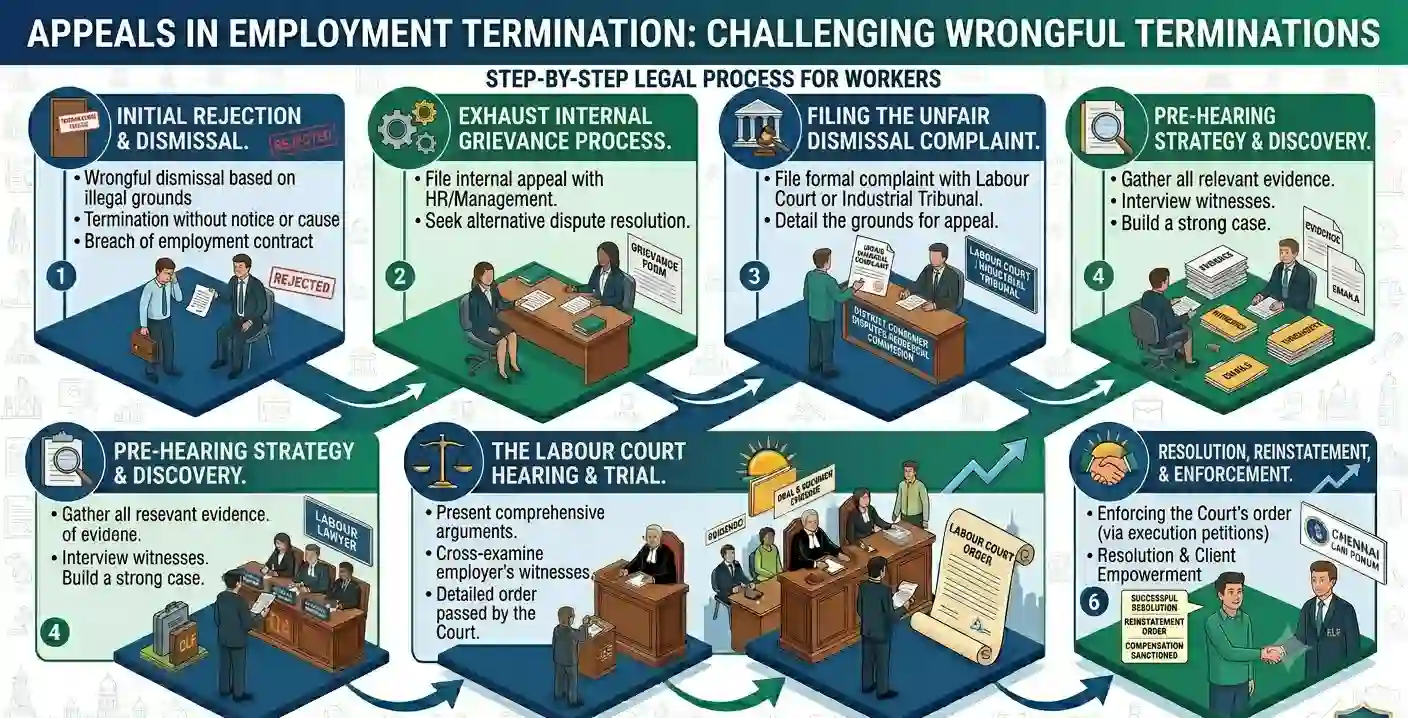
Key issues include misconduct allegations, retrenchment violations, and breach of natural justice principles.
• Wrongful termination claims
• Illegal retrenchment disputes
• Contract breach cases
• Disciplinary inquiry challenges
Therefore, timely appeal filing ensures preservation of rights and strengthens evidentiary support for employment disputes across judicial forums and administrative authorities.
Legal Framework Governing Termination Disputes
Employment termination disputes rely on multiple legal frameworks including Industrial Disputes Act, CPC principles, BSA evidence rules, and constitutional protections. Moreover, BNSS applies where false criminal allegations arise during termination. Courts in Chennai assess fairness, proportionality, and procedural compliance. Employers must follow due process before dismissal. Additionally, statutory authorities like Labour Commissioner and Industrial Tribunal handle preliminary disputes. Remedies include reinstatement, compensation, and settlement orders.
Legal structure includes:
- Employment contracts
- Labour welfare statutes
- Constitutional remedies
- Tribunal adjudication
Furthermore, evidence such as appointment letters, emails, and disciplinary records plays a crucial role. Therefore, legal compliance ensures lawful termination procedures and reduces litigation risks.
Grounds and Legal Basis for Appeals
Grounds and Legal Basis for Appeals
Wrongful termination appeals arise when employers violate statutory or contractual obligations. Common grounds include lack of inquiry, bias, and absence of evidence. Moreover, procedural irregularities under Industrial Disputes Act strengthen employee claims. Chennai Labour Courts examine fairness and adherence to natural justice principles. Additionally, courts consider proportionality of punishment and documentary inconsistencies.
Key grounds include:
• Absence of domestic inquiry
• Violation of natural justice
• False misconduct allegations
• Retrenchment non-compliance
Furthermore, CPC principles support civil claims for damages. Therefore, employees should document termination notices, HR communications, and witness statements to build strong appellate cases.
Jurisdiction and Forums in Chennai
Employment disputes fall under multiple jurisdictions depending on employee category and nature of termination. Labour Courts in Chennai handle industrial disputes, while High Court hears writ petitions. Additionally, Industrial Tribunals resolve complex collective matters. Government departments like Labour Commissioner oversee conciliation processes.
Jurisdiction table:
| Forum | Function |
|---|---|
| Labour Court | Individual disputes |
| Industrial Tribunal | Collective disputes |
| High Court | Constitutional review |
Moreover, police stations in Chennai may become relevant in false criminal complaint cases linked to termination. Therefore, selecting correct jurisdiction ensures faster resolution and proper legal remedy enforcement.
Evidence Strategy in Termination Appeals
Strong evidence determines success in employment termination appeals. Under BSA, electronic records, emails, HR files, and witness testimony hold high value. Moreover, courts evaluate consistency and authenticity of documents. Employers must justify termination with valid records. Employees should preserve communication history and performance records.
Key evidence includes:
- Appointment letter
- Termination notice
- Email correspondence
- HR disciplinary records
Furthermore, BNSS applies when criminal allegations arise during employment disputes. Therefore, structured evidence presentation improves chances of reinstatement or compensation.
Industrial Disputes Act Framework
Industrial Disputes Act governs termination, retrenchment, and unfair labour practices. Employers must follow due process before dismissal. Moreover, retrenchment compensation and notice requirements remain mandatory. Chennai Labour Courts interpret compliance strictly.
Important provisions include:
• Section on retrenchment
• Disciplinary inquiry rules
• Settlement mechanisms
• Conciliation procedures
Additionally, CPC principles assist procedural litigation. Therefore, proper statutory compliance ensures valid termination and reduces appeal risks.
CPC in Employment Litigation
Civil Procedure Code principles apply in employment-related civil suits involving damages and injunctions. Courts examine pleadings, evidence, and procedural fairness. Moreover, interim relief may prevent reputational harm or financial loss.
Key CPC remedies:
• Injunction orders
• Compensation claims
• Declaratory relief
• Evidence discovery
Furthermore, BSA strengthens documentary admissibility. Therefore, structured pleadings improve litigation efficiency in employment termination appeals.
Labour Court Procedure in Chennai
Labour Courts in Chennai handle disputes involving wrongful termination and industrial misconduct. Proceedings include conciliation, evidence submission, and final adjudication. Moreover, legal representation ensures procedural compliance. Courts prioritize fairness and statutory adherence.
Steps include:
- Filing complaint
- Conciliation attempt
- Evidence hearing
- Final award
Additionally, BNSS may apply where criminal allegations overlap employment disputes. Therefore, structured representation improves case outcomes significantly.
Tribunal Appeal Process
Industrial Tribunal appeals involve complex labour disputes requiring detailed legal analysis. Employers and employees present documentary and oral evidence. Moreover, tribunal decisions are binding unless challenged in High Court.
Appeal process includes:
• Filing written submissions
• Evidence examination
• Cross-examination
• Final award issuance
Furthermore, CPC principles guide procedural fairness. Therefore, timely appeals ensure protection of employment rights and legal remedies.
High Court Writ Jurisdiction
Madras High Court exercises writ jurisdiction under Article 226 for employment termination disputes. Courts intervene when statutory remedies are inadequate. Moreover, judicial review ensures fairness and legality.
Writ remedies include:
• Certiorari
• Mandamus
• Prohibition
• Declaration
Additionally, police stations may become relevant in false FIR-linked terminations. Therefore, constitutional remedies provide powerful legal protection.
Notice Period and Contract Violations
Notice period violations often lead to termination disputes. Employers must follow contract terms strictly. Moreover, employees may claim salary compensation for breach.
Key issues include:
• No notice termination
• Salary withholding
• Contract breach
• Unilateral dismissal
Furthermore, CPC supports damages claims. Therefore, proper contract enforcement ensures fair employment practices.
Severance and Compensation Claims
Severance disputes arise when employers fail to provide statutory compensation. Employees may seek reinstatement or financial relief. Moreover, courts assess employment duration and contract terms.
Remedies include:
• Severance pay
• Back wages
• Compensation awards
• Settlement agreements
Therefore, proper legal assessment ensures fair financial recovery in termination cases.
Misconduct Allegations Defense
Employers often justify termination through misconduct allegations. Employees must challenge false claims using evidence. Moreover, disciplinary inquiries must follow natural justice.
Defense strategies include:
• Evidence rebuttal
• Witness statements
• Procedural challenge
• Documentation review
Furthermore, BSA ensures admissibility of digital proof. Therefore, strong defense protects employee rights effectively.
Disciplinary Inquiry Flaws
Improper disciplinary inquiries invalidate termination decisions. Employers must provide fair hearings and unbiased investigation. Moreover, failure violates labour law principles.
Common flaws include:
• Bias in inquiry
• No hearing opportunity
• Evidence suppression
• Procedural gaps
Therefore, legal challenges often succeed when inquiry fairness is violated.
BSA Evidence in Termination Cases
Bharatiya Sakshya Adhiniyam governs evidence in employment disputes. Courts rely on electronic and documentary proof. Moreover, authenticity plays a crucial role.
Evidence types include:
• Emails and chats
• HR records
• Digital logs
• Witness statements
Therefore, proper evidence handling strengthens appeal success rates.
BNSS and False Criminal Allegations
BNSS applies when employers file false criminal complaints during termination disputes. Employees may face police investigation or arrest risks. Moreover, courts protect against misuse of criminal law.
Remedies include:
• Quashing FIR
• Bail applications
• Police complaints
• Writ petitions
Therefore, legal protection ensures fair treatment during employment disputes.
Police Station Role in Employment Disputes
Chennai police stations may get involved in criminal allegations linked to termination. However, labour disputes remain civil in nature. Moreover, legal intervention prevents misuse of police power.
Key actions include:
• FIR review
• Complaint filing
• Protection requests
• Investigation monitoring
Therefore, legal guidance ensures proper handling of mixed civil-criminal disputes.
Compensation and Legal Remedies
Employees may claim compensation for wrongful termination under labour and civil law. Courts assess salary loss, emotional harm, and career impact. Moreover, settlements are common in Chennai Labour Courts.
Remedies include:
• Reinstatement
• Monetary compensation
• Damages claims
• Settlement orders
Therefore, structured legal claims ensure fair justice in termination disputes.
FAQs
- What is wrongful termination under Indian law?
It occurs when employer dismisses employee without valid reason or legal procedure under labour laws.
2. Can I appeal against termination in Chennai Labour Court?
Yes, employees can file appeal under Industrial Disputes Act before Labour Court or Tribunal.
3. What remedies are available for wrongful dismissal?
Remedies include reinstatement, back wages, compensation, and declaration of illegal termination.
4. Can I approach High Court for termination dispute?
Yes, writ petitions under Article 226 are maintainable in Madras High Court.
5. What evidence is needed for termination appeal?
Emails, HR records, appointment letters, and witness statements are essential under BSA rules.
6. Can police get involved in employment termination cases?
Only if false criminal allegations exist; otherwise disputes remain civil under labour law.
Read More
- Charity Dispute Appeals: Appealing charity-related disputes
- Regulatory Fines Appeals: Challenging fines imposed by regulators
- Tax Evasion Appeals: Handling appeals in tax evasion cases
- International Trade Disputes: Appealing trade-related disputes
- Civil Rights Litigation: Handling appeals in civil rights cases
- Ministry of Labour & Employment, Government of India