
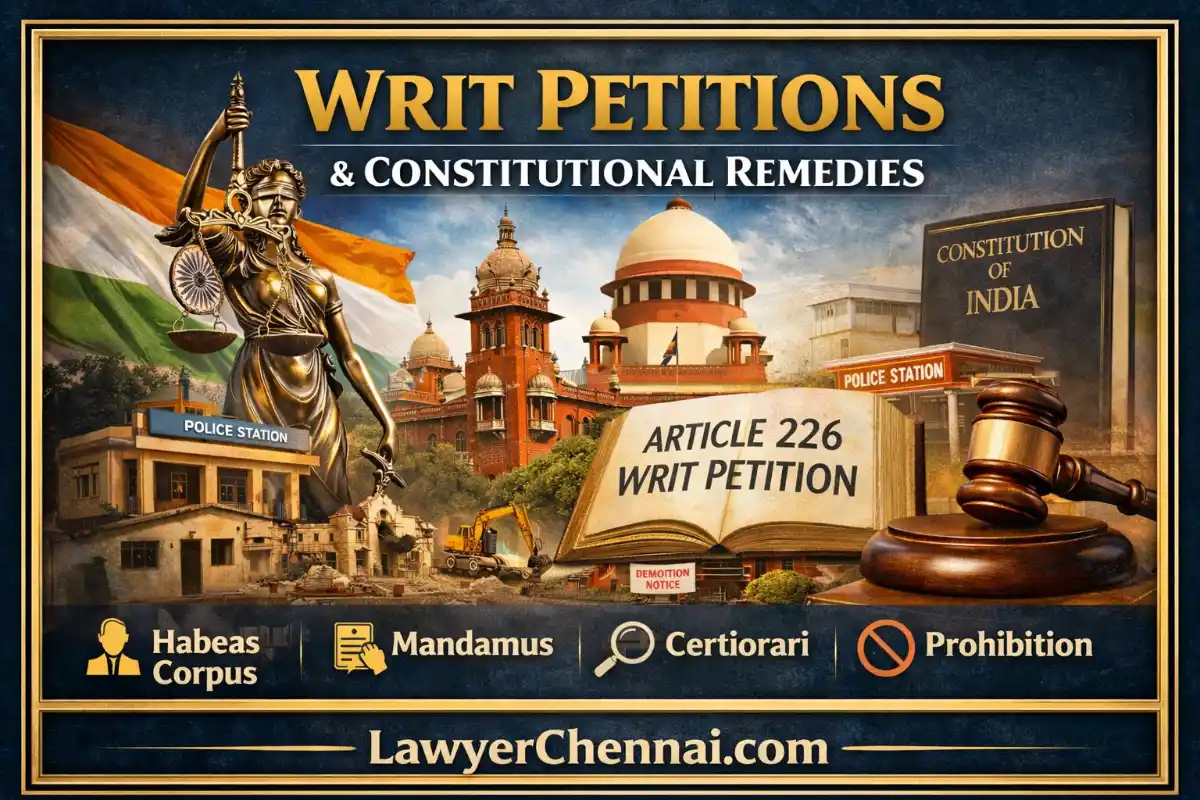
Constitutional remedies form the backbone of justice delivery in India. Citizens seeking relief against governmental actions often approach High Courts and the Supreme Court through writ petitions. These extraordinary remedies protect fundamental rights and ensure administrative accountability. The Indian Constitution empowers courts to issue writs under Articles 226 and 32. Writ petition lawyers in Chennai handle diverse cases involving police authorities, municipal bodies, and revenue departments. Understanding when and how to file these petitions becomes crucial for effective legal redressal. This comprehensive guide explores writ jurisdiction, types of writs, filing procedures, and practical remedies available. Whether facing police inaction or challenging government orders, constitutional lawyers provide strategic litigation support. The Madras High Court exercises extensive powers to grant relief through various writ remedies. Legal practitioners must navigate procedural complexities while ensuring client interests remain protected throughout the litigation process.
Understanding Constitutional Framework for Writ Petitions
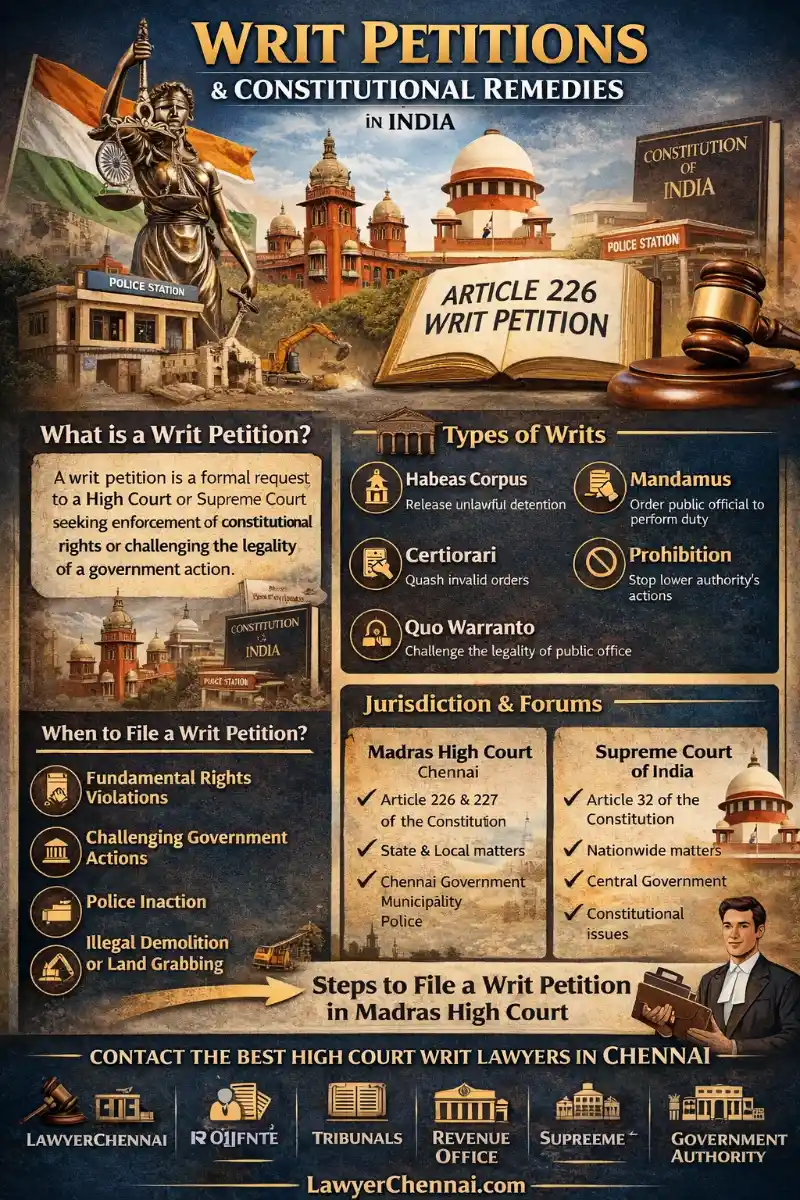
Article 226: High Court’s Writ Jurisdiction
Territorial and Subject Matter Jurisdiction
Article 226 empowers all High Courts in India to issue writs for enforcing fundamental rights and other legal rights. The Madras High Court possesses jurisdiction over the entire state of Tamil Nadu and Union Territory of Puducherry. Territorial jurisdiction extends to cases where cause of action arises within the state boundaries. Subject matter jurisdiction covers violations of fundamental rights, statutory duties, and administrative actions. High Court writ petition lawyers file petitions against state authorities, municipalities, police departments, and quasi-judicial bodies. The scope remains broader than Article 32, encompassing both fundamental and non-fundamental rights violations. Consequently, petitioners enjoy greater flexibility in approaching High Courts for relief. Constitutional lawyer Chennai practices frequently involve challenging government notifications, departmental orders, and administrative decisions. The High Court examines whether authorities acted within statutory powers or exceeded jurisdiction. Additionally, courts scrutinize procedural fairness and adherence to principles of natural justice.
Scope of Powers Under Article 226
High Courts exercise discretionary powers while entertaining writ petitions, balancing individual rights against public interest. The power extends to issuing directions, orders, or writs including habeas corpus, mandamus, certiorari, prohibition, and quo warranto. Courts may grant interim relief pending final adjudication when prima facie cases exist. Best High Court advocate Chennai professionals emphasize that Article 226 provides wider jurisdiction than Supreme Court under Article 32. Therefore, petitioners can seek relief for violations beyond fundamental rights alone. The discretionary nature allows courts to refuse writs despite technical maintainability when alternative remedies exist. However, courts exercise jurisdiction when alternative remedies prove ineffective, inadequate, or delayed. Madras High Court writ advocates regularly invoke Article 226 for challenging police inaction, illegal detentions, and administrative excesses. Furthermore, the power encompasses directing authorities to perform statutory duties and restraining ultra vires actions.
Article 32: Supreme Court’s Writ Powers
Fundamental Rights Enforcement Mechanism
Article 32 guarantees the right to move the Supreme Court for fundamental rights enforcement, itself constituting a fundamental right. This provision ensures direct access to the apex court without approaching High Courts first. The Supreme Court cannot refuse to exercise jurisdiction when fundamental rights violations occur. Unlike Article 226, this power remains confined strictly to fundamental rights protection under Part III of the Constitution. Article 226 lawyer India practitioners note that Supreme Court jurisdiction applies throughout India’s territory. Petitioners can directly approach the apex court regardless of where cause of action arose. The Supreme Court has described Article 32 as the Constitution’s heart and soul. Dr. B.R. Ambedkar emphasized its significance for safeguarding individual liberties against state action. Constitutional lawyer near me searches increase when citizens face nationwide fundamental rights violations. The Supreme Court’s expansive powers enable comprehensive relief across jurisdictions.
Comparative Analysis: Article 226 vs Article 32
Understanding jurisdictional differences between Articles 226 and 32 helps determine appropriate forum selection. The following table illustrates key distinctions:
| Aspect | Article 226 (High Court) | Article 32 (Supreme Court) |
|---|---|---|
| Scope of Rights | Fundamental and other legal rights | Only fundamental rights |
| Discretionary Power | Yes, court may refuse despite maintainability | No, must exercise jurisdiction |
| Territorial Jurisdiction | Limited to state boundaries | Entire country |
| Alternative Remedies | Court may refuse if alternatives exist | Generally entertains directly |
| Types of Writs | All five types plus directions | All five types |
| Filing Costs | Lower court fees | Higher court fees |
Writ petition lawyers in Chennai typically recommend approaching the Madras High Court first for state-level issues. Supreme Court jurisdiction becomes preferable when dealing with central government actions or multi-state matters. Strategic forum selection impacts litigation timelines and success rates significantly.
Five Types of Writs: Comprehensive Legal Framework
Habeas Corpus: Protection Against Illegal Detention
Legal Basis and Application
Habeas corpus literally means “to have the body” and commands authorities to produce detained persons before court. This writ protects personal liberty against unlawful detention by police, prison authorities, or private individuals. Constitutional lawyer Chennai files habeas corpus petitions when detention lacks legal sanction or exceeds statutory limits. The court examines detention legality and orders immediate release if confinement proves unlawful. Police not registering FIR complaints sometimes leads to illegal detentions requiring habeas corpus intervention. The writ applies equally to preventive detention, custody disputes, and missing person cases. Courts prioritize these petitions given the fundamental right to life and personal liberty under Article 21. Lawyer for writ petition against government authority services prove essential when state agencies exceed arrest powers. Additionally, habeas corpus protects against psychiatric institution confinements without proper legal procedures.
Who Can File Habeas Corpus Petitions
Any person can file habeas corpus petitions on behalf of detained individuals, including relatives, friends, or public-spirited citizens. Personal presence of the detained person before court becomes unnecessary during petition filing. Best High Court advocate Chennai professionals often receive urgent calls regarding illegal police custody or enforced disappearances. The petition must specify detention location, detaining authority, and grounds challenging detention legality. Courts entertain petitions even during non-working hours in emergencies involving life-threatening situations. Furthermore, habeas corpus extends to child custody disputes where one parent illegally retains children. The writ’s humanitarian character ensures swift judicial intervention protecting individual liberty. Madras High Court writ advocates maintain 24/7 availability for filing emergency habeas corpus petitions. Subsequently, courts issue notices requiring detention authorities to justify custody within specified timeframes.
Practical Scenarios Requiring Habeas Corpus
Real-life situations warranting habeas corpus include unlawful police custody beyond statutory periods allowed under Bharatiya Nagarik Suraksha Sanhita (BNSS). Police authorities sometimes detain suspects without following proper arrest procedures or informing family members. Writ petition for police inaction India searches spike when citizens face arbitrary detentions without FIR registration. Mental health institution admissions without lawful authority also justify habeas corpus intervention. Missing person cases where family suspects illegal confinement by state or non-state actors require this remedy. Additionally, immigration detention exceeding permissible limits falls within habeas corpus scope. The writ protects against private detention by individuals or organizations restricting personal movement. Constitutional lawyers leverage habeas corpus to challenge parental kidnapping and unlawful child retention. Consequently, this writ remains the most effective tool for immediate liberty protection.
Mandamus: Compelling Performance of Public Duties
Nature and Essentials of Mandamus
Mandamus means “we command” and directs authorities to perform statutory or public duties they refuse to discharge. This writ applies only when clear legal duty exists and petitioners possess corresponding legal rights. Government not approving application legal remedy often involves mandamus petitions compelling authorities to process pending applications. The duty must be mandatory rather than discretionary for mandamus to issue. Courts cannot issue mandamus for purely discretionary functions or policy decisions. How to file writ petition in Madras High Court queries frequently concern mandamus against municipal corporations, revenue departments, and police authorities. The writ becomes maintainable when authorities fail to act despite statutory obligations. Additionally, mandamus compels restoration to public offices when removals occur without legal authority. Constitutional lawyer Chennai practices extensively use mandamus for enforcing citizen entitlements.
Conditions for Mandamus Issuance
Several conditions must be satisfied before courts issue mandamus writs directing authorities to act. First, petitioners must establish clear legal rights corresponding to public duties authorities refuse to perform. Second, the duty must be public, mandatory, and enforceable through legal proceedings. Third, petitioners should have demanded performance and received refusal or inaction from responsible authorities. Fourth, no alternative adequate remedy should exist for obtaining relief. Fifth, petitioners must approach courts with clean hands without contributing to the default. Sixth, mandamus cannot issue against private individuals or bodies lacking public duty character. Writ petition lawyers in Chennai carefully evaluate these prerequisites before drafting mandamus petitions. Courts examine whether statutory provisions impose specific duties on authorities. Subsequently, courts balance individual rights against administrative discretion and public interest considerations.
Common Mandamus Applications
Mandamus petitions address diverse situations involving governmental inaction or refusal to perform statutory duties. Police not registering FIR what to do queries often lead to mandamus petitions compelling FIR registration under BNSS provisions. Municipal authorities refusing building plan approvals despite meeting statutory requirements face mandamus writs. Revenue departments delaying land document processing, mutation entries, or patta issuance encounter mandamus intervention. Educational institutions denying admission or certificate issuance contrary to rules receive mandamus directions. Pension authorities withholding retirement benefits without justification get compelled through mandamus orders. Lawyer for writ petition against government authority services prove crucial when departments ignore statutory timelines. Furthermore, mandamus enforces right to information when public authorities refuse RTI disclosures. Madras High Court regularly issues mandamus directing Chennai Corporation, police commissioners, and tahsildars to perform duties.
Certiorari: Quashing Illegal Orders
Supervisory Jurisdiction Through Certiorari
Certiorari means “to be certified” and quashes illegal, ultra vires, or jurisdictionally flawed orders passed by subordinate authorities. This writ exercises High Court’s supervisory jurisdiction over tribunals, administrative bodies, and quasi-judicial authorities. The remedy applies when inferior tribunals act without jurisdiction, exceed jurisdiction, or violate natural justice principles. Constitutional lawyer Chennai files certiorari petitions challenging municipal demolition notices, revenue assessment orders, and disciplinary proceedings. Courts examine whether impugned orders suffer from jurisdictional errors, procedural violations, or manifest illegality. Certiorari does not function as an appellate remedy for reassessing evidence or factual findings. Instead, courts scrutinize whether decision-making processes followed legal requirements and statutory procedures. Article 226 lawyer India practitioners emphasize certiorari’s importance for correcting administrative excesses. Additionally, certiorari quashes orders passed by authorities lacking competence or violating mandatory statutory provisions.
Grounds for Certiorari Relief
Courts issue certiorari writs on various grounds attacking the legality and validity of subordinate authority orders. Lack of jurisdiction occurs when authorities decide matters outside their statutory competence or territorial limits. Excess of jurisdiction happens when authorities overstep powers conferred by law while deciding within competence. Error of law apparent on the face of record enables certiorari when orders contain obvious legal mistakes. Violation of principles of natural justice, including audi alteram partem (right to be heard), justifies quashing. Bias or malafides demonstrated through evidence invalidates orders regardless of procedural compliance. Non-application of mind or mechanical order passing without considering materials warrants certiorari. Illegality or perversity making orders unsustainable in law provides adequate grounds. Best High Court advocate Chennai professionals identify these grounds while scrutinizing impugned orders. Consequently, certiorari maintains judicial supervision over expanding administrative state machinery.
Certiorari in Practice: Real Cases
Municipality demolition notice legal help often involves certiorari petitions challenging demolition orders issued without proper notices or hearings. Chennai Corporation demolition actions sometimes proceed without following Tamil Nadu Town and Country Planning Act procedures. Revenue authorities issuing assessment orders without considering objections face certiorari writs from aggrieved taxpayers. Disciplinary authorities dismissing government employees without inquiry or hearing get challenged through certiorari. Educational institutions denying degrees or expelling students without following university regulations encounter certiorari intervention. Tribunal orders suffering from non-consideration of crucial evidence or legal provisions get quashed. Illegal land grabbing legal remedy Chennai searches include certiorari against revenue officials who wrongly transfer land records. Writ petition lawyers in Chennai regularly file certiorari against wrongful property tax assessments and trade license cancellations. Additionally, certiorari protects citizens against arbitrary administrative actions lacking legal foundation.
Prohibition and Quo Warranto: Preventive Remedies
Prohibition: Preventing Jurisdictional Excess
Firstly, Prohibition prevents subordinate courts and tribunals from exceeding jurisdiction or acting contrary to law. This writ issues during pending proceedings, unlike certiorari which operates after order pronouncement. Courts grant prohibition when inferior tribunals attempt deciding matters beyond statutory authority or jurisdictional limits. The remedy protects parties from prolonged illegal proceedings and prevents wastage of judicial time and resources. Constitutional lawyer Chennai files prohibition petitions when tribunals ignore jurisdictional boundaries or proceed despite legal bars. Prohibition maintains proper hierarchy among judicial and quasi-judicial bodies by restraining jurisdictional transgressions. The writ does not interfere with discretionary powers exercised within jurisdiction. However, prohibition issues when authorities proceed fundamentally contrary to legal provisions. Madras High Court writ advocate services include prohibition against revenue tribunals exceeding monetary or territorial jurisdiction. Additionally, prohibition prevents bias, malafides, or natural justice violations during ongoing proceedings.
Quo Warranto: Challenging Unauthorized Appointments
Quo warranto literally means “by what authority” and challenges persons holding public offices without legal authority. This writ enquires into appointment legality and ousts usurpers from public positions they unlawfully occupy. The remedy applies only to substantive public offices of permanent character, not temporary or private employments. Courts examine whether appointees possess required qualifications and whether appointment procedures followed statutory prescriptions. Writ petition lawyers in Chennai file quo warranto against appointments violating reservation policies, age limits, or educational qualifications. The petitioner need not possess personal interest; any citizen can maintain quo warranto challenging illegal appointments. Public interest justifies entertaining these petitions since illegal office-holders undermine administrative integrity. Consequently, quo warranto ensures only legally qualified persons occupy public positions. Article 226 lawyer India expertise includes challenging political appointments made contrary to constitutional or statutory requirements.
Comparative Overview of All Writs
Understanding distinctions between five writ types helps in selecting appropriate remedies for specific legal violations:
| Writ Type | Purpose | Against Whom | When to Use |
|---|---|---|---|
| Habeas Corpus | Secure personal liberty | Any detaining authority | Illegal detention or custody |
| Mandamus | Compel performance of duty | Public authorities | Refusal to perform statutory duty |
| Certiorari | Quash illegal orders | Tribunals, quasi-judicial bodies | After order passed with defects |
| Prohibition | Prevent jurisdictional excess | Subordinate courts/tribunals | During pending proceedings |
| Quo Warranto | Challenge appointment validity | Public office holders | Illegal appointment or usurpation |
Best High Court advocate Chennai practitioners combine multiple writs when factual situations warrant comprehensive relief. Strategic writ selection significantly impacts litigation outcomes and client satisfaction.
Filing Writ Petitions: Procedure and Requirements
Pre-Filing Considerations and Documentation
Assessing Maintainability and Locus Standi
Before filing writ petitions, constitutional lawyers assess whether petitions satisfy maintainability criteria established through judicial precedents. Locus standi determines whether petitioners possess sufficient interest or legal right to maintain writ proceedings. Generally, persons whose legal rights suffer violations can file petitions seeking relief. However, public interest litigation relaxes locus standi allowing any citizen to approach courts for vindicating public interest. How to file writ petition in Madras High Court searches must understand that petitioners cannot maintain writs as busybodies without demonstrating genuine grievance. Alternative remedy availability sometimes defeats maintainability unless those remedies prove ineffective, illusory, or time-barred. Writ jurisdiction remains discretionary, permitting courts to refuse relief despite technical maintainability when equitable considerations dictate otherwise. Delay and laches principles apply, with courts rejecting stale claims lacking satisfactory explanation. Constitutional lawyer Chennai conducts thorough preliminary assessment before advising clients to proceed with writ litigation.
Essential Documents for Writ Petition
Comprehensive documentation strengthens writ petitions and enables courts to adjudicate matters effectively without repeated adjournments. Petitioners must submit attested copies of impugned orders, government notifications, or administrative communications being challenged. Supporting documents include correspondence with authorities, reply to show cause notices, and statutory provisions relied upon. Affidavits sworn by petitioners or knowledgeable persons verify factual averments made in petition papers. Vakalatnama (power of attorney) authorizes advocates to represent petitioners in court proceedings. Index of documents facilitates quick reference to annexed materials during hearings. Cost of filing writ petition in Chennai includes court fees calculated on petition valuation under Court Fees Act. Additional documents may include police complaints, FIRs, revenue records, or municipal orders depending on case specifics. Writ petition lawyers in Chennai prepare detailed compilation ensuring all material facts receive proper evidentiary support through authenticated documents.
Drafting Effective Writ Petitions
Skillful petition drafting determines litigation success by presenting facts, law, and prayers persuasively before constitutional courts. Petitions must clearly identify parties, including respondent authorities with official designations and departmental addresses. Brief synopsis precedes detailed statement of facts presented chronologically without argumentative assertions or legal conclusions. Grounds section articulates legal basis for relief, citing constitutional provisions, statutes, and judicial precedents supporting petitioner’s case. Prayer clause specifically requests relief sought, including interim and final prayers with sufficient particularity. Madras High Court writ advocates emphasize concise yet comprehensive drafting avoiding unnecessary verbosity or repetition. Facts must be stated accurately and completely without suppression of material information. Legal arguments distinguish binding precedents from persuasive authorities while demonstrating their applicability. Article 226 lawyer India experts incorporate relevant statutory provisions from Code of Civil Procedure, BNSS, and subject-specific legislation. Consequently, well-drafted petitions expedite hearings and improve prospects of favorable judicial consideration.
Court Procedures and Hearing Process
Filing and Initial Court Processing
After petition preparation, lawyers file writ petitions at Madras High Court registry along with requisite court fees and documents. Registry scrutinizes petitions for compliance with High Court Rules and returns defective petitions for rectification. Upon acceptance, registry assigns petition numbers and forwards cases to Chief Justice office for bench allocation. Urgent matters receive priority listing through mentioning before concerned judges seeking early hearing dates. Routine writ petitions get listed according to regular cause list maintained by registry. Constitutional lawyer near me searches help clients identify experienced advocates familiar with Madras High Court procedures and practices. First hearing typically involves admission stage where courts examine prima facie case and decide whether notices should issue to respondents. Judges may grant interim relief if petitioners demonstrate urgent necessity and irreparable injury pending final disposal. Best High Court advocate Chennai professionals guide clients through procedural requirements ensuring compliance with technical formalities.
Interim Relief and Stay Applications
Interim relief becomes crucial when immediate protection proves necessary pending final writ petition disposal. Courts consider three factors: prima facie case, balance of convenience, and irreparable injury when deciding interim applications. Stay applications suspend impugned orders or proposed actions until final adjudication of writ petitions. Municipality demolition notice legal help often requires urgent interim orders preventing demolition pending challenge disposal. Police authorities executing illegal arrests sometimes get restrained through interim directions protecting petitioners from imminent harm. Courts exercise discretion while granting interim relief, weighing petitioner interests against public interest and administrative exigencies. Undertakings regarding compensation or restoration may be required as conditions for granting interim protection. Writ petition for police inaction India cases sometimes involve interim mandamus directing FIR registration or investigation initiation. Consequently, interim relief provides temporary protection bridging the gap between petition filing and final judgment.
Final Hearing and Judgment
Final hearings involve detailed arguments on merits after respondents file counter-affidavits contesting petition averments. Petitioners may file rejoinder affidavits responding to new facts or defenses raised in counter-affidavits. Oral arguments allow lawyers to address legal issues, distinguish precedents, and highlight factual matrix supporting relief. Judges pose questions testing legal propositions and factual claims made by parties during hearings. Counter-arguments by government counsel defend administrative actions citing legal justifications and procedural compliance. Courts consider written submissions, case law compilations, and documentary evidence before reserving judgment. Judgments examine petition maintainability, merits of legal contentions, and appropriateness of relief sought. Disposal timeframes vary depending on case complexity, evidence volume, and court workload. Cost of filing writ petition in Chennai gets justified when courts grant substantial relief vindicating constitutional and legal rights. Madras High Court writ advocates secure favorable judgments through meticulous preparation and persuasive advocacy.
Practical Legal Remedies: Addressing Common Grievances
Police-Related Writ Remedies
Compelling FIR Registration
Police not registering FIR what to do remains a common query as citizens face reluctance from police authorities in cognizable offenses. Section 173 of Bharatiya Nagarik Suraksha Sanhita (BNSS) mandates FIR registration when information about cognizable offenses reaches police. Refusal to register FIRs violates statutory duties and constitutional rights to equal protection and access to justice. Writ petition for police inaction India provides effective remedy through mandamus compelling FIR registration and investigation initiation. Constitutional lawyer Chennai files writ petitions annexing written complaints, audio recordings, and witness statements proving police refusal. Courts direct police commissioners or superintendents to ensure FIR registration within specified timeframes, typically 24-48 hours. Subsequently, investigation proceeds under BNSS provisions with courts monitoring progress through periodic status reports. Lawyer for writ petition against government authority services include follow-up actions ensuring compliance with court directions. Additionally, compensation claims for police dereliction sometimes accompany mandamus petitions seeking FIR registration.
Challenging Illegal Arrests and Detention
Unlawful police custody exceeding statutory limits under BNSS or arrests without following prescribed procedures warrant habeas corpus petitions. Police must inform arrested persons about grounds of arrest and right to legal representation immediately upon custody. Failure to produce arrested persons before magistrates within stipulated timeframes renders continued detention illegal. Best High Court advocate Chennai professionals secure immediate release orders through habeas corpus when detention lacks legal sanction. Courts examine arrest memos, custody registers, and medical examination reports while adjudicating habeas corpus petitions. Torture or custodial violence allegations receive serious judicial attention with courts ordering medical examinations and investigation into police misconduct. Compensation awards for illegal detention and custodial torture vindicate victim rights beyond mere liberty restoration. Consequently, constitutional remedies provide comprehensive protection against police excesses violating fundamental rights under Articles 21 and 22.
Municipal and Revenue Authority Writs
Challenging Municipal Actions
Municipality demolition notice legal help addresses Chennai Corporation actions demolishing structures allegedly violating building bylaws without proper procedure. Tamil Nadu District Municipalities Act and Chennai City Municipal Corporation Act mandate show cause notices and personal hearings before demolition. Certiorari petitions quash demolition orders passed without following statutory procedures or considering owner objections. Interim stay applications prevent demolitions pending writ petition disposal, preserving status quo and preventing irreversible damage. Property owners must file detailed objections to demolition notices within prescribed timeframes before approaching courts. Illegal land grabbing legal remedy Chennai includes writs against municipal authorities who wrongly recognize encroachments or unauthorized constructions. Trade license cancellations, property tax assessments, and road-widening acquisitions also attract writ jurisdiction. Writ petition lawyers in Chennai secure relief through certiorari and mandamus against arbitrary municipal actions. Additionally, compensation claims arise when municipalities demolish properties without following legal procedures.
Revenue Department Writ Applications
Revenue authorities handle land records, patta issuance, mutation entries, and survey settlements under Tamil Nadu Land Revenue Act. Government not approving application legal remedy becomes necessary when revenue officials delay or refuse processing legitimate applications. Mandamus petitions compel tahsildars and district collectors to complete pending land document processing within reasonable timeframes. Patta transfer delays affecting property transactions get resolved through writ directions mandating action completion. Revenue assessment orders imposing excessive taxes without proper notice or hearing face certiorari challenges. Land survey discrepancies and boundary disputes sometimes require writ intervention directing proper resurvey and demarcation. Illegal land grabbing legal remedy Chennai encompasses writs against revenue officials who wrongly mutate records favoring encroachers. Article 226 lawyer India services include challenging land acquisition notifications violating statutory procedures or fair compensation principles. Consequently, revenue-related writs protect property rights against administrative arbitrariness.
Government Authorities and Administrative Bodies
Writs Against Central and State Governments
Government departments exercising statutory powers remain amenable to writ jurisdiction for actions violating legal provisions or constitutional rights. Policy decisions involving political considerations generally escape judicial review unless they manifest arbitrariness or violate fundamental rights. Administrative circulars, notifications, and executive orders affecting individual rights get challenged through certiorari and mandamus. Pension denials, promotion disputes, and service matters involving government employees frequently invoke writ remedies. Tender cancellations, contract terminations, and procurement policy violations attract writ jurisdiction protecting legitimate expectations and contractual rights. Constitutional lawyer Chennai handles writs against departments like Home, Finance, Health, Education, and Revenue. Lawyer for writ petition against government authority experience includes challenging discriminatory policies and unconstitutional legislation. Courts examine whether governmental actions pass reasonableness tests and constitutional validity benchmarks. Additionally, writs enforce statutory obligations that government departments refuse to honor despite clear legal mandates.
Tribunal and Quasi-Judicial Body Review
Tribunals and quasi-judicial authorities exercise specialized jurisdiction in taxation, labor, consumer protection, and administrative disputes. Their orders remain subject to High Court’s certiorari jurisdiction when suffering from jurisdictional errors or legal infirmities. Tamil Nadu Electricity Regulatory Commission, Central Administrative Tribunal, and Debts Recovery Tribunal orders face writ challenges regularly. Natural justice violations during tribunal proceedings justify certiorari relief quashing impugned orders and remanding matters. Excess of jurisdiction by tribunals deciding matters outside statutory competence invites prohibition or certiorari intervention. Best High Court advocate Chennai professionals distinguish between appellate review (generally unavailable through writs) and supervisory jurisdiction addressing legal errors. Factual findings by tribunals normally receive deference unless perverse, unreasonable, or unsupported by evidence. Madras High Court writ advocates secure relief when tribunals ignore binding precedents or misinterpret statutory provisions. Consequently, writ jurisdiction maintains judicial superintendence over expanding tribunal system.
Step-by-Step Guide: Filing Writ Petition in Madras High Court
How to file writ petition in Madras High Court involves systematic steps ensuring procedural compliance and effective presentation:
- Consultation: Engage constitutional lawyer Chennai to assess case merits, maintainability, and appropriate writ remedy selection.
- Documentation: Compile all supporting documents including impugned orders, correspondence, statutory provisions, and evidence.
- Petition Drafting: Prepare comprehensive writ petition with clear facts, legal grounds, and specific prayers for relief.
- Affidavit Preparation: Draft and execute verification affidavit before notary public or oath commissioner.
- Vakalatnama Execution: Sign power of attorney authorizing advocate to represent petitioner in court proceedings.
- Court Fee Payment: Calculate and pay requisite court fees through stamp papers or online payment modes.
- Registry Filing: Submit petition at Madras High Court registry for scrutiny and acceptance.
- Defect Rectification: Address any objections raised by registry regarding petition format or documentation.
- Petition Number Allocation: Receive unique petition number upon registry acceptance and proper filing.
- Mentioning for Urgent Listing: Mention before judge if urgent interim relief becomes necessary.
- Regular Listing: Await regular cause list posting for admission hearing before appropriate bench.
- Admission Hearing: Attend court for preliminary hearing where judges decide notice issuance and interim relief.
- Respondent Notice: Serve notices to respondent authorities through court process or advocate service.
- Counter-Affidavit Stage: Review government counter-affidavits and file rejoinder addressing new contentions.
- Final Hearing: Present detailed oral arguments supported by case law and statutory provisions.
- Judgment Compliance: Implement court directions and follow up ensuring authority compliance with orders.
Writ petition lawyers in Chennai navigate these steps efficiently, minimizing delays and maximizing success prospects through professional expertise.
Cost and Time Considerations
Financial Aspects of Writ Litigation
Cost of filing writ petition in Chennai includes multiple components affecting overall litigation expenses and budget planning. Court fees depend on petition valuation under Court Fees Act, typically ranging from nominal amounts to substantial sums in property matters. Advocate fees vary based on case complexity, seniority of counsel, and urgency of matter requiring immediate attention. Documentation expenses cover affidavit notarization, document attestation, and certified copy procurement from government offices. Service charges for notice delivery to respondents through court process or private courier add to overall costs. Miscellaneous expenses include travel, photocopying, binding, and correspondence with authorities or witnesses. Constitutional lawyer Chennai typically charges consultation fees separately from appearance fees for court hearings.
Senior advocates command premium fees justified by specialized expertise and higher success rates in constitutional matters. Cost-benefit analysis helps clients decide litigation viability comparing expected relief against anticipated expenses. Consequently, transparent fee structures and realistic cost estimates build client confidence.
Timeline Expectations for Writ Petitions
Writ petition timelines vary significantly depending on case urgency, complexity, and court workload affecting disposal schedules. Urgent matters involving personal liberty through habeas corpus receive immediate attention, often getting heard within days. Interim relief applications typically get posted within weeks, providing temporary protection pending final adjudication. Regular writ petitions may take several months from filing to final disposal considering counter-affidavit filing and hearing dates. Complex cases involving voluminous documents, multiple respondents, or constitutional questions extend beyond one year. Best High Court advocate Chennai professionals provide realistic timeline estimates helping clients plan accordingly. Registry processing consumes initial weeks for scrutiny, defect removal, and bench allocation.
Counter-affidavit stage adds months as government counsel requires time for obtaining instructions from responding departments. Final hearings span multiple dates when matters involve extensive arguments and legal issues. Appeals to Division Bench against single judge orders add further time to complete litigation closure. Therefore, patience and persistence become essential virtues for writ petition success.
Why Choose Specialized Writ Petition Lawyers
Expertise in Constitutional Law
Constitutional lawyer Chennai possesses specialized knowledge of fundamental rights jurisprudence, administrative law principles, and High Court procedures. Experience in writ litigation enables identifying optimal remedies from five writ types available under constitutional provisions. Understanding precedential value of Supreme Court and High Court judgments helps construct persuasive legal arguments. Familiarity with Madras High Court practices, bench compositions, and judicial preferences improves strategic litigation planning. Article 226 lawyer India expertise encompasses drafting skills, oral advocacy abilities, and negotiation capabilities for settlement possibilities. Specialized lawyers maintain updated knowledge about statutory amendments, new legislation, and evolving judicial interpretations. Professional networks with court staff, government counsel, and senior advocates facilitate smooth litigation conduct. Consequently, specialized constitutional lawyers deliver superior results compared to general practice advocates lacking writ litigation focus.
Track Record and Client Success
Established writ petition lawyers in Chennai demonstrate proven success through favorable judgments, interim relief grants, and efficient case management. Client testimonials and case results provide credibility indicators helping new clients make informed lawyer selection decisions. Successful habeas corpus petitions securing liberty, mandamus orders compelling governmental action, and certiorari writs quashing illegal orders showcase expertise. Best High Court advocate Chennai credentials include years of High Court practice, published articles, and speaking engagements at legal forums. Professional reputation built through ethical practice, timely communication, and dedicated client service ensures client satisfaction beyond mere litigation outcomes. Strong relationships with judiciary, built on competence and integrity, facilitate effective advocacy and favorable consideration. Transparent billing, realistic assessments, and honest advice distinguish quality lawyers from those making false promises. Therefore, track record evaluation becomes crucial when selecting constitutional lawyers for writ petitions.
Comprehensive Legal Support Beyond Filing
Madras High Court writ advocates provide end-to-end legal support from initial consultation through judgment execution and compliance monitoring. Pre-litigation advisory helps clients explore settlement options, alternative remedies, and cost-benefit analysis before committing to writ litigation. Petition drafting incorporates persuasive legal arguments, factual accuracy, and strategic prayer formulation maximizing success prospects. Court representation includes admission hearings, interim applications, final arguments, and reply to court queries during proceedings. Post-judgment assistance ensures proper implementation of court directions through follow-up with government departments and compliance verification. Appeal strategy gets developed when adverse judgments require challenging before Division Bench or Supreme Court. Related litigation support covers contempt proceedings when authorities willfully disobey court orders without justification. Lawyer for writ petition against government authority services extend to connected civil suits, criminal complaints, or tribunal proceedings arising from same factual matrix. Consequently, comprehensive legal support ensures complete client satisfaction and effective rights vindication.
Frequently Asked Questions
Common Questions About Writ Petitions
Read More
- Constitutional & Writ Jurisdiction
- How To File A Writ Of Mandamus? The Best Reliable High Court Lawyers
- Constitutional & Public Law
- Understanding the Jurisdiction for Filing Writ Petition in India: Expert Advice
- Constitutional Bench Appeals: Appealing before a Constitutional Bench
Contact Expert Writ Petition Lawyers
Constitutional remedies protect citizen rights against governmental excesses and administrative arbitrariness. Approaching experienced writ petition lawyers in Chennai ensures professional representation before Madras High Court. Expert constitutional lawyers analyze case merits, identify appropriate writs, draft persuasive petitions, and conduct effective advocacy throughout proceedings. Whether facing police inaction, municipal demolitions, revenue disputes, or fundamental rights violations, specialized legal assistance proves invaluable. LawyerChennai.com connects clients with experienced High Court advocates possessing proven track records in writ litigation. Timely legal intervention prevents irreversible harm and secures effective remedies vindicating constitutional and statutory rights. Contact constitutional lawyer Chennai today for comprehensive legal assessment and strategic litigation planning. Professional legal support transforms constitutional rights from mere paper guarantees into practical remedies delivering justice. Best High Court advocate Chennai services remain accessible through consultation scheduling for urgent and routine writ matters requiring immediate attention and expert handling.
For expert legal consultation on writ petitions and constitutional remedies:
Protect your constitutional rights through expert writ litigation. Schedule your consultation with Madras High Court writ advocates today.