
Constitutional remedies form the backbone of fundamental rights protection in India. Citizens facing rights violations can approach courts through writ petitions. The Constitution provides powerful mechanisms for enforcing fundamental rights under Articles 32 and 226. Moreover, these provisions ensure that governmental actions remain within legal boundaries. The Supreme Court and High Courts exercise writ jurisdiction extensively. Subsequently, this creates an effective check on executive and legislative actions. The jurisdiction extends to various matters affecting constitutional rights. Therefore, understanding writ procedures becomes essential for citizens and legal practitioners. Various types of writs serve different remedial purposes. Consequently, selecting the appropriate writ determines case success. Courts have evolved comprehensive jurisprudence around writ jurisdiction. Furthermore, recent amendments have streamlined procedural aspects significantly. The Bharatiya Nagarik Suraksha Sanhita, 2023 (BNSS) has modernized certain procedural elements. Additionally, technological integration has improved accessibility to constitutional remedies.
Understanding Constitutional & Writ Jurisdiction in India
Constitutional Framework of Writ Jurisdiction
Article 32 empowers the Supreme Court as the protector of fundamental rights. Citizens can directly approach the apex court when fundamental rights suffer violations. Meanwhile, Article 226 grants similar powers to High Courts across India. High Courts possess wider jurisdiction compared to the Supreme Court. They can issue writs for fundamental rights and also for other purposes. Nevertheless, this dual structure ensures accessible justice at multiple levels. The Constitution makers intentionally created this comprehensive protective framework. Indeed, Dr. B.R. Ambedkar termed Article 32 the soul of the Constitution. Courts cannot refuse to exercise writ jurisdiction under Article 32. However, High Courts enjoy discretionary powers under Article 226 in certain matters. The territorial jurisdiction of High Courts covers their respective states. Additionally, the Supreme Court exercises pan-India jurisdiction for constitutional matters. Writ petitions provide swift remedies compared to regular civil suits. Furthermore, they offer direct access to higher judiciary without lengthy proceedings.
Fundamental Rights Protection Mechanisms
Part III of the Constitution enumerates fundamental rights available to citizens. These rights include equality, freedom, exploitation prohibition, religion, culture, and constitutional remedies. Violations of these rights trigger writ jurisdiction immediately and effectively. The State cannot arbitrarily infringe upon these constitutionally guaranteed protections. Moreover, even private parties can face writ petitions in specific circumstances. Courts have expanded the scope through innovative judicial interpretation over decades. Consequently, right to life under Article 21 now encompasses numerous subsidiary rights. Environmental rights, privacy rights, and dignity rights emerged through judicial creativity. The Bharatiya Nyaya Sanhita, 2023 (BNS) recognizes these constitutional protections. Similarly, law enforcement agencies must respect fundamental rights during investigations. Police stations in Chennai including Mogappair, George Town, and Central operate accordingly. Therefore, citizens can challenge illegal detention or rights violations before courts. The remedy remains swift, effective, and constitutionally mandated for protection.
Article 32: Supreme Court Jurisdiction
The Supreme Court serves as the ultimate guardian of fundamental rights nationwide. Article 32 grants citizens the guaranteed right to move the apex court. This right itself constitutes a fundamental right that cannot be suspended ordinarily. However, during emergency proclamations, Article 32 remedies may face temporary restrictions. The Court exercises original jurisdiction when hearing writ petitions under this provision. Subsequently, parties need not exhaust alternative remedies before approaching the Court. Filing procedures require strict adherence to Supreme Court Rules, 2013. Petitioners must clearly establish fundamental rights violations with supporting evidence and documentation. The Court issues writs in the nature of habeas corpus, mandamus, prohibition, certiorari, and quo warranto. Additionally, it can pass any order necessary for enforcing fundamental rights. Jurisdiction extends throughout India regardless of where the violation occurred. Therefore, citizens from any state can file petitions in Delhi. Court fees remain minimal to ensure accessibility for all citizens seeking justice.
Article 226: High Court Powers
High Courts possess broader jurisdiction compared to Supreme Court writ powers. Article 226 permits writs for fundamental rights and also other legal rights. Consequently, they address violations of statutory rights, contractual rights, and other entitlements. The Madras High Court exercises jurisdiction over Tamil Nadu and Puducherry territories. Benches at Chennai and Madurai handle writ petitions from respective regions. Meanwhile, territorial jurisdiction determines which High Court can hear specific cases. Cause of action or respondent location establishes the appropriate forum for filing. High Courts retain discretionary power to refuse writs in certain situations. Nevertheless, they generally exercise jurisdiction when substantial legal questions arise. The procedure follows the Code of Civil Procedure (CPC) with modifications. Additionally, specific High Court Rules govern filing, pleading, and hearing procedures. Chennai bench handles cases from northern districts including Thiruvallur and Kanchipuram. Furthermore, urgent matters receive priority hearing through special mention procedures. Court fees vary based on petition nature and relief sought by petitioners.
Types of Writs Under Indian Constitution
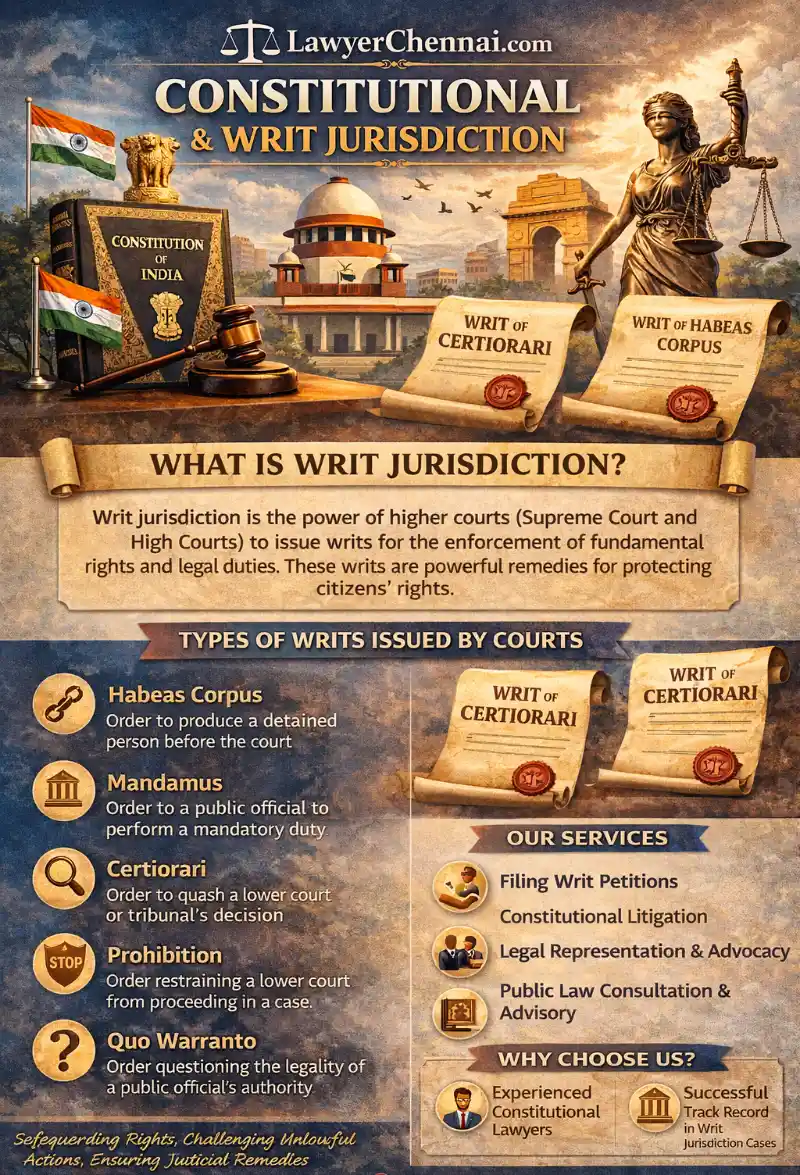
Five types of writs exist under Articles 32 and 226 of the Constitution. Each writ serves specific purposes and addresses particular legal violations effectively. Habeas corpus secures personal liberty against illegal detention by any authority. Mandamus compels public authorities to perform their statutory duties without delay. Prohibition prevents subordinate courts from exceeding their jurisdictional limits during proceedings. Certiorari quashes orders passed by tribunals or inferior courts beyond jurisdiction. Quo warranto challenges unauthorized occupation of public offices by unqualified persons. Subsequently, selecting the appropriate writ depends on violation nature and remedy sought. Courts may issue writs in the nature of these prerogative writs. Moreover, they possess powers to pass any other appropriate orders. The remedies remain flexible, adaptable, and responsive to justice requirements. Furthermore, courts have developed extensive principles governing writ issuance over decades. Recent judicial pronouncements continue refining and expanding writ jurisprudence progressively.
| Writ Type | Purpose | Primary Use |
|---|---|---|
| Habeas Corpus | Personal Liberty Protection | Illegal Detention |
| Mandamus | Performance of Duty | Official Inaction |
| Prohibition | Prevent Excess Jurisdiction | Ongoing Proceedings |
| Certiorari | Quash Illegal Orders | Past Orders |
| Quo Warranto | Challenge Office Holding | Unauthorized Appointments |
Habeas Corpus: Safeguarding Personal Liberty
Habeas corpus literally means “produce the body” before the court immediately. This writ protects citizens against illegal detention or wrongful confinement. Police stations must justify detention legality when habeas corpus petitions are filed. The Bharatiya Nagarik Suraksha Sanhita (BNSS) governs arrest and detention procedures. Mogappair Police Station, George Town Police Station follow these statutory provisions strictly. Courts examine whether detention complies with procedural and substantive law requirements. Subsequently, they order immediate release if detention lacks legal justification. The writ extends to government authorities, private parties, and even family members. Therefore, parents illegally confining adult children face habeas corpus proceedings. Courts prioritize these petitions due to liberty deprivation severity and urgency. Furthermore, they conduct hearings promptly, often on the same day of filing. Detaining authorities must produce the detained person physically before the court. Additionally, they must submit detailed reports explaining detention circumstances and legal basis. Non-compliance can result in contempt proceedings against responsible officers.
Legal Grounds for Habeas Corpus
Illegal arrest without following BNSS provisions constitutes valid grounds for habeas corpus. Detention exceeding statutory limits prescribed under various laws qualifies for relief. Moreover, denial of bail despite legal entitlement justifies approaching courts immediately. Unlawful confinement in mental health institutions without proper certification warrants intervention. Custody battles involving illegal child detention also fall within this jurisdiction. Subsequently, even preventive detention must comply with Article 22 and relevant statutes. The National Security Act requires strict procedural compliance before detention. Furthermore, detention orders must communicate grounds clearly and provide representation opportunities. Courts examine whether detaining authorities followed natural justice principles during proceedings. Additionally, they verify whether detention serves legitimate state interests proportionately. Arbitrary or mala fide detention receives immediate judicial correction through writ issuance. Therefore, liberty protection remains paramount in habeas corpus jurisprudence development. Chennai police stations face regular scrutiny through habeas corpus petitions filed by affected citizens.
Procedure for Filing Habeas Corpus Petition
- Gather detention details including date, time, place, and detaining authority information.
- Prepare petition clearly stating detention illegality with supporting legal provisions and facts.
- File petition with supporting affidavit before appropriate High Court or Supreme Court immediately.
- Seek urgent hearing through special mention before judges due to liberty deprivation involved.
- Court issues notice to detaining authority requiring production of detained person with records.
- Hearing conducted promptly with detained person’s physical production before the court bench.
- Court examines detention legality and orders release if illegal detention is established conclusively.
Mandamus: Compelling Performance of Duty
Mandamus directs public authorities to perform statutory or constitutional duties promptly. Government departments refusing to act despite legal obligations face mandamus petitions. The writ issues when officials exhibit arbitrary conduct or unjustified delay. However, it does not lie against private individuals or bodies ordinarily. Nevertheless, bodies performing public functions can receive mandamus in certain circumstances. Courts examine whether petitioners possess legal rights requiring enforcement through official action. Subsequently, they verify whether authorities owe corresponding duties toward petitioners. Alternative remedies do not bar mandamus when they prove inadequate or ineffective. The Central Government offices, State Government departments, and local bodies receive mandamus regularly. Tamil Nadu government departments in Chennai frequently face such petitions for inaction. Moreover, statutory authorities like pollution control boards, housing boards receive mandamus directions. Educational institutions, universities, and examination bodies also fall within mandamus jurisdiction. Therefore, this writ serves as a powerful tool for enforcing rights.
Conditions for Mandamus Issuance
Petitioners must establish clear legal rights requiring enforcement through state action. Public authorities must owe corresponding legal duties toward the petitioner specifically. The duty must be of public nature rather than purely private contractual obligations. Moreover, the duty should be peremptory and not discretionary in nature. Courts cannot issue mandamus to enforce discretionary functions of government authorities. Subsequently, petitioners must show they demanded performance before approaching courts. Refusal or failure by authorities must be clearly demonstrated with documentary evidence. Additionally, petitioners should not have alternative equally efficacious remedies available. Delay in filing can disentitle petitioners if it causes prejudice to respondents. Furthermore, petitioners must approach courts with clean hands and without any mala fides. Courts consider whether issuing mandamus serves public interest and justice requirements. Therefore, each case receives individual assessment based on specific facts and circumstances presented. Professional legal guidance helps establish all requisite conditions for successful mandamus relief.
Common Mandamus Applications
- Government employee appointment confirmations and service regularization matters requiring official action.
- Pension payment delays by government departments justify mandamus against concerned authorities immediately.
- License issuance, permit grants, and statutory approvals often need mandamus directions for processing.
- Educational institutions denying admission despite qualifications face mandamus for admission orders regularly.
- Pollution control boards refusing to act against violators receive mandamus for enforcement actions.
- Municipal corporations failing to provide basic amenities face mandamus petitions from affected citizens.
- Police stations refusing to register FIRs under BNSS receive mandamus directions from courts.
Prohibition and Certiorari: Controlling Subordinate Courts
Prohibition and certiorari control subordinate courts and tribunals exceeding jurisdictional limits. These writs maintain judicial hierarchy and prevent jurisdictional excesses by lower forums. Prohibition issues during pending proceedings to stop subordinate courts from continuing. Meanwhile, certiorari quashes orders already passed by tribunals or inferior courts. Both writs ensure that lower forums remain within their lawful jurisdictional boundaries. Subsequently, they protect parties from being subjected to unauthorized proceedings and orders. The distinction lies in timing – prohibition acts preventively while certiorari acts curatively. However, courts may issue certiorari even when proceedings remain pending in certain situations. Jurisdictional errors, legal errors apparent on face of record justify these writs. Moreover, violation of natural justice principles during proceedings warrants judicial intervention. Tribunals include consumer forums, labor courts, rent control tribunals, and administrative tribunals. Chennai has various tribunals including Central Administrative Tribunal, Income Tax Appellate Tribunal, and others. Therefore, these writs ensure all adjudicating bodies function within legal parameters.
Grounds for Prohibition and Certiorari
Jurisdictional excess constitutes the primary ground for issuing these supervisory writs. Subordinate courts acting without jurisdiction or beyond jurisdiction face judicial correction. Subsequently, assumption of jurisdiction on incorrect legal interpretation justifies writ intervention. Violation of natural justice principles including fair hearing denials warrant these writs. Bias, prejudice, or conflict of interest affecting adjudicators justifies certiorari or prohibition. Moreover, legal errors apparent on record without requiring elaborate examination qualify for correction. Orders passed in violation of statutory provisions or constitutional mandates face quashing. Procedural irregularities affecting case merits rather than mere technical defects justify intervention. Furthermore, tribunals deciding matters not assigned to them by statute receive prohibition. Courts examine whether impugned orders suffer from perversity, irrationality, or unreasonableness. Additionally, they verify compliance with mandatory statutory procedures during adjudication. Therefore, these writs maintain judicial discipline and legal correctness across forums.
Jurisdictional Errors and Legal Errors
Jurisdictional errors occur when courts or tribunals act outside their conferred powers. These errors go to the root of authority exercised by adjudicating forums. Subsequently, orders passed without jurisdiction are void ab initio and nullities. Courts cannot validate such orders through subsequent ratification or procedural corrections. Legal errors involve incorrect interpretation or application of law to facts. However, not all legal errors justify certiorari or prohibition intervention. Only errors apparent on face of record without elaborate evidence examination qualify. Moreover, the error must be substantial rather than merely technical or procedural. Courts distinguish between jurisdictional errors and errors within jurisdiction carefully. Furthermore, they respect concurrent findings of fact by specialized tribunals. Certiorari does not function as an appellate remedy for factual re-appreciation. Therefore, petitioners must establish jurisdictional error or natural justice violation clearly. The Madras High Court regularly exercises supervisory jurisdiction over tribunals in Chennai.
Quo Warranto: Challenging Public Office Holders
Quo warranto literally means “by what authority” someone holds public office. This writ prevents unauthorized persons from occupying public offices and drawing emoluments. Courts examine whether office holders possess requisite qualifications prescribed by law. Appointments made in violation of constitutional provisions, statutes, or rules face challenge. Subsequently, any citizen can file quo warranto petitions even without personal interest. The remedy protects public interest rather than individual rights of petitioners. Office must be public in nature, substantive rather than merely ministerial. Moreover, it should be created through statute or constitution rather than contract. Appointments to government positions, statutory bodies, public sector undertakings attract quo warranto. Educational institutions receiving government aid also fall within this writ’s scope. Furthermore, elected representatives facing disqualification questions may receive quo warranto proceedings. Courts can declare office occupation illegal and direct vacation if qualifications lack. Therefore, this writ ensures only qualified persons hold public offices and positions.
Eligibility and Disqualification Challenges
Government appointments require compliance with eligibility criteria prescribed under service rules. Age limits, educational qualifications, and experience requirements must be satisfied completely. Subsequently, reservation policies under Constitution must receive proper implementation during selections. Disqualifications arising from criminal convictions under BNS affect public office eligibility. Moreover, financial irregularities, moral turpitude convictions disqualify candidates from government positions. Courts examine whether selection procedures followed constitutional and statutory mandates strictly. Nepotism, favoritism, or violation of merit principles justify quo warranto intervention. Furthermore, continuing in office beyond tenure limits prescribed by law attracts challenge. Concurrent holding of incompatible offices can also face quo warranto proceedings. Additionally, citizenship requirements for certain positions must be clearly established. Courts balance public interest with individual rights while deciding quo warranto petitions. Therefore, office holders must demonstrate clear legal authority for holding positions.
Writ Petition Filing Procedure and Requirements
Filing writ petitions requires strict adherence to procedural rules and technical requirements. Madras High Court Rules govern writ petition procedures in Tamil Nadu jurisdiction. Subsequently, petitioners must prepare comprehensive petitions with proper averments and documentation. Title should clearly identify parties, nature of writ sought, and legal provisions invoked. Introduction paragraph must establish court jurisdiction, cause of action, and legal rights. Subsequently, detailed factual narration should chronologically present relevant events and circumstances. Legal grounds section must cite applicable constitutional provisions, statutes, and judicial precedents. Relief clause should precisely state the remedies sought from the court. Moreover, affidavits supporting petition averments must accompany the main petition. Documents proving factual assertions must be annexed as exhibits properly. Valuation for court fee purposes must be determined according to Court Fees Act. Therefore, professional legal assistance ensures technical compliance and avoids procedural rejections. LawyerChennai.com provides comprehensive writ petition drafting and filing services.
Essential Documents and Pleadings
Main writ petition must contain all material facts supporting the legal challenge. Supporting affidavit sworn by petitioner verifies petition contents as true and accurate. Subsequently, impugned orders or communications being challenged must be annexed as exhibits. Correspondence with respondents demonstrating exhaustion of alternative remedies requires inclusion. Legal notices sent to authorities before filing must be attached with proof. Moreover, statutory rules, notifications, or guidelines relevant to the case need annexation. Index listing all documents serially with brief descriptions aids court navigation. Vakalatnama executed by petitioner authorizing advocate representation must be filed. Furthermore, court fee stamps of appropriate value must be affixed on petition. Certified copies rather than photocopies of official documents maintain evidentiary value. Address for service must be provided for receiving future court notices. Therefore, complete documentation prevents adjournment requests and expedites case hearing. Professional assistance ensures no document deficiency causes technical dismissals.
Court Fees and Financial Aspects
Court fees depend on petition nature and relief sought from courts. Article 32 petitions before Supreme Court require nominal fixed court fees. However, Article 226 petitions before High Courts attract variable fees under Court Fees Act. Subsequently, ad valorem fees apply when reliefs involve monetary claims or property. Fixed fees apply for employment matters, mandamus petitions, and non-monetary reliefs. Service matters involving government employees generally attract fixed court fees. Moreover, senior citizen petitioners receive fee exemptions under specific provisions. Indigent persons can file petitions in forma pauperis without paying fees. Legal aid services from State Legal Services Authority assist economically weaker sections. Furthermore, advocate fees vary based on case complexity and experience levels. Senior counsels charge substantial fees compared to junior advocates for appearances. Chennai-based LawyerChennai.com offers competitive fee structures for writ petitions. Therefore, budget planning becomes essential before initiating constitutional litigation proceedings.
Interim Relief and Stay Applications
Writ petitions often require interim relief preventing irreversible damage during pendency. Stay applications suspend impugned orders or actions until final petition disposal. Courts examine prima facie case, balance of convenience, and irreparable injury while granting stays. Subsequently, petitioners must demonstrate that refusing interim relief causes serious prejudice. Respondents receive notice and opportunity to oppose interim applications through counter-affidavits. Urgent matters receive immediate hearing through special mention before designated judges. Moreover, courts may grant conditional stays requiring petitioners to fulfill certain obligations. Ex-parte interim orders pass in exceptional urgency situations without respondent hearing. Furthermore, courts review ex-parte orders after respondents appear and contest. Status quo directions maintain existing position without favoring either party during proceedings. Injunctions restraining specific actions protect petitioners from ongoing violations during case pendency. Therefore, effective interim relief strategies often determine practical case outcomes significantly. Professional litigation management ensures appropriate interim applications at proper stages.
Locus Standi and Public Interest Litigation
Traditional locus standi required direct personal injury for maintaining writ petitions. Subsequently, courts liberalized standing requirements for enforcing constitutional and legal rights. Public Interest Litigation (PIL) allows any citizen to challenge violations affecting public interest. Therefore, individuals can approach courts on behalf of disadvantaged or marginalized sections. Environmental protection, consumer rights, and human rights violations justify PIL intervention. Moreover, courts can treat letters or postcards as writ petitions in appropriate cases. Nevertheless, courts remain vigilant against frivolous PILs filed for publicity or oblique motives. Busybodies, meddlesome interlopers, and publicity seekers face dismissal with exemplary costs. Genuine public interest must motivate petitioners rather than personal vendetta or rivalry. Furthermore, courts may appoint commissioners or committees for investigating PIL allegations. NGOs, social activists, and lawyers regularly file PILs for systemic reforms. Chennai-based organizations frequently approach Madras High Court through PIL mechanism. Therefore, expanded standing democratizes justice access for socially disadvantaged communities.
Alternative Remedies and Exhaustion Doctrine
Alternative remedy availability generally bars writ petition entertainment by courts. Petitioners must ordinarily exhaust statutory appeals and revision mechanisms before approaching courts. Subsequently, departmental remedies, appellate forums, and administrative remedies require exhaustion. However, this rule operates as discretionary principle rather than absolute bar. Courts exercise writ jurisdiction despite alternatives when they prove inadequate or ineffective. Moreover, fundamental rights violations justify bypassing alternative remedies completely. Natural justice denial, jurisdictional errors, or legal invalidity warrant direct writ intervention. Undue delay in alternative forums renders them ineffective and justifies writ petitions. Furthermore, multiplicity of litigation gets avoided when writ petitions provide complete relief. Complex factual disputes generally require alternative forums rather than writ jurisdiction. Nevertheless, courts balance justice requirements against alternative remedy doctrine strictly. Tribunals like Consumer Disputes Redressal Commission, Labour Court provide alternative forums. Therefore, strategic litigation planning considers alternative remedy implications before filing.
When Alternative Remedies Can Be Bypassed
Fundamental rights violations under Part III permit direct High Court or Supreme Court approach. Jurisdictional excess by tribunals justifies bypassing appellate remedies provided under statutes. Subsequently, legal questions involving constitutional interpretation warrant direct constitutional court intervention. Alternative remedies proving illusory, inadequate, or ineffective lose their bar effect. Statutory appeals involving undue delay or uncertainty justify direct writ jurisdiction invocation. Moreover, when impugned actions suffer from complete legal invalidity, alternatives become unnecessary. Multiple proceedings before different forums can be consolidated through single writ petition. Administrative remedies lacking independence or fairness do not bar writ jurisdiction. Furthermore, violation of natural justice principles renders alternative remedies ineffective automatically. Public interest considerations sometimes justify bypassing individual alternative remedies completely. Courts retain discretion to entertain writs despite alternatives when justice requires. Therefore, petitioners must establish why alternative remedies should not bar their petitions. Professional legal assessment determines optimal forum selection for specific cases.
Statutory Appeals and Revision Mechanisms
Various statutes provide appellate and revision forums for challenging administrative orders. Income Tax Act provides Commissioner (Appeals) and Income Tax Appellate Tribunal hierarchy. Subsequently, service matters have departmental appeals, administrative tribunals, and High Court jurisdiction. Consumer Protection Act establishes District, State, and National Consumer Disputes Redressal Commissions. Motor Vehicles Act provides transport tribunals and appellate authorities for license matters. Moreover, revenue laws provide revision mechanisms before higher revenue authorities systematically. Educational institution disputes have university appellate bodies and regulatory council remedies. Industrial disputes have conciliation, Labour Court, and Industrial Tribunal mechanisms statutorily. Furthermore, municipal act violations have appeal provisions before higher municipal authorities. Land acquisition matters have arbitration, reference courts, and High Court appeals. Professional misconduct cases have disciplinary committees, appellate tribunals before court intervention. Therefore, statute-specific remedies must receive consideration before approaching constitutional courts. Legal practitioners guide clients through appropriate remedial hierarchies for optimal results.
Territorial and Subject Matter Jurisdiction
Territorial jurisdiction determines which High Court can entertain specific writ petitions. Cause of action location or respondent location establishes appropriate High Court jurisdiction. Subsequently, Madras High Court exercises jurisdiction over Tamil Nadu and Puducherry territories. Chennai bench handles cases from northern Tamil Nadu districts including Thiruvallur, Kanchipuram, Vellore. Madurai bench covers southern districts and exercises concurrent jurisdiction over state-wide matters. Moreover, when cause of action arises within multiple High Court jurisdictions, choice exists. Petitioners can approach any High Court where part of cause of action arises. Central government actions can be challenged before High Court having territorial connection. Furthermore, online causes of action may permit filing before petitioner residence High Court. Supreme Court jurisdiction remains pan-India without any territorial restrictions whatsoever. Subject matter jurisdiction depends on whether issues involve fundamental rights violations. Therefore, proper jurisdiction selection prevents transfer applications and jurisdictional challenges. Professional advice ensures filing before correct forum avoiding procedural complications.
Madras High Court Jurisdiction Areas
Madras High Court has principal seat at Chennai and permanent bench at Madurai. Chennai bench jurisdiction covers districts including Chennai, Thiruvallur, Kanchipuram, Chengalpattu, Ranipet, Tiruvannamalai, Vellore. Subsequently, Villupuram, Cuddalore, Kallakurichi, Ariyalur also fall under Chennai bench territorial limits. Madurai bench covers southern districts including Madurai, Theni, Dindigul, Virudhunagar, Ramanathapuram, Sivaganga. Moreover, Thoothukudi, Tirunelveli, Tenkasi, Kanyakumari districts also approach Madurai bench. Puducherry Union Territory falls within Madras High Court jurisdiction for all purposes. State-wide matters can be filed before either bench based on convenience. Furthermore, transfer petitions allow movement between benches when justified by circumstances. Cause of action arising within specific district determines initial filing bench. Respondent government department location also influences jurisdictional determination in certain matters. Therefore, Chennai residents typically approach Chennai bench for local government action challenges. LawyerChennai.com practices before both Chennai and Madurai benches regularly.
Important Courts and Tribunals in Chennai
Madras High Court principal seat at Chennai handles thousands of writ petitions annually. Central Administrative Tribunal (CAT) Chennai bench handles central government employee service matters. Subsequently, Customs Excise and Service Tax Appellate Tribunal (CESTAT) operates in Chennai. Income Tax Appellate Tribunal has multiple benches handling direct tax appeals. National Company Law Tribunal (NCLT) Chennai bench handles corporate insolvency and company matters. Moreover, Debts Recovery Tribunal assists banks in recovering non-performing assets systematically. Tamil Nadu State Consumer Disputes Redressal Commission provides consumer grievance redressal. Intellectual Property Appellate Board heard patent, trademark, and copyright appeals previously. Furthermore, Armed Forces Tribunal Chennai bench handles defense personnel service matters. National Green Tribunal Southern Zone bench at Chennai addresses environmental law violations. Railway Claims Tribunal handles compensation claims for railway accidents and losses. Therefore, multiple specialized forums operate within Chennai providing sector-specific adjudication. Proper forum selection ensures effective remedies based on subject matter expertise.
Relevant Government Departments and Authorities
Tamil Nadu government departments frequently face writ petitions for administrative actions. Revenue Department handles land records, survey settlements, and property-related government functions. Subsequently, Home Department oversees police administration, law and order maintenance across state. Transport Department manages vehicle registration, licenses, and permits under Motor Vehicles Act. Education Department controls government schools, colleges, and implements educational policies state-wide. Moreover, Health Department manages public health facilities, medical education, and disease control. Public Works Department maintains roads, buildings, and government infrastructure facilities systematically. Forest Department enforces wildlife protection, forest conservation under relevant environmental laws. Furthermore, Municipal Administration Department oversees urban local bodies, town planning functions. Rural Development Department implements rural welfare schemes, panchayati raj institutions. Labour Department enforces labor laws, handles industrial relations, and workers’ welfare. Therefore, writ petitions identify specific departments as respondents based on challenged actions. Proper party identification ensures effective relief implementation after favorable orders.
Police Stations and Law Enforcement Agencies
Chennai city has numerous police stations handling law enforcement under BNSS provisions. Mogappair Police Station serves western Chennai areas including Mogappair, Ambattur, Padi localities. Subsequently, George Town Police Station covers northern Chennai commercial areas near Chennai Port. Central Police Station handles central Chennai areas including major commercial establishments. Law enforcement actions including arrests, detention, investigation face constitutional scrutiny through writs. Moreover, illegal arrests, custodial torture, fake encounters justify immediate habeas corpus relief. Police stations must follow BNSS procedures strictly during arrest, investigation, and detention. Rights of accused persons under Article 22 require strict compliance during custody. Furthermore, magisterial permission for custody extension beyond initial limits remains mandatory. Police must inform family members about arrests and detention location immediately. Legal representation access during interrogation constitutes fundamental right under Article 21. Therefore, violations of procedural safeguards justify writ petitions seeking appropriate remedies. Professional legal assistance ensures constitutional rights protection during criminal proceedings.
Procedure and Timeline for Writ Petitions
Writ petition procedure commences with petition drafting incorporating all necessary legal elements. Subsequently, petitioners must ensure factual accuracy and complete disclosure of material facts. Suppression of facts or misrepresentation can lead to dismissal with costs. Filing requires submitting petition with prescribed documents, affidavits, and court fee stamps. Registry scrutinizes petitions for technical compliance before assigning case numbers and listing. Moreover, admitted petitions receive notice to respondents for filing counter-affidavits. Notice period typically ranges from two to four weeks for response submission. Counter-affidavits present respondent version and contest petition grounds with supporting documents. Furthermore, petitioners can file rejoinder affidavits responding to new facts in counter. Final hearing involves oral arguments by advocates for both parties before judges. Courts may require additional documents, clarifications, or legal submissions during hearings. Therefore, complete procedure duration varies from few months to several years. Urgent matters receive expedited hearing through specific mention procedures before judges.
Petition Filing and Initial Processing
Petition drafting requires comprehensive legal research and precedent analysis for strong grounds. Subsequently, collection of all supporting documents and evidence strengthens petition factual foundation. Affidavit swearing before notary or oath commissioner verifies petition contents authentically. Court fee stamp purchase and affixation on petition as per valuation rules. Moreover, vakalatnama execution authorizes specific advocate for representing petitioner in proceedings. Petition submission at High Court registry with all enclosures and index. Registry officials conduct preliminary scrutiny checking technical compliance and document completeness. Furthermore, any defects identified by registry require rectification within specified timeframes. Case number allotment happens after successful registry clearance and numbering. Petition listing for preliminary hearing before bench for admission consideration. Courts examine whether petition discloses prima facie case for detailed hearing. Therefore, technical perfection during filing prevents avoidable delays and rejection risks. Professional legal assistance ensures smooth filing process and registry acceptance.
Notice and Response Timelines
Courts issue notice to respondents after admitting writ petitions for hearing. Notice period typically allows four to six weeks for filing counter-affidavits. Subsequently, respondents must file written statements addressing petition allegations with supporting documents. Service of notice on government departments occurs through government pleader panel. Private respondents receive notice through court process servers or registered post. Moreover, publication in newspapers serves notice when respondents remain untraced or avoid service. Counter-affidavit filing deadline can be extended on valid applications showing sufficient cause. Courts consider extension requests based on case complexity and document volume requirements. Furthermore, default in counter filing permits ex-parte proceedings but courts generally grant opportunities. Rejoinder affidavit filing by petitioners responds to counter-affidavit contents within specified periods. Written submission filing by both parties helps courts understand complex legal arguments. Therefore, procedural timeline compliance ensures systematic case progression toward final disposal. Monitoring case status through online court portals helps track procedural developments.
Average Case Duration and Disposal Time
Simple writ petitions without complex factual disputes typically conclude within six months. Contested matters involving detailed evidence examination may extend to one or two years. Subsequently, cases requiring extensive document verification or commissioner appointments take longer duration. Interim applications, stay petitions add additional hearing dates extending overall case timeline. Adjournments requested by either party delay proceedings and extend final disposal timelines. Moreover, court vacation periods during summer and winter affect hearing schedules significantly. High Courts conduct vacation benches for urgent matters during official court holidays. Priority matters like habeas corpus receive immediate hearing often within days. Furthermore, PIL matters involving systemic reforms may continue for years with multiple hearings. Final judgment pronouncement after completion of arguments may take several weeks. Courts reserve judgment after hearing for detailed consideration and order drafting. Therefore, realistic timeline expectations help parties plan accordingly and avoid disappointment. Expeditious disposal depends on case nature, parties’ cooperation, and court workload.
| Stage | Typical Duration | Urgency Factor |
|---|---|---|
| Filing & Admission | 1-2 weeks | Immediate for habeas corpus |
| Notice to Respondents | 4-6 weeks | Expedited for urgent matters |
| Counter-Affidavit Filing | 4-8 weeks | Extensions granted liberally |
| Rejoinder Filing | 2-3 weeks | Standard timeline |
| Final Arguments | 2-6 months | Multiple hearings possible |
| Judgment Reserved | 2-8 weeks | Complex cases take longer |
| Total Duration | 6-24 months | Varies by case complexity |
Expediting Writ Petition Disposal
Mentioning petitions before judges for early hearing accelerates case movement through list. Subsequently, demonstrating urgency based on rights violation severity persuades courts for priority hearing. Filing concise petitions with clear legal issues facilitates faster judicial comprehension and decision. Avoiding unnecessary adjournments and maintaining readiness for hearing expedites disposal significantly. Moreover, cooperating in document production and evidence presentation reduces time-consuming proceedings. Settling undisputed facts through consent affidavits narrows hearing scope to legal issues. Alternative dispute resolution including mediation can resolve certain writ petitions amicably. Furthermore, withdrawing petitions becoming infructuous or resolving disputes out of court saves time. Compliance with procedural directions and timelines maintains case momentum toward conclusion. Professional case management by experienced counsel ensures procedural efficiency throughout litigation. Therefore, proactive litigation strategy combined with court cooperation achieves faster disposals. LawyerChennai.com employs effective case management ensuring timely petition disposal.
Remedies and Relief Available Through Writs
Writ jurisdiction provides comprehensive remedies for constitutional and legal rights violations. Courts can quash illegal orders, directions, notifications, and administrative actions completely. Subsequently, they can issue mandamus compelling authorities to perform statutory duties properly. Prohibitions prevent subordinate courts from proceeding beyond jurisdictional limits systematically. Certiorari brings up records for judicial review and quashes erroneous orders. Moreover, habeas corpus secures immediate release from illegal detention or confinement. Declaratory reliefs establish legal rights, status, or entitlements without specific performance. Damages and compensation for rights violations accompany writ reliefs in appropriate cases. Furthermore, courts can issue directions for policy formulation addressing systemic deficiencies. Contempt proceedings ensure compliance with writ court orders by recalcitrant authorities. Monitoring mechanisms through periodic compliance reports ensure effective implementation of orders. Therefore, writ jurisdiction offers flexible, effective, and comprehensive remedial mechanisms. Professional legal guidance helps identify appropriate remedies matching specific violation circumstances.
Specific Reliefs for Different Violations
Employment disputes receive reliefs including reinstatement, back wages, and seniority protection. Subsequently, wrongful termination orders face quashing with directions for restoration to service. Promotion denials get corrected through mandamus for implementing promotion orders with arrears. Pension disputes receive directions for calculating and releasing pension amounts with interest. Moreover, license suspensions or cancellations get set aside when procedural violations exist. Admission denials in educational institutions result in mandamus for admission with fee refund. Environmental violations receive directions for pollution control measures and penalty imposition. Furthermore, police excesses including illegal detention receive damages along with disciplinary action directions. Property acquisition challenges result in enhanced compensation or acquisition cancellation as appropriate. Tax assessment orders get quashed when they violate natural justice or statutory provisions. Therefore, tailored relief formulation matching specific violation contexts ensures effective rights vindication. Experienced advocates craft relief clauses maximizing benefits for clients within legal parameters.
Compensation and Damages in Writ Petitions
Constitutional courts award compensation for fundamental rights violations through writ petitions. Article 21 violations including custodial torture, fake encounters justify substantial compensation awards. Subsequently, illegal detention beyond permissible limits attracts damages proportional to liberty deprivation duration. Medical negligence in government hospitals warrants compensation under state liability principles. Environmental damage caused by government inaction receives remedial costs from responsible authorities. Moreover, delay in government dues payment results in interest and compensation awards. Wrongful prosecution causing reputation damage justifies exemplary compensation against the state. Gender discrimination, caste discrimination in public employment receive compensation with punitive elements. Furthermore, malicious prosecution by police departments results in damages for harassment and trauma. Land acquisition without proper compensation payment attracts enhanced amounts with interest components. Courts determine compensation quantum considering violation severity, victim circumstances, and deterrent requirements. Therefore, monetary relief complements other writs ensuring comprehensive justice to aggrieved persons. Professional representation helps secure appropriate compensation reflecting actual losses suffered.
Implementation and Compliance Monitoring
Court orders require strict compliance by respondent authorities within specified timelines. Subsequently, authorities must file compliance affidavits detailing implementation steps taken post-judgment. Non-compliance attracts contempt proceedings against responsible officers personally and departmentally. Courts can impose fines, imprisonment, or departmental action for willful disobedience. Moreover, monitoring committees appointed by courts oversee complex order implementation regularly. Periodic status reports from authorities help courts track compliance progress systematically. PIL matters often require continued monitoring until complete systemic reform achievement. Furthermore, courts retain continuing mandamus jurisdiction even after passing final orders. Petitioners can approach courts through applications reporting non-compliance or partial compliance. Show-cause notices issued to defaulting authorities require explanation for non-implementation. Therefore, writ courts possess effective enforcement mechanisms ensuring order compliance despite administrative resistance. Professional follow-up by legal counsel ensures authorities implement favorable orders completely.
Contempt Proceedings for Non-Compliance
Contempt of Courts Act, 1971 governs contempt proceedings for disobeying court orders. Civil contempt involves willful disobedience of court orders, judgments, or undertakings. Subsequently, criminal contempt covers actions scandalizing court or interfering with judicial proceedings. Punishment includes imprisonment up to six months, fine up to Rs. 2,000, or both. Personal liability attaches to officers responsible for order implementation and compliance. Moreover, departmental inquiry and disciplinary action may follow contempt findings against officials. Purging contempt through unconditional apology and compliance sometimes averts punishment imposition. Courts exercise contempt jurisdiction cautiously but firmly when authority deliberately defies orders. Furthermore, repeated non-compliance justifies stringent punishment deterring future disobedience by authorities. Corporate entities, government departments face contempt proceedings for systematic order violation. Therefore, compliance consciousness among authorities stems partly from contempt jurisdiction existence. Professional legal services include contempt application filing when authorities ignore court orders.
Recent Developments in Writ Jurisdiction
Digital transformation has revolutionized writ petition filing and processing procedures significantly. E-filing facilities enable petitioners to submit documents online without physical court visits. Subsequently, virtual hearings became common during pandemic and continue for certain matters. Case status tracking through online portals provides real-time information to parties. Moreover, digitization of court records enables quick retrieval and reference during hearings. Artificial intelligence tools assist in legal research and precedent identification for petitions. Bharatiya Nagarik Suraksha Sanhita, 2023 modernized criminal procedure affecting habeas corpus procedures. Furthermore, Bharatiya Nyaya Sanhita, 2023 replaced IPC changing substantive criminal law references. Environmental jurisprudence expansion through PIL has created extensive green law protection. Privacy rights recognition post-Puttaswamy judgment affects data protection writ petitions significantly. Therefore, evolving legal landscape requires continuous knowledge updating for effective writ practice. Professional legal services incorporate latest developments ensuring contemporary legal argumentation quality.
Impact of New Criminal Laws
Bharatiya Nyaya Sanhita (BNS) 2023 replaced Indian Penal Code affecting criminal jurisprudence. Subsequently, Bharatiya Nagarik Suraksha Sanhita (BNSS) 2023 replaced CrPC modernizing criminal procedures. Bharatiya Sakshya Adhiniyam (BSA) 2023 replaced Evidence Act changing evidentiary rules substantially. New provisions affect habeas corpus petitions challenging arrests and detention under BNSS. Moreover, enhanced victim rights under new laws create additional writ petition grounds. Technology integration including videography requirements affects procedure compliance scrutiny by courts. Police powers modification under BNSS impacts judicial review scope in writ petitions. Furthermore, timeline modifications for investigation and trial affect liberty protection through writs. Digital evidence provisions under BSA create new grounds challenging electronic evidence admissibility. Courts interpret new provisions while maintaining constitutional rights protection through writs. Therefore, practitioners must master new criminal law framework for effective writ representation. LawyerChennai.com provides expertise in new criminal law writ applications.
Technological Integration in Courts
E-Courts Mission Mode Project has digitized Indian judiciary improving access and efficiency. Online filing systems enable document submission anytime without physical court attendance. Subsequently, video conferencing facilities permit virtual appearances reducing travel costs and time. SMS and email notifications keep parties informed about hearing dates and orders. Moreover, e-payment gateways facilitate online court fee payment avoiding physical stamp purchases. Cause list apps provide daily hearing schedules on mobile devices for convenience. Digital case files eliminate paper volumes enabling faster record retrieval during hearings. Furthermore, AI-based legal research tools help identify relevant precedents and statutory provisions. Judgment repositories provide instant access to previous decisions across courts nationwide. Online certified copy applications deliver documents digitally without registry visits. Therefore, technology adoption democratizes justice access especially benefiting rural and remote litigants. Professional legal services leverage technology for efficient case management and client communication.
Cost Structure and Fee Details
Court Fees and Government Charges
Court fees constitute mandatory payment for entertaining writ petitions in High Courts. Fixed fees apply for service matters, employment disputes, and non-monetary reliefs. Subsequently, ad valorem fees calculated on claim value apply for monetary reliefs. Tamil Nadu Court Fees Act determines fee calculation methodology for different petition types. Condonation applications, vakalatnama require separate stamp paper fees as per rules. Moreover, certified copy charges apply when obtaining court orders for execution purposes. Translation fees apply when documents require translation into English or regional languages. Process service charges cover serving notices on respondents through court mechanisms. Furthermore, miscellaneous application fees apply for interim reliefs, stay petitions, amendments. Appeal filing from writ orders attracts separate court fees under appellate rules. Supreme Court writ petitions have different fee structure compared to High Courts. Therefore, budgeting total court-related expenses helps financial planning before litigation commencement. Professional guidance provides accurate cost estimates preventing surprise expenses during proceedings.
Professional Legal Fees
Advocate fees vary based on experience, expertise, and case complexity significantly. Senior advocates command premium fees reflecting their specialization and court standing. Subsequently, junior advocates offer cost-effective services suitable for straightforward matters. Consultation fees cover initial case assessment and legal advice provision. Drafting fees apply for petition preparation, affidavits, and written submissions. Moreover, appearance fees cover each hearing attendance before courts by advocates. Retainer arrangements provide dedicated legal services for ongoing matters at fixed costs. Success fees sometimes supplement basic fees when cases conclude favorably for clients. Furthermore, travel expenses and accommodation costs add to total fees for outstation matters. Research assistance costs apply when extensive precedent study becomes necessary. Multiple counsels’ fees apply when senior-junior teams handle complex constitutional matters. Therefore, transparent fee discussion ensures mutual clarity and prevents payment disputes later. LawyerChennai.com offers competitive yet quality legal services matching client budgets.
Additional Litigation Expenses
Documentation costs include notarization, attestation, and document procurement from government offices. Subsequently, translation expenses arise when original documents exist in languages other than English. Courier charges apply for serving notices and documents on opposite parties. Commissioner fees apply when courts appoint commissioners for local investigation or verification. Moreover, expert witness fees become necessary for technical matters requiring specialized knowledge. Certified copy charges apply for obtaining tribunal orders or government documents as evidence. Publication costs arise when notices require newspaper publication for untraced respondents. Furthermore, miscellaneous expenses cover printing, binding, and case bundle preparation. Stamp paper purchases for affidavits, agreements, and undertakings add to costs. Technology costs including e-filing charges and digital signature certificates require budgeting. Therefore, comprehensive expense estimation covering all ancillary costs prevents budget overruns. Professional case management includes transparent billing and regular expense updates to clients.
Legal Support Services Available
Comprehensive Legal Assistance
LawyerChennai.com provides end-to-end legal services for constitutional matters. Initial consultation involves detailed case assessment and remedy identification by experienced advocates. Subsequently, legal research and precedent analysis strengthen petition drafting quality significantly. Documentation assistance includes collecting, verifying, and organizing supporting evidence comprehensively. Petition drafting follows technical requirements ensuring registry acceptance without defect memos. Moreover, liaison with government departments helps obtaining necessary documents and information. Court representation includes arguments presentation, interim application handling, and order compliance. Post-judgment services cover execution, compliance monitoring, and contempt proceedings if required. Furthermore, appeal filing and higher forum representation continue legal support through appellate stages. Regular client updates maintain transparency regarding case progress and developments. Strategic litigation planning optimizes chances of favorable outcomes through calculated legal moves. Therefore, integrated legal services provide convenience and quality throughout litigation journey. Professional expertise across practice areas ensures comprehensive problem-solving for clients.
Contact LawyerChennai.com
LawyerChennai.com operates from strategic Chennai locations serving clients effectively. West Mogappair office at 8/13, 1st Floor, Bharathi Salai provides convenient access. Subsequently, George Town office at 323/156, Andhra Insurance Building serves central Chennai clients. Both offices provide complete legal consultation and documentation facilities for client convenience. Appointments can be scheduled through phone calls at 044-26533389 or 044-47660443. Moreover, mobile numbers +91-9994287060 and +91-9444014096 offer direct lawyer access. Email inquiries reach sarav@lawyerchennai.com for detailed discussions. Website www.lawyerchennai.com provides comprehensive information about services and expertise areas. Furthermore, LawyerChennai.com offers additional resources and legal information for visitors. Office timings accommodate client schedules including early morning and evening appointments. Walk-in consultations receive accommodation subject to advocate availability on specific days. Therefore, multiple contact channels ensure easy access to professional legal assistance. Senior Advocate Saravvanan R personally handles complex constitutional and writ matters.
Why Choose Professional Legal Representation
Constitutional litigation requires specialized knowledge of substantive law and procedural intricacies. Experienced advocates understand nuanced legal principles governing writ jurisdiction comprehensively. Subsequently, they identify appropriate legal grounds maximizing petition success possibilities significantly. Technical compliance with court rules prevents avoidable rejections and procedural delays. Moreover, effective oral advocacy during hearings influences judicial decision-making positively. Strategic interim relief applications protect client interests during prolonged litigation processes. Professional network access facilitates document procurement and information gathering from authorities. Furthermore, courtroom experience helps anticipate judicial concerns and address them proactively. Precedent knowledge enables distinguishing unfavorable judgments and leveraging favorable ones effectively. Negotiation skills sometimes achieve favorable settlements avoiding prolonged uncertain litigation. Therefore, professional representation significantly enhances success prospects in constitutional litigation. Self-representation risks technical errors compromising meritorious cases despite strong factual foundations. Investment in quality legal services provides value through favorable outcomes and peace of mind.
Frequently Asked Questions About Writ Jurisdiction
Take Action to Protect Your Constitutional Rights
Constitutional rights violations demand immediate legal intervention through writ petitions. Delays in approaching courts can result in irreparable damage to rights. Therefore, timely consultation with experienced constitutional lawyers becomes absolutely essential. LawyerChennai.com provides expert guidance on writ jurisdiction matters. Subsequently, professional assessment helps determine appropriate legal strategy for specific violations. Documentation preparation, legal research, and petition drafting require specialized expertise. Moreover, courtroom advocacy skills significantly influence case outcomes in constitutional litigation. The firm’s strategic Chennai locations ensure convenient access for all clients. Furthermore, comprehensive legal services cover entire litigation lifecycle from filing to execution. Multiple contact channels facilitate easy communication and appointment scheduling with advocates. Senior Advocate Saravvanan R brings extensive experience in constitutional and writ matters. Therefore, partnering with professional legal experts protects your constitutional rights effectively. Contact today for comprehensive legal assistance and consultation.
LawyerChennai.com – Your Constitutional Rights Protector