

Education law encompasses the legal framework governing educational institutions, student rights, and academic policies in India. Furthermore, it addresses disputes between students, parents, educational bodies, and regulatory authorities. The Bharatiya Nyaya Sanhita (BNS) 2023 and Bharatiya Nagarik Suraksha Sanhita (BNSS) 2023 have replaced outdated provisions. Consequently, educational rights are now protected under modernized legislation. The Right to Education Act 2009 mandates free compulsory education for children aged 6-14 years. Additionally, the University Grants Commission Act 1956 regulates higher education standards across India. Meanwhile, the All India Council for Technical Education Act 1987 governs technical education institutions. Educational institutions must comply with safety, infrastructure, and quality norms established by regulatory bodies. Therefore, students and parents can seek legal remedies when institutions violate statutory obligations or contractual commitments.
Education Law: Comprehensive Legal Framework and Remedies in India
Constitutional Rights and Educational Entitlements
Article 21A of the Indian Constitution guarantees free and compulsory education as a fundamental right. Moreover, Article 45 directs the State to provide early childhood care and education. The Supreme Court has consistently upheld education as integral to human dignity and development. Subsequently, courts have recognized education as essential for achieving social justice and equality. The Constitution also protects minority institutions under Articles 29 and 30, ensuring cultural and educational rights. However, these institutions must still maintain minimum academic standards prescribed by regulatory authorities. The Directive Principles under Article 41 mandate educational provisions for economically weaker sections. Additionally, Article 46 promotes educational interests of Scheduled Castes, Scheduled Tribes, and backward classes. Therefore, educational institutions cannot deny admission based on caste, religion, or economic status discriminatorily.
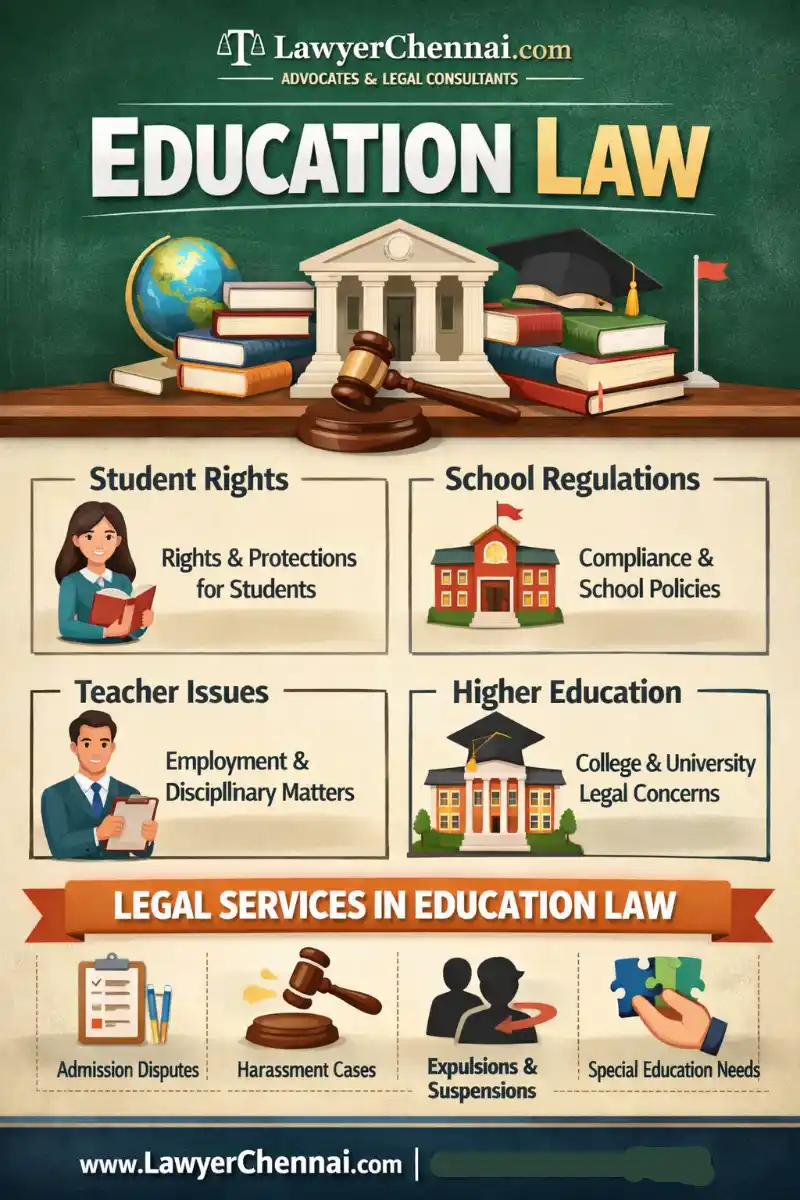
Regulatory Authorities Governing Educational Institutions
The University Grants Commission (UGC) regulates and coordinates university education standards throughout India. Similarly, the All India Council for Technical Education (AICTE) oversees technical education institutions and approves new programs. The National Council for Teacher Education (NCTE) regulates teacher training institutions and certification requirements. Furthermore, the Central Board of Secondary Education (CBSE) administers school education across multiple states. The Tamil Nadu State Board of School Examination conducts state-level assessments for matriculation and higher secondary students. Additionally, Anna University affiliates engineering colleges and grants technical degrees in Tamil Nadu. The Directorate of Technical Education Tamil Nadu monitors polytechnic colleges and diploma programs. Meanwhile, the School Education Department Tamil Nadu implements state policies for primary and secondary education. These authorities ensure quality standards, grant recognition, and address grievances against educational institutions.
- University Grants Commission – Higher education regulation
- AICTE – Technical and management education oversight
- NCTE – Teacher training and certification standards
- CBSE – Central board school education
- State Education Department – Regional policy implementation
Key Educational Legislation and Statutory Provisions
The Right of Children to Free and Compulsory Education Act 2009 mandates free education until elementary level. Consequently, private schools must reserve 25% seats for economically disadvantaged students under Section 12(1)(c). The National Commission for Protection of Child Rights Act 2005 safeguards educational rights of children. Moreover, the Persons with Disabilities Act 2016 ensures inclusive education with reasonable accommodations. The Prohibition of Unfair Practices in Technical Educational Institutions Act 2010 prevents capitation fees and fraudulent admissions. Additionally, the Sexual Harassment of Women at Workplace Act 2013 applies to educational institutions. The Bharatiya Sakshya Adhiniyam (BSA) 2023 governs evidence in education-related disputes. Furthermore, the Consumer Protection Act 2019 applies when education is considered a service. Therefore, students can approach consumer forums for deficiency in educational services provided.
Common Legal Issues in Educational Institutions
Admission disputes arise when institutions deny entry unfairly or violate reservation policies mandated by law. Similarly, fee-related conflicts occur when schools charge amounts exceeding approved fee structures or impose hidden charges. Disciplinary actions including suspension or expulsion often lead to litigation when institutions bypass procedural safeguards. Moreover, examination irregularities such as paper leaks, unfair evaluation, or mark manipulation generate legal complaints. Discrimination based on caste, religion, gender, or disability violates constitutional guarantees and statutory protections. Additionally, infrastructure deficiencies compromising student safety trigger liability under negligence principles. Breach of contract occurs when institutions fail to provide promised facilities, faculty, or educational standards. Furthermore, sexual harassment complaints require immediate institutional response under the Prevention of Sexual Harassment Act. Consequently, students and parents can invoke multiple legal remedies depending on the nature of grievance.
Admission-Related Legal Disputes and Remedies
Institutions must follow transparent admission procedures published in prospectuses and official websites. However, arbitrary denial of admission violates natural justice principles and invites judicial intervention. Courts have mandated that admission criteria must be reasonable, non-discriminatory, and consistently applied. Subsequently, students can challenge admissions through writ petitions in High Courts under Article 226. The Madras High Court frequently entertains admission disputes involving Anna University affiliated colleges and state universities. Additionally, applicants can approach regulatory authorities like UGC or AICTE for grievance redressal. Private institutions charging capitation fees face prosecution under anti-corruption laws and education-specific statutes. Moreover, denial of admission to reserved category candidates violates constitutional mandates and invites contempt proceedings. Therefore, timely legal intervention ensures admission rights are protected effectively.
Fee Disputes and Recovery Proceedings
Educational institutions cannot charge fees exceeding amounts approved by fee regulatory committees established under state laws. Nevertheless, many schools and colleges impose arbitrary charges disguised as development fees or miscellaneous expenses. The Tamil Nadu Educational Institutions (Prohibition of Collection of Capitation Fee) Act 1992 prohibits capitation fees. Furthermore, the Fee Regulatory Committee under the Tamil Nadu Regulation of Private Schools Act monitors fee structures. Students can file complaints with the District Education Officer or Deputy Director of School Education. Additionally, consumer forums under the Consumer Protection Act 2019 provide remedies for unfair trade practices. The Principal District Court Chennai and subordinate courts entertain civil suits for fee recovery or refund. Moreover, criminal prosecution under Section 318(4) BNS applies to fraudulent collection of fees. Therefore, multiple legal avenues exist to challenge arbitrary fee impositions.
| Legal Forum | Jurisdiction | Remedy Available |
|---|---|---|
| High Court | Writ Petition | Admission, Policy Challenges |
| Consumer Forum | Service Deficiency | Compensation, Refund |
| District Court | Civil Suits | Damages, Specific Performance |
| Education Tribunal | Statutory Appeals | Review of Orders |
Disciplinary Actions and Student Rights Protection
Educational institutions possess inherent authority to maintain discipline but must exercise it reasonably and transparently. However, arbitrary suspension or expulsion without following due process violates principles of natural justice. Students must receive notice of charges, opportunity to explain, and reasoned orders before disciplinary action. Subsequently, courts have quashed expulsions where institutions failed to provide fair hearing opportunities. The Madras High Court has repeatedly emphasized that educational institutions are not immune from judicial scrutiny. Additionally, disciplinary proceedings must not be motivated by malice, discrimination, or extraneous considerations. Section 223 BNSS governs inquiry procedures that educational institutions should adopt as best practices. Moreover, corporal punishment is prohibited under the Right to Education Act and various state-specific regulations. Therefore, students can challenge arbitrary disciplinary actions through writ petitions or statutory appeals.
Examination Malpractice and Evaluation Disputes
Universities and examination boards must ensure fair, transparent, and standardized evaluation procedures for all students. Nevertheless, allegations of paper leaks, unfair marking, or manipulation of results frequently arise across educational institutions. Students can apply for re-evaluation or re-totaling under university regulations within prescribed time limits. Furthermore, courts entertain writ petitions when examination authorities act arbitrarily or violate their own regulations. The Anna University has specific provisions for scrutiny and revaluation applications with prescribed fees. Additionally, criminal complaints under Section 318(4) BNS apply to persons involved in examination fraud. The Central Bureau of Investigation occasionally investigates large-scale examination scams involving organized criminal networks. Moreover, the Bharatiya Sakshya Adhiniyam 2023 governs admissibility of electronic evidence in examination disputes. Therefore, students have both administrative and judicial remedies for examination-related grievances.
Discrimination and Harassment in Educational Settings
Educational institutions must provide safe, inclusive environments free from discrimination, harassment, and violence. However, caste-based discrimination persists in some institutions despite constitutional prohibitions and the SC/ST Prevention of Atrocities Act. Gender discrimination in admissions, facilities, or opportunities violates Articles 14, 15, and 21 of the Constitution. Subsequently, the Persons with Disabilities Act 2016 mandates reasonable accommodations for students with special needs. Sexual harassment cases require immediate institutional response through Internal Complaints Committees under the POSH Act 2013. Additionally, ragging is criminalized under Section 115(2) BNS and UGC Anti-Ragging Regulations 2009. The National Commission for Protection of Child Rights monitors implementation of child protection measures in schools. Moreover, cyberbullying and online harassment increasingly require legal intervention under Information Technology Act provisions. Therefore, victims can seek remedies through institutional mechanisms, police complaints, and civil litigation.
Sexual Harassment Prevention and Redressal Mechanisms
The Sexual Harassment of Women at Workplace (Prevention, Prohibition and Redressal) Act 2013 applies to educational institutions. Consequently, colleges and universities must constitute Internal Complaints Committees with external members and student representatives. Complaints must be inquired into within 90 days following principles of natural justice and confidentiality. Furthermore, complainants can approach Local Complaints Committees if institutional mechanisms fail to respond adequately. The Chennai City Police has established dedicated cells for crimes against women including educational institution cases. Additionally, the Women Police Station in Kilpauk and Mylapore handle sexual harassment complaints from nearby educational institutions. Criminal prosecution under Sections 74-79 BNS covers various forms of sexual assault and harassment. Moreover, victims can claim compensation under Section 357A BNSS from the State Victim Compensation Scheme. Therefore, comprehensive legal protection exists for addressing sexual harassment in educational environments effectively.
Ragging Prevention and Criminal Liability
Ragging is prohibited under Section 115(2) BNS as unlawful assembly causing hurt or wrongful restraint. Additionally, the UGC Regulations on Curbing the Menace of Ragging 2009 impose strict liability on institutions. Educational institutions must display anti-ragging helpline numbers, constitute anti-ragging committees, and conduct awareness programs. Subsequently, failure to prevent ragging makes institutional authorities liable for negligence under civil and criminal law. The Anti-Ragging Helpline 1800-180-5522 operates nationally for immediate reporting and intervention. Furthermore, institutions must file mandatory affidavits annually regarding anti-ragging measures implemented. The nearest police stations such as Anna University Police Outpost and Guindy Police Station handle ragging complaints. Moreover, victims can approach the Madras High Court for directions to investigate and prosecute offenders. Therefore, zero-tolerance policies backed by criminal law provide robust protection against ragging in educational institutions.
- File complaint with Anti-Ragging Committee immediately
- Report to nearest police station under Section 115(2) BNS
- Contact Anti-Ragging Helpline 1800-180-5522 for assistance
- Approach Dean or Principal for immediate protective measures
- File writ petition in High Court if institutional response inadequate
Infrastructure Safety and Institutional Negligence
Educational institutions owe a duty of care to ensure safe premises, adequate infrastructure, and emergency preparedness. However, accidents due to structural deficiencies, inadequate safety measures, or negligent supervision lead to legal liability. The Right to Education Act mandates minimum infrastructure standards including safe buildings, drinking water, and sanitation facilities. Subsequently, institutions failing to maintain these standards face recognition cancellation by regulatory authorities. Parents can file civil suits for damages under tort law when students suffer injuries due to institutional negligence. Additionally, criminal prosecution under Section 106 BNS applies when negligent acts endanger human life or safety. The District Consumer Forum Chennai entertains complaints regarding deficiency in educational services including safety failures. Moreover, the Tamil Nadu Fire and Rescue Services Department conducts safety audits and issues fire safety certificates. Therefore, institutions must proactively ensure infrastructure safety to avoid legal and regulatory consequences.
Liability for Student Injuries and Accidents
Schools and colleges are liable under vicarious liability principles for negligent acts of teachers and staff. Consequently, institutions must carry adequate insurance coverage for student accidents and injuries during educational activities. The principle of in loco parentis makes educational authorities responsible for student welfare during school hours. Furthermore, organized trips, sports activities, and laboratory experiments require enhanced safety protocols and supervision. The Motor Vehicles Act 1988 mandates insurance for school buses and compliance with safety regulations. Additionally, institutions must conduct regular safety drills, maintain first-aid facilities, and train staff in emergency response. Civil suits for damages can be filed in the Principal District Court Chennai within three years. Moreover, criminal negligence charges under Section 106 BNS apply when gross negligence causes death or grievous injury. Therefore, institutions must implement comprehensive safety management systems to minimize legal exposure.
Remedies Available Under Different Legal Forums
Aggrieved students and parents can approach multiple forums depending on the nature and urgency of grievances. Primarily, the Madras High Court exercises writ jurisdiction under Article 226 for constitutional violations and statutory breaches. Additionally, the Principal District Court Chennai handles civil suits for damages, specific performance, and injunctive relief. Consumer Disputes Redressal Commissions provide speedy remedies when education is treated as a service under Consumer Protection Act. Furthermore, regulatory authorities like UGC, AICTE, and state education departments offer administrative remedies through grievance cells. The National Commission for Protection of Child Rights and State Commission investigate violations of children’s educational rights. Moreover, criminal complaints can be filed at jurisdictional police stations for offenses under BNS provisions. The Tamil Nadu State Human Rights Commission addresses systemic violations of educational rights affecting marginalized communities. Therefore, selecting appropriate forum based on legal issue ensures effective and timely resolution.
Writ Jurisdiction of High Courts in Education Matters
The Madras High Court entertains writ petitions challenging admission denials, arbitrary fee hikes, and disciplinary actions. Subsequently, writ of mandamus compels authorities to perform statutory duties or admit eligible students. Writ of certiorari quashes illegal orders passed by universities, examination boards, or educational institutions. Furthermore, writ of prohibition prevents authorities from acting beyond their jurisdiction or contrary to natural justice. The High Court can issue interim orders staying expulsions, cancellations, or adverse actions pending final hearing. Additionally, Public Interest Litigations address systemic issues affecting multiple students or educational rights violations. The Madras High Court Registry at Chennai accepts writ petitions on all working days except court holidays. Moreover, the High Court Mediation Centre facilitates amicable settlement of education disputes through structured mediation. Therefore, writ jurisdiction provides swift, effective remedies for urgent educational grievances requiring immediate judicial intervention.
Civil Remedies Through District and Subordinate Courts
The Principal District Court Chennai exercises original civil jurisdiction for education-related disputes exceeding specified pecuniary limits. Consequently, suits for damages due to breach of contract, negligence, or defamation are filed here. The Code of Civil Procedure applies to pleadings, discovery, trial procedures, and appeals in educational disputes. Furthermore, interim injunctions under Order 39 CPC prevent irreversible damage pending final disposal of suits. Specific performance suits compel institutions to fulfill contractual obligations regarding admissions, facilities, or refunds. Additionally, declaratory suits establish legal rights without necessarily seeking damages or specific performance. The City Civil Court Chennai handles suits below specified pecuniary jurisdiction involving smaller claims. Moreover, appeals from district court decisions lie to the Madras High Court within prescribed limitation periods. Therefore, civil courts provide comprehensive remedies including damages, injunctions, and specific performance for education-related legal issues.
Consumer Forum Remedies for Educational Services
The Consumer Protection Act 2019 recognizes education as a service when provided for consideration. Subsequently, District Consumer Disputes Redressal Commissions in Chennai entertain complaints regarding deficiency in educational services. State Consumer Disputes Redressal Commission handles appeals and complaints exceeding district commission pecuniary jurisdiction. Furthermore, the National Consumer Disputes Redressal Commission exercises appellate jurisdiction over state commission orders. Complaints can be filed online through the e-Daakhil portal facilitating paperless consumer litigation nationwide. Additionally, consumer forums can award compensation, direct service improvement, and order refunds for deficient educational services. The limitation period for filing consumer complaints is two years from the cause of action. Moreover, legal representation is optional in consumer forums, making them accessible to common citizens. Therefore, consumer forums provide speedy, inexpensive remedies for education service deficiencies without complex legal procedures.
Criminal Remedies and Police Complaints
Criminal complaints can be filed at jurisdictional police stations for cognizable offenses under BNS provisions. Consequently, the George Town Police Station handles complaints involving educational institutions in that jurisdiction. The Anna University Police Outpost specifically addresses crimes occurring within university campus and affiliated institutions. Furthermore, the Kilpauk Women Police Station investigates sexual harassment and gender-based violence complaints from nearby schools. Cognizable offenses under Sections 74-79, 115(2), 318(4) BNS allow police to investigate without magistrate permission. Additionally, non-cognizable complaints require magistrate’s permission before investigation under Section 173 BNSS procedures. The Cyber Crime Police Station Chennai investigates online harassment, data theft, and technology-enabled educational fraud. Moreover, First Information Reports must be registered immediately for cognizable offenses under Section 173 BNSS. Therefore, criminal remedies supplement civil remedies for serious offenses involving fraud, violence, or statutory violations.
Administrative Remedies Through Regulatory Authorities
The University Grants Commission operates a grievance redressal portal for complaints against universities and colleges. Similarly, the AICTE online grievance system addresses complaints regarding technical education institutions and approval processes. The National Council for Teacher Education investigates complaints against teacher training institutions violating prescribed norms. Furthermore, the Directorate of School Education Tamil Nadu receives complaints regarding private schools through online portals. The District Education Officer exercises supervisory jurisdiction over schools within the district and addresses grievances. Additionally, the Chief Educational Officer monitors educational institutions and ensures compliance with statutory requirements. The Commissioner for Collegiate Education Tamil Nadu oversees government and aided colleges throughout the state. Moreover, regulatory authorities can cancel recognition, suspend admissions, or impose penalties for statutory violations. Therefore, administrative remedies provide sector-specific expertise and enforcement mechanisms complementing judicial remedies.
Alternative Dispute Resolution in Education Conflicts
Mediation and arbitration offer less adversarial, more flexible approaches to resolving education disputes efficiently. Consequently, the Madras High Court Mediation Centre facilitates settlement conferences with trained mediators at nominal costs. Many universities have established internal ombudsperson offices to mediate disputes between students and institutional authorities. Furthermore, arbitration clauses in admission agreements enable parties to resolve disputes through private arbitrators. The Arbitration and Conciliation Act 1996 governs institutional arbitration ensuring enforceability of arbitral awards. Additionally, mediation preserves ongoing relationships between students and institutions while achieving mutually acceptable solutions. The Tamil Nadu Mediation and Conciliation Centre Chennai provides professional mediation services for various disputes. Moreover, Lok Adalats organized by District Legal Services Authority offer compromise settlements with court backing. Therefore, alternative dispute resolution mechanisms provide cost-effective, time-saving alternatives to protracted litigation.
Legal Aid and Pro Bono Services
The District Legal Services Authority Chennai provides free legal aid to eligible persons based on income criteria. Consequently, economically disadvantaged students can access legal representation without financial burden through legal aid schemes. The Tamil Nadu State Legal Services Authority operates legal aid clinics in district courts providing preliminary advice. Furthermore, law colleges conduct legal aid camps and pro bono clinics offering free consultations to students. LawyerChennai.com occasionally undertakes pro bono representation in meritorious education rights cases affecting vulnerable students. Additionally, the National Human Rights Commission Legal Cell assists complainants in preparing petitions and pursuing remedies. The Child Rights Protection Centre provides specialized legal support for children facing educational rights violations. Moreover, online legal aid portals connect eligible persons with empaneled advocates willing to provide free services. Therefore, financial constraints need not prevent students from accessing justice through multiple legal aid channels.
Documentation and Evidence Collection Strategies
Successful legal remedies require systematic documentation of communications, transactions, and grievances from inception. Consequently, students should maintain copies of admission letters, fee receipts, academic records, and institutional correspondence. Email communications with institutional authorities serve as critical evidence under Section 61 Bharatiya Sakshya Adhiniyam 2023. Furthermore, audio-visual recordings of disciplinary proceedings can be admitted as electronic evidence subject to authentication requirements. Witness statements from classmates, teachers, or parents corroborate factual allegations in legal proceedings. Additionally, medical reports, police complaints, and forensic evidence strengthen cases involving physical injuries or harassment. The Right to Information Act 2005 enables students to obtain institutional records relevant to grievances. Moreover, preservation of social media evidence requires proper screenshots with timestamps before accounts are deleted. Therefore, proactive evidence collection significantly enhances prospects of success in education-related legal disputes.
Limitation periods dictate maximum time within which legal proceedings must be initiated from the cause of action. Consequently, writ petitions should be filed promptly as delay causes dismissal on the ground of laches. Civil suits for damages must be filed within three years from the date of accrual under Article 113 Limitation Act. Furthermore, consumer complaints must be filed within two years, although this period can be condoned for sufficient cause. Criminal complaints for cognizable offenses have no limitation period and can be filed anytime. Additionally, appeals from lower court decisions must be filed within prescribed periods ranging from 30 to 90 days. The Limitation Act 1963 provides specific limitation periods for different types of legal actions. Moreover, continuing wrongs such as ongoing discrimination create fresh cause of action daily, extending limitation periods. Therefore, timely legal action is crucial as delayed claims may be dismissed irrespective of merit.
Frequently Asked Questions on Education Law
LawyerChennai.com provides comprehensive legal services for education law matters including admission disputes, fee conflicts, disciplinary challenges, and institutional negligence. Contact us at +91-9994287060 or visit www.lawyerchennai.com for expert legal assistance.
Read More
- Education Law Appeals: Appealing educational disputes in Supreme court
- Educational standards, infrastructure in several existing universities need to be seen by
- Police harassment in Chennai: Expert Criminal Lawyers Help
- BA LLB program: Students with a 3-year diploma or polytechnic after Xth are eligible for admission
- Sexual Harassment