Judicial Review of Tribunals: Reviewing tribunal decisions
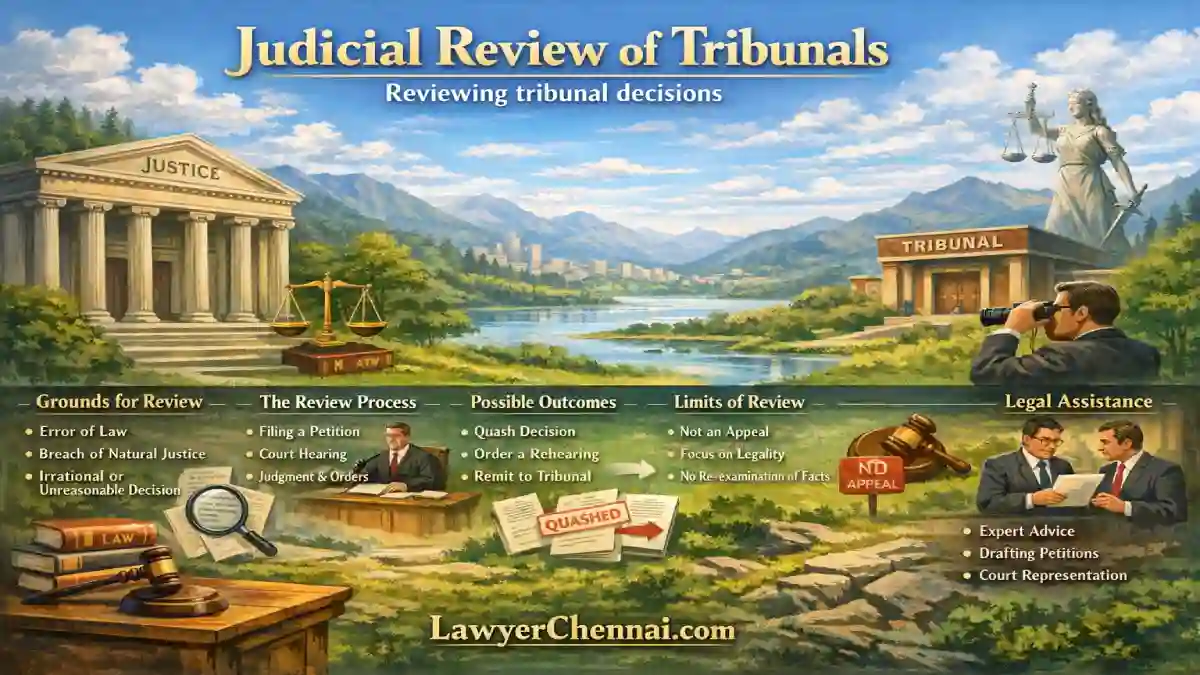
Judicial Review of Tribunals – In today’s legal system, tribunals play an important role in resolving disputes quickly and efficiently. However, like any decision-making body, tribunals can sometimes make errors. This is where judicial review becomes essential. It acts as a safeguard to ensure fairness, legality, and justice. At LawyerChennai.com – Best Lawyer Firm in Chennai India 24×7, we help individuals, companies, NGOs, and NRIs understand and challenge tribunal decisions effectively.
Judicial Review of Tribunals: Reviewing Tribunal Decisions – LawyerChennai.com – Best Lawyer Firm in Chennai India 24×7
Understanding Tribunals and Their Role
Tribunals are specialized bodies created to handle specific types of disputes. For example, they deal with tax matters, administrative issues, service disputes, and more. Unlike regular courts, tribunals follow simpler procedures and aim to deliver faster decisions.
However, even though tribunals are designed to reduce the burden on courts, their decisions must still follow the law. That is why higher courts, such as the Supreme Court of India and the High Court of Madras, have the power to review tribunal decisions.
What is Judicial Review?
Judicial review is the process by which courts examine the decisions made by tribunals or government authorities. In simple terms, it means checking whether the decision was made legally and fairly.
This power comes from the Constitution of India. It ensures that no authority acts beyond its powers and that every decision respects fundamental rights.
Importantly, judicial review does not focus on whether the decision is right or wrong in terms of facts. Instead, it checks whether the correct legal process was followed.
Why Judicial Review is Important
Judicial review is crucial for several reasons. First, it protects individuals from unfair decisions. Second, it ensures that tribunals act within their limits. Third, it maintains public confidence in the legal system.
Moreover, judicial review promotes accountability. When tribunals know their decisions can be reviewed, they are more careful and transparent in their approach.
As a result, judicial review strengthens the rule of law across India.
Grounds for Reviewing Tribunal Decisions
Courts do not review every tribunal decision. Instead, they intervene only when there are valid legal grounds. Some of the most common grounds include:
1. Lack of Jurisdiction
If a tribunal acts beyond its legal authority, its decision can be challenged. For instance, if it handles a matter it is not allowed to decide, the court may set aside the decision.
2. Violation of Natural Justice
Natural justice means fairness. If a person was not given a chance to be heard, or if the decision was biased, the court can interfere.
3. Error of Law
If the tribunal misinterprets the law or applies it incorrectly, judicial review can correct the mistake.
4. Procedural Irregularity
Tribunals must follow proper procedures. If they fail to do so, their decision may become invalid.
5. Irrational or Unreasonable Decision
If a decision is so unreasonable that no sensible authority would have made it, courts can step in.
Judicial Review vs Appeal
Many people confuse judicial review with an appeal. However, they are different.
An appeal focuses on the correctness of the decision. In contrast, judicial review focuses on the decision-making process. In other words, the court does not re-hear the case but checks whether the tribunal followed the law properly.
Therefore, choosing the right remedy is very important. At LawyerChennai.com – Best Lawyer Firm in Chennai India 24×7, we guide clients on whether to file an appeal or seek judicial review.
Procedure for Filing Judicial Review
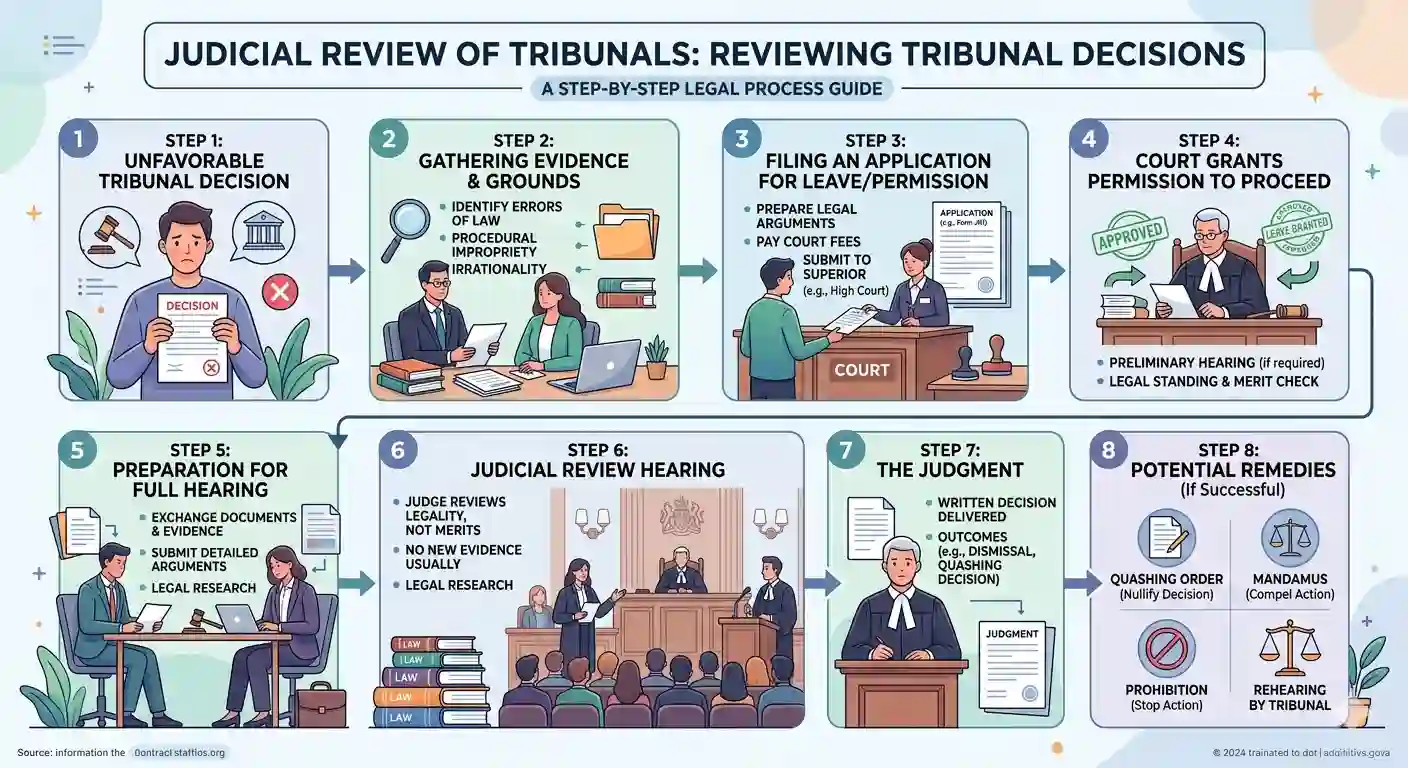
The process of judicial review involves several steps. Although it may vary depending on the case, the general procedure is as follows:
Step 1: Filing a Petition
The affected party files a writ petition before the High Court or Supreme Court. Most cases are filed before the High Court, especially in Chennai.
Step 2: Stating Grounds Clearly
The petition must clearly explain the legal grounds for challenging the tribunal’s decision.
Step 3: Submitting Evidence
Relevant documents, tribunal orders, and supporting evidence must be attached.
Step 4: Court Hearing
The court hears both parties and examines whether the tribunal acted lawfully.
Step 5: Final Order
The court may set aside, modify, or uphold the tribunal’s decision.
Powers of the Court in Judicial Review
Courts have wide powers when reviewing tribunal decisions. They can:
- Quash the decision if it is unlawful
- Direct the tribunal to reconsider the case
- Issue orders to ensure fairness
- Protect fundamental rights
However, courts usually avoid interfering unless there is a clear legal issue. This ensures respect for the tribunal system.
Challenges Faced in Judicial Review
Even though judicial review is a powerful tool, it comes with certain challenges.
First, it requires strong legal grounds. Not every dissatisfaction with a decision will succeed. Second, the process can take time, especially in complex cases. Third, proper documentation and legal drafting are essential.
Therefore, professional legal assistance becomes very important to avoid delays and rejection.
Role of Legal Experts in Judicial Review
Handling judicial review requires deep knowledge of constitutional law and procedural rules. Experienced lawyers can identify valid grounds, prepare strong petitions, and present arguments effectively.
At LawyerChennai.com – Best Lawyer Firm in Chennai India 24×7, our team provides complete support, including:
- Case evaluation
- Drafting writ petitions
- Filing and documentation
- Court representation
- Strategic legal advice
As a result, clients receive reliable guidance at every stage.
When Should You Consider Judicial Review?
You should consider judicial review in situations such as:
- When a tribunal decision appears unfair
- When proper procedure was not followed
- When your rights are violated
- When the tribunal exceeded its authority
However, timing is critical. Courts expect petitions to be filed without unnecessary delay. Therefore, it is always better to seek legal advice immediately.
Importance for Businesses, NGOs, and NRIs
Judicial review is not limited to individuals. It is equally important for businesses, NGOs, and NRIs.
For businesses, it helps challenge regulatory or tax-related tribunal decisions. NGOs, it ensures protection of rights and compliance issues. For NRIs, it provides a legal remedy when dealing with Indian authorities.
Thus, judicial review serves as a powerful tool for all stakeholders.
Frequently Asked Questions
Judicial review is the process where higher courts examine whether a tribunal has made its decision legally and fairly. Instead of re-evaluating facts, courts like the High Court of Madras check if proper procedures were followed, principles of natural justice were applied, and whether the tribunal acted within its legal powers.
A tribunal decision can be challenged when there is a legal error, lack of jurisdiction, procedural unfairness, or violation of natural justice. For example, if you were not given a fair hearing or the tribunal acted beyond its authority, you may approach courts such as the Supreme Court of India or the relevant High Court.
An appeal focuses on whether the decision itself is correct based on facts and law. In contrast, judicial review examines the decision-making process.
The duration varies depending on the complexity of the case, court workload, and documentation. Some cases may be resolved within a few months, while others can take longer. However, timely filing and proper legal representation can help speed up the process and improve the chances of a favorable outcome.
Judicial review involves technical legal arguments and strict procedural requirements. Skilled lawyers help identify valid grounds, prepare strong petitions, and present arguments effectively. Without proper legal guidance, petitions may be dismissed. Therefore, expert assistance ensures that your rights are protected and your case is presented clearly before the court.
Conclusion
Judicial review of tribunal decisions is a vital part of the legal system. It ensures that justice is not only done but also seen to be done. While tribunals provide quick resolutions, judicial review ensures those decisions are lawful and fair.
In a dynamic legal environment, understanding your rights is essential. Whether you are facing an unfavorable tribunal order or simply need legal clarity, expert guidance can make a significant difference.
At LawyerChennai.com – Best Lawyer Firm in Chennai India 24×7, we are committed to helping you navigate judicial review with confidence and clarity. With the right approach and timely action, you can effectively challenge unjust decisions and protect your legal rights.
Read More
- Human Rights Appeals: Addressing human rights violations in SC
- Debt Recovery Appeals: Appealing decisions in debt recovery cases
- Fraudulent Transaction Appeals: Handling fraud-related appeals
- Civil Liberty Appeals: Challenging cases related to civil liberties
- Medical Malpractice Appeals: Appealing medical malpractice cases
- Supreme Court of India