
Real Estate Lawyer in Chennai

Real Estate Lawyer in Chennai: Comprehensive Legal Solutions by LawyerChennai.com

Real estate transactions in Chennai require expert legal guidance to navigate complex property laws. Consequently, choosing the right real estate lawyer becomes crucial for protecting your investment. LawyerChennai.com, located in West Mogappair and George Town, Chennai, provides comprehensive legal services. Our experienced attorneys handle property disputes, documentation, and regulatory compliance effectively. Moreover, we serve clients across Chennai – 600037 and Chennai – 600001 jurisdictions with dedication. Furthermore, our team understands Tamil Nadu-specific property regulations and central government laws thoroughly. Therefore, we ensure seamless transactions while safeguarding your legal rights throughout the process. Additionally, our decades of combined experience enable us to anticipate potential issues before they arise. Subsequently, clients benefit from proactive legal strategies that minimize risks and maximize protection. Indeed, real estate matters demand meticulous attention to detail and comprehensive knowledge of applicable laws.

Understanding Real Estate Legal Services in Chennai

Property Documentation and Title Verification Services

Importance of Title Verification in Real Estate Transactions

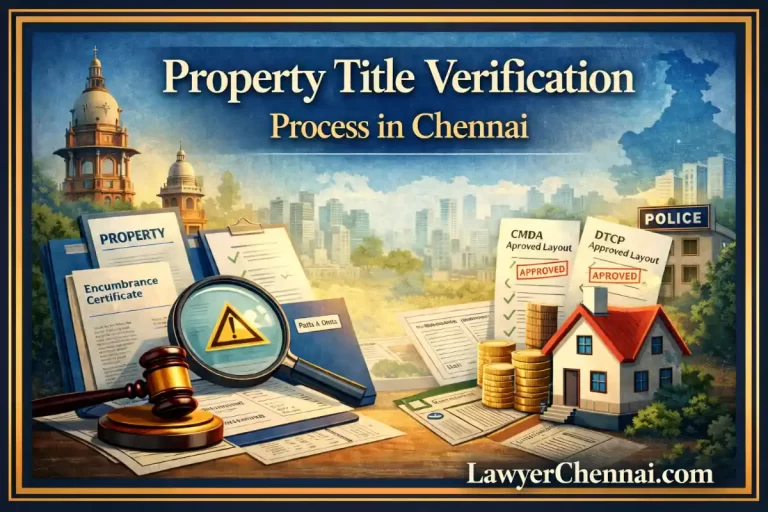
Title verification represents the foundation of any secure real estate transaction in Chennai. Therefore, thorough examination of property documents prevents future legal complications and ownership disputes. Our legal team scrutinizes encumbrance certificates, sale deeds, and previous transaction records meticulously. Additionally, we verify ownership chains extending back thirty to forty years as required. Moreover, examination includes checking for pending litigation, mortgage liens, or revenue department encumbrances. Furthermore, we obtain certified copies from the Sub-Registrar Office across various Chennai districts. Subsequently, our lawyers prepare detailed title reports highlighting any defects or clouds on title. Consequently, buyers receive complete information enabling informed decisions about property purchases. Indeed, this due diligence protects against fraudulent sellers and disputed property claims. Meanwhile, sellers benefit from clean title certificates that expedite transactions smoothly.

Key documents verified:

  • Parent documents and original sale deeds
  • Encumbrance certificates from Sub-Registrar offices
  • Tax receipts and revenue records from Chennai Corporation
  • Building approval plans from CMDA and local authorities
  • NOC certificates from relevant government departments
  • Property tax records and paid receipts
  • Litigation search reports from courts

Registration Process and Documentation Requirements

Registration procedures under the Registration Act, 1908 require strict compliance with statutory provisions. Therefore, proper documentation ensures legally valid property transfers recognized by law in Chennai. Our lawyers prepare sale agreements, gift deeds, and mortgage documents per applicable regulations. Moreover, we coordinate with Sub-Registrar offices in Ambattur, Egmore, Saidapet, and other Chennai locations. Additionally, stamp duty calculations follow Tamil Nadu Stamp Act provisions ensuring correct government revenue payment. Furthermore, we assist with online document submission through the TNREGINET portal efficiently. Subsequently, appointment scheduling and document presentation before registering authorities becomes seamless for clients. Consequently, registration happens within stipulated timelines avoiding delays and additional costs for all parties. Indeed, proper registration establishes legal ownership and provides protection against third-party claims effectively. Meanwhile, unregistered documents lack enforceability under Indian law as per legal precedents.

Registration requirements include:

  1. Identity proof of all parties (Aadhaar, PAN card)
  2. Address proof with current residential documentation
  3. Property tax receipts for the last fiscal year
  4. Encumbrance certificate (EC) for 13-30 years
  5. Sale deed draft approved by legal counsel
  6. Stamp duty payment through authorized banks or online
  7. Two witnesses with valid identification documents
  8. Previous sale deed or title documents chain

Property Dispute Resolution and Litigation Management

Types of Real Estate Disputes Handled

Property disputes in Chennai range from boundary conflicts to title ownership disagreements requiring specialized legal intervention. Therefore, experienced real estate lawyers become essential for protecting property rights through judicial forums. Our firm handles partition suits among family members seeking division of ancestral properties fairly. Additionally, we represent clients in specific performance cases compelling sellers to complete agreed transactions. Moreover, landlord-tenant disputes regarding lease violations, eviction, and rent recovery receive expert handling. Furthermore, we manage construction defect claims against builders violating approved plans or quality standards. Subsequently, adverse possession claims and encroachment removal cases require strategic litigation approaches we provide. Consequently, clients achieve favorable outcomes through well-prepared legal arguments and documentary evidence presentation. Indeed, early legal intervention often prevents escalation and facilitates amicable settlements between disputing parties. Meanwhile, our litigation team remains prepared for prolonged court battles when settlements prove impossible.

Common dispute categories:

  • Ownership title disputes and competing claims
  • Boundary demarcation and encroachment issues
  • Fraudulent sale transactions and document forgery
  • Partition suits among co-owners or legal heirs
  • Specific performance of sale agreements
  • Landlord-tenant eviction and rent matters
  • Builder-buyer disputes over project delays
  • Development agreement violations and breaches

Jurisdiction and Competent Courts for Property Matters

Understanding jurisdictional requirements ensures filing suits before appropriate courts under the Code of Civil Procedure, 1908. Therefore, territorial jurisdiction depends on property location while pecuniary jurisdiction considers dispute value. Civil Courts in Chennai, including City Civil Court and District Courts, handle property disputes primarily. Moreover, the Madras High Court entertains appeals, writ petitions, and original suits involving substantial questions. Additionally, civil judges (junior division and senior division) have jurisdiction based on suit valuation thresholds. Furthermore, commercial courts established under the Commercial Courts Act, 2015 handle high-value real estate disputes. Subsequently, proper venue selection prevents jurisdictional challenges that delay proceedings and waste resources unnecessarily. Consequently, our lawyers analyze facts carefully before determining the correct forum for filing litigation.

Relevant courts and tribunals:

Court/TribunalJurisdiction TypeLocation in Chennai
Madras High CourtAppellate & OriginalHigh Court Building, Parry’s Corner
City Civil CourtOriginal Civil SuitsSaidapet, Chennai
District CourtOriginal & AppellateChengalpattu, Kancheepuram
Commercial CourtCommercial DisputesSaidapet, Chennai
Small Causes CourtRent & EvictionGeorge Town, Chennai
RERA TribunalBuilder-Buyer DisputesNandanam, Chennai

Remedies Available Under Civil Procedure Code and BNS

Legal remedies under the Code of Civil Procedure (CPC) provide comprehensive relief mechanisms for aggrieved parties. Therefore, understanding available remedies helps formulate effective litigation strategies for property dispute resolution. Declaratory suits under Section 34 CPC establish legal rights and title ownership without additional relief. Moreover, injunction applications prevent wrongful possession transfer or property alteration during pending litigation proceedings. Additionally, specific performance decrees compel contract fulfillment when monetary compensation proves inadequate or insufficient. Furthermore, the Bharatiya Nyaya Sanhita, 2023 (BNS) replaced the Indian Penal Code providing criminal remedies. Subsequently, criminal complaints for cheating (Section 318 BNS), forgery (Sections 336-340 BNS) protect against fraudulent transactions. Consequently, combined civil and criminal proceedings offer comprehensive protection against wrongdoers and dishonest parties.

Available legal remedies:

  1. Permanent and temporary injunction orders
  2. Declaratory decrees establishing ownership rights
  3. Specific performance of sale agreements
  4. Possession delivery through court commissioners
  5. Damages for breach of contract or torts
  6. Cancellation of sale deeds and documents
  7. Criminal prosecution under BNS provisions
  8. Attachment and sale of disputed properties

Regulatory Compliance and Government Approvals

CMDA Approval and Building Plan Sanctioning Process

Chennai Metropolitan Development Authority Regulations

CMDA regulations govern construction activities within Chennai Metropolitan Area covering 1,189 square kilometers comprehensively. Therefore, obtaining proper approvals prevents legal complications and ensures structural safety compliance throughout construction. Our legal team assists clients in securing building plan approvals from CMDA headquarters in Egmore. Moreover, we handle applications for residential, commercial, and industrial construction projects of varying scales. Additionally, setback requirements, Floor Space Index (FSI), and height restrictions receive careful consideration. Furthermore, we coordinate with architects and engineers ensuring submitted plans comply with development control rules. Subsequently, CMDA scrutiny involves multiple departments including town planning, highways, and traffic management divisions. Consequently, professional legal assistance expedites approval processes that otherwise consume months or years unnecessarily. Indeed, unapproved constructions face demolition orders and substantial penalties under applicable regulations severely.

CMDA approval requirements:

  • Building plan with structural drawings and specifications
  • Site plan showing boundaries and adjacent properties
  • Ownership documents and encumbrance certificates
  • NOC from Chennai Metropolitan Water Supply (CMWSSB)
  • Fire NOC for buildings exceeding height limits
  • Environmental clearance for large-scale projects
  • Payment of scrutiny fees and development charges
  • Parking space allocation as per regulations

Local Body Permissions and Panchayat Approvals

Local body permissions become mandatory for properties falling outside CMDA jurisdiction in Chennai periphery. Therefore, town panchayats and village panchayats exercise planning authority over their respective territorial limits. Our lawyers coordinate with Ambattur Municipality, Avadi Corporation, and surrounding panchayat authorities effectively. Moreover, building rules differ between urban local bodies and rural panchayats requiring jurisdiction-specific compliance. Additionally, conversion of agricultural land to residential or commercial use requires District Collector approval. Furthermore, Section 17(A) TNPID Act governs land use conversions protecting agricultural land preservation. Subsequently, obtaining conversion orders involves revenue department scrutiny and technical evaluation by competent authorities. Consequently, legal expertise ensures navigation through bureaucratic processes achieving approvals within reasonable timelines efficiently.

Local authority approvals needed:

  1. Building permit from concerned municipality or corporation
  2. Land use conversion certificate from Revenue Department
  3. Panchayat president approval for small constructions
  4. Trade license for commercial establishments
  5. Water connection and sewage disposal approvals
  6. Road cutting permission for utility connections
  7. Occupancy certificate after construction completion
  8. Property tax assessment and enrollment

RERA Compliance for Real Estate Projects

Real Estate Regulatory Authority Registration Requirements

The Real Estate (Regulation and Development) Act, 2016 mandates project registration protecting homebuyer interests comprehensively. Therefore, promoters developing projects exceeding 500 square meters or eight apartments must register. Tamil Nadu RERA (TN-RERA) located in Nandanam, Chennai oversees registration and complaint redressal mechanisms. Moreover, our legal team assists developers in preparing registration applications with necessary documentation requirements. Additionally, project details, land title documents, and approvals must be submitted through the RERA portal. Furthermore, quarterly progress reports, financial statements, and construction updates become mandatory post-registration compliance. Subsequently, violations attract penalties, project deregistration, and potential imprisonment for promoters under RERA provisions. Consequently, professional legal guidance ensures ongoing compliance avoiding regulatory sanctions and buyer complaints effectively.

RERA registration documents:

  • Title deeds and encumbrance certificates
  • Building plan approvals from CMDA
  • Authenticated copies of environmental clearances
  • Project proforma with detailed specifications
  • Architect and engineer registration certificates
  • Builder’s PAN, incorporation certificate, and partnership deeds
  • Audited financial statements for last three years
  • Project commencement and completion timeline declarations

Buyer Protection and Complaint Mechanisms Under RERA

RERA provides robust buyer protection mechanisms addressing common grievances against developers and promoters effectively. Therefore, homebuyers can file complaints with TN-RERA for project delays, quality defects, or misrepresentation. Our legal team represents buyers before the RERA tribunal ensuring proper presentation of grievances. Moreover, the authority can order refunds, interest payments, or specific project completion as remedies. Additionally, appeals from RERA orders lie before the Real Estate Appellate Tribunal in Chennai. Furthermore, compensation for mental agony and harassment gets awarded in appropriate cases under RERA. Subsequently, completion certificates and occupancy permissions become mandatory before possession handover to buyers. Consequently, buyers enjoy unprecedented protection compared to the pre-RERA era when remedies were limited.

Complaint grounds under RERA:

  1. Project delivery delays beyond registered timeline
  2. Structural defects and quality deviations
  3. Changes in project plans without consent
  4. Failure to provide promised amenities
  5. Incorrect carpet area measurements
  6. Non-refund of booking amounts
  7. Misleading advertisements and misrepresentation
  8. Interest payment defaults on delayed possession

Environmental Clearances and Coastal Regulation Zone Compliance

Environmental clearances become mandatory for projects potentially impacting ecological balance under environmental protection laws. Therefore, developers must obtain Environment Impact Assessment (EIA) approvals from state pollution control boards. Projects in Coastal Regulation Zone (CRZ) areas require additional clearances from Tamil Nadu Coastal Zone Management Authority. Moreover, Chennai’s extensive coastline brings many properties under CRZ-I, CRZ-II, and CRZ-III categories. Additionally, CRZ Notification 2019 restricts construction activities within 500 meters from High Tide Line (HTL). Furthermore, existing violations require regularization through appropriate authorities preventing future legal complications for buyers. Subsequently, violations attract criminal prosecution under the Environment Protection Act, 1986 and Water Act provisions. Consequently, our lawyers conduct thorough CRZ verification before advising clients on coastal property transactions.

Environmental compliance requirements:

  • EIA reports for large construction projects
  • CRZ clearance from TNCZMA, Chennai
  • NOC from Tamil Nadu Pollution Control Board
  • Consent to establish and operate certificates
  • Tree cutting permissions from Forest Department
  • Wetland protection compliance certificates
  • Groundwater extraction permits from CGWA
  • Waste management plan approvals

Tax Implications and Financial Compliance

Stamp Duty and Registration Charges in Tamil Nadu

Stamp duty represents a significant cost component in real estate transactions payable to the Tamil Nadu government. Therefore, understanding applicable rates prevents underpayment leading to document impoundment and penalty imposition later. Currently, stamp duty ranges from 7% for properties valued above Rs. 50 lakhs in Chennai. Moreover, women buyers enjoy concessional rates at 5% encouraging female property ownership throughout Tamil Nadu. Additionally, registration charges amount to 1% of property value subject to maximum limits prescribed. Furthermore, stamp duty calculation depends on guideline value or transaction value, whichever is higher. Subsequently, guideline values are fixed by the Registration Department considering locality and property characteristics. Consequently, our lawyers ensure accurate duty calculation preventing future disputes with registration authorities effectively.

Stamp duty rates in Chennai:

Transaction TypeStamp Duty RateRegistration Fee
Male buyers (above Rs. 50L)7%1% (max limit)
Female buyers5%1% (max limit)
Joint ownership (male+female)6%1% (max limit)
Gift deeds to relatives5%1% (max limit)
Lease deeds1% of total rent1% (max limit)
Mortgage deeds0.1% of amount1% (max limit)

Capital Gains Tax and Income Tax Implications

Capital gains tax applies on profits from property sales under the Income Tax Act, 1961. Therefore, understanding tax implications helps in effective financial planning for real estate transactions undertaken. Short-term capital gains apply when property gets sold within 24 months of purchase. Moreover, long-term capital gains rates become applicable beyond the 24-month holding period threshold. Additionally, exemptions under Section 54 and 54F allow reinvestment in residential properties avoiding tax liability. Furthermore, indexation benefits reduce taxable gains when calculating long-term capital gains tax effectively. Subsequently, TDS deduction at 1% becomes mandatory for property transactions exceeding Rs. 50 lakhs. Consequently, our legal team coordinates with chartered accountants ensuring complete tax compliance for clients.

Tax planning considerations:

  1. Holding period calculation for capital gains classification
  2. Indexation benefits for long-term capital gains
  3. Section 54/54F exemptions through reinvestment
  4. Capital gains account scheme deposits
  5. TDS compliance and Form 26QB filing
  6. Self-occupied property exemptions under Section 24
  7. Joint ownership tax implications and distribution
  8. Agricultural land exemption criteria verification

Property Tax and Municipal Corporation Compliance

Property tax constitutes annual revenue payable to Greater Chennai Corporation or respective municipal bodies. Therefore, timely payment prevents interest accumulation and legal complications during property transactions later on. Property tax calculation depends on annual rental value or capital value assessment methods. Moreover, self-assessment system requires property owners to calculate and pay taxes through online portals. Additionally, vacant land tax applies differently from built-up property taxation under corporation regulations. Furthermore, revised property tax came into effect from April 2021 following the Tamil Nadu Act amendments. Subsequently, objections to property tax assessments can be filed before designated authorities within specified timelines. Consequently, maintaining property tax payment records becomes essential for smooth transaction documentation and approvals.

Property tax obligations:

  • Annual property tax payment to Chennai Corporation
  • Professional tax for commercial establishments
  • Drainage and conservancy charges
  • Water supply and sewage charges
  • Street light and road maintenance tax
  • Educational cess and library cess components
  • Vacant land tax for undeveloped plots
  • Special assessment charges for infrastructure projects

Legal Support Services Offered by LawyerChennai.com

Comprehensive Property Due Diligence and Investigation

Due diligence investigations form the cornerstone of secure real estate transactions preventing future legal complications. Therefore, our comprehensive verification process examines all aspects of property title, approvals, and compliance. We conduct searches at Sub-Registrar offices obtaining encumbrance certificates for extended periods as required. Moreover, litigation searches are performed across civil courts, criminal courts, and revenue tribunals. Additionally, we verify survey numbers, patta details, and land revenue records from Taluk offices. Furthermore, site inspections identify physical possession, boundary disputes, and encroachment issues requiring resolution. Subsequently, detailed due diligence reports highlight risks, defects, and recommended corrective actions clearly. Consequently, clients make informed investment decisions based on complete information avoiding costly mistakes.

Due diligence components:

  1. Title search extending back 30-40 years
  2. Encumbrance certificate verification from registration offices
  3. Litigation search in all competent courts
  4. Revenue records examination from Taluk offices
  5. Survey and settlement records verification
  6. Physical inspection and boundary confirmation
  7. Approval verification from CMDA and local bodies
  8. Tax payment verification and arrears check

Transaction Documentation and Agreement Drafting

Proper documentation ensures enforceability of agreements and protection of contractual rights under Indian law. Therefore, professionally drafted documents prevent ambiguities and potential disputes between transacting parties effectively. Our lawyers prepare sale agreements incorporating all terms, conditions, and payment schedules comprehensively. Moreover, development agreements, joint development agreements, and power of attorney documents receive expert drafting. Additionally, lease agreements for residential and commercial properties include all necessary clauses protecting client interests. Furthermore, we draft memorandums of understanding (MoUs) for preliminary negotiations and conditional sales agreements. Subsequently, document review services identify unfavorable clauses in agreements prepared by opposite parties. Consequently, clients enter into transactions with clear understanding and adequate legal protection always.

Documents we draft:

  • Sale agreements and conveyance deeds
  • Gift deeds and relinquishment deeds
  • Lease and rental agreements
  • Development and joint venture agreements
  • General and special power of attorney
  • Mortgage deeds and loan agreements
  • Partition deeds among co-owners
  • Release deeds and settlement agreements

Litigation Representation and Dispute Resolution

Expert litigation representation becomes essential when property disputes require judicial intervention for resolution purposes. Therefore, our experienced advocates appear before all courts and tribunals handling real estate matters. We represent clients in civil suits, writ petitions, and appeals before the Madras High Court. Moreover, trial court proceedings in City Civil Court, District Courts, and subordinate courts receive comprehensive handling. Additionally, RERA complaint representation before Tamil Nadu Real Estate Regulatory Authority remains a specialty. Furthermore, arbitration and mediation services provide alternative dispute resolution avoiding prolonged court battles. Subsequently, execution proceedings ensure decree implementation and possession delivery to rightful owners effectively. Consequently, our litigation success rate reflects thorough preparation, strategic planning, and persuasive advocacy skills.

Litigation services provided:

  1. Civil suit filing for title declaration
  2. Injunction applications and stay orders
  3. Specific performance suit prosecution
  4. Partition suit filing and representation
  5. Writ petitions before Madras High Court
  6. RERA complaint filing and hearings
  7. Arbitration and mediation proceedings
  8. Execution proceedings and possession delivery

Criminal Aspects of Real Estate Fraud and Protection

Bharatiya Nyaya Sanhita Provisions for Property Offenses

The Bharatiya Nyaya Sanhita, 2023 (BNS) replaced the Indian Penal Code providing updated criminal law framework. Therefore, property-related offenses now fall under BNS provisions with enhanced penalties and procedures. Section 318 BNS addresses cheating and dishonestly inducing delivery of property through fraud. Moreover, forgery offenses under Sections 336 to 340 BNS cover document fabrication and false certifications. Additionally, criminal breach of trust provisions protect against misappropriation of properties entrusted for specific purposes. Furthermore, Section 331 BNS penalizes dishonest misappropriation of property belonging to another person. Subsequently, criminal complaints can be filed at jurisdictional police stations with supporting documentary evidence. Consequently, parallel criminal and civil proceedings provide comprehensive legal protection against fraudulent transactions.

Relevant BNS provisions:

BNS SectionOffense DescriptionMaximum Punishment
Section 318Cheating and dishonest inducement7 years imprisonment
Section 316(2)Criminal breach of trustLife imprisonment
Section 331Dishonest misappropriation2 years imprisonment
Section 336Forgery of documents2 years imprisonment
Section 337Forgery for cheating purpose7 years imprisonment
Section 340Using forged documentsPunishment for forgery

Filing Criminal Complaints and Police Investigation

Criminal complaints provide powerful remedies when property transactions involve fraud, forgery, or cheating elements. Therefore, understanding complaint procedures ensures effective protection and prosecution of guilty parties involved. Complaints can be filed at local police stations having jurisdiction over the offense location. Moreover, jurisdictional police stations include Ambattur Police Station, Mogappair Police Station, and Central Crime Branch. Additionally, complaints before Judicial Magistrates under Bharatiya Nagarik Suraksha Sanhita, 2023 (BNSS) bypass police investigation. Furthermore, Economic Offenses Wing handles complex financial frauds and large-scale cheating cases in Chennai. Subsequently, First Information Reports (FIRs) trigger police investigation and potential arrest of accused persons. Consequently, our lawyers assist in complaint drafting, evidence collection, and prosecution monitoring throughout proceedings.

Criminal complaint process:

  1. Complaint drafting with factual chronology and legal provisions
  2. Documentary evidence collection and compilation
  3. Filing at jurisdictional police station or magistrate court
  4. FIR registration and investigation monitoring
  5. Anticipatory bail or regular bail applications
  6. Chargesheet scrutiny and trial preparation
  7. Witness examination and cross-examination
  8. Final arguments and judgment follow-up

Preventive Measures Against Real Estate Fraud

Preventive legal strategies prove more effective than remedial actions after fraud occurrence in transactions. Therefore, adopting precautionary measures reduces vulnerability to fraudulent schemes and dishonest sellers significantly. Verify seller identity through government-issued photo identification and address proof documents thoroughly. Moreover, insist on original title documents rather than photocopies or digital scans during negotiations. Additionally, conduct independent verification of property details rather than relying on seller representations alone. Furthermore, avoid cash transactions and ensure all payments happen through banking channels with proper documentation. Subsequently, registration should happen within four months of agreement execution preventing time-barred claims. Consequently, legal counsel involvement from transaction initiation provides comprehensive protection throughout the process.

Fraud prevention tips:

  • Verify seller identity with original government-issued documents
  • Conduct independent title verification and encumbrance search
  • Physical inspection of property before payment
  • Avoid power of attorney transactions with unknown persons
  • Check for litigation through court record searches
  • Verify current ownership through recent EC
  • Payment through banking channels with proper receipts
  • Registration within statutory timeline after agreement

Special Categories of Real Estate Transactions

Agricultural Land Transactions and Restrictions

Agricultural land transactions in Tamil Nadu face specific restrictions under the Tamil Nadu Protection of Agricultural Land Act. Therefore, conversion permissions become necessary before using agricultural land for non-agricultural purposes legally. Our legal team assists in obtaining conversion orders from District Collectors across Chennai district. Moreover, Section 17A TNPID Act requires government permission for alienation of agricultural lands. Additionally, land ceiling laws limit agricultural land holdings preventing excessive concentration in few hands. Furthermore, revenue records classification as ‘wet’, ‘dry’, or ‘garden’ determines applicable regulations and restrictions. Subsequently, violation of agricultural land regulations attracts penalties and potential transaction cancellation by authorities. Consequently, thorough legal verification becomes essential before purchasing agricultural or converted lands anywhere.

Agricultural land compliance:

  1. Verification of land classification in revenue records
  2. Section 17A permission check from Revenue Department
  3. Land use conversion application to District Collector
  4. Ceiling law compliance verification for large holdings
  5. Patta and chitta verification from Taluk office
  6. Survey number and boundary confirmation
  7. Water rights and irrigation source verification
  8. Access road and pathway rights confirmation

Apartment and Condominium Purchases Under Apartment Ownership Act

Apartment purchases require understanding of the Tamil Nadu Apartment Ownership Act, 1994 governing multi-unit buildings. Therefore, examining apartment deeds, common area rights, and association bylaws becomes crucial before purchase. Our lawyers review undivided share of land (UDS) allocations ensuring proportionate rights in common areas. Moreover, apartment association formation, registration, and governance receive careful scrutiny during documentation review. Additionally, maintenance charges, sinking fund contributions, and repair responsibilities need clear contractual definition. Furthermore, parking slot allocation, amenity access rights, and usage restrictions require verification before transaction. Subsequently, occupancy certificates and building completion certificates must be obtained from local authorities legally. Consequently, comprehensive documentation ensures hassle-free apartment ownership avoiding disputes with associations and neighbors.

Apartment purchase checklist:

  • UDS verification and proportionate land share
  • Apartment deed and schedule of property
  • Association bylaws and governance rules
  • Occupancy certificate from local authorities
  • Building completion certificate verification
  • Common area rights and maintenance obligations
  • Parking and amenity allocation documents
  • No-objection certificate from apartment association

Commercial Property Leasing and Rent Control Laws

Commercial property leasing involves complex negotiations and documentation protecting both landlord and tenant interests. Therefore, professionally drafted lease agreements prevent future disputes regarding rent, possession, and maintenance obligations. Tamil Nadu Buildings (Lease and Rent Control) Act, 1960 governs tenancy relationships in the state. Moreover, rent control provisions apply to premises rented before specific cutoff dates protecting tenant rights. Additionally, lease terms, renewal options, rent escalation clauses, and security deposits need precise documentation. Furthermore, permitted use clauses prevent unauthorized business activities violating lease agreement terms and conditions. Subsequently, eviction proceedings under rent control law require specific grounds and procedural compliance strictly. Consequently, legal expertise ensures balanced lease agreements protecting client interests while maintaining statutory compliance.

Commercial lease considerations:

  1. Lease duration and renewal option clauses
  2. Monthly rent and escalation schedule
  3. Security deposit amount and refund terms
  4. Maintenance and repair responsibilities allocation
  5. Permitted use and business activity restrictions
  6. Subletting and assignment rights or prohibitions
  7. Termination notice period and conditions
  8. Dispute resolution through arbitration or courts

Why Choose LawyerChennai.com for Real Estate Matters

Decades of Combined Legal Experience in Chennai

LawyerChennai.com brings decades of combined legal experience handling real estate matters across Chennai. Therefore, our deep understanding of local practices, court procedures, and regulatory frameworks benefits clients immensely. Senior Advocate Saravvanan R leads our real estate practice with extensive courtroom experience and expertise. Moreover, our team has successfully handled hundreds of property transactions, disputes, and regulatory compliance matters. Additionally, long-standing relationships with registration offices, CMDA, and municipal authorities facilitate smooth transactions. Furthermore, our track record includes landmark judgments in property disputes before the Madras High Court. Subsequently, clients benefit from strategic insights developed through years of practical legal experience. Consequently, choosing experienced counsel significantly increases chances of favorable outcomes in complex property matters.

Our experience includes:

  • Over two decades handling Chennai real estate matters
  • Representation before all courts and tribunals
  • Successful resolution of complex title disputes
  • Expertise in CMDA and RERA regulations
  • Strong relationships with government authorities
  • Landmark judgments in property law
  • Extensive transaction documentation experience
  • Multi-disciplinary legal team support

Client-Centric Approach and Transparent Communication

Client satisfaction remains our primary objective achieved through transparent communication and dedicated service delivery. Therefore, we maintain regular updates about case progress, document status, and strategic developments promptly. Our offices in West Mogappair and George Town provide convenient access for clients across Chennai. Moreover, flexible consultation timings accommodate working professionals and business owners effectively without inconvenience. Additionally, we explain legal complexities in simple language ensuring clients understand proceedings and implications. Furthermore, fee structures remain transparent with no hidden charges or unexpected cost escalations later. Subsequently, personalized attention to each matter ensures customized solutions addressing specific client requirements. Consequently, long-term client relationships and repeat business demonstrate our commitment to service excellence.

Our client commitments:

  1. Transparent fee structure with written engagement agreements
  2. Regular case updates and progress reports
  3. Prompt response to client queries and concerns
  4. Simplified explanations of complex legal issues
  5. Convenient office locations across Chennai
  6. Flexible consultation scheduling including weekends
  7. Confidentiality and professional ethics maintenance
  8. Post-transaction support and follow-up services

Comprehensive Legal Solutions Under One Roof

LawyerChennai.com provides end-to-end legal solutions eliminating need for multiple legal service providers. Therefore, clients benefit from integrated services covering all aspects of real estate transactions comprehensively. Our practice areas include property law, corporate law, taxation, criminal law, and civil litigation. Moreover, coordinated legal strategies address multifaceted issues arising in complex real estate development projects. Additionally, collaboration with chartered accountants, architects, and valuers provides holistic professional support. Furthermore, dispute resolution through litigation, arbitration, or mediation happens under unified legal team guidance. Subsequently, one-point contact simplifies communication and ensures consistency in legal advice provided throughout. Consequently, comprehensive service delivery saves time, reduces costs, and improves overall transaction efficiency significantly.

Integrated services offered:

  • Property documentation and registration services
  • Title verification and due diligence investigations
  • Litigation and dispute resolution representation
  • RERA compliance and complaint handling
  • Tax planning and stamp duty advisory
  • Corporate structuring for real estate investments
  • Environmental and regulatory clearance assistance
  • Criminal complaint filing and prosecution support

Frequently Asked Questions About Real Estate Lawyers in Chennai

What services does a real estate lawyer provide in Chennai?

Real estate lawyers provide title verification, documentation, registration assistance, dispute resolution, RERA compliance, tax advisory, and litigation representation for property matters comprehensively.

How much does property registration cost in Chennai?

Property registration costs include 7% stamp duty for males, 5% for females, plus 1% registration charges calculated on guideline value or transaction value, whichever is higher in Chennai.

Which court handles property disputes in Chennai?

City Civil Court, District Courts, Commercial Courts, and Madras High Court handle property disputes based on suit valuation and nature of dispute. RERA tribunal handles builder-buyer disputes specifically.

What documents are required for property purchase verification?

Essential documents include sale deed, encumbrance certificate (13-30 years), property tax receipts, CMDA approval, patta, chitta, survey documents, and litigation search reports from competent courts.

How to file a complaint against a builder in Chennai?

Complaints against builders can be filed with Tamil Nadu RERA in Nandanam for project delays, quality issues, or misrepresentation. Consumer forums and civil courts provide additional remedies available.

Disclaimer: This article provides general information about real estate legal services in Chennai. Specific legal advice should be obtained based on individual circumstances. Laws and regulations are subject to amendments and updates periodically.