
Process to get a Legal Heir Certificate in Chennai

Process to get a Legal Heir Certificate in Chennai

Process to Get a Legal Heir Certificate in Chennai – Complete Legal Guide

Understanding the Legal Heir Certificate in Tamil Nadu

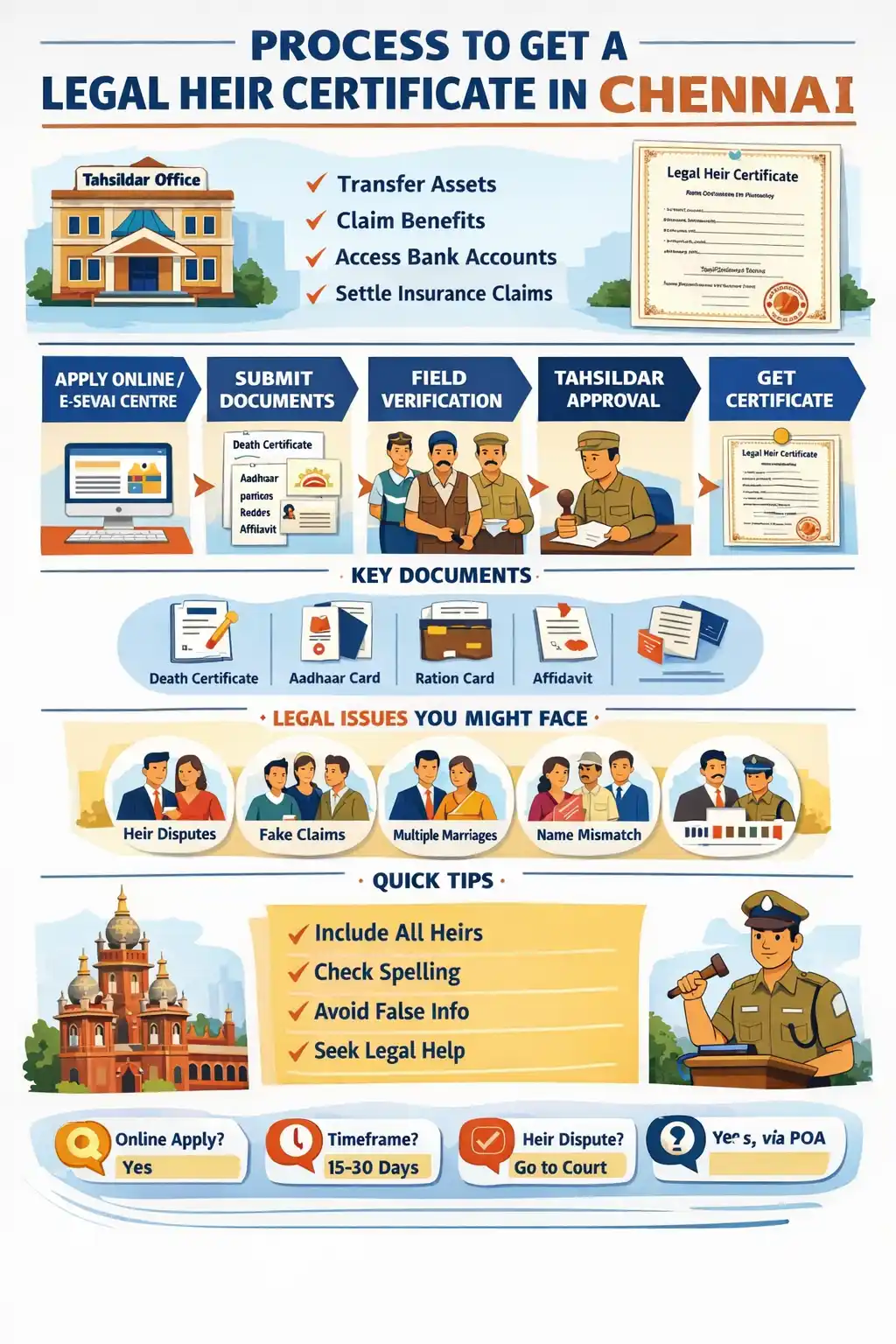
A Legal Heir Certificate serves as an official document identifying the surviving legal heirs of a deceased person. In Chennai, the Tahsildar Office issues this certificate after verifying family details and supporting records. It plays a critical role in administrative and financial matters. Therefore, individuals require it for transferring assets, claiming benefits, and updating government records.

This certificate typically applies in non-contentious situations involving inheritance and family claims. However, it does not determine ownership rights conclusively. Courts may still require a succession certificate in disputed cases. Consequently, applicants must understand its scope before relying on it for legal transactions.

Key uses include:

  • Transfer of electricity and patta records
  • Claiming pension and gratuity benefits
  • Accessing bank accounts of the deceased
  • Settling insurance claims

Step-by-Step Procedure to Apply in Chennai

Step 1: Application Through Online Portal or e-Sevai Centre

Applicants can submit their request through the Tamil Nadu e-Sevai Portal or visit nearby e-Sevai centres. The application requires accurate details of the deceased and family members. Therefore, applicants should ensure consistency with official documents before submission.

Information required includes:

  • Name and date of death of the deceased
  • Complete list of family members
  • Residential address and jurisdiction details

Step 2: Submission of Required Documents

Applicants must submit supporting documents along with the application. These documents establish identity, relationship, and residence. Moreover, authorities rely heavily on documentary proof during verification.

Essential documents include:

  • Death Certificate of the deceased
  • Aadhaar card of applicant and heirs
  • Family ration card or smart card
  • Address proof
  • Self-declaration affidavit

Even minor discrepancies in names or dates can lead to rejection.


Step 3: Field Verification by Revenue Officials

After submission, officials such as the Village Administrative Officer (VAO) and Revenue Inspector conduct field verification. They may visit the residence and interact with neighbours or local authorities. Therefore, transparency during this stage becomes crucial.

Verification involves:

  • Confirmation of family members
  • Checking authenticity of documents
  • Recording statements from neighbours

Any objection raised during this stage may delay or complicate the process.


Step 4: Approval by Tahsildar

Once verification concludes, the file reaches the Tahsildar for final decision. The Tahsildar reviews the report and supporting documents before granting approval. Consequently, the outcome depends on the completeness and accuracy of the application.

Typical timelines:

  • 15 to 30 days for straightforward cases
  • 30 to 90 days where objections exist

Step 5: Issuance of Certificate

Upon approval, the Legal Heir Certificate gets issued. Applicants can download it online or collect it from the office. The certificate lists all recognized legal heirs. Therefore, applicants should verify details immediately after issuance.


Document Checklist for Legal Heir Certificate

DocumentPurpose
Death CertificateProof of death
Aadhaar CardIdentity verification
Ration CardFamily relationship proof
Address ProofJurisdiction confirmation
AffidavitDeclaration of heirs

Legal Issues and Disputes in Chennai

Legal heir applications often trigger disputes among family members. These disputes may arise due to exclusion of heirs or false claims. Therefore, authorities exercise caution before issuing certificates.

Common legal issues include:

  • Exclusion of rightful heirs
  • Submission of false information
  • Disputes arising from multiple marriages
  • Mismatch in official records

Legal Remedies Available

When disputes arise, applicants can pursue legal remedies through appropriate forums. The Civil Procedure Code governs civil disputes, while criminal actions fall under Bharatiya Nyaya Sanhita.

Available remedies include:

  • Filing representation before Tahsildar
  • Initiating civil suit for declaration
  • Filing writ petition before Madras High Court
  • Filing police complaint in case of fraud

When Legal Heir Certificate is Not Sufficient

A Legal Heir Certificate may not suffice in certain situations. For example, banks or courts may require a succession certificate. Therefore, applicants must assess the requirement before proceeding.

Situations requiring court intervention:

  • Disputed inheritance claims
  • Recovery of debts and securities
  • Conflicts among legal heirs

Practical Tips for Applicants

Applicants should adopt a careful approach while applying for the certificate. Even small errors can cause delays or rejection. Therefore, preparation becomes essential.

Important tips:

  • Include all legal heirs without omission
  • Verify spelling consistency across documents
  • Avoid false declarations
  • Seek legal advice in complex cases

Authorities and Forums in Chennai

Applicants may approach the following authorities:

  • Tahsildar Office (Jurisdiction-based)
  • e-Sevai Centres
  • District Collector Office
  • Civil Courts for disputes
  • Police Stations for fraud complaints

Frequently Asked Questions

1. Can I apply online in Chennai?
Yes, applicants can apply through the Tamil Nadu e-Sevai Portal or authorized centres.

2. How long does the process take?
It usually takes 15 to 30 days for straightforward applications without disputes.

3. Who issues the certificate?
The Tahsildar of the concerned jurisdiction issues the Legal Heir Certificate.

4. Is an affidavit required?
Yes, a self-declaration affidavit supports the application and confirms heir details.

5. What if an heir objects?
Authorities may reject the application, requiring resolution through civil courts.

6. Are married daughters included?
Yes, married daughters are recognized as legal heirs under applicable laws.

7. Is it valid for property transactions?
It helps administratively, but courts may require additional legal documents.

8. What happens if documents mismatch?
Applicants must correct discrepancies before applying to avoid rejection.

9. Can NRIs apply?
Yes, NRIs can apply through a power of attorney holder in Chennai.

10. Is legal assistance necessary?
Legal assistance is optional but beneficial in disputed or complex cases.


This guide equips applicants in Chennai with a clear, practical, and legally sound process to obtain a Legal Heir Certificate efficiently.