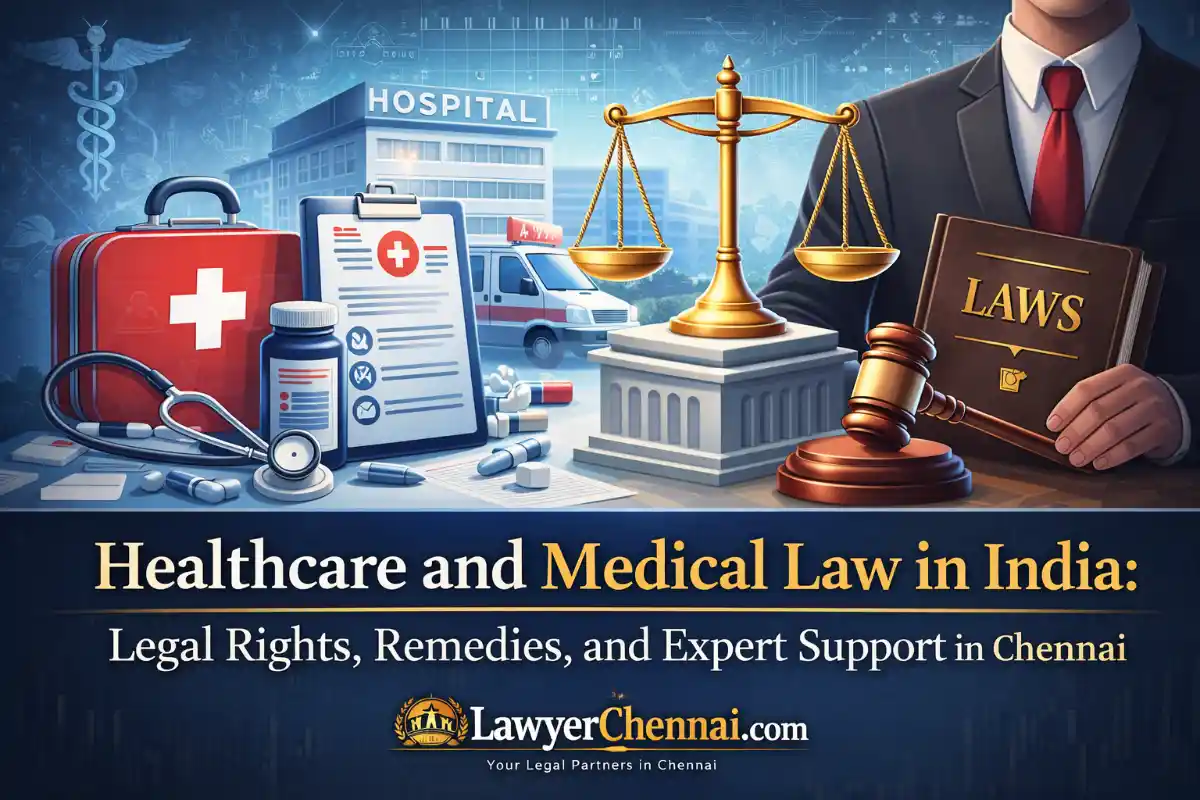
Healthcare and medical law governs the legal relationship between patients, doctors, hospitals, and regulatory bodies. In India, this area of law has gained significant prominence due to rising medical negligence claims, patient rights violations, and hospital disputes. Consequently, understanding your legal rights under Indian healthcare law is no longer optional — it is essential. The legal framework includes the Consumer Protection Act 2019, the Indian Medical Council Act 1956, the Clinical Establishments Act 2010, and the new Bharatiya Nyaya Sanhita 2023 (BNS). Additionally, the Bharatiya Nagarik Suraksha Sanhita 2023 (BNSS) governs the procedural aspects of criminal complaints against medical professionals. Therefore, every patient in Chennai and across Tamil Nadu must know their legal remedies before a medical crisis escalates.
Healthcare and Medical Law in India: Legal Rights, Remedies, Legal Helpline and Expert Support in Chennai
Understanding Healthcare and Medical Law: Scope, Framework, and Legal Jurisdiction in India
Healthcare and medical law in India covers a wide spectrum of legal issues involving clinical negligence, informed consent violations, unlicensed medical practice, and wrongful death. Furthermore, the jurisdiction for these matters spans across multiple forums, including Consumer Disputes Redressal Commissions, civil courts, criminal courts, and the National Medical Commission (NMC). The Clinical Establishments (Registration and Regulation) Act 2010 mandates the registration of all hospitals and clinics across India. However, Tamil Nadu follows the Tamil Nadu Private Clinical Establishments (Regulation) Act 1997 in addition to central regulations. Correspondingly, the Madras High Court holds supervisory jurisdiction over all healthcare legal matters arising in Tamil Nadu. Legal practitioners at LawyerChennai.com provide expert guidance on all medical law matters across Chennai, Madurai, Coimbatore, and other Tamil Nadu districts.
Types of Legal Issues Under Healthcare and Medical Law in India
Medical law disputes in India arise in several distinct categories, each requiring specialised legal knowledge and procedural strategy. Therefore, recognising the type of legal issue is the first step toward seeking appropriate legal relief. The most common types of medical law disputes include:
- Medical negligence by doctors, surgeons, or hospital staff
- Wrongful death due to improper treatment or diagnostic errors
- Lack of informed consent before surgery or invasive procedures
- Denial of emergency medical care under Article 21 of the Constitution
- Deficiency in hospital services under Consumer Protection Act 2019
- Illegal medical practice without valid MBBS or specialisation degree
- Drug administration errors causing patient harm or death
- Medical data privacy violations under the DPDP Act 2023
- Insurance claim denials by health insurance providers
- Sexual harassment of patients within hospital premises
- False medical certificates issued for illegal purposes
- Unethical clinical trials conducted without proper patient consent
Additionally, issues related to the unethical conduct of medical professionals are addressed by the National Medical Commission under the NMC Act 2020. Similarly, dental professionals are regulated under the Dentists Act 1948. Consequently, patients must carefully identify the nature of their grievance before approaching the appropriate legal forum. Expert legal support from LawyerChennai.com ensures that every client receives targeted, jurisdiction-specific legal strategy right from the outset.
Medical Negligence Law in India: Legal Standards, Proof, and BNS Provisions
Medical negligence is one of the most litigated healthcare law issues in India. Importantly, the Supreme Court in Jacob Mathew v. State of Punjab (2005) set the standard for proving criminal medical negligence. Under Section 106 of the Bharatiya Nyaya Sanhita 2023 (BNS), death caused by a negligent act is punishable with imprisonment up to five years. Furthermore, if the negligent act is committed by a registered medical practitioner, the punishment extends to two years under the proviso to Section 106 BNS. Therefore, the law recognises a professional standard of care for doctors that is distinct from ordinary negligence. Moreover, civil negligence claims can be filed simultaneously before Consumer Commissions under the Consumer Protection Act 2019 for compensation. Consequently, patients harmed by medical negligence can pursue both criminal and civil remedies simultaneously. LawyerChennai.com’s medical law team handles all stages of medical negligence litigation in Chennai.
Patient Rights Under Indian Law: Constitutional Guarantees and Statutory Protections
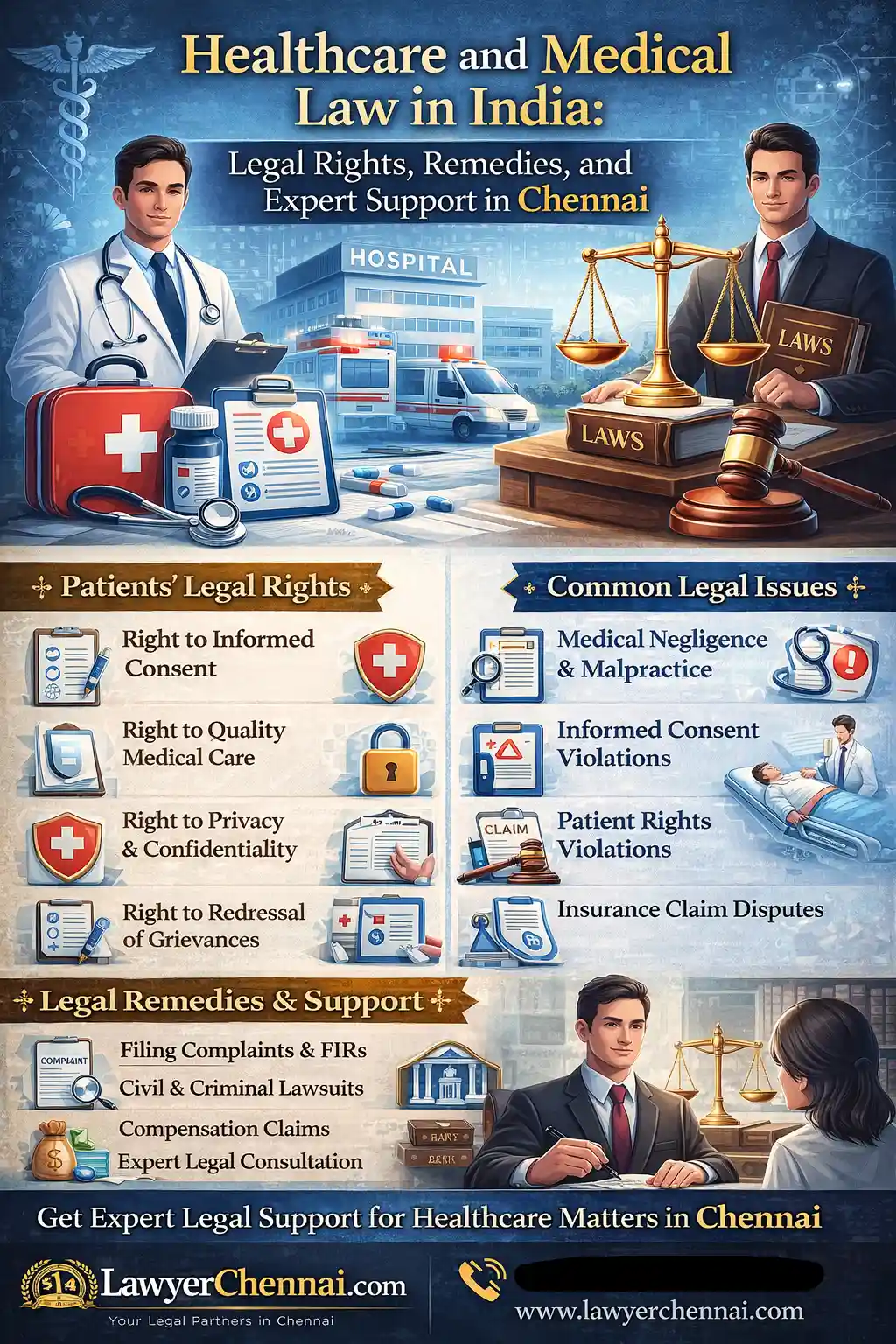
Every patient in India enjoys fundamental rights that no hospital or medical professional can lawfully violate. Primarily, Article 21 of the Constitution of India guarantees the right to life, which expressly includes the right to health and emergency medical treatment. The Supreme Court has repeatedly held that denial of emergency treatment is an unconstitutional act. Under the Consumer Protection Act 2019, every patient is also a consumer entitled to redressal for deficient medical services. Additionally, the DPDP Act 2023 protects the privacy of all patient health records and medical data. Hospitals cannot share patient data without explicit consent under the Digital Personal Data Protection Act 2023. Furthermore, under the Pre-Conception and Pre-Natal Diagnostic Techniques Act 1994 (PCPNDT Act), patients have rights against sex-selective practices. Below is a summary of key patient rights under Indian law:
| Patient Right | Legal Source | Enforcing Authority |
|---|---|---|
| Right to Emergency Treatment | Article 21, Constitution of India | High Court / Supreme Court (Writ) |
| Right to Informed Consent | Medical Council of India Ethics Regulations 2002 | National Medical Commission |
| Right to Medical Records | Consumer Protection Act 2019 / NMC Act 2020 | Consumer Commission / NMC |
| Right Against Negligent Treatment | BNS Section 106 / Consumer Protection Act 2019 | Criminal Court / Consumer Commission |
| Right to Health Data Privacy | DPDP Act 2023 | Data Protection Board of India |
| Right Against Discriminatory Treatment | Article 14 & 21, Constitution | High Court (Writ Jurisdiction) |
Furthermore, patients have the right to a second medical opinion at any stage of treatment. Therefore, hospitals cannot legally withhold records or obstruct patients from seeking second opinions. Consequently, violations of these rights attract both civil and criminal liability under Indian law.
Informed Consent in Medical Procedures: Legal Importance and Consequences of Violation
Informed consent is a cornerstone of ethical and legal medical practice in India. Specifically, the National Medical Commission’s Professional Conduct Regulations require doctors to obtain written consent before performing any surgical or invasive procedure. Failure to obtain informed consent constitutes both civil negligence and an ethical violation under medical law. Additionally, in emergency situations, the doctrine of implied consent permits treatment without express agreement. However, this implied consent provision is narrowly interpreted and cannot be misused by medical professionals.
Under the Consumer Protection Act 2019, absence of informed consent amounts to a deficiency in service. Furthermore, operating on a patient without consent may attract criminal liability under BNS Section 115 (voluntarily causing hurt) and Section 118 (grievous hurt). Therefore, obtaining proper documented consent is not merely a formality — it is a mandatory legal obligation. Patients who undergo procedures without proper consent can seek compensation before the District Consumer Disputes Redressal Commission in Chennai.
Hospital Liability and Corporate Medical Negligence: Legal Accountability Under Indian Law
In contemporary Indian healthcare, hospitals and corporate medical entities bear direct and vicarious liability for the negligent acts of their employees. Therefore, a patient need not limit their claim to the individual treating doctor. The principle of vicarious liability under Section 2(47) of the Consumer Protection Act 2019 makes hospitals liable as service providers. Additionally, under BNS Section 106 read with BNSS Section 35, criminal complaints can be filed against hospital administrators for negligent systemic failures. Furthermore, the Tamil Nadu Private Clinical Establishments Act 1997 imposes direct regulatory obligations on private hospitals in Chennai. Consequently, corporate hospital chains are increasingly being held liable in consumer forums across India. The key grounds for hospital liability include:
- Failure to maintain sterile surgical environments causing post-operative infections
- Inadequate nursing care leading to patient deterioration
- Faulty medical equipment causing patient injury during procedures
- Improper credentialing of doctors employed by the hospital
- Delay in treatment due to administrative insurance or payment disputes
- Failure to maintain accurate and complete medical records
Moreover, hospitals must comply with NABH accreditation standards and the Central Drugs Standard Control Organisation (CDSCO) guidelines for drug usage. Therefore, regulatory non-compliance strengthens a patient’s legal claim significantly. LawyerChennai.com represents patients in all hospital liability claims before Chennai’s Consumer Commissions and the Madras High Court.
Competent Forums and Courts for Medical Law Disputes in Chennai and Tamil Nadu
Choosing the right legal forum is critical for an effective medical law remedy in India. Therefore, understanding the jurisdiction of each forum saves time, cost, and procedural effort. The forums available for medical law disputes in Chennai and Tamil Nadu are as follows:
| Forum / Court | Jurisdiction / Claim Type | Location |
|---|---|---|
| District Consumer Disputes Redressal Commission (DCDRC) | Claims up to ₹50 Lakhs — deficiency in medical services | Chennai District, George Town |
| State Consumer Disputes Redressal Commission (SCDRC) | Claims ₹50 Lakhs to ₹2 Crores | Chennai (Nandanam) |
| National Consumer Disputes Redressal Commission (NCDRC) | Claims above ₹2 Crores | New Delhi |
| Madras High Court | Writ petitions, supervisory jurisdiction, criminal appeals | Chennai (High Court Campus) |
| Chief Judicial Magistrate Court | Criminal complaints under BNS / BNSS against doctors | Chennai City Courts Complex, Parry’s |
| National Medical Commission (NMC) | Professional misconduct, licence cancellation | New Delhi (Online Complaint Portal) |
| Tamil Nadu Medical Council (TNMC) | Ethical complaints against Tamil Nadu-registered doctors | Chennai |
| Data Protection Board of India | Patient data privacy violations under DPDP Act 2023 | New Delhi (Online) |
Furthermore, for criminal matters arising from gross medical negligence, complaints can be lodged at the nearest police station. Consequently, in Chennai, the jurisdictional police stations for hospital areas include Kilpauk Police Station (for Kilpauk Medical College area), Royapettah Police Station (for Apollo and Kauvery hospital zone), Egmore Police Station (for Government General Hospital area), and Anna Nagar West Police Station (for Fortis and other private hospitals in the zone). Therefore, knowing the jurisdictional police station enables faster and more targeted complaint filing.
Legal Remedies Available to Patients: Compensation, Prosecution, and Regulatory Action
Indian medical law offers a comprehensive range of remedies to patients who have suffered harm due to negligent or unethical medical practice. Primarily, civil compensation is available through Consumer Commissions under the Consumer Protection Act 2019. Additionally, criminal prosecution under BNS Section 106 (negligent death) and BNS Section 115 (voluntarily causing hurt) provides a penal remedy. Furthermore, disciplinary proceedings before the National Medical Commission or Tamil Nadu Medical Council can result in suspension or permanent cancellation of a doctor’s licence. Regulatory complaints can also be filed with the Clinical Establishments Registering Authority under the Tamil Nadu Private Clinical Establishments Act 1997. Moreover, writ petitions under Articles 226 and 32 of the Constitution are available for violations of fundamental rights such as denial of emergency treatment. Therefore, the full spectrum of legal remedies includes:
- Monetary compensation for pain, suffering, and medical expenses before Consumer Commission
- Criminal prosecution for negligent death or grievous hurt under BNS 2023
- Licence suspension or cancellation before NMC or Tamil Nadu Medical Council
- Writ petition before Madras High Court for violation of Article 21 rights
- Complaint to CDSCO for unauthorised drug use or medical device malfunction
- Complaint to Insurance Ombudsman for wrongful denial of health insurance claims
- Data privacy complaint to the Data Protection Board under DPDP Act 2023
- Civil suit for damages in District or High Court for tortious liability
Consequently, patients must approach an experienced medical law attorney to determine the optimal combination of remedies. LawyerChennai.com’s legal team in Chennai provides expert multi-forum strategy for all healthcare law disputes.
Drug Regulation, Pharmaceutical Liability, and Patient Safety Law in India
India’s pharmaceutical and drug regulatory framework directly impacts patient safety and healthcare law. Primarily, the Drugs and Cosmetics Act 1940 and its corresponding Rules govern the manufacture, distribution, and administration of drugs in India. Additionally, the Central Drugs Standard Control Organisation (CDSCO) under the Ministry of Health and Family Welfare is the apex regulatory authority.
Under the Drugs and Cosmetics Act, prescribing or administering spurious, adulterated, or misbranded drugs attracts criminal penalties. Furthermore, Schedule H and Schedule X of the Drugs Rules 1945 regulate the prescription-only sale of powerful medicines, including opioids and sedatives. Consequently, pharmacists who dispense these drugs without a valid prescription are liable under Indian law. Under BNS Section 304 (culpable homicide), administering a wrong drug resulting in death can attract up to ten years of imprisonment. Therefore, pharmaceutical liability is a serious legal risk for both doctors and pharmacies. LawyerChennai.com handles all drug-related liability and pharmaceutical negligence claims in Chennai and across Tamil Nadu.
Health Insurance Disputes and Legal Remedies Under IRDAI Regulations
Health insurance disputes represent a rapidly growing category of medical law litigation in India. Primarily, wrongful denial of cashless treatment, delayed claim settlement, and arbitrary policy repudiation are the most common complaints.
The Insurance Regulatory and Development Authority of India (IRDAI) has issued comprehensive guidelines for health insurance claim settlements. Furthermore, under the Consumer Protection Act 2019, insurance companies are classified as service providers, making them directly liable for deficiency in claim processing. Additionally, the Insurance Ombudsman under the Redressal of Public Grievances Rules 1998 provides a cost-free alternate dispute resolution mechanism. Significantly, the IRDAI Master Circular on Health Insurance 2023 mandates that insurance companies settle all claims within thirty days of receiving complete documentation. Therefore, delays beyond thirty days attract interest penalties on the insurer. Moreover, fraud by insurance companies in rejecting valid claims constitutes a criminal offence under BNS Section 318 (cheating). Consequently, policyholders have strong legal remedies across multiple forums.
LawyerChennai.com assists clients in filing consumer complaints, insurance ombudsman petitions, and civil suits against insurance companies in Chennai.
Mental Health Law in India: Rights of Patients Under the Mental Healthcare Act 2017
Mental health law is a specialised and often overlooked branch of healthcare and medical law in India. Importantly, the Mental Healthcare Act 2017 (MHCA) completely overhauled the legal framework for persons with mental illness. Under Section 18 of the MHCA, every person has the right to access mental healthcare and treatment. Furthermore, the MHCA prohibits chaining, restraining, or subjecting mentally ill patients to cruel or inhumane treatment. Consequently, violations of these rights attract penalties under the Act as well as under BNS Section 115 (voluntarily causing hurt). Additionally, the MHCA mandates the establishment of Mental Health Review Boards in every state, including Tamil Nadu, to safeguard patient rights.
The Tamil Nadu Mental Health Authority, constituted under the Act, oversees compliance by all mental health establishments in the state. Therefore, unlawful admission, wrongful confinement, or forced treatment of mentally ill persons is a punishable offence. Moreover, the MHCA specifically decriminalises suicide attempt, bringing it in alignment with the humane approach under BNS Section 226. LawyerChennai.com provides dedicated legal support for mental health law matters across Tamil Nadu.
Government Departments and Regulatory Authorities Governing Healthcare in India and Tamil Nadu
Multiple government departments and regulatory authorities play a crucial role in enforcing healthcare law in India. Therefore, knowing the right authority to approach ensures faster and more effective legal action. The key departments and authorities include:
- Ministry of Health and Family Welfare, Government of India — apex policy-making body for national healthcare laws
- National Medical Commission (NMC) — regulates medical education and professional conduct of doctors under NMC Act 2020
- Central Drugs Standard Control Organisation (CDSCO) — regulates drugs, medical devices, and clinical trials
- Insurance Regulatory and Development Authority of India (IRDAI) — governs all health insurance companies and their claim practices
- Tamil Nadu Health and Family Welfare Department — administers government hospitals, Tamil Nadu Medical Council, and clinical establishment registration in Tamil Nadu
- Tamil Nadu Medical Council (TNMC) — registers doctors practising in Tamil Nadu and handles disciplinary proceedings
- Tamil Nadu Nurses and Midwives Council — regulates nursing professionals across Tamil Nadu
- Food Safety and Standards Authority of India (FSSAI) — regulates food supplements, nutraceuticals, and medical nutrition products
- Data Protection Board of India — enforces the DPDP Act 2023 for patient data privacy violations
- National Commission for Women (NCW) — handles cases of gender-based medical exploitation and female patient rights violations
Additionally, the Directorate of Medical Education, Tamil Nadu, oversees the quality and standards of government medical institutions. Consequently, complaints against government hospital negligence can also be routed through the Tamil Nadu Health Secretary’s office under the Right to Public Services Act. Therefore, the multi-layered regulatory architecture in India provides several parallel avenues for effective healthcare law enforcement.
Clinical Establishments Act, Telemedicine Law, and Emerging Healthcare Regulations in India
The rapid growth of telemedicine, digital health, and corporate hospital chains has created new frontiers in healthcare and medical law in India. Importantly, the Telemedicine Practice Guidelines 2020, issued by the Board of Governors of the National Medical Commission, govern all digital and remote medical consultations.
Under these guidelines, only registered medical practitioners are permitted to conduct telemedicine consultations. Furthermore, informed consent must be obtained digitally before a telemedicine consultation begins. Additionally, the National Digital Health Mission (NDHM) under the Ayushman Bharat Digital Mission 2021 is creating a unified digital health ID ecosystem. Consequently, patient data generated through digital health platforms is fully governed by the DPDP Act 2023. Moreover, the Clinical Establishments (Registration and Regulation) Act 2010 covers all types of clinical establishments including telemedicine service providers. Therefore, non-compliant telemedicine operators face both regulatory action and criminal liability under BNS. LawyerChennai.com advises hospitals, clinics, and digital health startups on regulatory compliance across India.
Furthermore, the Indian Transplantation of Human Organs and Tissues Act 1994 (THOTA) governs organ donation and transplantation, creating strict legal safeguards against organ trafficking.
Violations of THOTA attract imprisonment up to ten years under Section 18 of the Act. Additionally, the Pre-Conception and Pre-Natal Diagnostic Techniques Act 1994 (PCPNDT Act) prohibits sex determination and sex-selective abortion, with offenders facing up to five years of imprisonment. Consequently, patients subjected to illegal sex determination can seek legal remedies before the PCPNDT Appropriate Authority in each district. Moreover, the Epidemic Diseases Act 1897, as amended in 2020, creates special legal protections for healthcare workers during disease outbreaks, specifically criminalising violence against medical personnel under BNS provisions. Therefore, the healthcare regulatory landscape in India is continuously evolving, demanding constant legal vigilance from both patients and medical professionals.
LawyerChennai.com stays at the forefront of these regulatory developments, offering proactive compliance advice and reactive litigation support across Tamil Nadu.
Read More
- Conquer the best Chennai’s Law Labyrinth: Your Legal FAQ Guide
- Corporate Manslaughter, Health & safety: How to find the Best Lawyers?
- Medical Negligence Appeals: Appealing medical negligence judgments
- Clinical Negligence & Personal Injury
- How to Get a Divorce by Mutual Consent?