

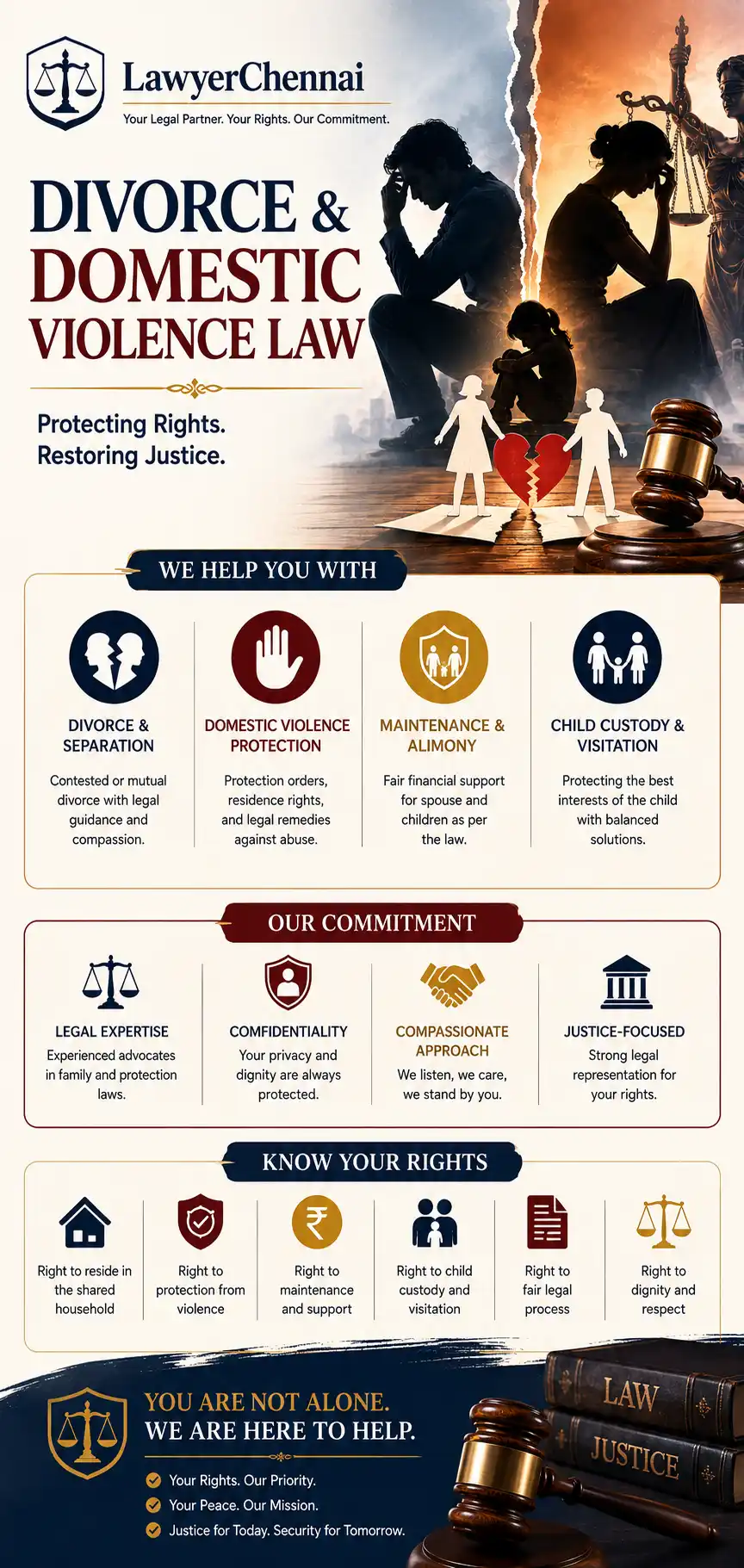
Divorce and domestic violence are two of the most emotionally devastating legal challenges anyone can face. Fortunately, Indian law provides comprehensive protection and remedies for victims. The Bharatiya Nyaya Sanhita (BNS) 2023, the Bharatiya Nagarik Suraksha Sanhita (BNSS) 2023, and the Bharatiya Sakshya Adhiniyam (BSA) 2023 have modernised India’s legal landscape significantly. Additionally, the Protection of Women from Domestic Violence Act, 2005 (PWDVA) remains a cornerstone statute. This guide explains your rights clearly and practically. Understanding these laws empowers you to take informed action. Courts across Chennai actively enforce these protections. Simultaneously, family courts, magistrate courts, and the Madras High Court hear matrimonial disputes regularly. Legal support from a qualified advocate ensures you navigate every stage confidently. Victims of domestic violence deserve immediate, effective justice. Therefore, knowing your legal rights is the first step toward safety and dignity.
Divorce and Domestic Violence Law in India: Your Complete Legal Guide
Understanding Divorce Law Under Indian Personal Laws and the BNS 2023
India’s divorce law operates through multiple personal law statutes based on religion and community. The Hindu Marriage Act, 1955 governs Hindus, Buddhists, Jains, and Sikhs comprehensively. The Muslim Personal Law (Shariat) Application Act, 1937 governs Muslim matrimonial matters. The Indian Divorce Act, 1869 applies to Christians seeking dissolution. The Special Marriage Act, 1954 covers inter-religion and civil marriages effectively. Moreover, the Parsi Marriage and Divorce Act, 1936 governs the Parsi community distinctly. The BNS 2023 replaced the Indian Penal Code, 1860, criminalising matrimonial cruelty under Section 85 and 86. These sections directly replace the former IPC Section 498A framework. Importantly, cruelty includes both physical and mental harassment comprehensively. Courts interpret mental cruelty broadly to include emotional abuse, financial deprivation, and humiliation. Understanding which personal law applies to your case is therefore fundamental to any divorce proceeding.

Grounds for Divorce Recognised by Indian Courts
Indian courts recognise several well-established grounds for granting divorce to aggrieved spouses. These grounds vary slightly across personal laws but share common principles of justice. Knowing these grounds helps you assess your legal position accurately and confidently.
- Adultery – Voluntary sexual intercourse with a person other than the spouse.
- Cruelty – Physical or mental cruelty making cohabitation unsafe or unreasonable.
- Desertion – Abandonment without reasonable cause for two or more years continuously.
- Conversion – Change of religion by one spouse without the other’s consent.
- Mental Disorder – Incurable insanity or serious mental illness affecting marital life.
- Leprosy or Venereal Disease – Virulent and incurable communicable disease (where applicable).
- Renunciation – Entering a religious order and renouncing the world entirely.
- Presumption of Death – Spouse not heard of for seven or more years.
- Mutual Consent – Both parties agree to dissolve the marriage voluntarily.
Furthermore, under the Hindu Marriage Act, wives have additional grounds including husband’s second marriage and rape, sodomy, or bestiality. Family courts in Chennai regularly adjudicate these matters with due diligence. Consequently, filing with proper documentation strengthens your case considerably. Legal counsel ensures all grounds are correctly pleaded and supported with sufficient evidence under the BSA 2023.
Types of Divorce Proceedings Available in Indian Family Courts
Indian law offers two primary types of divorce proceedings: contested divorce and mutual consent divorce. Contested divorce involves one spouse filing against the other on proven legal grounds. Mutual consent divorce requires both parties to agree on separation, maintenance, and custody terms. Under the Hindu Marriage Act Section 13-B, a waiting period of six months applies after the first motion. However, the Supreme Court has recently waived this cooling-off period in genuine cases. The BNSS 2023 streamlines trial procedures for matrimonial offences significantly. Contested divorces are typically heard by Family Courts established under the Family Courts Act, 1984. Chennai has well-functioning Family Courts at Allikulam and Anna Salai handling thousands of cases annually. Additionally, district courts exercise jurisdiction where family courts are not constituted. Mediation has also emerged as a preferred alternative dispute resolution method in matrimonial disputes across Tamil Nadu.
| Type of Divorce | Applicable Law | Minimum Duration | Forum |
|---|---|---|---|
| Mutual Consent Divorce | Hindu Marriage Act S.13-B | 6 months (waivable) | Family Court |
| Contested Divorce | Hindu Marriage Act S.13 | 1–3 years typically | Family Court / District Court |
| Christian Divorce | Indian Divorce Act 1869 | Varies | District Court / High Court |
| Muslim Divorce (Talaq) | Muslim Personal Law | Varies | Civil Court |
| Triple Talaq (Criminalised) | Muslim Women Protection Act 2019 | N/A | Magistrate Court / Family Court |
| Inter-religion Divorce | Special Marriage Act 1954 | Varies | District Court / Family Court |
Domestic Violence Law in India: Protection, Rights, and Remedies Under PWDVA and BNS 2023
The Protection of Women from Domestic Violence Act, 2005 (PWDVA) is India’s most powerful civil law protecting women from domestic abuse. Additionally, the BNS 2023 strengthens criminal prosecution of domestic violence offenders significantly. Section 85 of the BNS 2023 punishes cruelty by husband or relatives with imprisonment up to three years. Section 86 defines cruelty broadly to include harassment for dowry and willful conduct causing grave injury. Consequently, victims now have both civil and criminal remedies available simultaneously. The PWDVA covers physical, sexual, verbal, emotional, and economic abuse comprehensively. Shared household rights under PWDVA allow women to continue residing in the matrimonial home legally. Protection Officers appointed under the Act assist victims in filing complaints and accessing services. Furthermore, Service Providers registered under PWDVA offer shelter, legal aid, and medical assistance immediately. Understanding these dual frameworks empowers domestic violence survivors to seek full and complete justice.
Types of Domestic Violence Recognised Under Indian Law
Indian law recognises multiple forms of domestic violence that courts take seriously and address legally. Victims must understand all recognised forms to document and report their experiences effectively. Both physical and non-physical forms of abuse are legally actionable under current Indian law.
Physical Abuse and Its Legal Consequences
Physical abuse includes any act causing bodily pain, harm, or danger to life or health of the victim. This covers beating, slapping, pushing, kicking, burning, and using weapons against the victim. Under BNS Section 85, physical cruelty by a husband or his relatives is a cognisable offence. Police must register an FIR upon receiving a domestic violence complaint immediately and without delay. The BNSS 2023 mandates prompt investigation and trial in such cases efficiently. Magistrates can grant emergency protection orders on the same day of application urgently. Medical evidence, photographs, and witness statements are valuable proof under BSA 2023 provisions. Hospital records documenting injuries are admissible and significant pieces of evidence in court. Moreover, the victim can simultaneously pursue civil remedies under PWDVA and criminal action under BNS together. Therefore, victims should report every incident to police and seek immediate medical attention without hesitation.
Sexual Abuse Within Marriage: Legal Position Under BNS 2023
Sexual abuse within a domestic relationship is explicitly covered under the PWDVA 2005. Section 3(a) of PWDVA defines sexual abuse as any conduct that humiliates, degrades, or violates the victim’s dignity. Marital rape remains a contested legal issue in India currently and lacks explicit criminalisation in BNS. However, courts have broadly interpreted cruelty to include forced sexual acts within marriage. Importantly, the Protection Officer can record the victim’s statement and forward it to the magistrate immediately. The magistrate may grant a Protection Order preventing further sexual abuse quickly. Additionally, Women’s Helpline (181) and One Stop Crisis Centres (OSCCs) provide immediate support and medical assistance. Police stations with Women Protection Cells in Chennai handle such complaints with sensitivity. Furthermore, legal aid under TNSLSA (Tamil Nadu State Legal Services Authority) is freely available to all victims. Victims are strongly encouraged to seek legal help without delay or fear of social stigma.
Emotional and Verbal Abuse: A Legally Recognised Form of Domestic Violence
Verbal and emotional abuse is legally recognised under Section 3(b) of the PWDVA 2005 explicitly. This includes insults, ridicule, humiliation, name-calling, and threats causing mental suffering to the victim. Repeated verbal assaults affecting the victim’s mental health constitute emotional cruelty under BNS Section 85. Courts have consistently held that emotional cruelty can be a standalone ground for divorce proceedings. Importantly, audio recordings and witness testimonies are admissible as evidence under BSA 2023 provisions. Victims should maintain a detailed diary recording all incidents with dates and witnesses methodically. WhatsApp messages, emails, and social media posts are valid documentary evidence under BSA provisions. Additionally, psychiatric and psychological evaluations confirming mental trauma strengthen the victim’s case significantly. Counsellors and psychologists at Government Hospitals and NGOs provide professional support to abuse survivors effectively. Therefore, emotional abuse victims must not minimise their suffering but instead document and report it immediately.
Economic Abuse: Controlling Finances as a Form of Domestic Violence
Economic abuse involves denying, restricting, or controlling the victim’s access to financial resources and assets. Section 3(iv) of PWDVA explicitly recognises economic abuse as a form of domestic violence. This includes preventing the victim from earning income, accessing bank accounts, or owning property. Disposing of jointly owned assets without the victim’s consent also constitutes economic abuse legally. Courts can grant Monetary Relief orders under PWDVA Section 20 covering loss of earnings promptly. Such relief includes medical expenses, loss of property, and maintenance for the victim and children. Simultaneously, maintenance under CrPC (now BNSS Section 144) may be sought before the magistrate efficiently. Family courts also have jurisdiction to award interim maintenance during divorce proceedings swiftly. Additionally, Hindu women can claim Stridhan recovery through civil suits before district courts independently. Economic abuse victims must preserve all financial records, bank statements, and property documents carefully as evidence.
Dowry Harassment and the Law: BNS Section 84 and Dowry Prohibition Act
Dowry-related harassment is one of the gravest matrimonial offences recognised under Indian law today. BNS Section 84 replaces IPC Section 304-B, penalising dowry death with rigorous imprisonment of 7 years to life. BNS Section 85 addresses cruelty connected to unlawful dowry demands from husband or relatives. The Dowry Prohibition Act, 1961 bans giving, taking, and demanding dowry completely and unconditionally.
Violations attract imprisonment up to five years and fines up to Rs.15,000 or the dowry value. Police are legally obligated to register FIRs for dowry harassment complaints without delay or discrimination. The BNSS 2023 mandates arrest of accused persons in cognisable dowry offences promptly. Additionally, Section 113-B of BSA 2023 creates a presumption against the accused in dowry death cases strongly. National Crime Records Bureau (NCRB) data shows thousands of dowry cases reported annually across India. Victims and their families must report dowry demands immediately to the nearest police station without hesitation.
Legal Remedies Available to Domestic Violence and Divorce Victims
Indian law provides a wide spectrum of legal remedies to victims of domestic violence and matrimonial abuse. These remedies operate through both civil courts and criminal courts simultaneously. Victims may pursue multiple remedies at the same time without any legal bar or restriction. Choosing the right combination of remedies maximises protection and ensures comprehensive justice for the survivor. Qualified legal counsel helps identify the most effective remedies for each specific factual situation. Courts in Chennai are well-versed in handling complex matrimonial and domestic violence cases efficiently. Simultaneously, tribunals and magistrate courts provide quick interim relief pending full trial proceedings. Legal aid is freely available to economically weaker victims through TNSLSA and NALSA schemes. Therefore, no victim should be deterred from seeking justice due to financial constraints or social pressure. Every remedy exists to restore dignity, safety, and legal rights to the aggrieved person completely.
Protection Orders Under PWDVA: Immediate Safety for Victims
A Protection Order under Section 18 of PWDVA prohibits the respondent from committing further acts of violence. Courts can pass ex-parte Protection Orders on the same day of application in urgent situations. The order prevents the respondent from entering the victim’s workplace, school, or residence area. Breach of a Protection Order is a cognisable and non-bailable offence under PWDVA Section 31 strictly.
Police must arrest the respondent immediately upon receiving a complaint of breach effectively. Protection Officers are designated to monitor compliance with orders and assist victims proactively. Residence Orders under Section 19 ensure the woman’s right to remain in the shared household legally. No-contact orders and restraining orders are also regularly granted by magistrates in Chennai courts. Additionally, Interim Protection Orders may be issued pending the final disposal of the main petition. These orders provide immediate and tangible safety to domestic violence victims without delay or procedural hurdles.
Maintenance and Financial Support: Rights of Divorced and Separated Women
Maintenance is a critical financial remedy available to wives during and after divorce proceedings in India. Section 144 of BNSS 2023 (replacing CrPC Section 125) provides maintenance to wives, children, and parents efficiently. Family courts can award interim maintenance from the date of filing the application itself immediately. Under the Hindu Adoption and Maintenance Act, 1956, Hindu wives have an independent right to maintenance.
The Supreme Court has repeatedly held that maintenance must meet the wife’s reasonable standard of living adequately. Furthermore, Muslim women can claim maintenance under the Muslim Women (Protection of Rights on Divorce) Act, 1986. Christian women seek maintenance under the Indian Divorce Act before district courts directly. Permanent alimony is awarded upon final dissolution of marriage under each personal law respectively.
Courts consider husband’s income, wife’s earnings, assets, and lifestyle while determining fair maintenance quantum. Victims of domestic violence are additionally entitled to Monetary Relief under PWDVA Section 20 comprehensively.
Child Custody and Guardianship in Divorce and Domestic Violence Cases
Child custody is often the most contested and emotionally significant issue in matrimonial disputes. Indian courts apply the paramount principle that the child’s welfare supersedes all other considerations in custody decisions. The Guardians and Wards Act, 1890 governs custody of children across all religions uniformly. Family courts in Chennai have jurisdiction to decide custody, visitation, and guardianship applications together. Interim custody orders can be secured quickly when a domestic violence situation endangers the child. Notably, courts have denied custody to parents with a history of domestic violence consistently and firmly. Psychological evaluations of children are increasingly used by courts in contested custody cases today.
Visitation rights for the non-custodial parent are carefully balanced with the child’s safety needs judiciously. International child custody disputes are governed by the Hague Convention principles though India is not yet a signatory. Legal guidance from a family law advocate ensures child custody arrangements prioritise the child’s best interests effectively.
Filing a Domestic Violence Complaint: Step-by-Step Legal Process
Filing a domestic violence complaint in India involves clear procedural steps that victims should understand thoroughly. Following the correct procedure ensures your complaint is legally sound and effectively prosecuted by authorities.
- Step 1 – Contact Police or Protection Officer: Visit the nearest police station or approach the District Protection Officer immediately upon experiencing violence.
- Step 2 – File an FIR or Domestic Incident Report (DIR): A DIR is filed under PWDVA; an FIR is filed for criminal offences under BNS at the police station.
- Step 3 – Medical Examination: Seek immediate medical care and preserve all injury records, prescriptions, and hospital documents carefully.
- Step 4 – Approach a Magistrate: File an application under PWDVA before the Judicial Magistrate First Class (JMFC) in the jurisdictional area.
- Step 5 – Seek Interim Orders: Request interim Protection Orders, Residence Orders, and Monetary Relief from the magistrate on an urgent basis.
- Step 6 – Engage a Legal Advocate: Hire a qualified family law advocate to represent your interests in all court proceedings effectively.
- Step 7 – Attend Hearings and Follow Up: Attend all scheduled court hearings, produce evidence, and ensure the respondent complies with court orders.
- Step 8 – Enforcement of Orders: If orders are violated, file a breach complaint immediately with the police or directly before the magistrate.
Jurisdictions, Courts, Forums, and Government Departments Handling Divorce and Domestic Violence in Chennai
Chennai has a well-structured legal infrastructure to address divorce and domestic violence cases comprehensively. Multiple courts, forums, and government departments work in coordination to deliver justice to victims efficiently. The Family Court at Allikulam, Chennai, is the primary forum for matrimonial disputes and divorce petitions. The Madras High Court exercises appellate jurisdiction over all family court decisions in Tamil Nadu. Judicial Magistrate Courts across Chennai hear PWDVA applications and BNS-based criminal complaints.
District Legal Services Authorities (DLSA) and TNSLSA provide free legal aid to eligible victims promptly. Government-run One Stop Crisis Centres at hospitals provide immediate medical, legal, and counselling support. The Tamil Nadu Women Development Corporation runs Mahalir Thittam centres assisting domestic violence survivors statewide. All India Women’s Helpline (181) operates 24/7 providing immediate crisis intervention and referral services. Police Stations with Women Protection Cells handle domestic violence complaints with trained personnel and sensitivity. Therefore, victims in Chennai have comprehensive institutional support available to them at every stage.
Key Police Stations and Women’s Help Desks in Chennai Handling Domestic Violence
Chennai Police operates dedicated Women Protection Cells and All Women Police Stations across the city. These stations are specifically equipped to handle domestic violence, matrimonial cruelty, and dowry harassment cases. Victims are encouraged to approach the nearest Women Police Station without hesitation for immediate assistance and safety.
| Station / Cell | Location / Area | Jurisdiction | Key Function |
|---|---|---|---|
| All Women Police Station (AWPS) – Egmore | Egmore, Chennai | Central Chennai | DV Complaints, FIR, Rescue |
| All Women Police Station – Anna Nagar | Anna Nagar, Chennai | North-West Chennai | DV Complaints, FIR, Child Protection |
| All Women Police Station – Adyar | Adyar, Chennai | South Chennai | DV Complaints, Maintenance Issues |
| Women Protection Cell – Commissioner’s Office | Vepery, Chennai | City-Wide | Escalated Cases, Monitoring |
| Anti-Dowry Cell – CBCID | Chennai | State-Wide | Dowry Death, Harassment Investigation |
| Women Helpline | Toll-Free 181 | State-Wide | Crisis Intervention, Referral |
Role of Family Courts, Magistrate Courts, and the Madras High Court
Family Courts in Chennai play a central role in resolving matrimonial disputes, divorce petitions, and custody battles. Established under the Family Courts Act, 1984, these courts focus on conciliation and speedy resolution simultaneously. Importantly, Family Courts discourage adversarial litigation and actively promote mediation and counselling between parties. Magistrate Courts (JMFC) exercise jurisdiction over PWDVA applications and criminal complaints under BNS provisions. These courts can issue urgent orders on the same day in emergency domestic violence situations quickly.
The Madras High Court hears matrimonial appeals, revision petitions, and writs challenging lower court orders efficiently. Additionally, the High Court has original jurisdiction over certain matrimonial matters under its Letters Patent jurisdiction. Sessions Courts in Chennai hear trial proceedings for serious matrimonial offences like dowry death under BNS. Tribunals and Lok Adalats also play a valuable role in settling matrimonial disputes through negotiated settlements amicably. Therefore, the judicial hierarchy in Chennai provides multiple access points for domestic violence and divorce victims.
Legal Aid and Free Services Available to Domestic Violence Victims in Tamil Nadu
Domestic violence victims who cannot afford legal representation are entitled to free legal aid under the Legal Services Authorities Act, 1987. Tamil Nadu State Legal Services Authority (TNSLSA) provides free lawyers, court fee exemptions, and legal advice to eligible victims. Eligibility includes women victims of domestic violence, women below the poverty line, and scheduled caste and other similar group members. Additionally, National Legal Services Authority (NALSA) schemes support free legal aid across India comprehensively. DLSA offices in Chennai districts coordinate free legal representation in family courts and magistrate courts. NGOs such as SNEHA, Majlis Pathways, and Tamil Nadu Resource Centre for Women provide paralegal and legal support. Government Shelter Homes in Tamil Nadu accept domestic violence survivors and offer temporary safe accommodation.
One Stop Centres at Government Hospitals provide integrated support covering medical, police, legal, and psychological assistance simultaneously. Importantly, all these services are completely free and confidential for genuine victims in need. Therefore, financial limitations should never prevent a domestic violence victim from accessing justice and safety.
Role of Protection Officers and Service Providers Under PWDVA
Protection Officers (POs) play a vital linking role between domestic violence victims and the legal system under PWDVA. They are appointed by the State Government under Section 8 of the PWDVA in every district across India. POs assist victims in filing Domestic Incident Reports (DIRs) before the magistrate quickly and accurately. They coordinate with service providers, police, and courts to ensure the victim receives comprehensive support. Additionally, POs facilitate access to shelter homes, legal aid, and medical facilities for the victim promptly. Registered Service Providers under Section 10 of PWDVA include NGOs and healthcare facilities assisting victims effectively. These organisations provide shelter, counselling, medical facilities, and legal aid to survivors comprehensively. Importantly, POs are legally bound to act within specific timelines under PWDVA rules nationally.
Tamil Nadu has designated Protection Officers in all districts, including Chennai and surrounding areas. Consequently, victims should directly approach the nearest PO or Women and Child Development Department office immediately upon experiencing violence.
How Digital Evidence and Social Media Are Used in Domestic Violence and Divorce Cases
The BSA 2023 (replacing the Indian Evidence Act, 1872) significantly modernises the law on digital evidence in India. Electronic records, including WhatsApp messages, emails, call recordings, and social media posts, are now admissible evidence. Section 57 of BSA 2023 deals with the admissibility of electronic records in all court proceedings comprehensively. Courts regularly accept screenshots, voice recordings, and CCTV footage in domestic violence and divorce cases. Importantly, evidence must be preserved carefully and produced with proper certification under Section 63 of BSA 2023.
Tampering with or deleting digital evidence constitutes an offence punishable under applicable BNS provisions. Digital forensic experts are increasingly engaged by advocates to authenticate and analyse electronic evidence professionally. Victims are advised to immediately save and backup all threatening messages, call recordings, and violent content securely. Furthermore, courts have granted Protection Orders based primarily on digital evidence produced before them successfully. Therefore, preserving digital evidence from the very first instance of abuse is critically important for building a strong legal case.
Why Expert Legal Representation Matters in Divorce and Domestic Violence Cases
Navigating divorce and domestic violence law without expert legal representation is extremely challenging and risky. Indian matrimonial law is complex, multi-layered, and involves multiple simultaneous proceedings in different courts. An experienced family law advocate protects your rights at every stage of the legal process effectively. Expert advocates draft petitions, applications, and affidavits with precision ensuring no procedural lapses occur.
They negotiate settlements in maintenance, property division, and custody matters on your behalf strategically. Importantly, they represent you confidently in court hearings, cross-examinations, and arguments before judges professionally. Additionally, advocates coordinate between police, Protection Officers, and courts to ensure rapid enforcement of orders. Victims who represent themselves are frequently disadvantaged due to procedural complexities and lack of legal knowledge. Comprehensive legal support also provides emotional reassurance and guidance throughout an otherwise traumatic process. Therefore, engaging a skilled family law advocate in Chennai is the most important step any victim can take proactively.
Read More
- Family Court Advocates in Chennai: How To Resolve The Matrimonial Disputes?
- How to defend a Domestic violence case?
- Find the Best Divorce Lawyers in Chennai