

Labour and Industrial Relations Law governs the workplace rights of millions across India. This legal domain defines relationships between workers, employers, trade unions, and the state. Furthermore, the four Labour Codes enacted in 2020 have dramatically transformed compliance obligations for all establishments. Navigating this complex terrain demands expert legal guidance at every stage. Experienced advocates at LawyerChennai.com provide specialized legal support in labour and employment matters across Chennai, Tamil Nadu, and before national forums.
Understanding Labour and Industrial Relations Law in India
Labour and Industrial Relations Law governs workplace relationships between employers, employees, and the state. India enforces one of the world’s most comprehensive labour law frameworks. These laws safeguard workers’ rights, regulate employment conditions, and resolve industrial conflicts effectively. Furthermore, they impose clear duties and liabilities on management across private and public sectors. Indian labour law derives its constitutional foundation from Articles 14, 16, 21, 23, 24, and 43A. Therefore, it enjoys protection under both fundamental rights and directive principles of state policy.
Key central statutes include the Industrial Disputes Act 1947, the Factories Act 1948, and the Minimum Wages Act 1948. Additionally, the four Labour Codes of 2020 consolidate twenty-nine central laws into a unified framework. These codes address wages, industrial relations, social security, and occupational safety comprehensively. Moreover, Tamil Nadu enforces state-specific statutes that provide additional protections to local workers beyond central law. Consequently, every stakeholder must understand both existing statutes and emerging Code provisions carefully. Skilled legal guidance ensures full compliance and effective dispute resolution across all labour matters.

Major Types of Labour Law Issues in India
Labour law disputes emerge across multiple employment domains and require skilled legal intervention. Wrongful termination remains the most commonly litigated form of labour law violation in India. Wage theft, illegal deductions, and denial of overtime pay affect millions of workers every year. Moreover, workplace harassment, unsafe working conditions, and discriminatory treatment lead to legal proceedings regularly.
Violations of Provident Fund, ESI, and gratuity obligations create serious financial hardship for workers nationwide. Collective bargaining failures and trade union recognition disputes generate significant industrial unrest. Additionally, contract labour exploitation and non-compliance with the new Labour Codes trigger formal legal action. The Industrial Disputes Act 1947, the Payment of Wages Act 1936, and the Factories Act 1948 address most issues effectively. Furthermore, the Code on Industrial Relations 2020 introduces updated procedures for all forms of dispute resolution. Workers in Tamil Nadu benefit from state-specific statutes providing additional protections beyond central law. Consequently, identifying the applicable statute and correct forum is the critical first step in every labour matter.
- Wrongful Termination and Illegal Retrenchment – Challenging arbitrary dismissal and forced resignations before Labour Courts
- Wage Theft and Overtime Denial – Recovery of unpaid wages under the Code on Wages 2019
- Workplace Harassment and Discrimination – POSH Act complaints and BNS 2023 criminal remedies
- Social Security Benefit Denial – PF, ESI, and Gratuity recovery proceedings
- Collective Bargaining Disputes – Trade union recognition and negotiation failures
- Contract Labour Exploitation – Principal employer liability and regularization claims
- Child Labour and Bonded Labour Violations – Criminal prosecution under BNS 2023 and special statutes
Wrongful Termination and Retrenchment Laws
Wrongful termination represents one of the most contested areas in Indian labour law today. The Industrial Disputes Act 1947 prohibits arbitrary retrenchment without following proper legal procedures. Therefore, any employer retrenching a workman must strictly comply with Section 25F of this Act. This provision requires one month’s prior written notice or equivalent wages in lieu thereof. Additionally, the employer must pay retrenchment compensation at fifteen days’ average pay per completed service year. Furthermore, the employer must notify the appropriate government authority before implementing any retrenchment decision. Consequently, non-compliance renders the retrenchment legally invalid and exposes employers to reinstatement and back wage orders.
Workers can challenge wrongful termination before the Labour Court within applicable limitation periods. Similarly, the Industrial Relations Code 2020 introduces modified procedures for retrenchment in large industrial establishments. Moreover, government employees in public undertakings enjoy additional protection under Article 311 of the Constitution. Expert advocates at LawyerChennai.com provide comprehensive guidance to both workers and management in navigating all wrongful termination disputes.
Industrial Disputes Act, 1947 – Key Provisions
The Industrial Disputes Act 1947 remains the cornerstone statute governing all employer-employee conflicts in India. This legislation establishes mechanisms for investigation, settlement, and prevention of industrial disputes effectively. Furthermore, it defines key terms including “workman,” “industry,” and “industrial dispute” with precise legal meanings. The Act mandates compulsory conciliation proceedings before referring any dispute to formal adjudication. Additionally, it establishes a tiered system of dispute resolution bodies at various governmental levels. The new Industrial Relations Code 2020 consolidates this Act with the Trade Unions Act 1926 comprehensively. Consequently, practitioners must monitor both legacy provisions and emerging Code requirements with equal attention.
- Section 10 – Reference of disputes to Labour Courts, Industrial Tribunals, and National Tribunals
- Section 25F – Mandatory conditions before implementing any retrenchment of workmen
- Section 25G – Prescribed procedure for carrying out lawful retrenchment
- Section 25H – Statutory right of retrenched workmen to re-employment
- Section 33 – Protection of workers during the pendency of proceedings
- Section 10A – Voluntary arbitration by mutual agreement of both parties
Retrenchment Compensation and Severance Pay
Retrenchment compensation serves as a critical financial safety net for workers facing sudden job loss. Section 25F of the Industrial Disputes Act 1947 governs this entitlement comprehensively. Therefore, every retrenched workman must receive fifteen days’ average pay for each completed year of service. This compensation calculation covers basic wages plus dearness allowance as the statutory base. Moreover, additional severance benefits may arise under company standing orders or individual service agreements. Employers frequently dispute the continuity of service to reduce financial obligations in retrenchment cases. However, courts consistently uphold workers’ rights to full compensation in such disputes nationwide.
The Industrial Relations Code 2020 retains these compensation provisions with certain modifications for larger establishments. Additionally, workers in the unorganized sector can seek compensation under the Unorganised Workers Social Security Act 2008. Furthermore, employees earning above the wage threshold under the new Code may not qualify as “workmen” under the statute. Consequently, determining the correct worker classification is crucial before initiating any retrenchment challenge before the Labour Court.
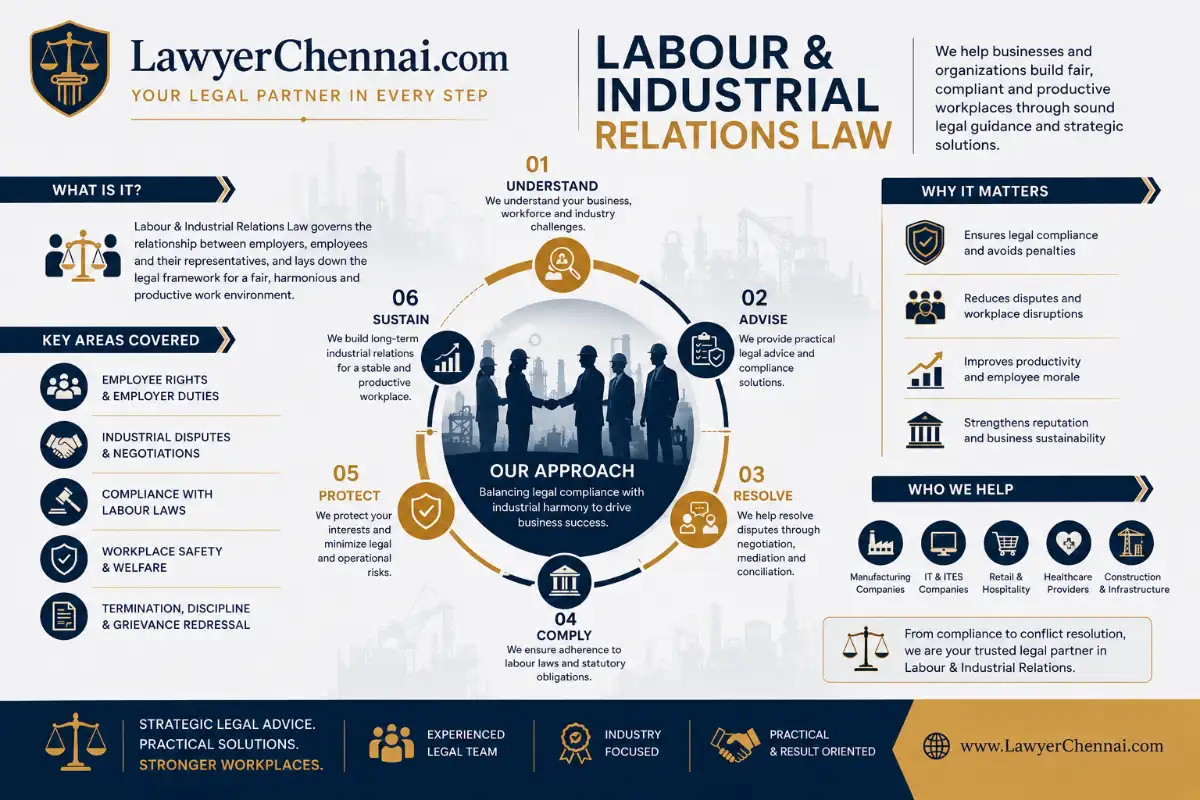
Wage Disputes and the Code on Wages 2019
Wage disputes represent a persistent and widespread form of labour law violation throughout India. The Payment of Wages Act 1936 mandates timely wage payment without any unauthorized deductions. Additionally, the Minimum Wages Act 1948 establishes sector-specific wage floors for all workers across industries. Furthermore, the Code on Wages 2019 consolidates both these Acts alongside the Payment of Bonus Act 1965. Consequently, employers must comply with a unified wage framework applicable across all industries in India.
Workers facing wage theft, illegal deductions, or non-payment of overtime can file complaints before the Wages Inspector. Alternatively, they may approach the Labour Court directly for faster and comprehensive redress. The Code on Wages 2019 significantly strengthens enforcement mechanisms and increases penalties against violators. Moreover, the Code introduces a universal “floor wage” concept applicable across all states including Tamil Nadu. State-specific minimum wage notifications from the Tamil Nadu Labour Department further protect local workers from exploitation. Experienced advocates at LawyerChennai.com guide workers through all wage recovery proceedings before appropriate forums.
Filing Labour Complaints Under BNS and BNSS 2023
The Bharatiya Nyaya Sanhita (BNS) 2023, Bharatiya Nagarik Suraksha Sanhita (BNSS) 2023, and Bharatiya Sakshya Adhiniyam (BSA) 2023 have transformed India’s criminal law framework. These three codes replaced the IPC 1860, CrPC 1973, and Indian Evidence Act 1872 respectively. Therefore, labour disputes involving criminal elements must now proceed under this new legal framework entirely. Notably, BNS provisions address offences involving economic exploitation and organized criminal activities. Furthermore, wage theft and bonded labour offences attract criminal liability under specific BNS sections. Workers can file First Information Reports at the nearest police station under the BNSS framework.
The BNSS introduces a zero FIR provision enabling complaints at any police station regardless of territorial jurisdiction. Additionally, this provision greatly benefits migrant workers in unfamiliar cities and districts. Moreover, digital communication records such as emails and WhatsApp messages constitute primary evidence under BSA 2023. Employees must therefore preserve all electronic employment records from the very moment any dispute first arises. Prompt legal consultation ensures workers properly navigate criminal complaints alongside civil labour proceedings.
Gratuity, PF, and ESI Recovery Mechanisms
Gratuity, Provident Fund, and ESI entitlements form the backbone of India’s worker social security architecture. The Payment of Gratuity Act 1972 entitles every eligible employee to gratuity after five continuous service years. Therefore, employees who resign, retire, or are retrenched must receive this statutory payment without delay.
The Employees’ Provident Fund and Miscellaneous Provisions Act 1952 governs PF contributions for establishments employing twenty or more workers. Additionally, EPFO oversees recovery, enforcement, and dispute resolution for provident fund matters across India. Workers facing PF non-deposit issues can file complaints before the Regional PF Commissioner promptly. Furthermore, the Employees’ State Insurance Act 1948 provides medical and cash benefits to eligible workers below the wage ceiling. ESI disputes are resolved before the ESI Court constituted under the Act itself. Moreover, employers defaulting on PF or ESI contributions face asset attachment orders and criminal prosecution. The Social Security Code 2020 extends coverage to gig workers, platform workers, and unorganized sector employees. Consequently, timely legal intervention by experienced advocates effectively protects workers’ long-term financial security interests.
Workplace Sexual Harassment and the POSH Act 2013
Workplace sexual harassment constitutes a serious violation of employees’ dignity and fundamental rights in India. The Sexual Harassment of Women at Workplace (Prevention, Prohibition and Redressal) Act 2013 mandates specific employer obligations. Therefore, every employer with ten or more employees must constitute an Internal Complaints Committee. This ICC investigates complaints from aggrieved women employees within ninety days of each incident. Additionally, employers failing to constitute an ICC face significant financial penalties under the POSH Act. Furthermore, the Bharatiya Nyaya Sanhita 2023 has strengthened criminal provisions relating to workplace sexual harassment.
Section 74 and related BNS provisions address criminal sexual harassment offences with enhanced punishments. Workers can simultaneously pursue civil remedies under POSH and criminal remedies under BNS most effectively. Moreover, the Local Complaints Committee at each district level handles complaints against smaller establishments with fewer than ten employees. Consequently, both formal and informal sector workers enjoy comprehensive legal protection against all forms of workplace harassment. Expert advocates provide strategic guidance for POSH proceedings and parallel criminal complaints before the Magistrate’s Court.
Electronic Evidence Under the BSA 2023 in Labour Cases
The Bharatiya Sakshya Adhiniyam (BSA) 2023 has fundamentally modernized India’s evidence law for the digital age. This legislation replaces the Indian Evidence Act 1872 with updated provisions recognizing electronic records. Therefore, digital documents now play a central and decisive role in all labour law proceedings. Under BSA Section 57, electronic records including emails, SMS messages, and digital payslips qualify as primary evidence. Consequently, employees must carefully preserve all digital communication with employers throughout their employment period. Additionally, BSA Section 61 governs the authentication of electronic evidence through certificates from qualified IT personnel. Furthermore, CCTV footage from workplace premises constitutes valid and compelling evidence in harassment and termination disputes.
Employers must maintain accurate employment records to avoid adverse inferences in legal proceedings. Moreover, BSA explicitly recognizes audio and video recordings as legitimate forms of documentary evidence in court. Labour advocates must therefore advise clients on proper evidence preservation from the very first moment a dispute arises. Consequently, early legal consultation at LawyerChennai.com significantly strengthens a worker’s position before Labour Courts and Industrial Tribunals throughout Tamil Nadu.
Role of Government Departments in Labour Law Enforcement
Government departments play an indispensable role in implementing and enforcing labour laws throughout India. The Ministry of Labour and Employment formulates national policy and oversees all central enforcement agencies. Additionally, the Tamil Nadu Labour Department handles state-level enforcement through field officers posted across all districts. Furthermore, the Chief Inspector of Factories enforces workplace safety standards under the Factories Act 1948. Labour Inspectors conduct surprise inspections to detect violations and issue improvement notices to defaulting employers regularly.
The Central Labour Commissioner manages industrial relations in centrally scheduled industries including railways, mines, and major ports. Moreover, the Regional PF Commissioner enforces provident fund compliance across all covered establishments in Tamil Nadu. The ESIC enforces health insurance contributions and promptly addresses employer defaults. Additionally, the State Wage Board periodically revises minimum wages for all employment categories within Tamil Nadu. Consequently, workers and employers must engage with multiple government agencies to resolve labour disputes comprehensively. Professional legal guidance streamlines interaction with all relevant regulatory bodies for timely resolution.
- Office of the Chief Labour Commissioner (Central) – Central sphere enforcement and conciliation
- Tamil Nadu Labour Department – State-level inspection, enforcement, and welfare
- Employees’ Provident Fund Organisation (EPFO) – PF compliance, recovery, and disputes
- Employees’ State Insurance Corporation (ESIC) – Health insurance enforcement and benefits
- Tamil Nadu Industrial Safety and Health Department – Factories inspection and accident regulation
Conciliation Officers and Labour Commissioners in India
Conciliation Officers occupy a vital position within India’s statutory labour dispute resolution mechanism. Under the Industrial Disputes Act 1947, these officers assist parties in reaching mutually acceptable settlements. Therefore, most industrial disputes must pass through conciliation before any formal adjudication can begin. Conciliation Officers handle both individual and collective disputes based on applicable statutory provisions. Additionally, the State Labour Commissioner supervises these officers and handles complex disputes requiring senior-level intervention. Furthermore, the Central Industrial Relations Machinery (CIRM) handles conciliation in all central sphere industry establishments across India.
The conciliation process carries a statutory time limit of fourteen days for public utility service disputes. Moreover, failure to achieve conciliation results in a Failure Report enabling parties to immediately approach the Labour Court. Consequently, the conciliation stage offers a cost-effective opportunity for both parties to resolve disputes quickly. Legal representation during conciliation proceedings is strongly advisable to protect each party’s legal rights comprehensively. Experienced advocates ensure fair outcomes and prevent prejudicial admissions during conciliation that could harm later litigation.
Central and State Government Labour Departments
The division of labour law jurisdiction between Central and State governments creates a dual enforcement structure in India. Central sphere industries include railways, oilfields, mines, major ports, and all central government establishments. Therefore, central government enforcement agencies exclusively handle labour disputes arising in these establishments. State governments regulate labour matters in all other industries within their territorial boundaries. The Tamil Nadu Labour Department operates through Deputy Commissioners, Labour Officers, and Inspectors across all districts. Furthermore, Tamil Nadu-specific statutes such as the Industrial Establishments (National and Festival Holidays) Act expand worker protections significantly.
The Central Industrial Relations Machinery (CIRM) handles conciliation in all centrally scheduled industry disputes. Additionally, the Ministry of Labour and Employment coordinates policy implementation between central and state enforcement agencies effectively. Moreover, the four Labour Codes 2020 require both Central and State governments to notify separate rule frameworks. Determining the applicable enforcement agency is therefore a crucial preliminary step in every labour law matter. Expert advocates at LawyerChennai.com correctly identify the appropriate agency for all labour matters before initiating proceedings.
Key Legal Forums and Jurisdictions for Labour Disputes in India
India provides multiple specialized adjudicatory forums for resolving labour and industrial disputes at all levels. These forums exercise jurisdiction based on the nature, industry category, and monetary value of each dispute. Therefore, selecting the correct forum constitutes a critical strategic decision in every labour law matter. The Industrial Disputes Act 1947 establishes Labour Courts and Industrial Tribunals as the primary adjudicatory bodies. Furthermore, the National Industrial Tribunal handles disputes of national importance referred by the Central Government.
High Courts exercise supervisory jurisdiction under Article 226 over all labour tribunal and court decisions. The Supreme Court of India adjudicates constitutional questions and significant matters of national labour law importance. Moreover, specialized forums include the EPFO Appellate Tribunal for provident fund disputes and ESI Courts for insurance matters. The National Company Law Tribunal (NCLT) handles employment-related matters arising from corporate insolvency proceedings. Consequently, workers and employers benefit enormously from experienced legal counsel who understands forum selection and jurisdictional strategy. Expert advocates at LawyerChennai.com represent clients before all these labour forums throughout India.
Industrial Disputes and Collective Bargaining Rights
Industrial disputes involve conflicts between workers and management over wages, working conditions, and employment terms. Collective bargaining serves as the primary mechanism through which trade unions negotiate on behalf of workers. Therefore, strong union representation significantly enhances workers’ bargaining power during all dispute resolution processes. The Trade Unions Act 1926, now consolidated under the Industrial Relations Code 2020, governs union registration and recognition procedures. Furthermore, the new Code introduces provisions for a sole Negotiating Union in each establishment to streamline collective bargaining. Notably, a trade union with over fifty-one percent membership qualifies as the Negotiating Union for that establishment. Additionally, the Code prescribes mandatory negotiation timelines between recognized unions and management teams.
Employers who engage in unfair labour practices face penalties under the Industrial Relations Code 2020. Moreover, strikes, lockouts, and go-slow tactics remain subject to strict procedural requirements under the new Code. Consequently, both workers and management must engage experienced labour law advocates to navigate collective bargaining and industrial dispute resolution processes. Expert legal counsel at LawyerChennai.com ensures full procedural compliance throughout.
Trade Union Rights and Recognition Under Labour Codes
Trade unions enjoy constitutional protection under Article 19(1)(c) of the Indian Constitution. This provision guarantees every citizen the fundamental right to form associations and unions freely. Therefore, employers cannot legally prevent workers from forming or joining registered trade unions. The Industrial Relations Code 2020 replaces the Trade Unions Act 1926 with updated recognition criteria and modern procedures. Furthermore, the new Code provides for either a Negotiating Union or a Negotiating Council in multi-union establishments. Workers who face victimization for trade union activities can seek protection under unfair labour practice provisions. Additionally, reinstatement of wrongly dismissed union leaders constitutes a commonly sought and awarded judicial remedy.
The Code mandates formal recognition procedures when a union represents over fifty-one percent of the workforce. Moreover, even unrecognized unions retain the right to represent individual members in individual grievance proceedings. Consequently, active trade union participation strengthens workers’ collective voice and improves working conditions across all industries. Legal guidance from experienced advocates at LawyerChennai.com ensures effective union formation, registration, and effective dispute representation before all forums.
Labour Courts and Industrial Tribunals in India
Labour Courts and Industrial Tribunals form the principal adjudicatory framework for resolving industrial disputes in India. In fact, Labour Courts adjudicate disputes concerning discharge, dismissal, retrenchment, and individual workman grievances. Therefore, aggrieved workers must approach the Labour Court within the applicable limitation period under the Act. Industrial Tribunals handle collective disputes concerning wages, bonus, allowances, and general working conditions. The National Industrial Tribunal resolves disputes of national importance referred directly by the Central Government. Furthermore, Tamil Nadu has established multiple Labour Courts in Chennai and at district headquarters to handle high volumes of cases. The Second Schedule and Third Schedule of the Industrial Disputes Act clearly delineate the respective jurisdictions of these forums. Additionally, the Industrial Relations Code 2020 proposes Industrial Tribunals with expanded powers to cover a wider range of matters. Consequently, timely filing and proper legal representation are absolutely essential in all tribunal proceedings.
| Forum | Nature of Disputes | Applicable Cases | Appeal Forum |
|---|---|---|---|
| Labour Court | Individual | Dismissal, Retrenchment, Discharge | High Court (Art. 226) |
| Industrial Tribunal | Collective | Wages, Bonus, Working Conditions | High Court (Art. 226) |
| National Industrial Tribunal | National Importance | Central Government References | Supreme Court |
| EPFO Appellate Tribunal | PF Disputes | PF Recovery and Liability | High Court |
| ESI Court | ESI Disputes | Contribution Defaults, Benefits | High Court |
High Courts and Supreme Court Jurisdiction in Labour Matters
High Courts exercise supervisory jurisdiction over all labour courts and industrial tribunals under Article 226 of the Constitution. Therefore, aggrieved parties can challenge tribunal decisions through Writ Petitions before the High Court. The Madras High Court in Chennai handles a substantial volume of labour law writ petitions every year. Additionally, the High Court exercises jurisdiction under Section 17B of the Industrial Disputes Act 1947.
This provision mandates wage payment to reinstated workers during the pendency of proceedings in higher courts. Furthermore, the Supreme Court adjudicates constitutional questions relating to workers’ fundamental labour rights. Special Leave Petitions under Article 136 provide direct access to the Supreme Court from all High Court decisions. Constitutional bench decisions of the Supreme Court bind all lower courts and tribunals without exception. Moreover, the Supreme Court has consistently upheld workers’ right to livelihood as integral to Article 21 of the Constitution. Consequently, constitutional remedies remain powerful tools in complex and significant labour matters. Expert advocates craft effective writ petitions and SLPs for appropriate and meritorious cases before higher courts throughout India.
Contract Labour and Outsourcing Legal Issues
Contract labour arrangements are widely used across Indian industries to reduce employment costs and increase operational flexibility. However, the Contract Labour (Regulation and Abolition) Act 1970 strictly regulates this practice throughout India. Therefore, principal employers must register their establishments, and contractors must obtain valid licences before deploying workers. The Act mandates that contract workers receive wages, welfare facilities, and benefits comparable to regular employees. Furthermore, when contract labour is abolished for a specific process, courts direct the regularization of affected workers. The Industrial Relations Code 2020 modifies certain provisions but retains core statutory protections for contract workers. Additionally, principal employers face direct liability for wage defaults committed by their registered contractors.
Workers in IT, construction, manufacturing, and logistics sectors frequently experience contract labour exploitation. Moreover, the Non-Deduction of Wages provision protects contract workers from unauthorized salary withholding by contractors. Consequently, both workers and principal employers benefit from proactive legal compliance review. Expert labour law advocates at LawyerChennai.com provide comprehensive advisory and representation services for all contract labour matters.
Injunctions and Stay Orders in Labour Disputes
Injunctions and stay orders provide critical interim relief mechanisms in labour and employment disputes. Civil courts and High Courts grant injunctions to maintain the status quo during all pending proceedings. Therefore, workers facing illegal lockouts or arbitrary terminations can seek urgent interim relief without delay. Under Order XXXIX of the Code of Civil Procedure 1908, courts grant temporary injunctions in appropriate cases. Furthermore, the BNSS 2023 enables courts to issue protective orders in cases involving criminal employment law elements.
Employers facing illegal strike actions can also seek injunctions to prevent workplace damage and serious disruption. Additionally, the High Court’s jurisdiction under Article 226 expressly includes the power to stay industrial tribunal orders. Consequently, injunction applications require prompt filing and strong legal argumentation to succeed effectively. Moreover, courts carefully examine the balance of convenience, risk of irreparable harm, and prima facie case before granting any interim relief. Legal teams must act swiftly to secure injunctions before adverse actions cause irreversible harm to their clients’ interests. Experienced advocates at LawyerChennai.com prepare and file effective injunction applications in all urgent labour matters.
Social Security and Employee Benefits Disputes
Social security disputes represent a rapidly growing category of labour law litigation across India. Workers frequently face employer non-compliance regarding PF deposits, ESI contributions, and gratuity payments. Therefore, employees must proactively monitor their EPFO accounts through the unified member portal on a regular basis. The Employees’ Provident Fund and Miscellaneous Provisions Act 1952 and the ESI Act 1948 govern these entitlements comprehensively. Furthermore, the Social Security Code 2020 consolidates nine separate social security statutes into a single unified framework. Gig workers, platform workers, and unorganized sector employees now benefit from expanded coverage under the new Code. Additionally, the National Social Security Board specifically addresses grievances of unorganized sector workers across India.
Workers can file complaints before the Provident Fund Commissioner, ESI Court, and the Controlling Authority under respective applicable Acts. Moreover, employers defaulting on contributions face attachment orders, damages, and criminal prosecution under applicable statutes. Consequently, timely legal intervention by experienced advocates effectively protects workers’ long-term financial security. Expert guidance ensures all employers achieve and maintain full social security compliance at all times.
Alternative Dispute Resolution in Labour Law
Alternative Dispute Resolution (ADR) mechanisms offer faster and more cost-effective solutions for labour and employment disputes. Mediation, conciliation, and arbitration provide practical alternatives compared to prolonged formal court proceedings. Therefore, parties in labour disputes should actively explore ADR options before approaching courts and tribunals. The Industrial Disputes Act 1947 already incorporates statutory conciliation as a mandatory pre-adjudication step. Furthermore, voluntary arbitration under Section 10A allows parties to refer disputes to mutually agreed arbitrators of their choosing.
The Industrial Relations Code 2020 retains and strengthens arbitration provisions for both individual and collective disputes. Additionally, the Mediation Act 2023 creates a formal statutory framework for mediation in civil and commercial matters applicable to employment disputes. Parties who resolve disputes through mediation must register their settlement agreements for full legal enforceability. Moreover, court-annexed mediation centres at the Madras High Court actively facilitate employment-related settlement proceedings. Consequently, ADR represents a practical and time-saving avenue for amicable resolution of all labour disputes. Experienced advocates at LawyerChennai.com guide parties through ADR processes to achieve fair and durable settlements.
Legal Remedies and Support Under Labour Laws in India
Indian labour law provides a comprehensive array of remedies to protect the rights of both workers and employers. These effective remedies include reinstatement, back wages, compensation, penalty proceedings, and criminal prosecution. Therefore, understanding available remedies helps parties design optimal legal strategies for their specific situations. The Industrial Disputes Act 1947, the Payment of Wages Act 1936, and the Payment of Gratuity Act 1972 prescribe specific remedies comprehensively. Furthermore, the new Labour Codes 2020 introduce enhanced penalty structures and stricter compliance timelines for all violations. Courts consistently grant reinstatement with full back wages in proven cases of wrongful termination. Additionally, High Courts exercise extraordinary writ jurisdiction to grant relief in appropriate and significant matters.
Workers facing exploitation can also approach the National Human Rights Commission and the National Commission for Women. Moreover, BNS 2023 and BNSS 2023 provisions enable criminal prosecution of employers for serious labour law violations. Consequently, experienced legal guidance from qualified advocates significantly enhances prospects of securing all available legal remedies. Expert representation at LawyerChennai.com maximizes outcomes across all Labour Courts, Industrial Tribunals, and High Courts throughout India.
How LawyerChennai.com Supports Workers and Employers
LawyerChennai.com provides expert legal services in labour and industrial relations law across Chennai and Tamil Nadu. The platform connects clients with highly experienced labour law advocates who handle disputes before Labour Courts, Industrial Tribunals, and the Madras High Court. Therefore, both workers and employers can access specialized legal support for their specific requirements quickly and efficiently. Services cover legal consultation, representation before government departments, negotiation, employment contract drafting, and full litigation support. Furthermore, advocates on the platform handle POSH Act compliance, trade union formation, PF and ESI recovery, and retrenchment challenges comprehensively. Additionally, legal support extends to writ petitions before the Madras High Court in appropriate and urgent cases.
The platform also assists employers in conducting thorough labour law audits to identify and address compliance gaps proactively. Moreover, prompt legal intervention frequently prevents escalation of disputes into costly and time-consuming litigation proceedings. Consequently, accessing qualified legal expertise at the earliest stage of any labour dispute saves significant time, money, and professional relationships. Visit LawyerChennai.com for an expert consultation today.
Child Labour and Bonded Labour – Criminal Law Provisions
Child labour and bonded labour represent the gravest violations of human rights and labour law in India. The Child Labour (Prohibition and Regulation) Amendment Act 2016 prohibits employment of children below fourteen years in all occupations. Therefore, employers engaging child labour face rigorous criminal prosecution under both BNS 2023 and the child labour statute. Additionally, adolescents between fourteen and eighteen years face strict restrictions on employment in hazardous occupations and processes.
The Bonded Labour System (Abolition) Act 1976 comprehensively prohibits all forms of bonded labour throughout the country. Furthermore, BNS 2023 contains specific provisions criminalizing trafficking and forced labour under Section 111 and related sections. District Magistrates hold primary statutory responsibility for identifying, releasing, and rehabilitating bonded labourers throughout the Act’s jurisdiction. Victims of bonded labour can also seek compensation under Supreme Court-monitored national rehabilitation schemes. Moreover, NGOs and trade unions play a vital role in detecting and reporting child and bonded labour violations. Consequently, strict legal enforcement and proactive community reporting remain essential to eliminate these exploitation forms. Expert advocates provide strong legal support in all child labour and bonded labour prosecution matters.
Reinstatement and Back Wages as Judicial Remedies
Reinstatement with back wages remains the primary judicial remedy for unlawful termination under Indian labour law. Labour Courts and Industrial Tribunals routinely grant this comprehensive relief to workers dismissed without legal justification. Therefore, workers who establish wrongful termination can recover their full employment benefits and all back pay. The Supreme Court has firmly held that reinstatement with full back wages is the appropriate remedy for illegal dismissal. Furthermore, courts retain discretion to award partial back wages based on the specific circumstances of each individual case. Additionally, where reinstatement is not practically feasible, courts award lump-sum compensation in lieu of reinstatement. This balanced approach preserves industrial harmony while safeguarding individual justice in complex employment relationships.
The quantum of compensation considers the worker’s length of service, current age, and future employment prospects. Moreover, the Industrial Relations Code 2020 introduces lump-sum compensation as a formal alternative to reinstatement in specific prescribed circumstances. Consequently, workers and employers must understand all traditional and emerging remedies under evolving Indian labour legislation. Expert legal advice at LawyerChennai.com ensures optimal remedy selection in every matter.