
Constitutional and Public Law forms the bedrock of India’s democratic governance structure. Moreover, these legal principles safeguard fundamental rights and ensure government accountability. Citizens often face violations requiring immediate constitutional remedies through appropriate legal channels. Subsequently, understanding your constitutional rights becomes essential for protecting individual liberties. The Indian Constitution guarantees various fundamental rights under Articles 12 to 35. Furthermore, public law governs the relationship between citizens and state authorities. At LawyerChennai.com, we specialize in constitutional litigation across Chennai jurisdictions. Additionally, our expertise extends to writ petitions, public interest litigation, and fundamental rights enforcement. Therefore, seeking timely legal intervention prevents prolonged rights violations. Constitutional remedies provide swift justice through High Courts and Supreme Court interventions.
Constitutional & Public Law: Comprehensive Legal Framework and Remedies
Understanding Fundamental Rights Under Indian Constitution
Fundamental Rights constitute the cornerstone of Indian constitutional democracy and individual freedom. Articles 14 to 32 enumerate six categories of fundamental rights available to citizens. Consequently, the Right to Equality prevents discrimination based on religion, caste, or gender. Similarly, the Right to Freedom encompasses speech, assembly, association, and movement rights. Furthermore, the Right against Exploitation prohibits human trafficking and forced labor practices. The Right to Freedom of Religion ensures secular governance and religious tolerance nationwide. Additionally, Cultural and Educational Rights protect minority communities’ interests and cultural preservation. Moreover, the Right to Constitutional Remedies enables enforcement through High Courts and Supreme Court. Therefore, understanding these rights empowers citizens to challenge governmental overreach effectively. Violations of fundamental rights warrant immediate legal intervention through constitutional remedies. Subsequently, our legal team assists in drafting comprehensive writ petitions for rights enforcement.
Right to Equality: Legal Protection Against Discrimination
Article 14 guarantees equality before law and equal protection of laws throughout India. Moreover, this provision prevents arbitrary state action and ensures rational classification in legislation. Article 15 prohibits discrimination on grounds of religion, race, caste, sex, or birthplace. Similarly, Article 16 ensures equality of opportunity in public employment for all citizens. Furthermore, Article 17 abolishes untouchability and makes its practice a punishable criminal offense. Article 18 abolishes titles except military and academic distinctions granted by the state. Consequently, these provisions create a framework for egalitarian society and social justice. Violations occur frequently in employment, education, and public service delivery contexts nationwide. Therefore, affected individuals can approach Madras High Court through writ petitions for remedy. Additionally, our firm handles discrimination cases involving government departments and public sector undertakings. Subsequently, successful litigation ensures compensation and corrective measures against discriminatory practices.
- Equality before law under Article 14
- Prohibition of discrimination under Article 15
- Equal opportunity in employment under Article 16
- Abolition of untouchability under Article 17
- Abolition of titles under Article 18
- Reasonable classification permitted for legislation
- Special provisions for women and children
- Reservations for socially disadvantaged groups
Right to Freedom: Essential Liberties and Legal Safeguards
Article 19 guarantees six fundamental freedoms essential for democratic functioning and personal liberty. Firstly, freedom of speech and expression enables citizens to voice opinions without censorship. However, reasonable restrictions exist for sovereignty, integrity, public order, and decency considerations. Secondly, freedom to assemble peacefully without arms facilitates democratic protests and gatherings. Similarly, freedom to form associations or unions protects collective bargaining and organizational rights. Moreover, freedom to move freely throughout Indian territory ensures mobility and livelihood opportunities. Additionally, freedom to reside and settle anywhere in India promotes national integration. Furthermore, freedom to practice any profession, occupation, trade, or business drives economic liberty. Nevertheless, the state can impose reasonable restrictions through legislation for public interest. Consequently, balancing individual liberty with societal interests remains crucial in constitutional interpretation. Therefore, our legal team challenges unconstitutional restrictions on fundamental freedoms through appropriate forums.
Freedom of Speech and Expression: Boundaries and Exceptions
Freedom of speech forms the bedrock of democratic governance and public discourse nationwide. Moreover, this right includes freedom of press, media, and digital expression platforms. However, Article 19(2) permits reasonable restrictions on grounds of sovereignty and integrity. Similarly, restrictions apply for security of state, public order, and friendly relations purposes. Furthermore, restrictions exist for decency, morality, contempt of court, and defamation concerns. Additionally, incitement to offense constitutes a valid ground for restricting speech rights. Consequently, balancing free expression with societal interests requires careful judicial scrutiny always. Recent amendments to Bharatiya Nyaya Sanhita 2023 address online speech and digital defamation. Therefore, understanding these boundaries prevents inadvertent legal violations and criminal prosecution risks. Subsequently, our firm advises media houses, journalists, and content creators on constitutional limits. Moreover, we defend free speech cases involving government censorship and arbitrary restrictions nationwide.
Freedom of Movement and Residence: Inter-State Mobility Rights
Article 19(1)(d) guarantees freedom to move freely throughout Indian territory without hindrance. Similarly, Article 19(1)(e) ensures the right to reside and settle anywhere in India. However, reasonable restrictions exist for scheduled tribes’ interests and public interest considerations. Consequently, these freedoms facilitate employment opportunities, education access, and family reunification nationwide. Moreover, inter-state mobility drives economic growth and cultural exchange across diverse regions. Nevertheless, restrictions apply during emergencies, pandemics, and national security threats temporarily. Additionally, domicile requirements for certain benefits remain valid under constitutional provisions legally. Furthermore, our firm challenges arbitrary restrictions imposed by state governments on movement rights. Therefore, affected individuals can seek judicial intervention through High Court writ petitions promptly. Subsequently, successful litigation ensures removal of unconstitutional barriers to mobility and residence.
Constitutional Remedies: Writ Jurisdiction and Enforcement Mechanisms
Article 32 empowers Supreme Court to issue writs for fundamental rights enforcement nationwide. Similarly, Article 226 grants High Courts writ jurisdiction for fundamental rights and other purposes. Consequently, five types of writs provide effective remedies against governmental actions and omissions. Habeas Corpus secures personal liberty by challenging illegal detention or custody orders. Moreover, Mandamus compels public authorities to perform statutory duties and legal obligations. Furthermore, Prohibition prevents subordinate courts and tribunals from exceeding their jurisdiction wrongly. Additionally, Certiorari quashes orders of inferior courts and tribunals for jurisdictional errors. Quo Warranto questions the legality of a person holding public office without authority. Therefore, writ petitions constitute powerful tools for vindicating constitutional rights through judicial intervention. Subsequently, our firm specializes in drafting comprehensive writ petitions before Madras High Court. Moreover, we handle urgent matters requiring immediate judicial attention through vacation benches.
| Writ Type | Purpose | Applicable Situations |
|---|---|---|
| Habeas Corpus | Personal Liberty | Illegal detention, custody violations |
| Mandamus | Duty Enforcement | Government inaction, statutory obligations |
| Prohibition | Jurisdiction Control | Excess jurisdiction by tribunals |
| Certiorari | Order Quashing | Judicial review of inferior court orders |
| Quo Warranto | Office Legality | Unauthorized public office holders |
Habeas Corpus: Safeguarding Personal Liberty Against Illegal Detention
Habeas Corpus literally means “produce the body” and challenges illegal detention practices. Moreover, this writ applies when individuals face custody without proper legal authority. Consequently, police stations in Chennai including West Mogappair Police Station face scrutiny regularly. Similarly, detention under preventive detention laws requires strict compliance with constitutional safeguards. Furthermore, mental health facilities and rehabilitation centers cannot detain individuals without proper procedures. Additionally, immigration detention requires legal basis and cannot extend beyond prescribed periods. Therefore, family members can file habeas corpus petitions for detained relatives immediately. Subsequently, courts examine detention legality and order release if detention lacks authority. Moreover, compensation awards follow when detention proves manifestly illegal and arbitrary. Our firm handles habeas corpus matters involving police custody, preventive detention, and immigration. Additionally, we secure immediate bail and release through urgent High Court interventions.
Procedure for Filing Habeas Corpus Writ Petitions
Filing habeas corpus petitions requires immediate action and precise legal documentation standards. Firstly, ascertain the exact location and authority holding the detained person currently. Moreover, gather detention orders, arrest memos, and relevant documents substantiating illegal custody. Subsequently, draft a comprehensive writ petition citing constitutional violations and legal grounds. Furthermore, approach Madras High Court registry with petition, vakalatnama, and supporting affidavits. Additionally, mention the petition before appropriate bench seeking urgent hearing and relief. Consequently, courts prioritize habeas corpus matters recognizing personal liberty’s fundamental importance. Therefore, hearings often occur within 24 to 48 hours of filing petitions. Moreover, courts issue notice to detaining authorities seeking their response and justification. Subsequently, detained individuals must be produced before court for physical verification. Our firm ensures swift petition filing and effective representation during urgent hearings.
Mandamus: Compelling Government Authorities to Perform Statutory Duties
Mandamus writs compel public authorities to discharge statutory and constitutional duties effectively. Moreover, this remedy applies when officials refuse to perform mandatory legal obligations. Consequently, government departments including Revenue Department, Police Department, and Municipal Corporations face mandamus petitions. Similarly, regulatory bodies like Tamil Nadu Pollution Control Board require mandamus for inaction. Furthermore, educational institutions receiving government aid must comply with statutory admission procedures. Additionally, pension disbursement, license issuance, and certificate provision constitute mandatory duties. Therefore, aggrieved citizens can seek mandamus when authorities fail to perform duties. However, mandamus does not lie for discretionary functions or policy decisions. Subsequently, courts examine whether the duty is mandatory, statutory, and enforceable. Moreover, successful mandamus petitions result in specific directions to authorities for compliance. Our firm drafts effective mandamus petitions against various government departments and statutory bodies.
Common Situations Requiring Mandamus Relief in Chennai
Chennai residents frequently require mandamus for addressing governmental inaction and bureaucratic delays. Firstly, property tax assessments and corrections by Greater Chennai Corporation need mandamus intervention. Moreover, building plan approvals delayed beyond statutory timelines warrant judicial directions. Similarly, police stations refusing to register FIRs under Bharatiya Nagarik Suraksha Sanhita 2023 require mandamus. Furthermore, passport applications pending beyond prescribed periods need High Court intervention. Additionally, pension claims by retired government employees often require mandamus for processing. Consequently, license renewals for businesses and professions delayed unreasonably warrant legal action. Therefore, RTI responses not provided within statutory timelines justify mandamus petitions. Moreover, admission disputes in aided educational institutions require mandamus for enforcement. Subsequently, pollution control clearances delayed by TNPCB need judicial intervention for businesses. Our firm successfully handles mandamus matters across various government departments in Chennai.
Public Interest Litigation: Collective Rights Enforcement Mechanism
Public Interest Litigation democratizes access to justice for marginalized and disadvantaged communities. Moreover, PIL enables any citizen to approach courts for public interest protection. Consequently, environmental violations, human rights abuses, and corruption require PIL intervention. Similarly, non-implementation of welfare schemes and social security benefits warrant collective action. Furthermore, PIL addresses systemic issues affecting large populations across jurisdictions simultaneously. Additionally, courts relax locus standi requirements allowing concerned citizens to file petitions. Therefore, social activists, NGOs, and lawyers initiate PILs for public causes regularly. However, courts discourage frivolous PILs filed for publicity or personal gain purposes. Subsequently, genuine PILs result in policy changes, compensation awards, and systemic reforms. Moreover, PIL jurisdiction extends to Supreme Court and all High Courts nationwide. Our firm evaluates PIL proposals and files well-researched petitions for genuine causes. Additionally, we collaborate with civil society organizations for effective PIL litigation strategies.
Environmental Protection Through Constitutional Litigation
Environmental PIL protects ecological balance and ensures sustainable development across Tamil Nadu. Moreover, Article 21 interpreted expansively includes right to clean environment and healthy life. Consequently, industrial pollution, encroachments on water bodies, and deforestation require judicial intervention. Similarly, violation of environmental clearance conditions by industries warrants strict action. Furthermore, solid waste management failures by municipalities affect public health significantly. Additionally, air quality deterioration in Chennai requires stringent measures and monitoring mechanisms. Therefore, PIL petitions seek closure of polluting industries and restoration of ecological damage. Moreover, courts appoint expert committees for assessing environmental violations and suggesting remedies. Subsequently, compensation principles under “polluter pays” and “precautionary principle” apply effectively. Our firm handles environmental PIL involving Ennore Creek pollution, Cooum River restoration, and air quality. Additionally, we represent fishing communities affected by industrial effluents and coastal pollution.
Jurisdiction and Forums for Environmental Litigation
Environmental cases involve multiple forums including National Green Tribunal and High Courts. Firstly, National Green Tribunal (Southern Zone) in Chennai handles environmental disputes exclusively. Moreover, NGT has jurisdiction over environmental clearances, pollution control, and forest conservation matters. Similarly, Madras High Court exercises writ jurisdiction for environmental constitutional rights violations. Furthermore, Tamil Nadu Pollution Control Board acts as regulatory authority for pollution control. Additionally, District Collectors exercise powers under environmental protection statutes for local enforcement. Consequently, choosing appropriate forum depends on nature of violation and relief sought. Therefore, NGT provides specialized expertise and expedited disposal of environmental cases. Moreover, appeals from NGT lie to Supreme Court within specified timelines. Subsequently, our firm strategically selects forums ensuring effective environmental litigation outcomes. Additionally, we coordinate with pollution control authorities for compliance monitoring and enforcement.
Administrative Law: Judicial Review of Executive Actions
Administrative law governs the exercise of executive power and ensures accountability mechanisms. Moreover, judicial review examines legality, rationality, and procedural fairness of administrative decisions. Consequently, government orders, notifications, and circulars face scrutiny for constitutional validity. Similarly, licensing decisions, tender awards, and disciplinary proceedings require procedural compliance. Furthermore, principles of natural justice mandate fair hearing before adverse decisions. Additionally, doctrines of legitimate expectation and promissory estoppel protect citizen rights. Therefore, arbitrary administrative action without application of mind invites judicial intervention. Moreover, doctrine of proportionality ensures penalties commensurate with violations committed. Subsequently, wednesbury unreasonableness tests administrative decisions for rationality and reasonableness standards. Our firm challenges arbitrary administrative actions across departments including Revenue, Police, and Municipal. Additionally, we represent government contractors and licensees in administrative dispute resolution.
Natural Justice Principles in Administrative Proceedings
Natural justice constitutes the foundation of fair administrative decision-making processes nationwide. Firstly, audi alteram partem principle requires hearing before adverse decisions affecting rights. Moreover, notice specifying charges, evidence, and opportunity for explanation constitute essential requirements. Similarly, reasonable time for preparing defense and presenting case ensures fairness. Furthermore, right to legal representation applies in proceedings affecting civil consequences. Additionally, speaking orders with reasons demonstrate application of mind by authorities. Consequently, violation of natural justice principles renders administrative decisions void and unenforceable. Therefore, disciplinary proceedings, license cancellations, and disqualifications require strict procedural compliance. Moreover, bias by decision-makers vitiates proceedings requiring independent adjudication instead. Subsequently, our firm challenges administrative orders violating natural justice before appropriate forums. Additionally, we advise government employees, professionals, and businessmen on procedural rights.
Remedies Available Against Arbitrary Administrative Actions
Multiple remedies exist for challenging arbitrary administrative actions through constitutional and statutory routes. Firstly, writ petitions under Article 226 provide comprehensive relief against administrative illegality. Moreover, statutory appeals lie to appellate authorities specified under respective regulatory statutes. Similarly, revision petitions challenge orders before superior administrative authorities for reconsideration. Furthermore, departmental representations seek reconsideration of adverse decisions by original authorities. Additionally, arbitration and conciliation provide alternative dispute resolution for contractual disputes. Consequently, choosing appropriate remedy depends on urgency, relief sought, and legal grounds. Therefore, writ jurisdiction provides wider scope for challenging constitutional violations effectively. Moreover, interim relief including stay of adverse orders protects parties pending adjudication. Subsequently, successful challenges result in quashing orders, compensation awards, and reinstatement directions. Our firm strategically selects remedies ensuring effective client representation and favorable outcomes.
Service Law: Government Employee Rights and Remedies
Service law governs employment relationship between government employees and state authorities comprehensively. Moreover, constitutional protection under Article 311 prevents arbitrary dismissal, removal, or reduction. Consequently, disciplinary proceedings must follow prescribed procedure under conduct rules strictly. Similarly, charge sheets must specify allegations with particulars enabling proper defense. Furthermore, inquiry proceedings require impartial inquiry officer and adherence to principles. Additionally, punishment must be proportionate to misconduct proven during inquiry proceedings. Therefore, government employees can challenge arbitrary disciplinary actions through appropriate legal forums. Moreover, promotion, transfers, and posting orders face judicial scrutiny for mala fides. Subsequently, Central Administrative Tribunal and State Administrative Tribunals handle service matters exclusively. Our firm represents government employees in disciplinary proceedings, promotions, and pension matters. Additionally, we handle cases before Tamil Nadu Administrative Tribunal located in Chennai.
Tamil Nadu Administrative Tribunal: Jurisdiction and Procedure
Tamil Nadu Administrative Tribunal exercises exclusive jurisdiction over state government service matters. Firstly, tribunal hears grievances related to recruitment, seniority, promotion, and disciplinary actions. Moreover, pension, gratuity, and terminal benefits disputes fall within tribunal’s jurisdiction. Similarly, transfers, postings, and deputation orders can be challenged before tribunal. Furthermore, tribunal exercises powers equivalent to High Court for service matter adjudication. Additionally, appeals from tribunal lie to Division Bench and subsequently to Supreme Court. Consequently, tribunal provides specialized expertise and expedited disposal of service disputes. Therefore, applications must be filed within prescribed limitation periods with proper documentation. Moreover, interim relief applications secure stays of adverse orders pending final adjudication. Subsequently, tribunal’s orders are executable like court decrees through contempt proceedings. Our firm regularly appears before Tamil Nadu Administrative Tribunal representing government employees effectively.
- File Original Application within limitation period
- Serve notice to respondent departments properly
- File counter affidavits and reply submissions
- Attend hearings and present oral arguments
- Obtain final orders and certified copies
- File appeals if aggrieved by tribunal orders
- Execute favorable orders through contempt proceedings
- Seek modification or clarification when necessary
Election Law: Electoral Rights and Dispute Resolution
Election law ensures free, fair, and transparent electoral processes across democratic institutions. Moreover, constitutional provisions under Articles 324-329 govern election conduct and dispute resolution. Consequently, Election Commission exercises superintendence, direction, and control over elections nationwide. Similarly, Representation of People Act 1951 prescribes eligibility, disqualifications, and corrupt practices. Furthermore, election petitions challenge election results before High Courts within prescribed timelines. Additionally, disqualification of elected representatives occurs for corrupt practices and criminal convictions. Therefore, electoral disputes require specialized legal expertise and understanding of electoral jurisprudence. Moreover, model code of conduct regulates campaigning and ensures level playing field. Subsequently, our firm handles election petitions, disqualification proceedings, and electoral bond matters. Additionally, we advise political parties and candidates on campaign finance and electoral compliance.
Election Petitions: Challenging Electoral Results and Corrupt Practices
Election petitions constitute sole remedy for challenging election results and electoral malpractices. Firstly, petitions must be filed in High Court within 45 days from result declaration. Moreover, petitions can challenge returned candidate’s election on specified statutory grounds only. Similarly, grounds include corrupt practices, improper acceptance/rejection of nominations, and improper reception/refusal. Furthermore, non-compliance with constitutional provisions and electoral law provisions constitute valid grounds. Additionally, petition must be accompanied by security deposit and verified properly by petitioner. Consequently, High Court conducts trial recording evidence and examining witnesses like civil suit. Therefore, burden of proof lies on petitioner to establish grounds beyond reasonable doubt. Moreover, successful petitions result in election being declared void and fresh elections. Subsequently, unsuccessful petitions result in forfeiture of security deposit by petitioner. Our firm drafts comprehensive election petitions and represents clients before Madras High Court.
Disqualification Under Anti-Defection Law and Criminal Convictions
Tenth Schedule provides for disqualification of members on grounds of defection from party. Moreover, voluntarily giving up party membership or voting against party whip attracts disqualification. Similarly, nominated members joining political parties face disqualification after expiry of six months. Furthermore, Speaker/Chairman decides disqualification petitions subject to judicial review by High Courts. Additionally, conviction for offenses with sentences exceeding two years disqualifies members immediately. Consequently, disqualified members cannot contest elections for six years from disqualification date. Therefore, Section 8 of Representation of People Act 1951 specifies disqualification grounds comprehensively. Moreover, recent amendments extend disqualification to convicted members even during appeal pendency. Subsequently, our firm challenges arbitrary disqualification orders and represents members before Speakers. Additionally, we handle appeals before High Courts against Speaker’s disqualification decisions.
Right to Information: Transparency and Government Accountability
Right to Information Act 2005 empowers citizens to access government information systematically. Moreover, RTI promotes transparency, accountability, and participatory governance across public authorities. Consequently, every citizen can request information from government departments and public sector undertakings. Similarly, Public Information Officers must respond within 30 days providing requested information. Furthermore, exemptions exist for security, personal privacy, and commercial confidence protection purposes. Additionally, appeals lie to First Appellate Authority and subsequently to Information Commission. Therefore, RTI enables citizens to monitor government functioning and detect corruption effectively. Moreover, penalties apply to PIOs for malafide refusal or destruction of information. Subsequently, our firm assists citizens in drafting RTI applications and pursuing appeals. Additionally, we represent whistleblowers and RTI activists facing harassment for exposing corruption.
Procedure for Filing RTI Applications in Tamil Nadu
Filing RTI applications requires precise identification of information and appropriate public authority. Firstly, determine whether the authority qualifies as “public authority” under RTI Act. Moreover, identify designated Public Information Officer for the concerned department or office. Similarly, draft application specifying information sought clearly without vague or sweeping requests. Furthermore, pay prescribed application fee through court fee stamp or online payment. Additionally, file application online through RTI portal or submit physically at office. Consequently, PIO must acknowledge receipt and provide information within 30 days. Therefore, information concerning life and liberty must be provided within 48 hours. Moreover, if information concerns third party, notice must be given before disclosure. Subsequently, appeals against refusal or inadequate response lie to First Appellate Authority. Our firm drafts effective RTI applications and represents clients in Information Commission proceedings.
Tamil Nadu Information Commission: Appeals and Penalties
Tamil Nadu Information Commission acts as appellate authority for RTI disputes in state. Firstly, second appeals lie to State Information Commission against First Appellate Authority orders. Moreover, Commission exercises powers of civil court for summoning witnesses and evidence. Similarly, Commission can impose penalties up to Rs. 25,000 on erring PIOs. Furthermore, Commission passes orders directing disclosure, imposing penalties, and awarding compensation. Additionally, Commission recommends disciplinary action against officials for malafide refusal of information. Consequently, Commission’s orders are binding and executable through contempt proceedings if necessary. Therefore, appeals must be filed within prescribed limitation periods with proper documentation. Moreover, Commission conducts hearings providing opportunity to both parties for submissions. Subsequently, successful appeals result in information disclosure and penalty on officials. Our firm regularly appears before Tamil Nadu Information Commission representing appellants effectively.
Constitutional Law Issues in Digital Age
Digital age presents novel constitutional challenges requiring adaptive legal interpretation and frameworks. Moreover, right to privacy recognized as fundamental right under Article 21 recently. Consequently, data protection, surveillance, and digital surveillance require strict constitutional scrutiny. Similarly, intermediary liability under Information Technology Act balances free speech with accountability. Furthermore, Aadhaar-based authentication raises concerns about privacy, surveillance, and exclusion from welfare. Additionally, internet shutdowns and social media blocking require proportionality and necessity tests. Therefore, courts examine digital age restrictions through fundamental rights framework comprehensively. Moreover, fake news, misinformation, and hate speech online require balanced regulatory responses. Subsequently, our firm handles constitutional challenges to digital regulations and surveillance measures. Additionally, we advise technology companies on constitutional compliance and fundamental rights protection.
Privacy Rights and Data Protection Constitutional Framework
Privacy constitutes intrinsic aspect of personal liberty under Article 21 per landmark judgments. Moreover, informational privacy includes control over personal data and its collection practices. Similarly, bodily privacy protects physical integrity and freedom from intrusive searches. Furthermore, decisional privacy safeguards intimate personal choices without state interference unjustifiably. Additionally, Digital Personal Data Protection Act 2023 provides statutory framework for protection. Consequently, data principals enjoy rights including consent, access, correction, and erasure rights. Therefore, data fiduciaries must process data lawfully, fairly, and transparently always. Moreover, violations attract monetary penalties and compensation to affected data principals. Subsequently, Data Protection Board adjudicates disputes and imposes penalties for non-compliance. Our firm advises businesses on data protection compliance and represents clients in privacy litigation. Additionally, we challenge unconstitutional surveillance and data collection by government agencies.
Cooperative Federalism: Centre-State Relations and Dispute Resolution
Constitutional federalism distributes powers between Union and States through legislative lists comprehensively. Moreover, Seventh Schedule contains Union List, State List, and Concurrent List demarcating powers. Consequently, Parliament legislates on Union List subjects including defense, foreign affairs, and currency. Similarly, State Legislatures legislate on State List subjects including police, public health, and agriculture. Furthermore, both legislate on Concurrent List subjects with Parliament’s law prevailing over State law. Additionally, residuary powers vest with Parliament under Article 248 for unlisted subjects. Therefore, inter-governmental disputes arise regarding legislative competence and administrative jurisdiction frequently. Moreover, Article 131 provides for original jurisdiction of Supreme Court in Centre-State disputes. Subsequently, Inter-State Council facilitates coordination and resolves disputes through consultation mechanisms. Our firm advises state governments on constitutional competence and federal relationship matters. Additionally, we represent parties in Supreme Court inter-governmental disputes and reference cases.
Emergency Provisions: Constitutional Safeguards and Judicial Review
Emergency provisions enable Union Government to respond to extraordinary situations effectively nationwide. Moreover, three types of emergencies exist: National Emergency, President’s Rule, and Financial Emergency. Consequently, National Emergency under Article 352 applies during war, external aggression, or armed rebellion. Similarly, President’s Rule under Article 356 applies when state government cannot function constitutionally. Furthermore, Financial Emergency under Article 360 applies when financial stability or credit faces threat. Additionally, fundamental rights under Article 19 remain suspended during National Emergency except life. Therefore, judicial review of emergency proclamation examines satisfaction of constitutional conditions. Moreover, 44th Amendment Act 1978 introduced parliamentary approval requirements for emergency continuance. Subsequently, abuse of emergency provisions during 1975-77 led to constitutional safeguards strengthening. Our firm advises on constitutional validity of emergency measures and challenges arbitrary restrictions. Additionally, we represent parties affected by emergency provisions seeking judicial remedies.
Judicial Review of Emergency Proclamations and Executive Actions
Judicial review of emergency proclamations examines procedural compliance and substantive satisfaction requirements. Firstly, proclamation must specify grounds and material facts justifying emergency imposition. Moreover, parliamentary approval must be obtained within prescribed timelines for proclamation continuance. Similarly, courts examine whether situation warrants emergency measures or alternatives suffice. Furthermore, proportionality principle requires measures commensurate with threat faced by nation. Additionally, executive actions during emergency face scrutiny for arbitrariness and constitutional violations. Consequently, habeas corpus petitions remain available even during emergency for illegal detention. Therefore, post-emergency judicial review examines validity of actions taken during emergency period. Moreover, compensation claims arise for illegal detention and property deprivation during emergency. Subsequently, our firm represents parties challenging emergency actions and seeking remedies. Additionally, we advise governments on constitutional compliance during emergency situations.
Legal Remedies and Procedures: Comprehensive Litigation Strategy
Constitutional litigation requires strategic planning, meticulous documentation, and effective advocacy before courts. Moreover, choosing appropriate forum between High Court and Supreme Court depends on case nature. Consequently, High Court writ jurisdiction provides accessible forum for constitutional rights enforcement. Similarly, Supreme Court entertains petitions involving national importance and inter-state disputes. Furthermore, Alternative Dispute Resolution mechanisms apply for certain constitutional disputes excluding fundamental rights. Additionally, legal aid provisions ensure access to justice for economically disadvantaged litigants. Therefore, Lok Adalats, mediation, and conciliation reduce litigation burden and expedite dispute resolution. Moreover, strategic litigation involves selecting test cases for establishing constitutional principles effectively. Subsequently, our firm develops comprehensive litigation strategies considering client objectives and constitutional jurisprudence. Additionally, we coordinate with expert witnesses, amicus curiae, and civil society organizations.
Drafting Effective Constitutional Writ Petitions
Drafting writ petitions requires precision, legal research, and persuasive writing skills combined effectively. Firstly, identify appropriate writ remedy based on nature of violation and relief sought. Moreover, frame precise questions of law highlighting constitutional violations and legal grounds. Similarly, narrate facts chronologically with supporting documents annexed as exhibits properly. Furthermore, cite relevant constitutional provisions, statutes, and judicial precedents supporting arguments. Additionally, distinguish adverse precedents and explain why they do not apply factually. Consequently, draft prayer clause specifying exact reliefs including interim relief sought urgently. Therefore, verify petition properly and accompany with vakalatnama and court fee stamps. Moreover, mention petition before appropriate bench through proper court procedures and rules. Subsequently, serve advance notice to respondents as required under statutory provisions. Our firm specializes in drafting persuasive writ petitions ensuring effective constitutional litigation outcomes.
Timeline and Costs for Constitutional Litigation in Chennai
Constitutional litigation timelines vary depending on case complexity, urgency, and court docket congestion. Firstly, urgent matters receive priority hearing within 24-48 hours of petition filing. Moreover, regular writ petitions get listed within 2-4 weeks after proper mentioning. Similarly, final hearings occur after counter affidavits and rejoinders are filed properly. Furthermore, average disposal time ranges from 6 months to 2 years depending on case complexity. Additionally, appeals to Supreme Court add 1-3 years to overall litigation timeline. Consequently, litigation costs include court fees, lawyer fees, and miscellaneous expenses. Therefore, court fees depend on petition nature with nominal fees for fundamental rights. Moreover, lawyer fees vary based on seniority, expertise, and case complexity involved. Subsequently, government fee waiver applies for economically disadvantaged litigants with income certificates. Our firm provides transparent cost estimates and flexible fee arrangements for clients.
| Litigation Stage | Average Timeline | Estimated Costs (INR) |
|---|---|---|
| Petition Drafting | 5-7 days | 15,000 – 50,000 |
| Filing and Mentioning | 2-3 days | 5,000 – 10,000 |
| Interim Relief Hearing | 1-2 weeks | 25,000 – 75,000 |
| Final Hearing | 6-18 months | 1,00,000 – 5,00,000 |
| Supreme Court Appeal | 1-3 years | 2,00,000 – 10,00,000 |
Jurisdiction: Appropriate Forums for Constitutional Matters
Selecting appropriate jurisdiction ensures effective constitutional litigation and favorable outcomes for clients. Firstly, Madras High Court exercises territorial jurisdiction over Tamil Nadu and Puducherry. Moreover, High Court has circuit benches at Madurai for southern districts’ convenience. Similarly, Supreme Court exercises nationwide jurisdiction for constitutional matters of national importance. Furthermore, specialized tribunals like NGT and CAT exercise jurisdiction for specific subject matters. Additionally, concurrent jurisdiction exists between High Courts and Supreme Court for fundamental rights. Consequently, strategic forum selection considers factors including territorial connection and legal questions. Therefore, Chennai-based matters typically proceed before Madras High Court Principal Bench. Moreover, inter-state disputes and national policy challenges proceed directly before Supreme Court. Subsequently, our firm analyzes jurisdictional aspects before filing constitutional petitions strategically. Additionally, we handle transfer petitions when cases need consolidation in single forum.
Madras High Court: Jurisdiction and Court Locations
Madras High Court operates with Principal Bench in Chennai and Madurai Bench in Madurai. Firstly, Principal Bench located at High Court Complex, Chennai hears northern districts matters. Moreover, Madurai Bench exercises jurisdiction over southern districts including Madurai, Ramanathapuram, and Virudhunagar. Similarly, administrative jurisdiction extends to entire Tamil Nadu and Union Territory of Puducherry. Furthermore, court comprises Chief Justice and several permanent and additional judges hearing matters. Additionally, specialized benches exist for criminal, civil, commercial, and tax matters. Consequently, writ petitions are heard by Single Judges with appeals to Division Bench. Therefore, understanding court procedures, rules, and practices ensures effective litigation management. Moreover, our law firm located near High Court at George Town ensures convenient access. Subsequently, we regularly appear before various benches handling constitutional and public law matters. Additionally, our Chennai offices at West Mogappair and George Town provide client accessibility.
Government Departments and Regulatory Bodies: Key Respondents
Constitutional litigation frequently involves government departments and regulatory bodies as respondent authorities. Firstly, Revenue Department handles land, taxation, and property-related constitutional matters statewide. Moreover, Police Department faces challenges regarding illegal detention, custodial violations, and procedural lapses. Similarly, Municipal Administration Department responds in service delivery and civic amenities disputes. Furthermore, Health Department faces litigation regarding medical negligence and healthcare access violations. Additionally, Education Department responds in admission disputes, scholarship delays, and institutional recognition matters. Consequently, proper identification of respondent department ensures effective service and compliance. Therefore, including appropriate government officers as parties ensures enforceable orders and remedies. Moreover, State Government and Union Government frequently appear as primary respondents. Subsequently, our firm has extensive experience handling cases against various government departments. Additionally, we ensure proper notice service and compliance monitoring post-judgment.
- Tamil Nadu Revenue Department – Land and taxation matters
- Greater Chennai Police – Law and order issues
- Greater Chennai Corporation – Civic amenities and municipal services
- Tamil Nadu Pollution Control Board – Environmental violations
- Directorate of Medical Education – Medical college admissions
- Transport Department – License and vehicle registration issues
- Labour Department – Industrial disputes and welfare schemes
- Social Welfare Department – Pension and welfare benefits
Police Stations in Chennai: Key Law Enforcement Authorities
Chennai comprises numerous police stations under Greater Chennai Police jurisdiction handling law enforcement. Firstly, West Mogappair Police Station serves our office locality and surrounding areas. Moreover, Egmore Police Station handles matters in central Chennai commercial and residential areas. Similarly, Teynampet Police Station covers important business districts and embassy areas. Furthermore, Anna Nagar Police Station serves one of largest residential neighborhoods in Chennai. Additionally, T Nagar Police Station handles high commercial activity areas with frequent disputes. Consequently, George Town Police Station near High Court handles matters in commercial district. Therefore, proper coordination with police authorities ensures effective investigation and prosecution support. Moreover, habeas corpus petitions frequently involve these police stations as respondent authorities. Subsequently, our firm maintains professional relationships with police authorities for effective case handling. Additionally, we assist clients in filing complaints and ensuring proper investigation procedures.
Cost-Effective Legal Solutions: Fee Structure and Payment Options
LawyerChennai.com provides transparent, competitive, and flexible fee structures for clients. Moreover, constitutional litigation costs depend on case complexity, urgency, and relief sought. Consequently, we offer initial consultation sessions to assess case merits and estimate costs. Similarly, retainer arrangements provide ongoing legal support at discounted rates for regular clients. Furthermore, contingency fee arrangements apply for certain matters where success determines payment. Additionally, installment payment options ease financial burden for middle-income clients seeking justice. Therefore, government employees and pensioners receive special consideration in fee negotiations. Moreover, pro bono representation extends to deserving cases involving public interest matters. Subsequently, detailed cost breakdowns include court fees, documentation, and professional fees transparently. Our firm believes constitutional justice should not remain inaccessible due to cost barriers. Additionally, we guide clients regarding legal aid availability from government and non-government sources.
Why Choose LawyerChennai.com for Constitutional Matters
LawyerChennai.com brings decades of constitutional litigation experience and proven track record. Firstly, Adv. Saravanan R possesses deep expertise in Indian and international constitutional law. Moreover, our firm successfully handled numerous landmark cases before Madras High Court and Supreme Court. Similarly, we maintain strong professional relationships with court registry, judges, and government counsel. Furthermore, strategic locations at West Mogappair and George Town ensure client accessibility and convenience. Additionally, comprehensive legal research support ensures strong legal grounds and persuasive arguments. Consequently, our client-centric approach prioritizes understanding unique needs and providing customized solutions. Therefore, regular updates, transparent communication, and ethical practices define our professional conduct. Moreover, multilingual support in Tamil, English, and Hindi accommodates diverse client base. Subsequently, our firm’s reputation for integrity and excellence attracts clients across Tamil Nadu. Additionally, affordable fee structures ensure constitutional justice remains accessible to all economic segments.
Our Expertise in Constitutional and Public Law
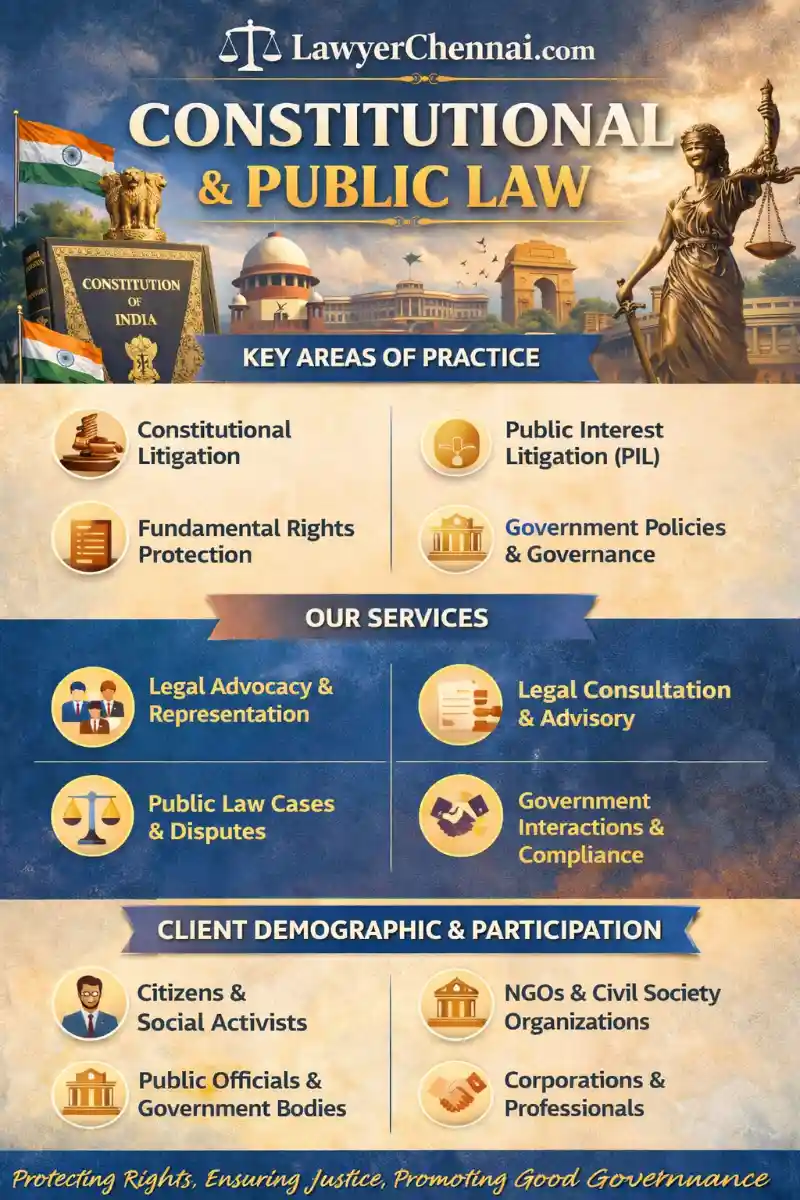
Our constitutional law practice encompasses fundamental rights enforcement, administrative law, and public interest litigation. Firstly, we handle habeas corpus petitions securing personal liberty against illegal detention. Moreover, mandamus petitions compel government authorities to perform statutory and constitutional duties. Similarly, environmental PIL protects ecological balance and ensures sustainable development practices. Furthermore, service law expertise includes disciplinary proceedings, promotions, and pension disputes. Additionally, election law practice covers election petitions and disqualification proceedings before courts. Consequently, RTI matters receive expert handling from application drafting to Information Commission appeals. Therefore, privacy rights and data protection litigation addresses emerging digital age challenges. Moreover, we represent government employees, professionals, activists, and common citizens effectively. Subsequently, our holistic approach combines legal expertise with practical solutions and empathetic client service. Additionally, continuous professional development ensures updated knowledge of latest constitutional developments nationwide.
Contact Information and Office Locations
LawyerChennai.com operates two strategically located offices serving Chennai clients conveniently. Firstly, West Mogappair office at 8/13, 1st Floor, Bharathi Salai provides accessible location. Moreover, George Town office at 323/156, Andhra Insurance Building, 2nd Floor serves High Court proximity. Similarly, both offices maintain comprehensive legal libraries and modern communication infrastructure. Furthermore, appointment scheduling through phone or email ensures efficient client meetings and consultations. Additionally, emergency consultations accommodate urgent constitutional matters requiring immediate legal intervention. Consequently, clients can visit either office based on geographic convenience and preference. Therefore, contact numbers 044-26533389, 044-47660443, and mobile numbers +91-9994287060, +91-9444014096 ensure accessibility. Moreover, email communication through info@lawyerchennai.com and sarav@lawyerchennai.com provides convenient correspondence. Subsequently, website access at www.lawyerchennai.com provides detailed information. Our firm welcomes constitutional law inquiries and consultations from across Tamil Nadu.
Schedule Your Constitutional Law Consultation Today
Constitutional rights violations require immediate legal intervention to prevent prolonged injustice and suffering. Therefore, schedule consultation today to discuss your constitutional law concerns with experts. Moreover, initial consultation helps assess case merits, legal options, and estimated timelines. Similarly, early legal intervention often prevents escalation and facilitates quicker resolution. Furthermore, our team evaluates urgency and prioritizes cases requiring immediate judicial attention. Additionally, consultation provides opportunity to understand constitutional rights and available remedies comprehensively. Consequently, informed decision-making becomes possible after professional legal assessment and advice. Therefore, delay in seeking legal counsel often results in missing statutory timelines. Moreover, constitutional remedies work most effectively when invoked promptly after violations. Subsequently, our firm ensures urgent matters receive immediate attention and expedited petition filing. Contact LawyerChennai.com today to protect your constitutional rights effectively.
Frequently Asked Questions About Constitutional and Public Law
Take Action: Protect Your Constitutional Rights Today
Constitutional rights violations demand immediate legal intervention to ensure justice and accountability. Therefore, do not delay in seeking expert legal advice and representation. Moreover, LawyerChennai.com provides comprehensive constitutional law services across Chennai. Similarly, our experienced team handles writ petitions, PIL, administrative matters, and election disputes. Furthermore, strategic locations and affordable fees ensure accessible legal services for everyone. Additionally, decades of experience and proven track record demonstrate our commitment to excellence. Consequently, contact us today to schedule your constitutional law consultation and case evaluation. Therefore, protect your fundamental rights through effective legal representation and strategic litigation. Moreover, early intervention often prevents escalation and ensures quicker resolution of disputes. Subsequently, our firm prioritizes client interests and delivers results-oriented legal solutions. Call us now at +91-9994287060 or email rajendralawoffice@gmail.com to discuss your constitutional concerns.
LawyerChennai.com – Your Constitutional Rights Defenders
Read More
- Constitutional Bench Appeals: Appealing before a Constitutional Bench
- Writ Petitions in Supreme Court: Enforcing fundamental rights
- Criminal Lawyers in Chennai for the Supreme Court of India
- Understanding the Jurisdiction for Filing Writ Petition in India: Expert Advice
- Special Leave Petitions (SLPs): Seeking special permission to appeal.